


Most Western traders glance at the Ichimoku Cloud, see five lines and a shaded area cluttering their chart, and immediately switch back to moving averages. That’s a mistake. The Ichimoku system is one of the few indicators that gives you trend direction, momentum, support and resistance, and entry timing all from a single overlay. No stacking three oscillators and two moving averages. It’s already built in.
But here’s the catch: Ichimoku only works if you understand what each component is telling you and, more critically, how they interact. Treating the Cloud as a single signal generator misses the entire point. It’s a system. The components confirm or contradict each other, and the best trades emerge when everything aligns.
Let me walk through how this actually works in practice.
The Five Components: What Each One Does
Before jumping into setups, you need to understand the machinery. The Ichimoku system has five elements, each serving a distinct function. Skipping this step is why most traders misread the signals.
Tenkan-sen (Conversion Line): The midpoint of the highest high and lowest low over the last 9 periods. Think of it as a fast-moving equilibrium line. It reacts quickly to price changes and reflects short-term momentum.
Kijun-sen (Base Line): Same calculation, but over 26 periods. This is the medium-term equilibrium. It moves more slowly, acts as a stronger support/resistance level, and serves as the anchor for trend bias on the current timeframe.
Senkou Span A (Leading Span A): The average of the Tenkan and Kijun, plotted 26 periods forward. It forms one edge of the Cloud.
Senkou Span B (Leading Span B): The midpoint of the highest high and lowest low over the last 52 periods, also plotted 26 periods ahead. It forms the other edge of the Cloud. Because it uses a longer lookback, it’s slower and flatter, making it a stronger boundary when tested.
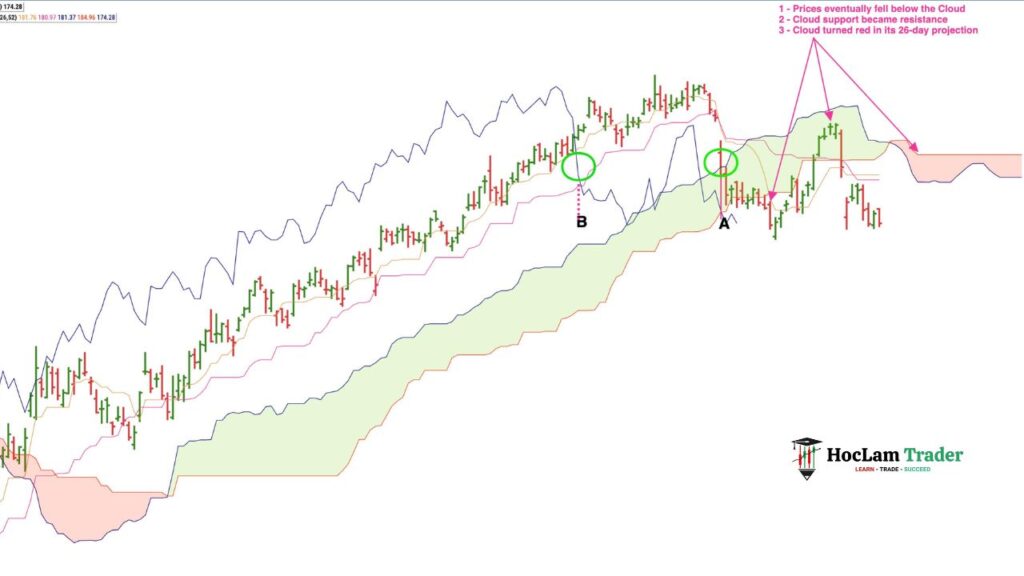
Chikou Span (Lagging Span): The current closing price plotted 26 periods back. This one confuses traders the most, but its purpose is simple: it compares the current price to where the price was 26 periods ago. If Chikou is above the past price, bullish momentum is present. Below? Bearish.
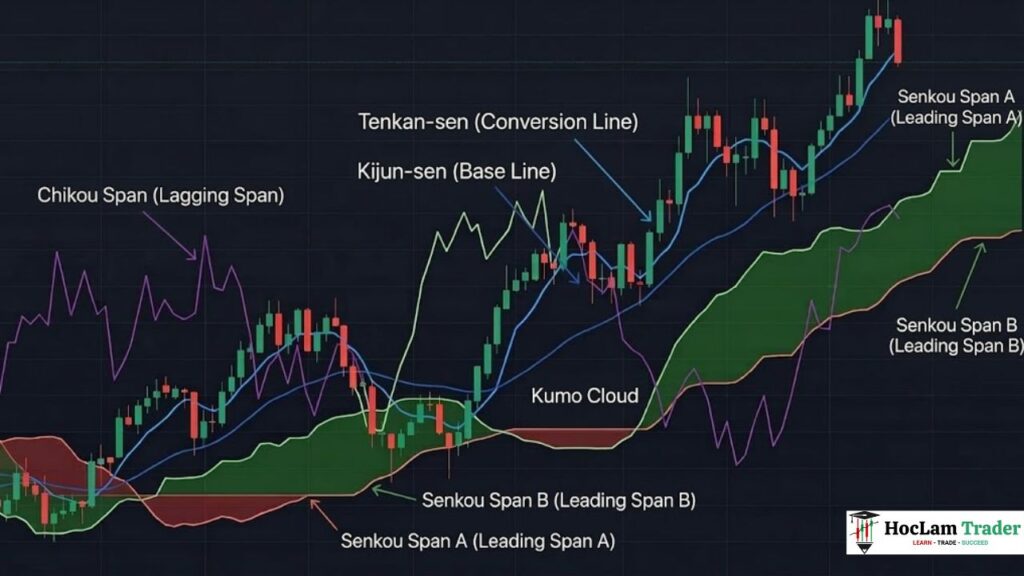
The Cloud (Kumo) itself is the shaded area between Senkou Span A and Senkou Span B. Its color, thickness, and position relative to price tell you nearly everything about the prevailing trend environment.
Reading Trend Bias Through the Kumo
The single most valuable thing the Ichimoku Cloud does is define trend bias instantly. No ambiguity. No subjective interpretation. You look at three things:
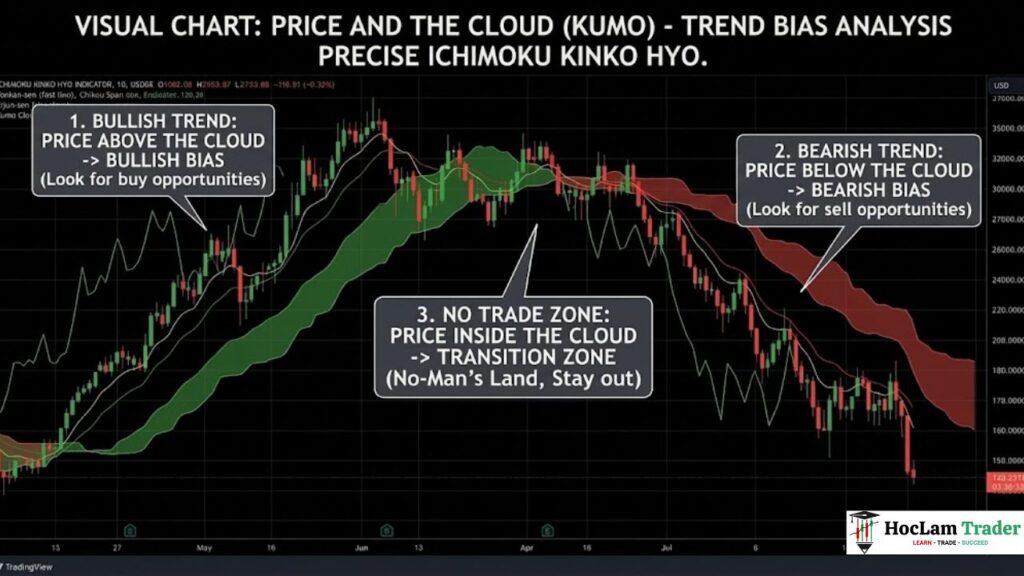
1. Where is the price relative to the Cloud?
- Price above the Cloud = bullish bias. You look for longs.
- Price below the Cloud = bearish bias. You look for shorts.
- Price inside the Cloud = no-man’s land. The trend is unclear, and most experienced Ichimoku traders step aside.
That last point is worth emphasizing. When price is stuck inside the Kumo, the market is in transition. Entering trades during Kumo residence is a low-probability game. Some traders will try to scalp within it, but for swing trading and position trading, the inside of the Cloud is a no-trade zone.
2. What color is the Cloud ahead?
Because the Cloud projects 26 periods into the future, you get a forward-looking bias. When Senkou Span A is above Senkou Span B, the future Cloud is bullish (typically shaded green). When Span A is below Span B, the future Cloud is bearish (typically red). A Cloud twist, where the spans cross, signals a potential trend change ahead.
This forward projection is unique to Ichimoku. No other standard indicator gives you a visual read on future support/resistance zones before the price gets there.
3. How thick is the Cloud?
Thin Clouds are weak. Price slices through them easily, and breakouts from thin Kumo zones tend to produce fast moves. Thick Clouds act as strong barriers. If the price is approaching a thick Cloud from below, expect resistance. The thicker the Cloud, the more conviction the market needs to push through it.
I’ve watched countless setups on USD/JPY and EUR/USD where price stalled for days against a thick Cloud on the daily chart, only to blast through a paper-thin section later. Cloud thickness matters for entry timing and expectation management.
Kumo Breakout: The Core Directional Signal
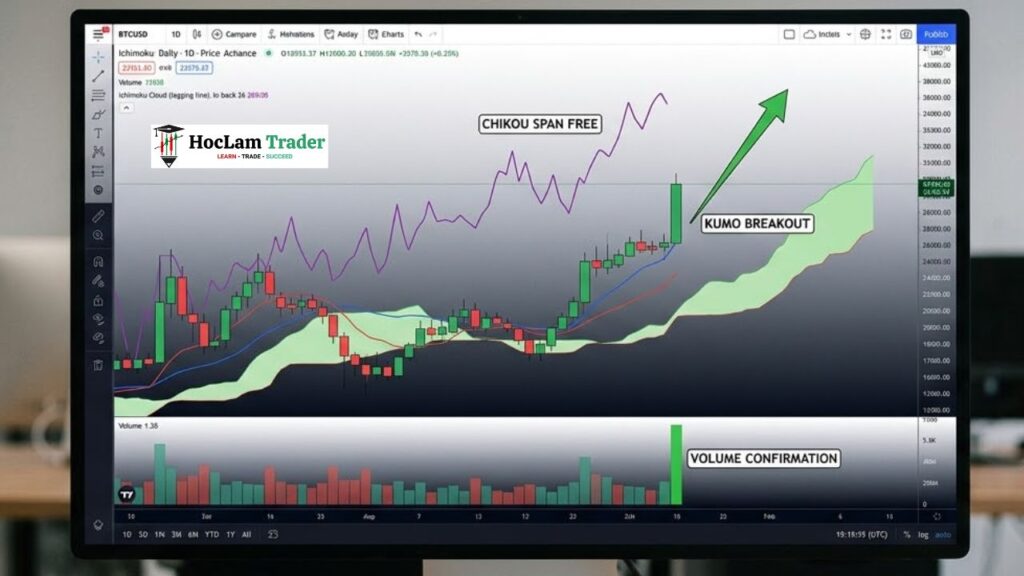
The Kumo breakout is the primary directional signal in any Ichimoku Cloud strategy. When the price closes above the Cloud, it signals a shift to bullish territory. A close below the Cloud signals a bearish shift. Clean and binary.
But not all Kumo breakouts are equal. Here’s how to filter for quality:
Strong Kumo Breakouts
- Price breaks through a thin Cloud section. This indicates less resistance and a higher probability of follow-through.
- The breakout candle is full-bodied with a decisive close beyond the Cloud, not a wick poking through.
- The Chikou Span is free of price obstruction. Look back 26 periods from the breakout. If the Chikou Span (lagging line) has clear space above the past price (for bullish) or below the past price (for bearish), there’s no historical resistance to impede the current move.
- The future Cloud is twisting in the direction of the breakout. If you’re buying a bullish Kumo breakout and the forward Cloud is also turning bullish, you have alignment.
Weak Kumo Breakouts
- Price breaks through a thick Cloud. Even if it closes beyond the boundary, the move required significant energy. Exhaustion is common.
- Chikou Span is tangled in past price action. This means the current move isn’t outperforming historical prices, which signals weak momentum.
- The breakout occurs against the future Cloud color. Buying above the Cloud while the forward projection is bearish creates a conflicting signal. Tradeable? Sometimes. High conviction? Rarely.
Crypto traders will find Kumo breakouts especially useful on the daily BTC/USD and ETH/USD charts. These assets trend hard once they leave consolidation zones, and the Cloud acts as a natural boundary between regimes. A clean Kumo breakout on Bitcoin’s daily chart, backed by volume, has historically preceded multi-week directional runs.
Tenkan-Kijun Cross: The Entry Trigger
If the Kumo defines trend bias, the Tenkan Kijun cross provides the entry timing. This is where most of your actual trade entries in the Ichimoku trading system come from.
The cross works like a moving average crossover, but with the added context of the Cloud:
- Bullish cross: Tenkan-sen crosses above Kijun-sen. Momentum is shifting upward.
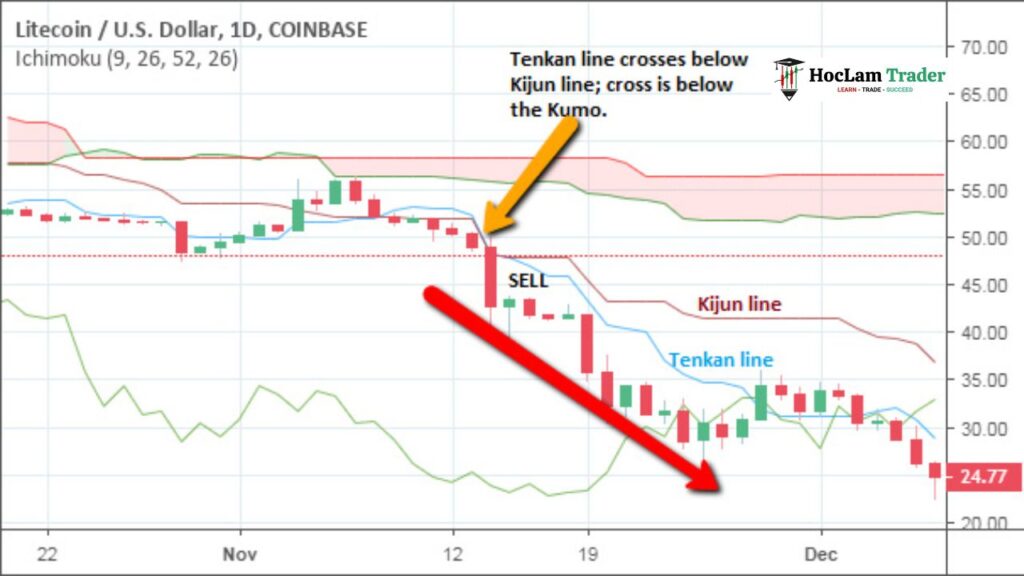
- Bearish cross: Tenkan-sen crosses below Kijun-sen. Momentum is shifting downward.
The quality of the cross depends entirely on its position relative to the Cloud.
Signal Strength Classification
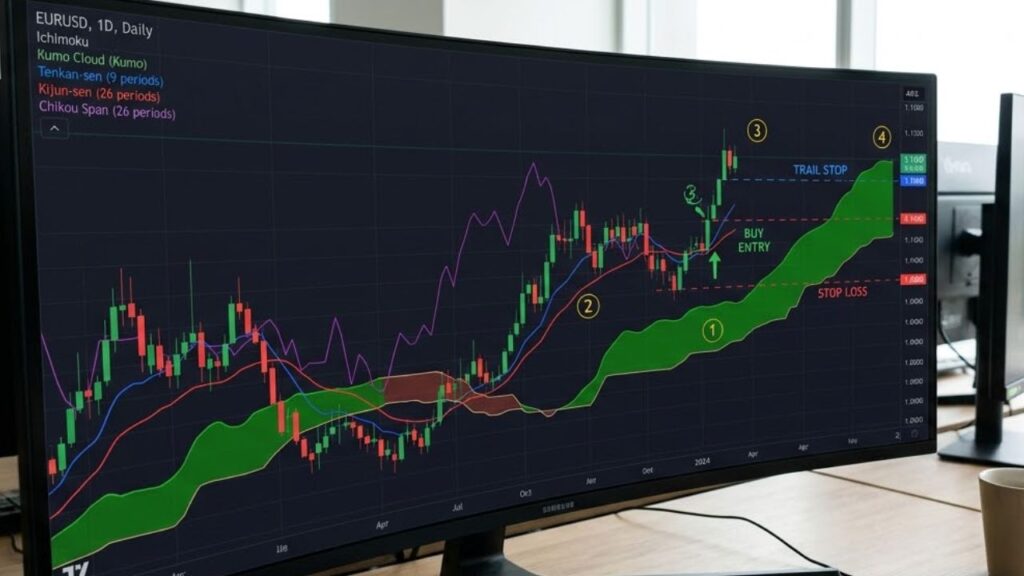
Strong bullish signal: Tenkan crosses above Kijun above the Cloud. The trend is already bullish, and this cross signals a high-probability resumption of momentum.
Neutral bullish signal: The cross occurs inside the Cloud. The trend environment is ambiguous. The cross might lead somewhere, but there’s no confirming trend structure. Medium probability at best.
Weak bullish signal: Tenkan crosses above Kijun below the Cloud. You’re getting a bullish momentum signal inside a bearish trend environment. This is a counter-trend signal. It might produce a bounce, but fading the Kumo is fighting the bigger picture.
The same logic applies in reverse for bearish crosses. The strongest shorts come from bearish Tenkan-Kijun crosses below the Cloud. Everything else carries reduced conviction.
Practical Execution
Here’s how I structure entries around the Tenkan Kijun cross:
Entry: On the candle close that confirms the cross. Some traders wait for the following candle to verify, which reduces false signals but costs some movement.
Stop loss: Beyond the Kijun-sen. The Kijun acts as the equilibrium line for the current timeframe. If the price reverses past it, the trade thesis is invalidated. On volatile pairs, add a buffer of a few pips or points beyond the Kijun.
Initial target: The opposite Cloud boundary. In a bullish trade above the Cloud, the next logical resistance is a structural level or a Senkou Span boundary from a higher timeframe. In a bearish trade, target the lower Cloud boundary or a support structure.
Trail stop: Move the stop to the Kijun-sen as it advances. The Kijun naturally trails price in a trend, creating a dynamic exit mechanism that keeps you in strong moves and pulls you out when momentum fades.
The Chikou Span Confirmation
Traders who ignore the Chikou Span are throwing away free information. It’s the simplest confirmation tool in the system.
Before entering any trade, check the Chikou Span’s position relative to past price:
- For longs: Chikou should be above the price curve from 26 periods ago. This confirms that the current price is outperforming the past bullish momentum, which is real.
- For shorts: Chikou should be below the price curve from 26 periods ago.
When the Chikou is tangled in past candles, weaving through previous price action, the momentum is unclear. These are the trades that chop you up. Waiting for Chikou clearance keeps you out of many mediocre setups.
One observation from years of watching this play out: the Chikou Span acts as a surprisingly effective early warning system. During a bullish trend, if Chikou starts approaching the price curve from 26 periods back, the trend is losing relative momentum even if the price hasn’t reversed yet. It’s often the first signal that a correction is coming.
Building a Complete Ichimoku Entry Model
Putting it all together, a high-conviction Ichimoku trade requires alignment across multiple components. Here’s the checklist I use:
Step 1: Determine trend bias.
Is the price above or below the Cloud? What’s the future Cloud color? If these conflict with your intended direction, reduce the size or skip the trade.
Step 2: Wait for the Tenkan-Kijun cross.
The cross should occur on the correct side of the Cloud. Strong signals only. Neutral and weak signals require additional confirmation from price action or another indicator.
Step 3: Confirm with Chikou Span.
Chikou must be free and clear on the correct side of the past price. If it’s obstructed, wait.
Step 4: Assess the cloud thickness ahead.
If you’re entering a long trade and the forward Cloud is thick and bullish, you have a tailwind. If the forward Cloud is thin or twisting, expect turbulence.
Step 5: Enter and manage.
Enter on cross confirmation. Stop beyond Kijun. Trail with Kijun as the trend develops. Exit on a reverse cross or a Kumo break in the opposite direction.
When all five components align price on the right side of the Cloud, Tenkan-Kijun cross in the right location, Chikou clear, future Cloud supportive, the signal is about as clean as technical analysis gets. These setups don’t appear every day. On a daily chart, you get two or three per quarter on any given instrument. But they tend to produce substantial moves.
Ichimoku Settings: The Default vs. Modified Debate
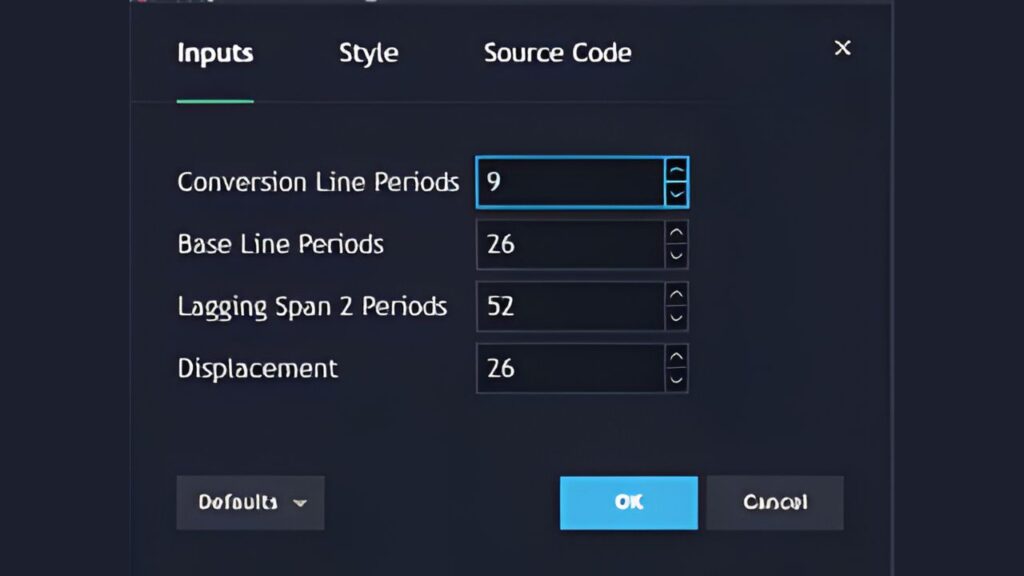
The standard Ichimoku settings are 9, 26, 52. Goichi Hosoda designed these based on the Japanese trading week, which at the time consisted of six trading days. Some traders argue that the settings should be adjusted to 7, 22, and 44 for the modern five-day trading week. Others use 10, 30, 60 for smoother signals.
My take: the default settings work. They’ve been tested across decades and multiple asset classes. Changing the settings can optimize results for a specific instrument or timeframe, but it introduces the risk of curve fitting. If you’re trading FX or indices on the daily chart, the 9-26-52 configuration remains the most widely validated.
For lower timeframes, such as 1-hour or 15-minute charts, some traders reduce settings to increase sensitivity. That’s a reasonable adjustment for intraday work. But for swing trading and position trading, the defaults have earned their place.
Crypto traders sometimes extend the settings to 20, 60, 120 on daily charts to account for the 24/7 market structure. There’s logic to this, though I’ve seen the standard settings produce solid results on Bitcoin and Ethereum without modification.
Where Ichimoku Struggles
No system works everywhere. Ichimoku’s weakness is range-bound, choppy markets. The Tenkan and Kijun lines cross back and forth. Price repeatedly enters and exits the Cloud. The Chikou Span gets tangled. Every component generates noise rather than a signal.
This is a trend-following system at its core. It excels in FX pairs with central bank divergence driving directional moves. It thrives during strong commodity trends and directional crypto cycles. It underperforms in congestion zones, low-volatility chop, and holiday-thinned markets.
Recognizing when not to use the system is just as important as knowing how to execute when conditions are right. If the Cloud is flat and thin, and the price keeps crossing through it, walk away. The Ichimoku trading system is telling you there’s no trend to trade.
Final Thought
Ichimoku rewards patience and discipline. The best signals come from full-system alignment, and those don’t happen constantly. Traders who cherry-pick individual components without checking the broader picture will generate mixed results and eventually blame the indicator. The power of this system lives in the confluence of all five elements pointing in the same direction, at the same time, with the Cloud confirming bias ahead. When that happens, you have a setup worth committing to.
FAQ
What is the Ichimoku Cloud strategy?
The Ichimoku Cloud strategy is a trend-following system that uses five components: Tenkan-sen, Kijun-sen, Senkou Span A, Senkou Span B, and Chikou Span to define trend direction, identify entries, and manage trades based on Cloud position and line interactions.
How do you read the Kumo for trend bias?
A price above the Cloud indicates bullish bias; a price below the Cloud indicates bearish bias. Price inside the Cloud signals a trendless environment. The future Cloud color and thickness provide additional context for upcoming support and resistance.
What is a Tenkan-Kijun cross?
A Tenkan-Kijun cross occurs when the fast Tenkan-sen line crosses the slower Kijun-sen line. A bullish cross above the Cloud is a strong buy signal. A bearish cross below the Cloud is a strong sell signal. Crosses inside the Cloud carry lower conviction.
What does the Chikou Span confirm?
The Chikou Span confirms momentum by comparing the current price to the price 26 periods ago. When the Chikou is above the past price, bullish momentum is confirmed. When it’s below, bearish momentum is confirmed. Tangled Chikou signals unclear momentum.
What are the best Ichimoku settings?
The default settings of 9, 26, and 52 are widely validated across FX, indices, and commodities on daily charts. Some crypto traders adjust to 20, 60, 120 for 24/7 markets, while intraday traders may reduce settings for faster signals.
Does Ichimoku work on crypto?
Yes. Kumo breakouts and Tenkan-Kijun crosses on daily BTC and ETH charts have historically produced strong trending signals, especially during directional market cycles.
When does the Ichimoku system fail?
Ichimoku underperforms in range-bound, choppy markets where price repeatedly enters and exits the Cloud, generating false crosses and conflicting signals across components. It is designed for trending environments.