


Risk of ruin describes the chance that a trading process reaches a predefined failure threshold, such as a maximum drawdown or loss of usable capital, under stated assumptions. It depends on risk per trade, the distribution of wins and losses, expectancy, correlation and the number of opportunities. It is a scenario tool, not a precise promise about the future.
Any probability shown in a simulation is conditional on the inputs; changing the assumptions can materially change the output.
What Is Risk of Ruin?
“Ruin” must be defined before it can be modeled. For one trader it may mean a 30% drawdown that triggers a stop rule; for another it may mean insufficient margin or inability to continue. Without a threshold, time horizon and return distribution, a risk-of-ruin number is not interpretable.
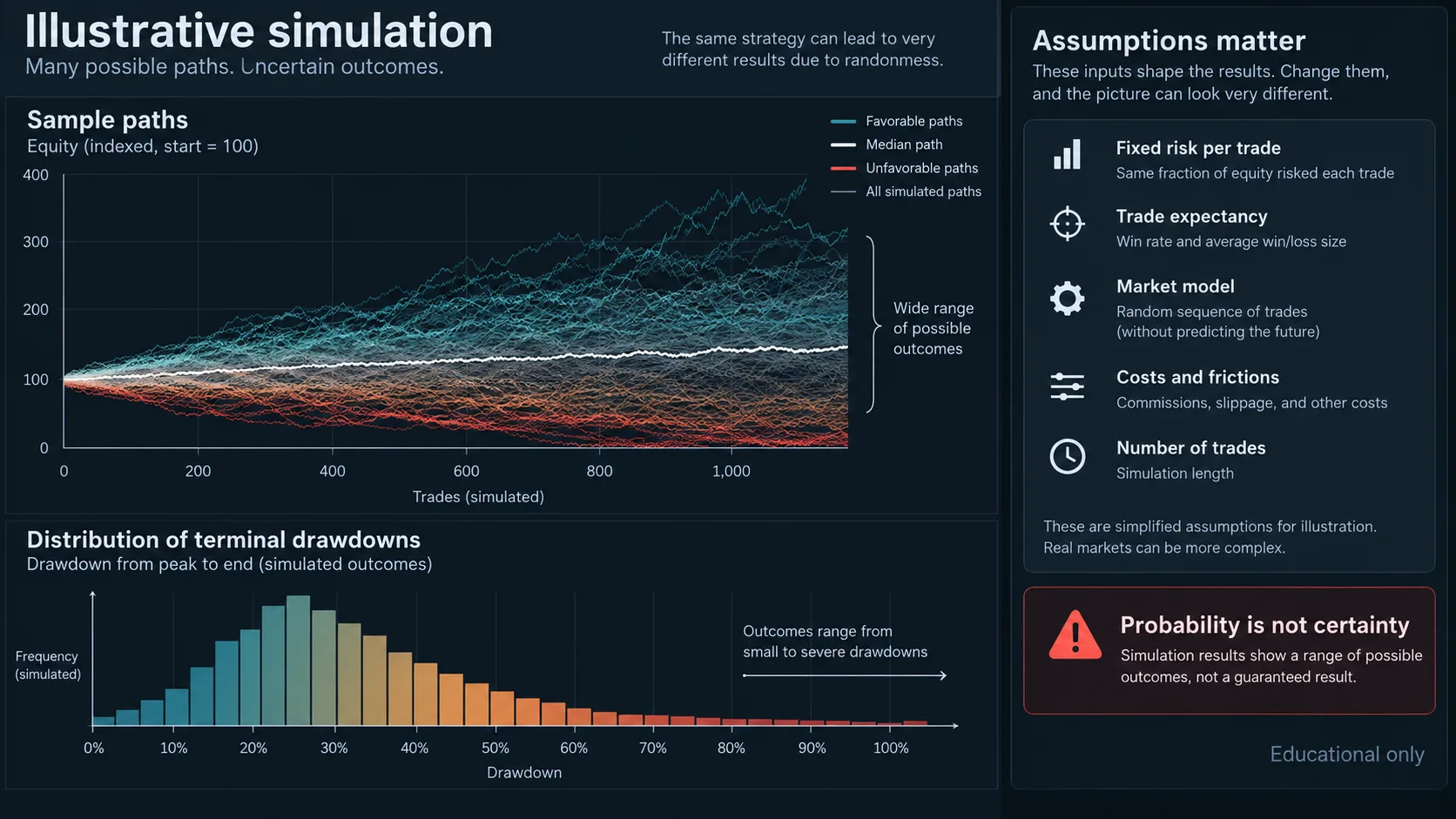
Inputs That Change the Scenario
- Risk per trade: a larger fraction of equity makes a losing streak more damaging.
- Expectancy and dispersion: average outcome alone hides variability and outliers.
- Win/loss dependence: clustered losses differ from independent random draws.
- Number of trades: more opportunities create more chances to encounter a tail sequence.
- Costs and slippage: net results can be weaker than gross assumptions.
Start with a transparent log and read position sizing formula and risk–reward ratio explanation first.
A Simple Scenario Workflow
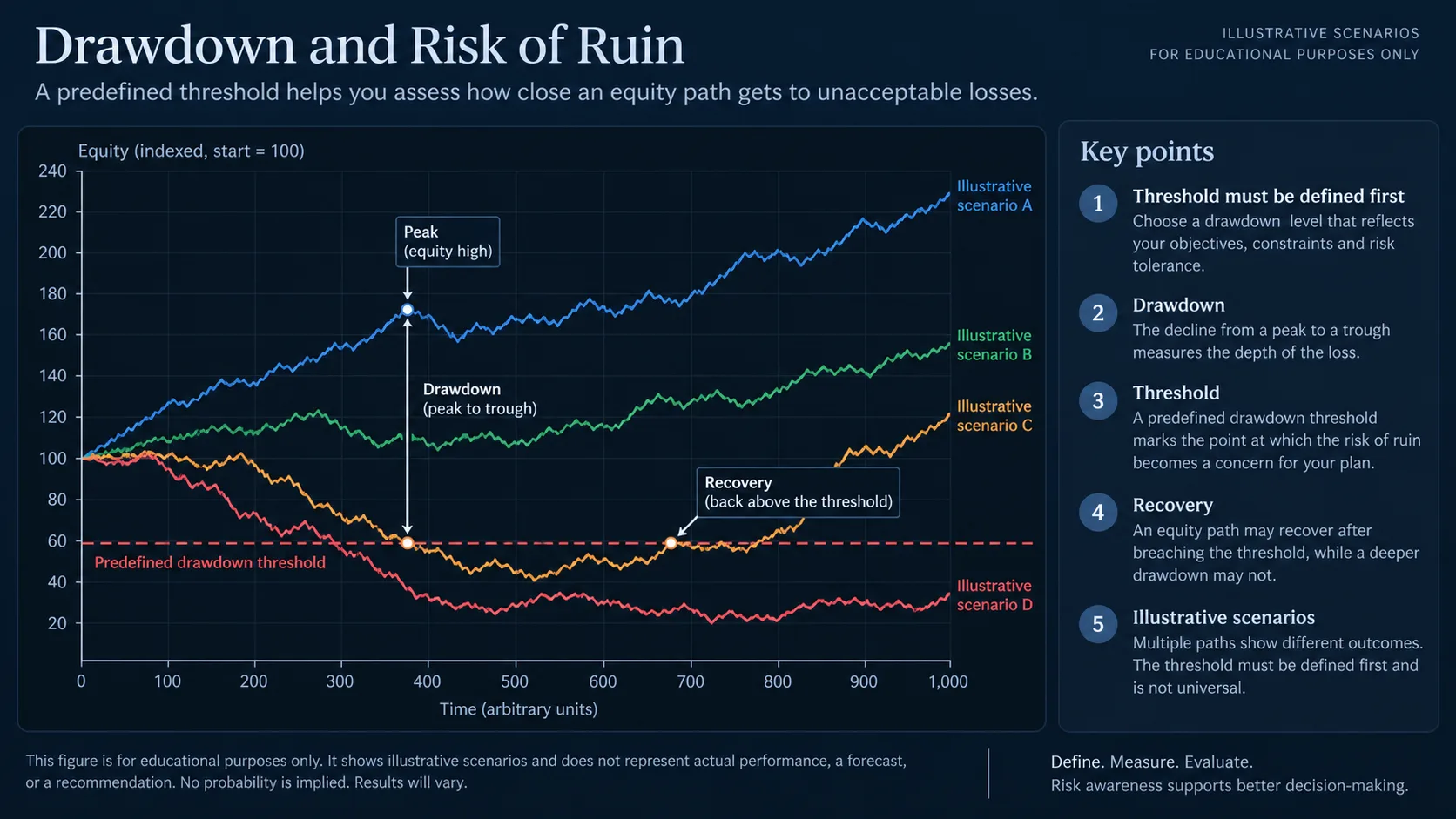
- Define the ruin threshold and time horizon.
- Estimate a distribution from a documented sample, separating in-sample and out-of-sample data.
- State whether trades are resampled independently or preserve clusters and regime order.
- Include fees, slippage, partial fills and risk-sizing rules.
- Run sensitivity checks with smaller and larger risk fractions.
- Report a range of outcomes and assumptions rather than one “true” probability.
Why Monte Carlo Is Not a Guarantee
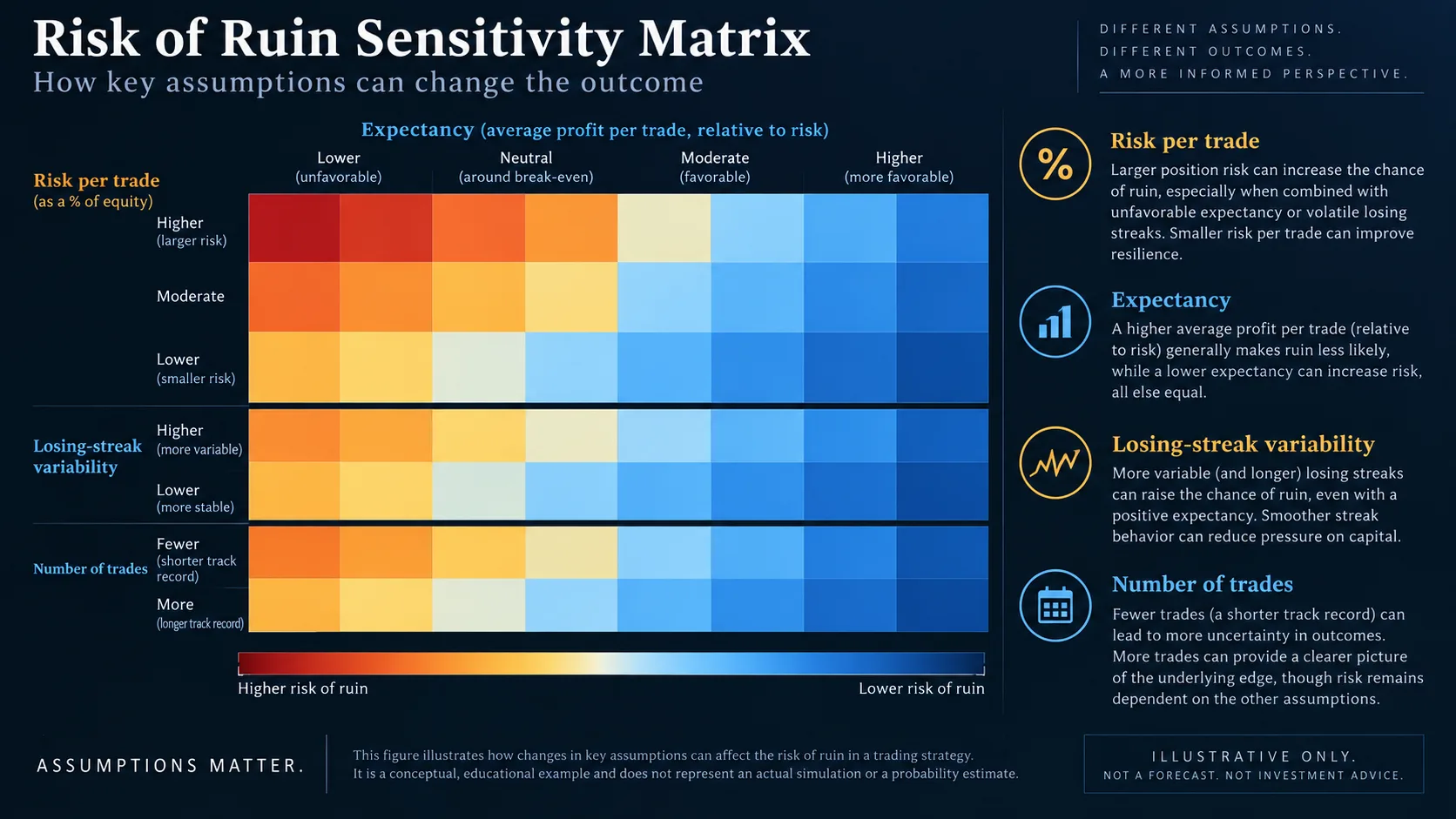
Monte Carlo reorders or simulates observations under a chosen model. It cannot reveal an unknown regime change, a broker failure, a missing data problem or a strategy rule that was never recorded. A narrow distribution may reflect an overconfident model rather than a safe process.
Risk of Ruin and Drawdown Controls
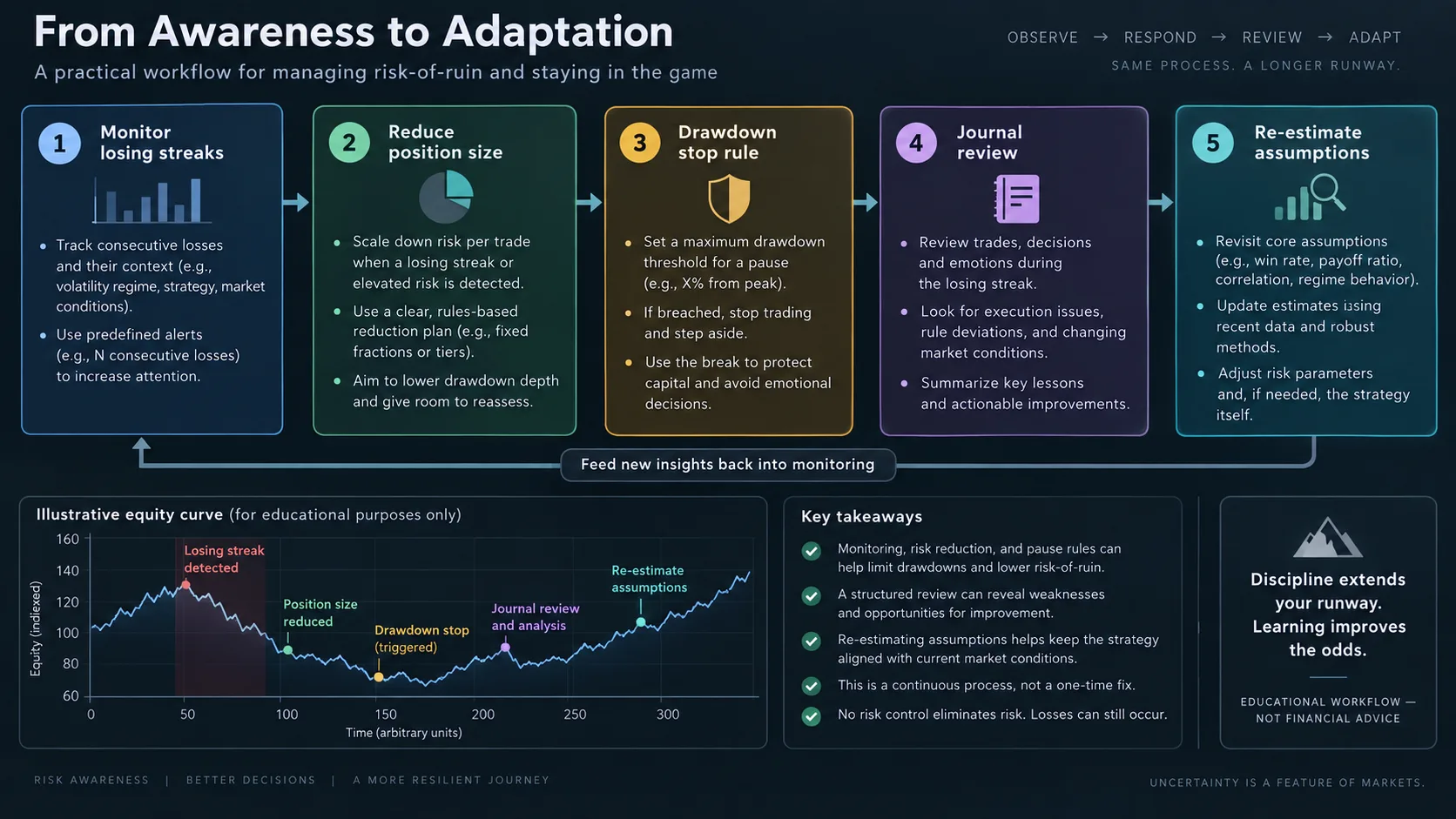
Practical controls can include a fixed cash-risk cap, a portfolio exposure limit, a drawdown-based size reduction and a review checkpoint after a losing streak. These are governance rules, not a way to avoid every loss. They should be written before stress arrives and tested against historical and forward data.
Common Misinterpretations
- Presenting a simulation as a live or audited track record.
- Using a universal risk percentage for every market and strategy.
- Assuming trades are independent when exposure is correlated.
- Ignoring margin, spread, swap and liquidity conditions.
- Calling a low modeled probability “safe” or “impossible.”
What the Measure Can and Cannot Tell You
| Can help assess | Cannot establish alone |
|---|---|
| Sensitivity to risk per trade and drawdown threshold | Future return or survival with certainty |
| Range of modeled equity paths | Whether the underlying strategy has a real edge |
| Impact of changing assumptions | Broker, market or regime shocks not in the data |
Key Takeaways
- Ruin is a defined threshold, not a universal event.
- Inputs and dependencies matter as much as the formula.
- Net costs and drawdown rules belong in the scenario.
- Use ranges and sensitivity tests, not false precision.
- Risk of ruin supports governance; it does not guarantee survival.
References
- CME Group: Technical Analysis education
- CFTC: Forex risk advisory
- NBER: Risk and return research resource
Risk warning: Trading can result in loss of capital. This article is educational, not investment advice; do not treat a modeled probability as a guarantee or use leverage beyond your ability to absorb losses.