


Every trader eventually stumbles across a chart covered in numbers and letters, looking more like an advanced calculus problem than a trading setup. You try to count the waves yourself, but every time the price moves unexpectedly, you have to redraw everything. This constant recounting leads to hesitation, confusion, and ultimately, losing trades. You might even start to believe that Elliott Wave Theory is just an academic illusion.
The truth is, Elliott Wave Theory is simply a framework for understanding market psychology and structure. At its core, it suggests that markets move in predictable, repetitive cycles driven by human emotion—optimism and pessimism. You do not need a perfect, complex wave count to be a profitable trader; you only need to understand where you are in the broader cycle.
In this guide, we will break down Elliott Wave Theory into its most actionable components. We will strip away the unnecessary academic complexity and focus on the unbreakable rules, how to spot the dominant trend, and how to combine it with practical price action tools to improve your execution.
What is Elliott Wave Theory? The Short Answer
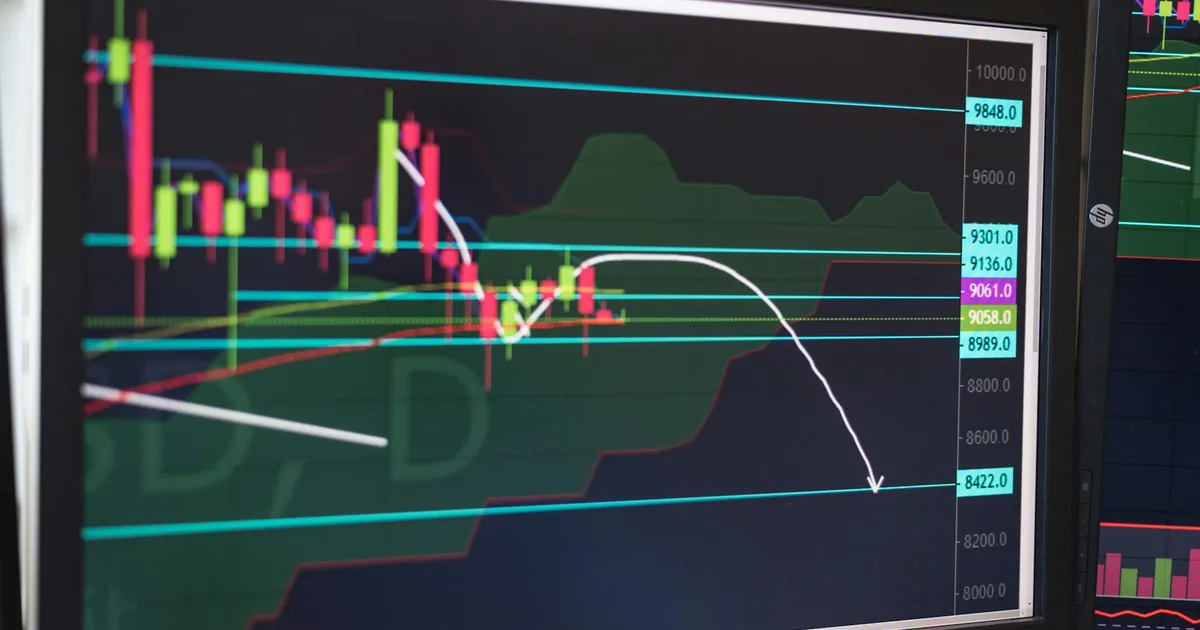
Elliott Wave Theory is a method of technical analysis that visualizes market structure as a series of repeating psychological cycles. Originally developed by Ralph Nelson Elliott in the 1930s, the theory posits that crowd psychology moves between optimism and pessimism in natural sequences.
These psychological shifts print on the price charts as specific wave patterns. Instead of viewing price movement as random noise, Elliott Wave allows you to map out the market’s current context. Are the buyers aggressively in control? Is the market simply pausing to take a breath? Or is a major reversal imminent? By identifying the current wave, traders can anticipate the probable next move with better accuracy.
The 5-3 Wave Cycle: How Markets Actually Move
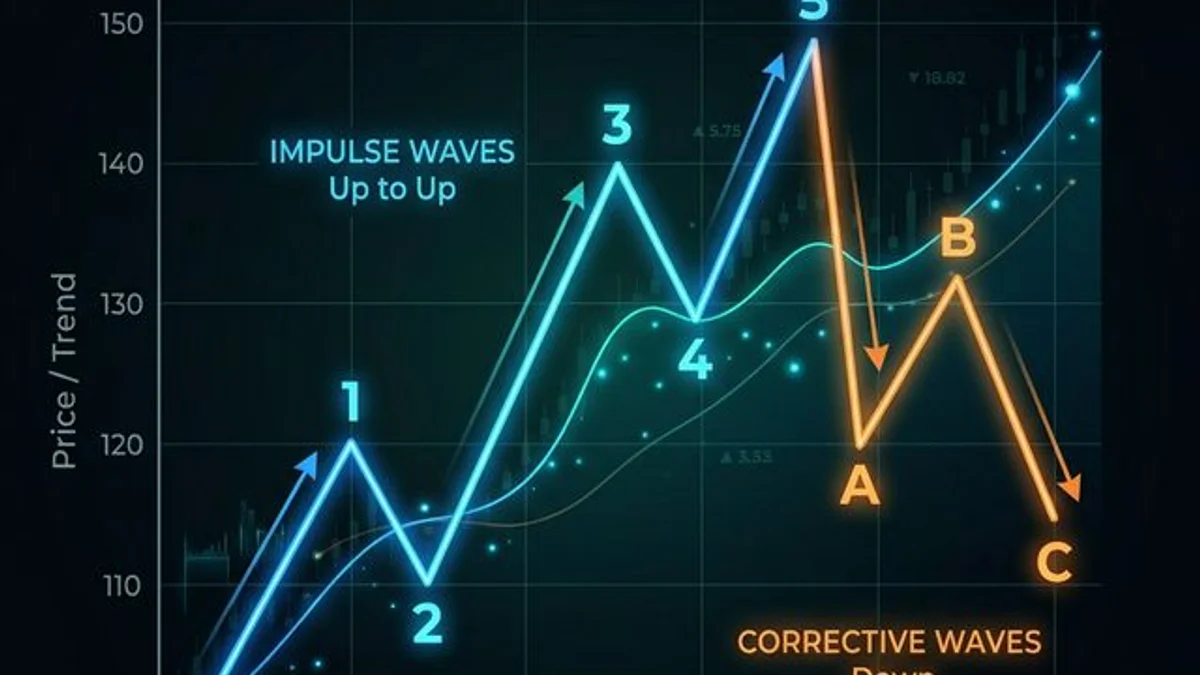
The entire foundation of the theory rests on the 5-3 wave cycle. Every complete market movement consists of an eight-wave sequence: five waves acting in the direction of the dominant trend, followed by three waves correcting that trend.
The Motive Phase (Impulse Waves 1, 2, 3, 4, 5)
This phase aggressively pushes the market in the direction of the primary trend. It is characterized by strong momentum and institutional participation.
- Wave 1: The initial move. Often difficult to spot as it looks like a standard pullback in the previous trend.
- Wave 2: A correction of Wave 1. It retests the lows but never entirely retraces Wave 1, shaking out early buyers.
- Wave 3: The strongest, longest, and most powerful wave. This is where the retail crowd catches on, and momentum surges.
- Wave 4: A complex, frustrating consolidation phase. It is often choppy as early buyers take profits.
- Wave 5: The final push. Momentum is usually weaker here compared to Wave 3, often forming a divergence on indicators like the RSI or MACD.
The Corrective Phase (Waves A, B, C)
Once the five-wave sequence is complete, the market enters a corrective phase against the main trend.
- Wave A: The beginning of the correction. Traders often mistake this for a standard pullback.
- Wave B: A trap. The market bounces back, making traders think the main trend is resuming, but it fails to break the previous high (the top of Wave 5).
- Wave C: A strong, aggressive move opposite to the main trend, trapping those who bought Wave B. It often targets the price zone of the previous Wave 4.
The 3 Unbreakable Rules of Elliott Wave

Many traders get lost in the nuances of complex corrections (zigzags, flats, triangles), but you can eliminate 90% of bad wave counts simply by adhering strictly to the three unbreakable rules. If your count breaks any of these, your count is wrong.
- Rule 1: Wave 2 cannot retrace more than 100% of Wave 1. If the price drops below the starting point of Wave 1 in a bullish trend, the pattern is invalid.
- Rule 2: Wave 3 can never be the shortest impulse wave. While it doesn’t always have to be the longest, Wave 3 is typically the most extended and powerful. If your Wave 3 is shorter than both Wave 1 and Wave 5, redraw your charts.
- Rule 3: Wave 4 cannot overlap the price territory of Wave 1. The low of Wave 4 must remain above the high of Wave 1. If they overlap, you are likely looking at a complex correction, not an impulsive five-wave sequence.
Why Most Traders Fail With Elliott Wave

The failure rate among aspiring Elliott Wave practitioners is exceptionally high. This usually stems from a fundamental misunderstanding of the tool’s purpose.
First, traders become obsessed with finding the “perfect” count. Market structure is messy. Forgetting that waves are fractal—meaning smaller waves exist inside larger waves—traders constantly shift their counts on the 15-minute timeframe while ignoring the clear daily trend. This leads to analysis paralysis.
Second, traders use Elliott Wave in isolation. Elliott Wave tells you the context of the market, but it is a poor timing tool. Knowing the market is likely in Wave 3 does not tell you exactly where to place your buy limit order or your stop loss. It must be paired with execution strategies to be effective in live trading.
How to Actually Trade the Waves

To use this theory profitably, you must stop treating it as an exact science and start using it as a contextual overlay. The most profitable approach is to look for high-probability setups at specific inflection points, rather than trying to trade every single wave.
For example, trading Wave 3 is the holy grail because it offers the largest reward for the lowest risk. To capture it, you wait for a completed Wave 1 and a deep pullback in Wave 2 (often settling around the 61.8% Fibonacci retracement level). You can then look for a shift in market structure (like a Change of Character or Break of Structure) on a lower timeframe to confirm the start of Wave 3.
Similarly, the end of Wave 4 offers a great opportunity to trade the final Wave 5 push. Because Wave 4 cannot overlap Wave 1, you have a hard invalidation level for your stop loss, making risk management highly objective.
Ultimately, Elliott Wave Theory is a roadmap. It prevents you from aggressively buying at the top of a Wave 5 or shorting into the bottom of a Wave C. By mapping the psychology of the market, you can align your execution tools with the broader cyclical flow.
Disclaimer: The information provided in this article is for educational purposes only and should not be construed as personalized financial advice. Always practice proper risk management when trading live markets.