


Most traders slap Bollinger Bands on a chart, watch price touch the upper band, and short it. Then they wonder why the trade blows up in a trending market. The problem isn’t the indicator. It’s the lack of context.
Bollinger Bands are one of the most misused tools in technical analysis. Not because they’re flawed, they’re actually brilliant in design, but because traders apply them with a single playbook regardless of market conditions. A Bollinger Bands strategy only works when you match the right technique to the right environment. Squeeze setups demand patience. Breakouts demand aggression. Mean reversion demands discipline. And trend riding? That demands the ability to sit on your hands while the trade works.
What Bollinger Bands Actually Measure
John Bollinger designed these bands around a simple concept: volatility expands and contracts in cycles. The indicator plots a 20-period simple moving average (SMA) in the center, with upper and lower bands set to 2 standard deviations.
When volatility drops, the bands tighten. When volatility spikes, the bands widen. That’s it. The bands don’t predict direction. They measure the degree of price dispersion relative to recent history.
This distinction matters more than most traders realize. The bands tell you how much the price is moving, not where it’s going. Direction comes from price action, structure, and context. The bands give you a volatility framework to build setups around.
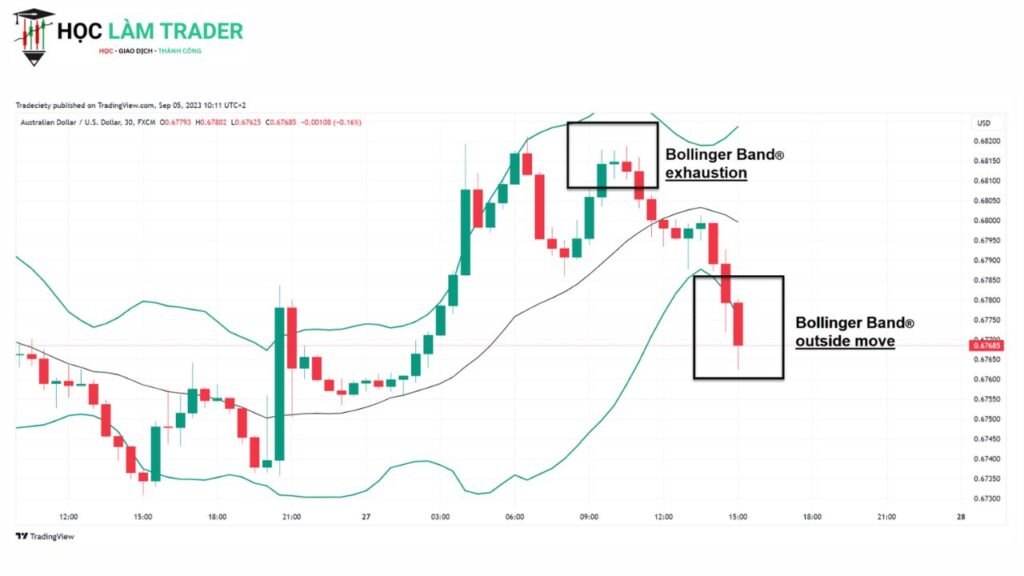
One more thing worth noting: roughly 95% of price action stays within two standard deviations. So when price pushes outside the bands, something unusual is happening, and unusual events tend to either reverse quickly or accelerate into powerful trends. Your job is figuring out which one.
The Bollinger Squeeze
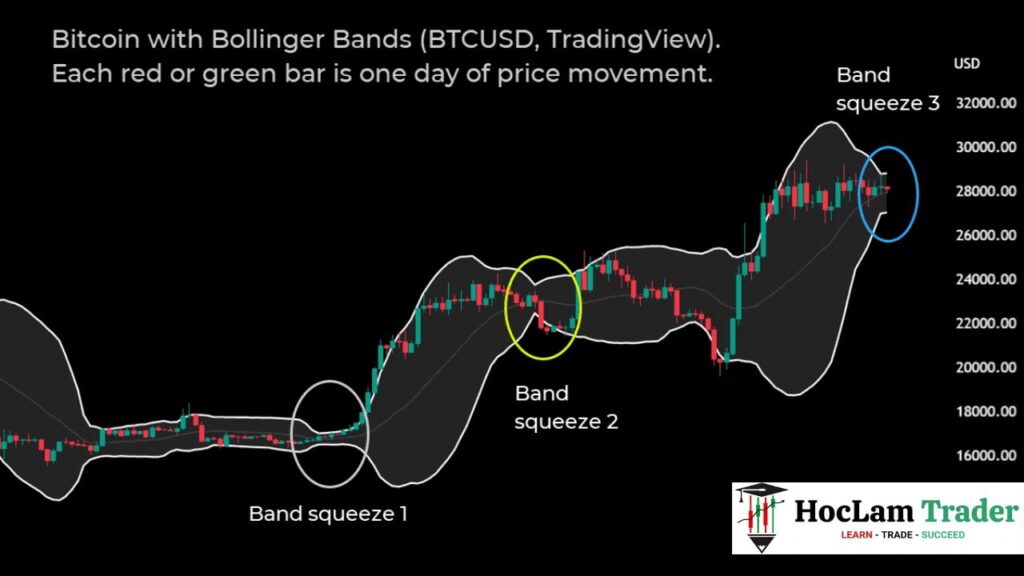
If there’s one setup that consistently delivers across asset classes, FX, crypto, indices, commodities, it’s the Bollinger squeeze. The logic is straightforward: periods of low volatility precede periods of high volatility. Always. Markets breathe. They compress, then expand.
A squeeze forms when the bands narrow to their tightest point in recent sessions. Visually, the bands almost pinch together around the moving average. Price chops sideways in a tight range, volume dries up, and most traders lose interest. That’s precisely when you should be paying the closest attention.
Identifying a Valid Squeeze
Not every narrow-band reading qualifies. Here’s what separates a tradeable squeeze from noise:
- Bandwidth drops to a multi-week or multi-month low. Use the BandWidth indicator (the percentage difference between upper and lower bands divided by the middle band) to quantify this objectively.
- Price consolidates in a defined range. You want horizontal chop, not a slow grind. Clean compression signals genuine indecision.
- Duration matters. A squeeze that builds over 15–25 candles on a daily chart carries more energy than a brief 5-bar contraction. The longer the coil, the more violent the release.
Trading the Squeeze
Here’s where traders get tripped up. The squeeze itself isn’t a trade signal; it’s a setup. You need a trigger. Entering before the expansion begins means sitting through dead price action, paying spread and swap costs, and risking a false start.
Wait for the breakout candle. A strong close outside the upper or lower band, accompanied by a volume spike, confirms expansion has started. Some traders use the Keltner Channel inside the Bollinger Bands as a secondary filter. When Bollinger Bands trade inside the Keltner Channel, the squeeze is “on.” When they pop back outside, the squeeze fires.
Directional bias? Look left. What was the trend before the squeeze formed? Squeezes that form as continuation patterns within an established trend have a higher probability of resolving in the trend’s direction. A squeeze at the base of a strong uptrend, for example, is far more likely to break upward.
Bollinger Breakout Trading
Once a squeeze fires, you’re in breakout territory. And Bollinger breakout trading is where this indicator earns its keep for momentum traders.
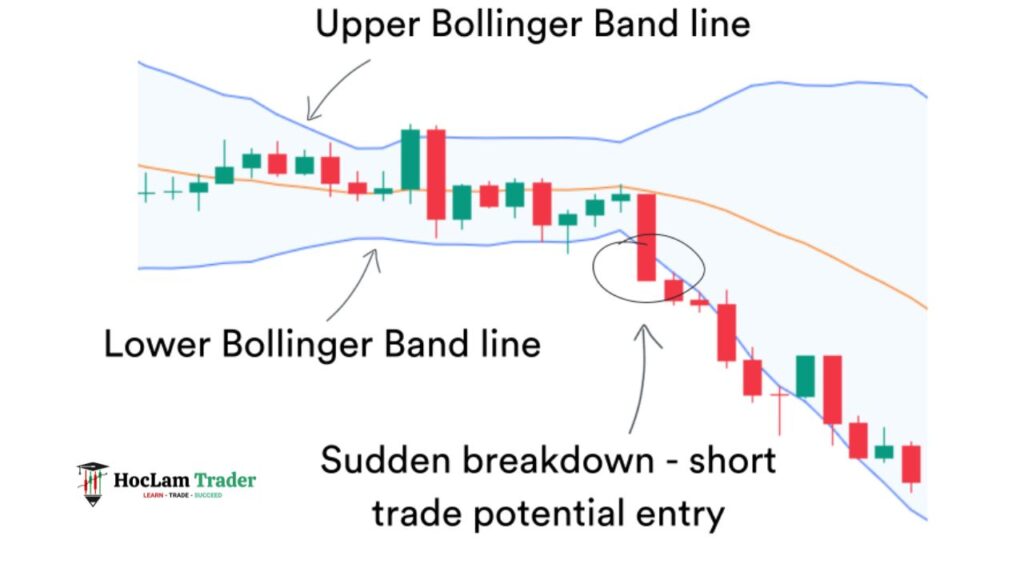
A legitimate breakout looks like this: price closes decisively beyond the upper or lower band, the bands begin expanding rapidly, and follow-through candles confirm the move. You’re not looking for a wick poking outside; you want a full-bodied candle closing beyond the band with conviction.
Execution Rules for Breakout Trades
Entry: On the close of the breakout candle, or on a pullback to the middle band (20 SMA) if you prefer a better risk-to-reward ratio. The pullback entry requires more patience but often delivers cleaner positioning.
Stop loss: Below the opposite band or below the consolidation range that preceded the squeeze. Tight stops get clipped during volatile breakouts, giving the trade room proportional to the expansion.
Targets: This depends on your style. Swing traders might target a measured move equal to the width of the preceding range. Trend followers let the trade run as long as the price stays above (or below, for shorts) the middle band.
Key filter: Watch for false breakouts. If the price breaks above the upper band but immediately reverses and closes back below it, the breakout has failed; there’s no shame in cutting that trade quickly. False breakouts during squeezes are common enough that you need a plan for them before entering.
Crypto markets, particularly BTC/USD and ETH/USD on the 4-hour and daily charts, produce some of the cleanest Bollinger squeeze breakouts you’ll find. The extreme volatility cycles in digital assets make the contraction-to-expansion pattern especially reliable.
Mean Reversion Trading with Bollinger Bands
This is the strategy most retail traders default to and the one that causes the most damage when applied carelessly.
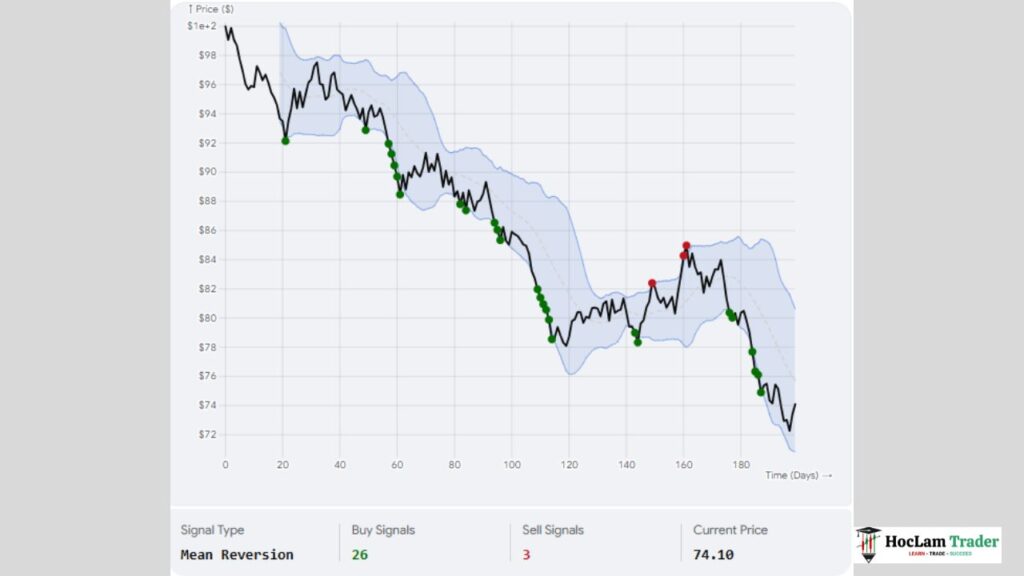
Mean reversion assumes that prices stretched to the outer bands will snap back toward the middle band (the 20 SMA). Buy at the lower band, sell at the upper band. Simple in theory. Dangerous without filters.
When Mean Reversion Works
Mean reversion with Bollinger Bands is a range-bound strategy. Full stop. It works when the market is chopping sideways, the bands are relatively flat, and there’s no dominant trend.
Check the slope of the 20 SMA. If it’s flat, you’re in a range environment, and fading the bands is a valid approach. If the moving average is angled sharply up or down, you’re in a trend, and fading the bands will put you on the wrong side of momentum again and again.
Execution Rules for Mean Reversion
- Buy zone: Price touches or penetrates the lower band and shows a reversal signal, a bullish engulfing candle, a hammer, a divergence on RSI or stochastic.
- Sell zone: Price touches or penetrates the upper band with a bearish reversal signal.
- Target: The 20 SMA (middle band). That’s your mean. Don’t get greedy trying to ride it to the other band; many mean-reversion moves stall at the average.
- Stop loss: Beyond the recent swing low (for longs) or swing high (for shorts), placed outside the band with a small buffer.
A practical addition: use RSI (14-period) as a confirmation layer. When the price hits the lower band and the RSI is below 30, the odds of mean reversion improve. When the price hits the upper band and the RSI is above 70, the fade setup carries more weight. Neither indicator alone is enough, but combined, they filter out a surprising amount of noise.
Forex pairs that tend to range AUD/NZD, EUR/CHF, and sometimes EUR/GBP are natural candidates for a Bollinger Bands mean reversion strategy. Trending pairs like USD/JPY during a rate divergence cycle? Not the place for fading bands.
Trend Riding with Bollinger Bands
This might be the most underappreciated use of Bollinger Bands. Most educational content focuses on the squeeze and the fade. But the bands also function as a dynamic trend-following tool if you know what to look for.
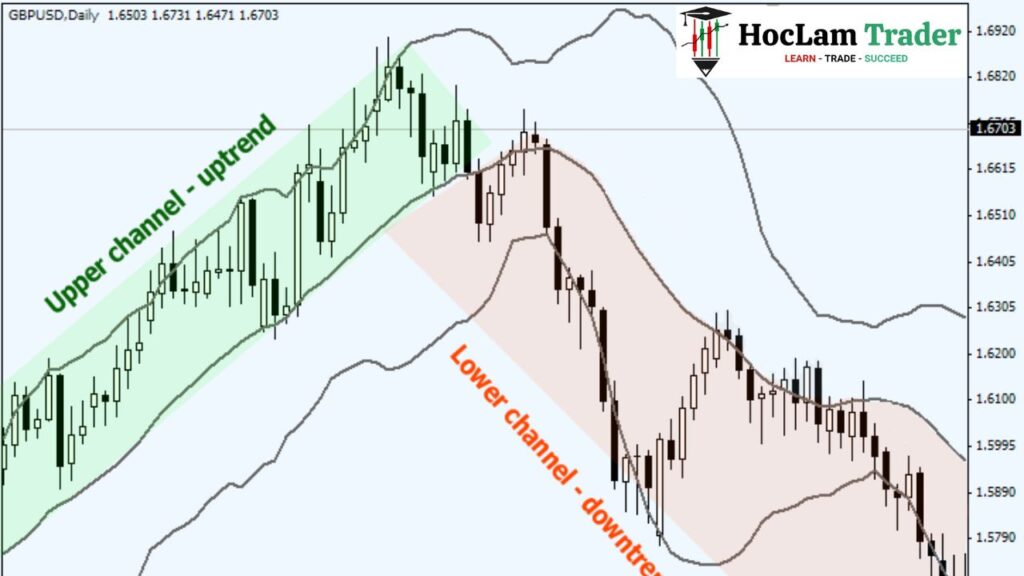
During strong trends, the price doesn’t just touch the outer band and reverse. It walks the band. Candle after candle closes at or beyond the upper band in an uptrend, or at or beyond the lower band in a downtrend. The bands expand, the middle band slopes sharply, and pullbacks find support at the 20 SMA rather than reaching the opposite band.
How to Ride the Trend
The Bollinger Bands trend strategy works like this:
- Identify the trend. The 20 SMA is angled sharply. Price has been closing near or beyond the outer band for multiple sessions. The bands are widening.
- Enter on pullbacks to the middle band. In a strong uptrend, a dip to the 20 SMA is a buying opportunity, not a reason to exit. In a downtrend, a bounce to the 20 SMA is a chance to add short exposure.
- Trail your stop. Use the opposite band as a trailing stop reference. In an uptrend, as long as the price doesn’t close below the lower band, the trend is intact. Some traders tighten this to the middle band once the move matures.
- Exit when the bands start contracting. When the expansion phase ends and the bands begin narrowing, the trend is losing steam. That’s your cue to take profits or tighten stops aggressively.
This approach requires sitting through noise. You’ll see intraday wicks to the middle band that look threatening but close back near the outer band by session end. Patience pays here. The best trends on the daily chart, think USD/JPY during 2022’s run from 115 to 150, or gold’s push from $1,800 to $2,400, all exhibited textbook band-walking behavior.
Combining Bollinger Bands with Volume and Momentum
Bollinger Bands measure volatility. They don’t measure momentum, trend strength, or volume. Pairing them with complementary tools dramatically improves accuracy.
Volume: A Bollinger breakout without a volume spike is suspect. Genuine breakouts attract participation. Thin-volume breakouts often reverse. On crypto and equity indices, volume data is straightforward. For on-spot FX, use tick volume as a proxy; it’s imperfect but still useful for relative comparisons.
RSI or Stochastic: Already mentioned for mean reversion, but equally useful for trend confirmation. In a healthy uptrend, RSI tends to oscillate between 40 and 80 rather than 20 and 60. If RSI is making higher lows while price walks the upper band, the trend has legs.
MACD: A MACD histogram expanding in the direction of the breakout adds conviction. Histogram contraction during a band-walk pullback to the 20 SMA is normal; it’s the reset before the next push.
No indicator combination eliminates losing trades. But a Bollinger Bands indicator strategy layered with volume and momentum reads gives you a genuine edge over single-indicator decision-making.
Common Mistakes to Avoid
A few patterns I see repeatedly:
Fading bands in a trend. The number one account killer with Bollinger Bands. Shorting the upper band in a raging uptrend because “price is overbought” is a fast way to learn about trend persistence.
Trading squeezes without a directional bias. Squeezes resolve in both directions. If you’re guessing, you’re gambling. Use structure, trend context, and order flow to lean one way.
Using default settings religiously. The 20-period, 2-standard-deviation setting is a starting point. Some traders use 2.5 standard deviations for fewer but higher-quality signals. Others shorten the lookback to 10 periods for scalping. Test what fits your timeframe and asset class.
Ignoring the middle band. The 20 SMA is the backbone of the entire indicator. It’s your trend filter, your mean reversion target, and your trend-following entry zone. Most traders fixate on the outer bands and miss the middle band’s significance entirely.
Final Thought
Bollinger Bands work. They’ve been around since the 1980s and remain on virtually every professional charting platform for a reason. But they reward traders who understand context, who recognize when to fade, when to chase, and when to sit still and wait for the squeeze to resolve. Master that judgment, and the bands become one of the most versatile tools in your kit.
FAQ
What is a Bollinger Bands strategy?
A Bollinger Bands strategy uses the upper and lower bands and the middle moving average to identify volatility-based trade setups, including squeezes, breakouts, mean-reversion fades, and trend-following entries.
How do you trade a Bollinger squeeze?
Wait for the bands to contract to a multi-week low, then enter when price breaks decisively beyond the upper or lower band with a strong candle close and volume confirmation.
When should you use mean reversion with Bollinger Bands?
Mean reversion works best in range-bound markets where the 20 SMA is flat. Buy near the lower band and sell near the upper band, using reversal candle patterns and RSI for confirmation.
Can Bollinger Bands be used for trend trading?
Yes. During strong trends, the price tends to walk along the outer band. Traders enter on pullbacks to the 20 SMA and trail stops using the opposite band or the middle band.
What is the best timeframe for Bollinger Bands?
The daily and 4-hour charts produce the most reliable signals for swing trading. Scalpers may use 15-minute or 5-minute charts with adjusted settings.
Do Bollinger Bands work on crypto?
Absolutely. Crypto’s extreme volatility cycles make squeeze-and-breakout setups particularly effective on pairs like BTC/USD and ETH/USD.
What indicators pair well with Bollinger Bands?
RSI, MACD, volume indicators, and Keltner Channels complement Bollinger Bands by providing momentum, trend strength, and squeeze confirmation.