


Fibonacci is among the most talked-about tools in technical analysis. Too many traders slap Fibonacci levels on random price swings, enter trades just because a candle touched a line, ignore market context, and then wonder why the “magic numbers” failed them.
This guide fixes that. We are cutting out the fluff and focusing strictly on execution. You’ll learn exactly what these levels mean, how to draw them without second-guessing yourself, how to pinpoint entries, and how to project accurate profit targets. Most importantly, you’ll learn how to combine Fibonacci with other technical tools so you stop guessing and start trading high-probability setups.
The core rule before we begin: Fibonacci levels are not buy or sell signals. They are simply zones of interest. They only work when the market is trending, when drawn on obvious swings, and when confirmed by other price action signals.
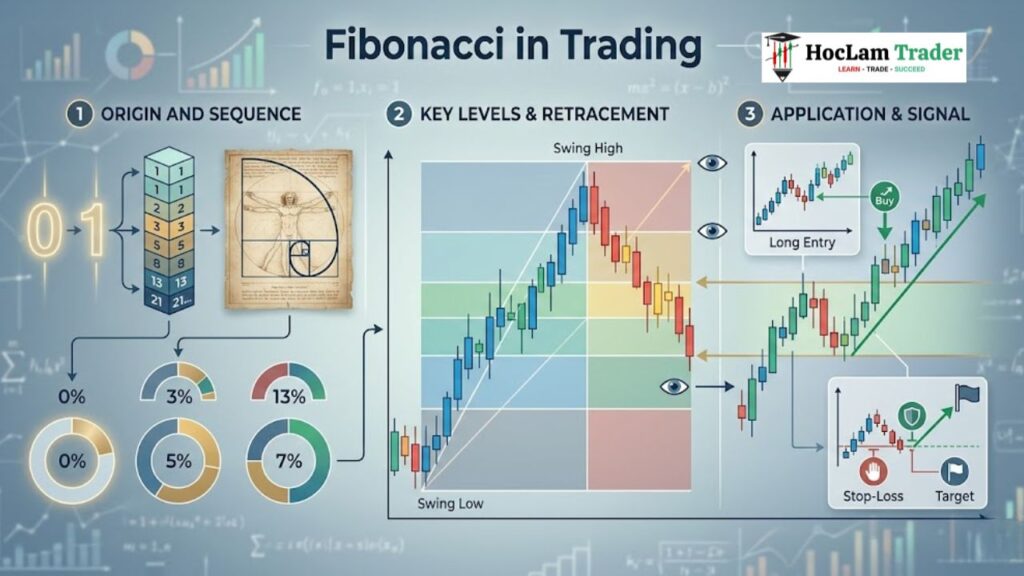
What Is Fibonacci in Trading?
In trading, Fibonacci is a tool that applies a specific set of mathematical ratios to a price chart. These ratios highlight hidden zones where the market is highly likely to pause, reverse, or accelerate.
Traders use the tool in two specific ways:
- Fibonacci Retracements: These measure how far a price has pulled back from the main trend. Use this to find your Entry.
- Fibonacci Extensions: These project how far the price might travel once the trend resumes. Use this to set your Take Profit.
Why Do These Random Ratios Work?
You don’t need a math degree to trade Fibs, but you do need to know why they show up on charts:
- Market Rhythm: Markets don’t move in straight lines; they move in waves (impulse, correction, impulse). Fibonacci ratios accurately describe the natural proportions of these market waves.
- Self-Fulfilling Prophecy: Millions of retail traders, bank algorithms, and institutional funds are looking at the same 0.618 level. When the price hits that zone, massive clusters of buy or sell orders are triggered, creating a real reaction.
When to Use Fibonacci (And When to Put It Away)
Understanding this one concept will save you from a massive percentage of losing trades.
Fibonacci is strictly a trend-following tool. It is designed to answer one question: “The market just made a strong move; how far will it pull back before continuing?”
If the market is chopping sideways in a tight range, pulling out the Fibonacci tool is completely useless. There is no clear impulse wave to measure.
- Clear Higher Highs / Higher Lows? Draw your Fibs.
- Choppy, overlapping candles going nowhere? Put the tool away and trade standard support/resistance (or stay out completely).
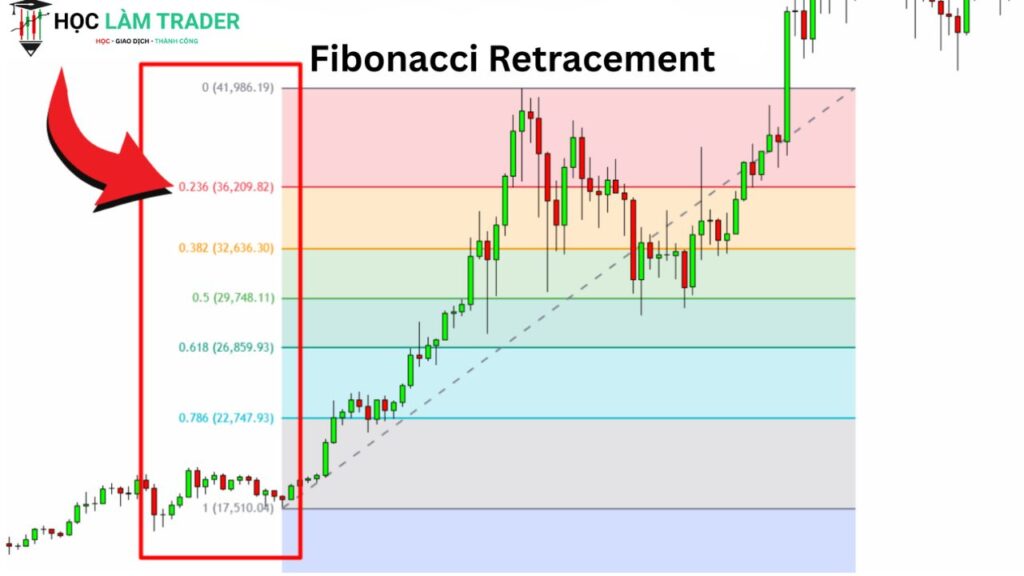
Fibonacci Retracement Levels Explained
Here is what each major level actually tells you about the market’s psychology.
- 0.382 (The Shallow Pullback): This level usually holds in incredibly aggressive, momentum-driven markets. Buyers (or sellers) are experiencing severe FOMO and step in early. The danger? If you enter here, your stop loss has to be wide.
- 0.500 (The Midpoint): While not a true mathematical Fibonacci ratio, a 50% retracement of a move is a massive psychological barrier. It frequently acts as strong support or resistance.
- 0.618 (The Golden Ratio): This is the holy grail of Fibonacci trading. A pullback to 0.618 is deep enough to trigger stop-losses from impatient early buyers (a liquidity grab), but shallow enough to keep the main trend completely intact. This is where “smart money” accumulates.
- 0.705 – 0.786 (Optimal Trade Entry / OTE): This is a very deep pullback, the last line of defense before the trend officially breaks. Trades taken in this zone offer an incredible Risk-to-Reward (R: R) ratio because your stop loss is very tight, but you will miss a lot of setups because the price rarely pulls back this far.
How to Draw Fibonacci Levels Correctly
A Fibonacci zone is only as reliable as the anchor points you choose. Drawing it wrong is the fastest way to lose money.
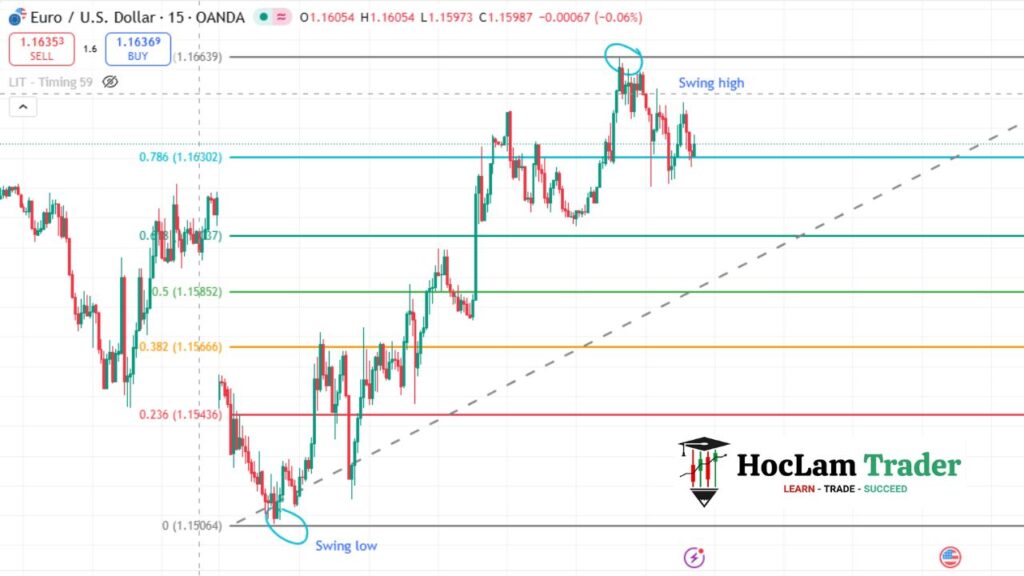
Drawing in a Uptrend (Looking for a Buy)
- Find the Swing Low (where the bullish impulse started).
- Find the Swing High (where the bullish impulse topped out).
- Click your Retracement tool on the Low and drag it up to the High.
- The levels will appear below the current price, showing you where to look for support.
Drawing in a Downtrend (Looking for a Sell)
- Find the Swing High (where the bearish drop started).
- Find the Swing Low (where the drop temporarily bottomed out).
- Click your Retracement tool on the High and drag it down to the Low.
- The levels will appear above the current price, showing you where to look for resistance.
Wicks vs. Bodies: Should you anchor to the tip of the wick or the candle body? Pick one and stick to it. Most professional traders use wicks because wicks represent the absolute extremes of price action, capturing stop hunts and liquidity grabs.
The Entry Strategy: Golden Pocket & Triggers
Now that you have your zones drawn, you need an execution plan.
The Golden Pocket (0.618 – 0.65)
This is the tight cluster between the 61.8% and 65% retracement. It is widely considered the highest-probability reversal zone on a chart. It’s the perfect depth to flush out weak hands while maintaining the broader trend structure.
Never Enter Blind (Wait for a Trigger)
Placing a blind limit order right on the 0.618 line is a coin flip. To trade like a professional, wait for the price to hit the Golden Pocket or OTE zone, and then wait for the market to give you a trigger signal:
- Candlestick Reversals: Look for a bullish hammer, a massive engulfing candle, or a pin bar with a long wick rejecting the Fib level.
- Lower Timeframe Shifts: If you draw your Fib on the 4-Hour chart, drop down to the 15-Minute chart when price hits your zone. Wait for the 15M structure to shift in your favor (e.g., breaking a lower high) before entering.
- Momentum Divergence: Price hits the 0.618, making a lower low, but the RSI makes a higher low. This shows downside momentum is dying exactly where it’s supposed to.
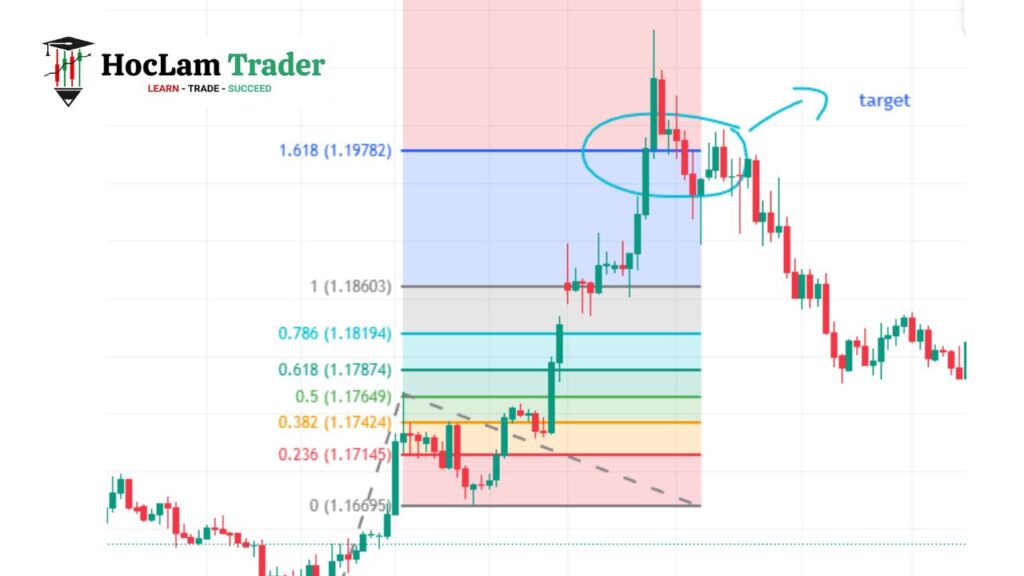
Fibonacci Extensions: Knowing When to Take Profit
Retracements get you into the trade; Extensions get you out.
Unlike the retracement tool, the Trend-Based Fibonacci Extension tool requires three anchor points:
- Point A: The start of the impulse move.
- Point B: The end of the impulse move.
- Point C: The end of the pullback (your entry zone).
Key Target Levels:
- 1.272: Your conservative first target. This is where you should consider taking partial profits (scaling out) and moving your stop loss to breakeven.
- 1.618 (The Golden Extension): The primary target for most trend-following strategies.
- 2.618: An extreme target. Price usually hits exhaustion around this level.
The Real Edge: Fibonacci Confluence
Trading a Fibonacci level in isolation is average. Trading a Fibonacci level with confluence is how you build a real edge. Confluence means stacking multiple, independent technical reasons that all point to the same price area.
- Fib + Historical Support/Resistance: If your 0.618 level perfectly overlaps with a major horizontal support level from three weeks ago, you have a golden setup. The market has a memory for horizontal levels.
- Fib + Moving Averages: When a dynamic support like the 50 EMA or 200 EMA lines up perfectly with a Fib retracement zone, institutional algorithms are highly likely to defend that area.
- Fib + Trendlines: A diagonal trendline intersecting with a horizontal Fib level creates a robust “X marks the spot” setup.
If you have a 0.618 retracement, sitting on previous resistance-turned-support, resting on a 50 EMA, and a hammer candle just formed… You take that trade.
Risk Management: Where Does the Stop Loss Go?
- Stop Placement: Never put your stop loss exactly on a Fibonacci line. Market makers know where these lines are and will wick through them to hunt liquidity. Always place your stop with a buffer (e.g., 10-20 pips) or safely beneath the 0.786/1.0 level.
- Trade Invalidation: The setup is officially dead if a candle closes firmly beyond the 1.0 level (meaning the market has retraced 100% of the impulse move). At that point, the trend is broken. Take the loss and move on. Do not widen your stop.
5 Rookie Fibonacci Mistakes to Avoid
- Measuring micro-swings: If you have to zoom in closely to find the swing, it’s irrelevant. Only use major, obvious swings that every other trader can clearly see.
- Cluttering the chart: Drawing 5 different Fibs over the top of each other creates a mess where every single price looks like support. Keep it clean: one major Fib per timeframe.
- Ignoring market structure: If the 1.618 extension target is at $150, but there is a massive weekly resistance wall at $145, take your profit at $145. Structure always overrides Fib math.
- Trading chop: Again, do not draw Fibonacci levels in ranging, sideways markets.
- Catching falling knives: Entering without a candlestick confirmation or lower-timeframe structural shift. Let the market prove it wants to reverse before you risk your capital.