

Moving averages are the most widely used technical indicators in the world. You’ll find them on every professional trader’s chart: forex, crypto, indices, stocks, futures, it doesn’t matter. They are simple, visual, and they work. The reason they remain popular after decades is that prices respect them, especially the 50-period and 200-period versions that institutions watch.
This guide is written for traders who already know what a candlestick is but still get confused about which moving average to use and when. We’ll go deep on the real differences between SMA and EMA, how crossovers actually perform in live markets, how to use moving averages as dynamic support and resistance, and which settings professional traders actually keep on their charts.
SMA vs EMA: The Real Difference
Everyone repeats the same line: “SMA gives equal weight, EMA gives more weight to recent price.” That’s true, but it doesn’t tell you when it actually matters.
SMA is slow and smooth. It removes noise extremely well. That makes it excellent for defining the primary trend on daily and weekly timeframes. If the price is above the 200 SMA on the daily chart, the trend is up. If it’s below, the trend is down. No debate. Institutions use the 200 SMA exactly as it is. When you see headlines about “Bitcoin holding the 200-day SMA,” they mean the simple one, not the exponential.
EMA reacts faster. The last 3–5 candles have significantly more weight than in an SMA. That means the EMA will curve sooner when momentum shifts. This is why day traders and crypto swing traders love the 9- and 21-EMA. They catch turns earlier.
The trade-off is whipsaws. In sideways, choppy markets (think forex pairs in the Asian session or BTC between $58k–$62k for weeks), the EMA will cross itself repeatedly, generating false signals. The SMA will sit there flat, keeping you out of bad trades.
Real-world rule I use personally:
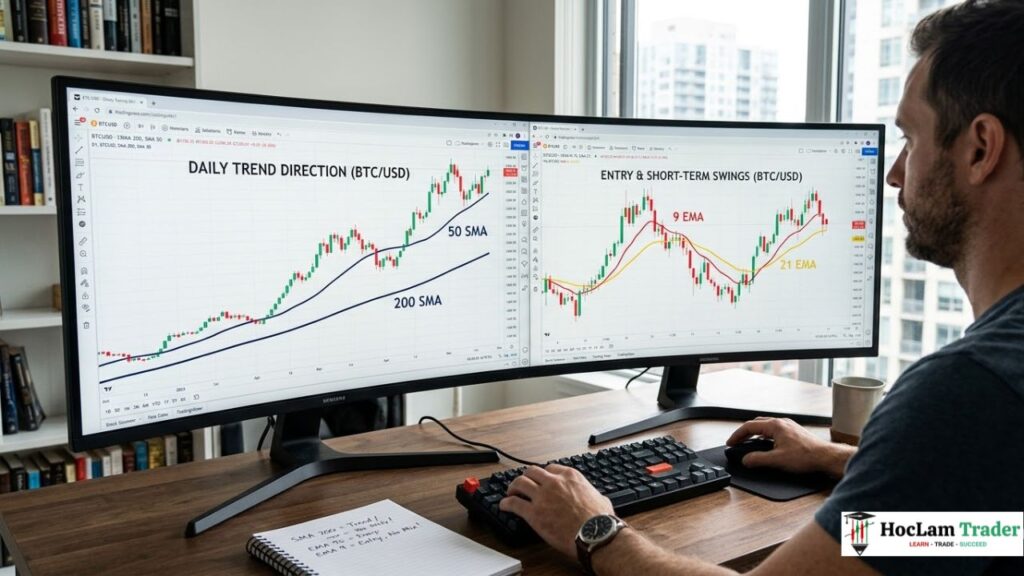
- Daily/Weekly charts for trend direction → 200 SMA + 50 SMA
- 4H and lower for entries and short-term swings → 9 EMA, 21 EMA, sometimes 50 EMA
- Never mix SMA and EMA on the same timeframe for crossovers
Moving Average Crossovers: Golden Cross, Death Cross, and the Ones That Actually Work
The 50 SMA crossing above the 200 SMA (Golden Cross) and the reverse (Death Cross) are famous for a reason. They have predicted every major bull and bear market in stocks since the 1950s. Yes, they lag sometimes badly, but when they finally trigger, the trend that follows is usually monstrous.
Examples:
- S&P 500 Golden Cross March 2023 → new all-time highs for the next 18 months
- Bitcoin Golden Cross October 2023 → run from $27k to $73k
- Nasdaq Death Cross June 2022 → bear market confirmed, down another 20 % after the cross
But here’s what most articles don’t tell you: on lower timeframes, the classic 50/200 crossover is too slow for most traders. Waiting 3–6 months for a signal is not practical if you trade forex or crypto.
The crossovers that actually make money on shorter timeframes are:
- 9 EMA crossing 21 EMA (my personal favorite on 1H and 4H charts)
- 8 EMA crossing 21 EMA (popular in crypto Twitter circles)
- 20 EMA crossing 50 EMA (good middle ground)
These faster crossovers catch momentum shifts within the larger trend defined by the 200 SMA.
Pro trick: Only take 9/21 EMA crosses in the direction of the 200 SMA.
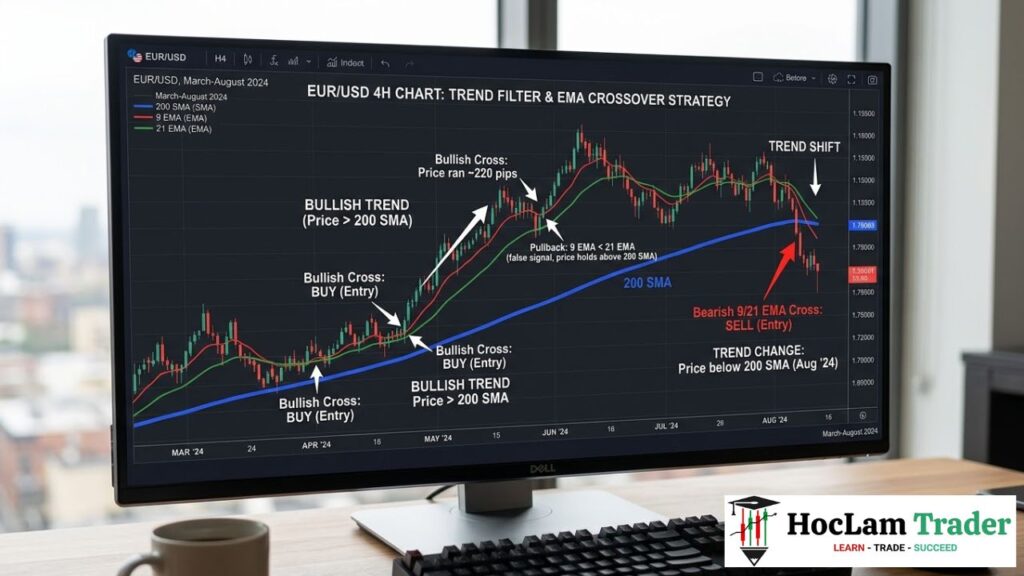
Example on EUR/USD 4H chart (March–May 2024):
Price was above the 200 SMA → clear uptrend.
Every time the 9 EMA crossed above the 21 EMA, the price ran 150–300 pips.
When the 9 EMA crossed below the 21 EMA while still above the 200 SMA, it was just a pullback. The price bounced off the 21 EMA and continued higher.
When the price finally closed below the 200 SMA in August 2024, and the 9/21 gave a bearish cross, the real downtrend started.
That combination, using the 200 SMA as a trend filter and the 9/21 EMA crossover for entries, is one of the highest-win-rate strategies I’ve ever tested across forex pairs and crypto.
Moving Averages as Dynamic Support and Resistance
This is where moving averages become magic.
Static horizontal levels get broken all the time. Moving averages move with price, so they are always relevant. The market literally “feels” them.
The levels institutions watch (and therefore self-fulfilling):
- 50 EMA → short-term trend and most common pullback level
- 200 EMA → the “big one” that defines bull/bear markets on any timeframe
- 21 EMA → very popular with crypto traders as dynamic support in uptrends
Real examples from 2024:
Bitcoin 2021–2024 cycle
After the 2022 bear market, BTC found support at the 200-day SMA (often the default moving average on charting platforms).
Every touch from November 2022 to March 2024 was a buying opportunity.
When BTC finally lost the 200 SMA in 2024 during the pullback to $53k, bears took control until it was reclaimed.
Ethereum vs 50 EMA on daily
During the 2023–2024 bull run, ETH respected the 50-day EMA like clockwork.
Eight separate touches, eight bounces.
The one time it closed below (July 2024), ETH dropped from $3,500 to $2,100.
Nasdaq 100 and the 21 EMA
Day traders and swing traders in US indices love the 21 EMA on the 4H chart.
During strong trends, the index pulls back to the 21 EMA and immediately reverses.
In ranging markets, price will slice through it another way to know when to stand aside.
Practical rule set I give to all my students:
In a trending market (price above rising 200 SMA or below falling 200 SMA):
- Buy pullbacks to the 50 EMA or 21 EMA if price holds
- Add to winners when price breaks above the previous swing high after touching the EMA
- Trail stop under the 21 EMA or 50 EMA, depending on the aggression
In a range (price chopping around the 200 SMA):
- Fade the edges, not the moving averages
- The 200 SMA will act as the center of the range, not support/resistance
Best Moving Average Settings for Different Markets and Timeframes
Here are the exact settings that work across markets right now.
Forex (EUR/USD, GBP/USD, USD/JPY)
- Daily trend: 200 SMA
- 4H entries: 9 EMA + 21 EMA crossover
- 1H scalping: 20 EMA (price respects it beautifully in trending sessions)
Crypto (BTC, ETH, SOL)
- Daily trend: 200 SMA (institutions) + 50 EMA (retail loves it)
- 4H swing: 9/21 EMA crossover (this is the crypto Twitter special)
- 1H/day trading: 8/21 EMA or 9/55 EMA (ICT traders love the 55)
Indices (Nasdaq, S&P 500, DAX)
- Daily: 50 SMA + 200 SMA (classic Golden/Death Cross)
- 4H swing: 20 EMA + 50 EMA
- Intraday: 21 EMA is god-tier on Nasdaq futures
My current personal chart setup (I trade forex + crypto):
Daily chart: 50 SMA (yellow), 200 SMA (red), 200 EMA (purple)
4H chart: 9 EMA (red), 21 EMA (green), 50 EMA (blue), 200 EMA (black)
1H chart: 9 EMA + 21 EMA only
Color coding: I make the 200 anything thick and obvious. Everything else is thin. You should instantly see the major trend when you open the chart.
Final Thoughts
Moving averages are not sexy. They will never flash bright arrows or promise 90 % win rates. But they are the closest thing to a universal edge that exists in trading.
Master these three concepts, and you will immediately trade better than 90 % of retail traders:
- Use the 200-period moving average (SMA on daily, EMA on lower timeframes) as your unbreakable trend filter
- Use the 9/21 or 8/21 EMA crossover for high-probability entries in the direction of the trend
- Treat the 50 EMA and 21 EMA as dynamic support/resistance zones where smart money accumulates or distributes
Put those on your chart today. Remove everything else for two weeks. You will be shocked by how clean your trading becomes.
The market hasn’t changed. Price still respects round numbers and moving averages. The traders who win are the ones who respect that simplicity, while everyone else hunts for the next holy-grail indicator.
Keep it simple. Trade the averages. Let the market come to you.