


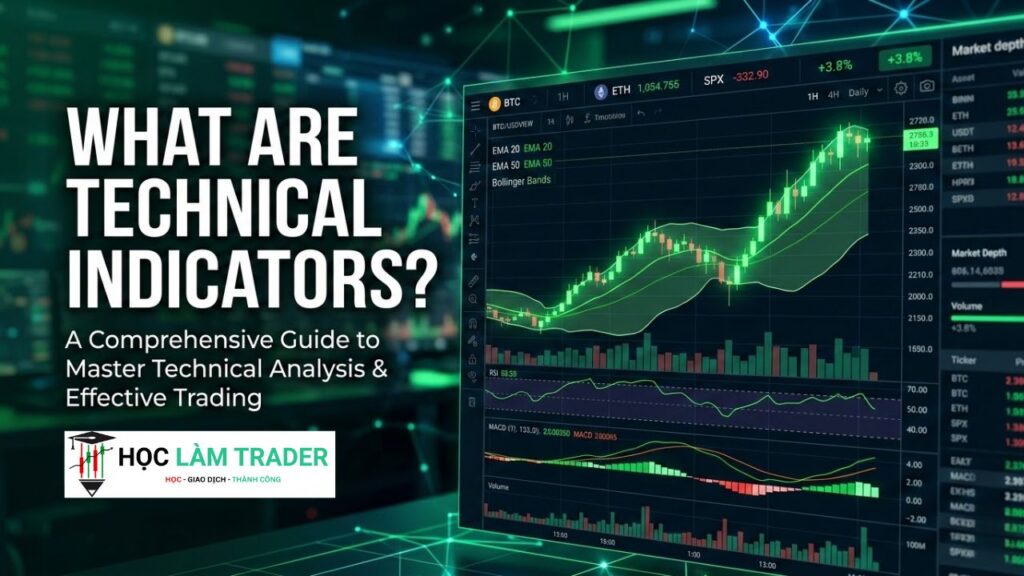
Most traders start their journey by loading every indicator they can find onto a chart. A few moving averages here, RSI at the bottom, MACD below that, Bollinger Bands stretched across the price action, and suddenly the chart tells you absolutely nothing.
The real skill in technical indicators trading isn’t knowing what every indicator does. It’s knowing which ones to use together, why they’re telling you what they’re telling you, and when to ignore the signal entirely.
This guide cuts through the noise. Whether you’re trading forex pairs, European indices, crypto, or equities, you’ll finish this article with a clearer framework for using indicators as decision-support tools rather than decision-makers.
Key Takeaways
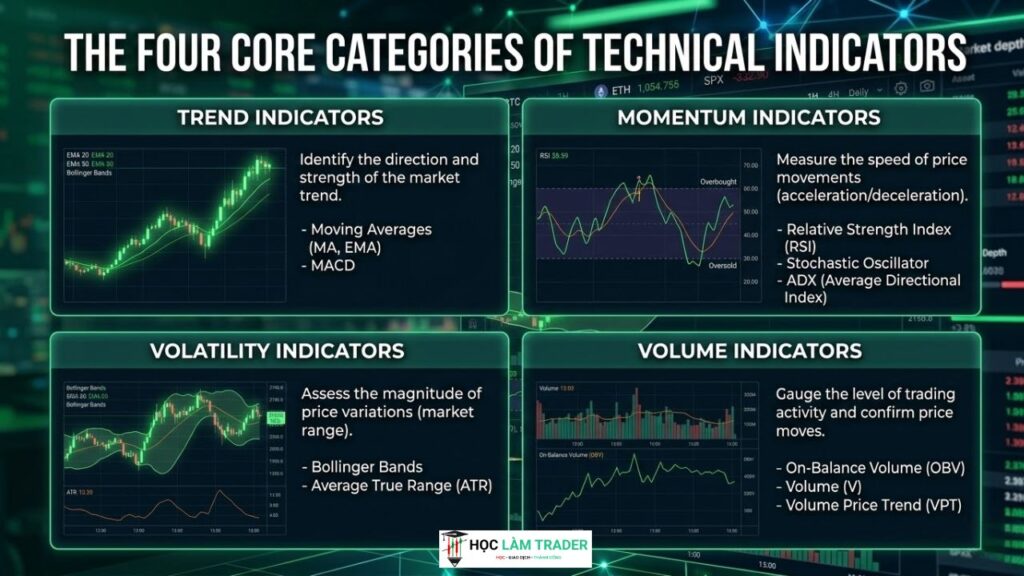
- Technical indicators fall into four categories: trend, momentum, volatility, and volume, and each serves a different purpose.
- Combining two to three complementary indicators from different categories produces more reliable signals than stacking similar ones.
- No indicator works consistently across all market conditions. Context trend, range, or choppy price action matters more than the indicator itself.
- ATR is one of the most underrated indicators for risk management, not just volatility reading.
- Fibonacci retracements are not magic levels; they work because many traders watch them, making them self-fulfilling under certain conditions.
What Are Technical Indicators?
Technical indicators are mathematical formulas applied to price data, and sometimes to volume or open interest, to help traders identify patterns, trends, and potential turning points in a market.
They don’t predict the future. What they do is organize historical price behavior into a format that makes it easier to spot conditions that have historically preceded certain moves.
There are two broad types based on timing:
- Lagging indicators (like moving averages) react to price after a move has begun. They confirm what’s happening but rarely catch the very start of a trend.
- Leading indicators (like RSI and Stochastic) attempt to signal what might happen next, often by measuring how overextended current price action is.
Neither type is superior. The best traders use both in ways that complement each other.
The Four Core Categories of Technical Indicators
Before picking specific tools, it helps to understand which functional family the indicators belong to. Knowing this prevents a common mistake: using five indicators that all say the same thing in different ways.
Trend Indicators
These tell you whether a market is going up, down, or sideways and how strong that trend is. They inherently lag because they smooth past price data to reveal direction.
Common examples include Moving Averages (SMA, EMA), Parabolic SAR, and Ichimoku Cloud.
When to lean on them: Trending markets. When the price is making higher highs and higher lows (an uptrend) or lower highs and lower lows (a downtrend), trend indicators remain useful. In ranging or choppy conditions, they produce false signals repeatedly.
Momentum Indicators
These measure the speed and strength of price movement. If prices are rising but momentum is slowing, that divergence often signals a potential reversal or consolidation.
Common examples: RSI, MACD, Stochastic Oscillator, Rate of Change (ROC).
When to lean on them: At extremes. Momentum indicators shine brightest when the price has pushed hard in one direction and appears stretched. Divergence between price and momentum is one of the more reliable setups across asset classes.
Volatility Indicators
Volatility indicators don’t tell you the direction; they tell you how much the price is moving. High volatility can mean breakout conditions. Low volatility often precedes explosive moves.
Common examples: Bollinger Bands, Average True Range (ATR), Keltner Channels.
When to lean on them: For sizing positions, setting stop-loss levels, and identifying squeeze conditions where a big move is building before the direction becomes clear.
Volume Indicators
Price tells you where the market went. Volume tells you how much conviction was behind that move. A breakout on thin volume is far less reliable than one backed by strong participation.
Common examples: On-Balance Volume (OBV), Volume-Weighted Average Price (VWAP), Accumulation/Distribution Line.
When to lean on them: For confirming breakouts, spotting divergence between price and institutional activity, and understanding whether a trend has real fuel behind it.
The Most Useful Indicators and How They Actually Work
Here’s a direct breakdown of the most widely used technical indicators with honest explanations of what they measure, how to read them, and where they commonly mislead traders.
Moving Averages (SMA and EMA)
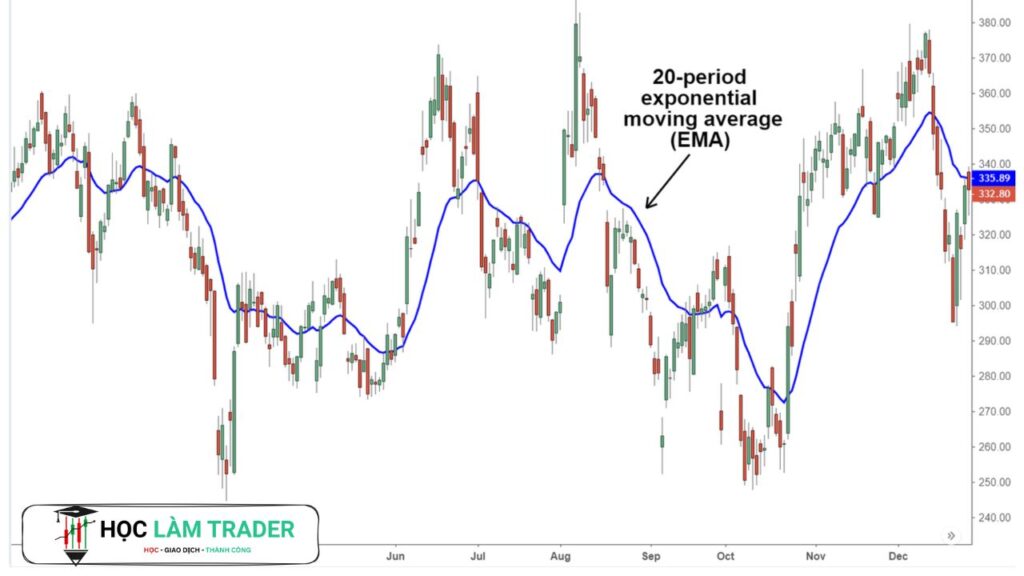
A Simple Moving Average (SMA) calculates the average closing price over a set number of periods. A 50-period SMA on a daily chart, for example, takes the average closing price over the last 50 days and plots it as a single point. Connect those points, and you get the smoothed line traders use to identify trend direction.
An Exponential Moving Average (EMA) does the same thing but applies more weight to recent prices. This makes it react faster to new information, which is useful in fast-moving markets, but also makes it more prone to whipsaws in noisy conditions.
Practical use:
- Price above the 200 EMA: generally bullish bias
- Price below the 200 EMA: generally bearish bias
- The 50/200 crossover (Golden Cross when 50 crosses above 200, Death Cross when it crosses below) is one of the most-watched signals in equity and crypto markets.
Where it fails: In sideways markets, price repeatedly crosses back and forth through moving averages, generating unreliable signals. Always pair MAs with a context filter, a range-detection method, or another confirming signal.
RSI Relative Strength Index
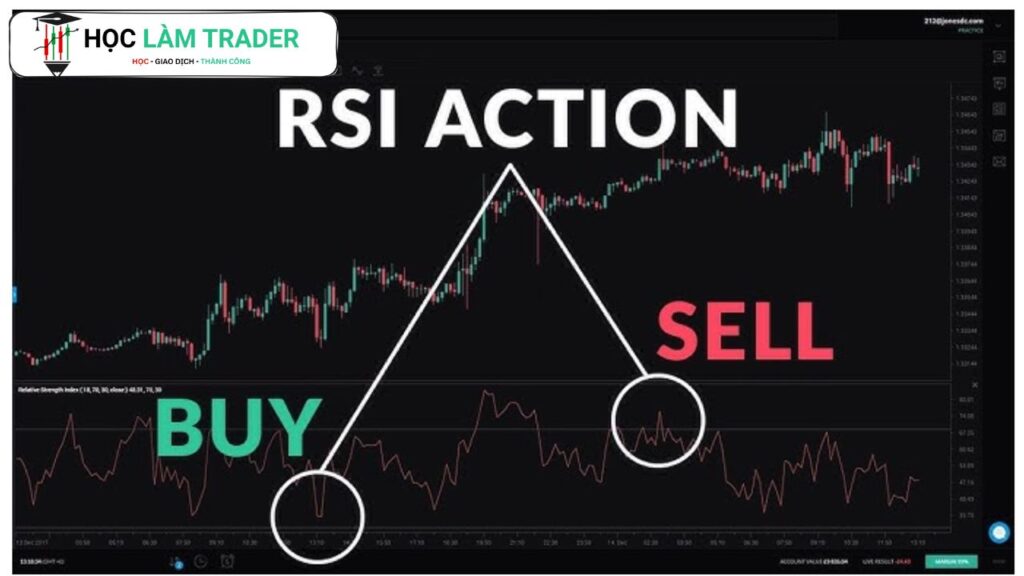
RSI measures the ratio of average gains to average losses over a specified period (typically 14), then scales the result to a 0–100 range. Readings above 70 traditionally signal overbought conditions; readings below 30 signal oversold.
That’s the textbook version. Here’s the practical reality:
In a strong uptrend, RSI can sit above 70 for extended periods without price reversing. Selling simply because RSI is “overbought” during a trend has burned many traders.
More reliable RSI applications:
- Divergence: When price makes a new high but RSI makes a lower high, the mismatch is called bearish divergence and warns that momentum is weakening even as price extends. This is one of the cleaner setups RSI provides.
- Midline holds: In an uptrend, watch how RSI behaves around 40–50. If it bounces consistently from that zone, trend momentum is intact.
- Range trading: In clearly defined ranges, RSI oscillating between ~35 and ~65 with clean boundaries can help time entries at the edges.
MACD Moving Average Convergence Divergence
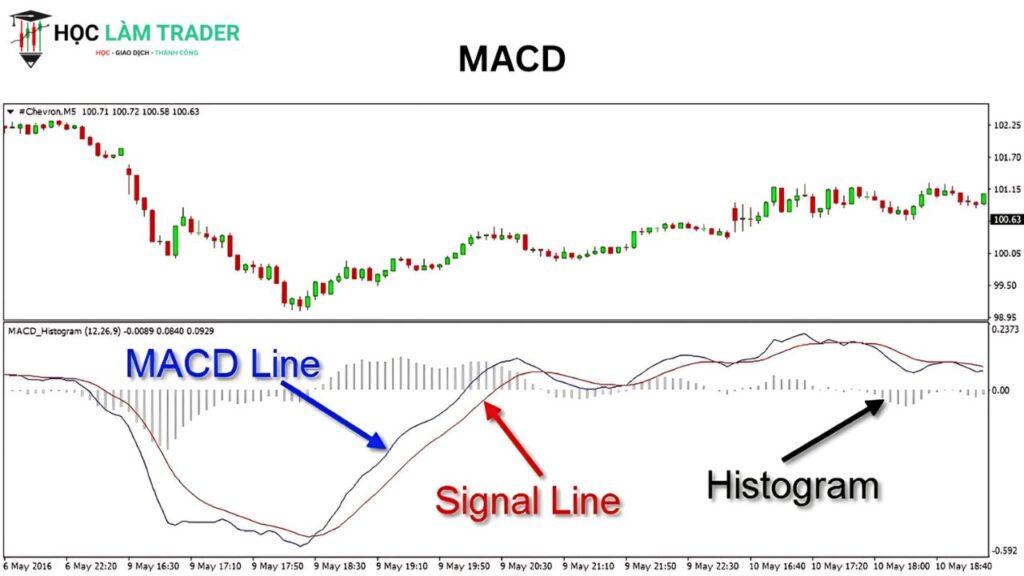
MACD tracks the relationship between two exponential moving averages, typically the 12-period and 26-period EMA. The difference between those two lines is plotted as the MACD line. A signal line (9-period EMA of the MACD line) is overlaid on top, and the space between them is displayed as a histogram.
What traders watch:
- Signal line crossovers: When the MACD line crosses above the signal line, it suggests building upward momentum. The reverse suggests weakening momentum.
- Zero line crossovers: When the MACD crosses above zero, the shorter-term EMA has climbed above the longer-term one, which is a more definitive bullish signal.
- Histogram changes: Decreasing histogram bars during a move warn that momentum is fading, even before the lines cross.
Like all momentum tools, MACD works best in trending conditions. During choppy sideways markets, the crossovers come fast and mean little.
Bollinger Bands
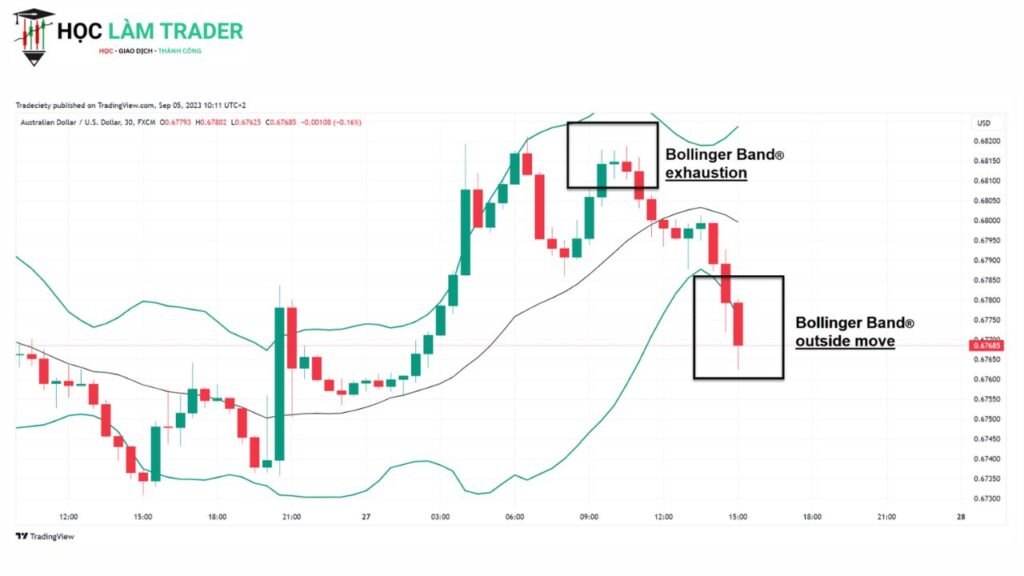
Bollinger Bands place two lines above and below a 20-period moving average, each at two standard deviations of distance. The bands expand when volatility increases and contract when it falls.
Practical applications:
- Squeeze: When the bands narrow dramatically, volatility has compressed. This often does not always precede a sharp breakout. The direction isn’t predetermined by the squeeze itself, which is why Bollinger Bands are best paired with a directional bias tool.
- Riding the bands: In strong trends, price can trade along the outer band for prolonged periods. This behavior suggests trend continuation rather than reversal.
- Mean reversion: In ranging conditions, touches of the upper band may favor selling pressure, and touches of the lower band may favor buying. This works in true ranges but breaks down in trends.
ATR Average True Range
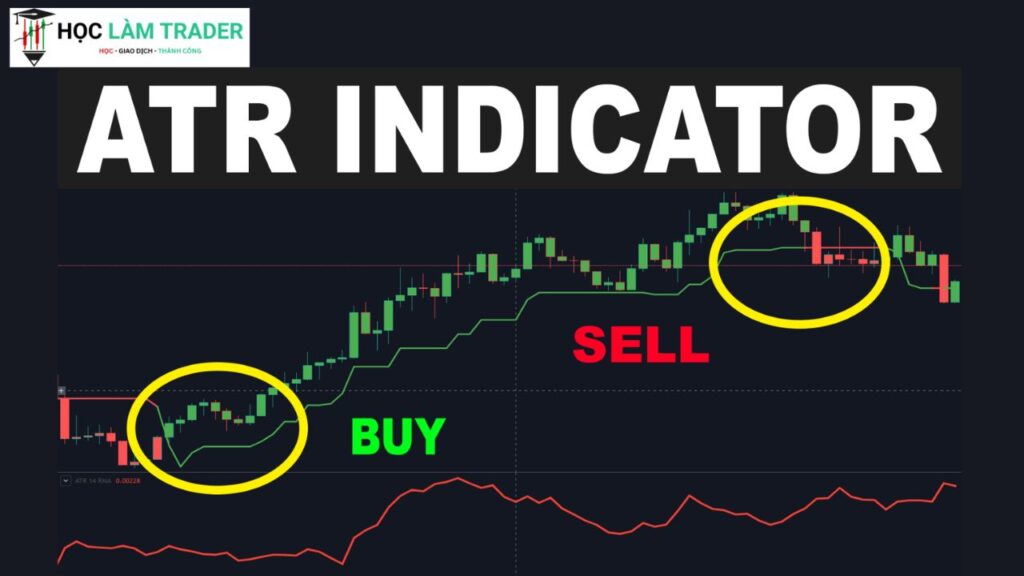
ATR measures average price movement over a set number of periods, accounting for gaps and overnight moves. It tells you how much the market is moving in absolute terms.
Most traders think of ATR as a volatility tool, but its most practical use is in risk management.
If EUR/USD has a 14-period ATR of 70 pips on a daily chart, placing your stop-loss 15 pips away from the entry means that normal daily fluctuations alone can hit it. ATR helps you place stops at distances the market needs to reach before your trade idea is invalidated.
Practical examples:
- Setting stop-loss at 1.5x or 2x ATR below (for longs) or above (for shorts) the entry price
- Avoiding trades during very low ATR conditions when spreads eat into potential gains
- Noting when ATR spikes dramatically, this often marks event-driven volatility that technical analysis handles poorly
Fibonacci Retracements
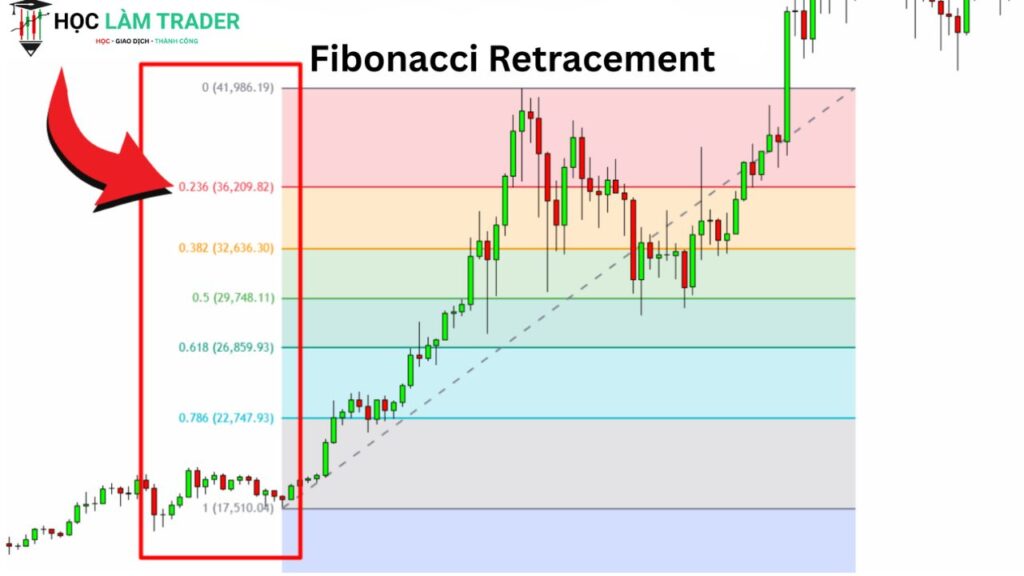
Fibonacci retracements draw horizontal levels at specific ratios: 23.6%, 38.2%, 50%, 61.8%, and 78.6% between a significant swing high and swing low. The idea is that after a meaningful move, the price tends to pull back to one of these levels before continuing.
It’s worth being direct about how these levels work: there’s no mystical property to the ratios themselves. They function primarily because a large number of traders watch them and place orders around them, creating self-fulfilling liquidity zones in liquid markets.
When they work well:
- After a clear, clean trending move with identifiable swing points
- In liquid markets (major forex pairs, large-cap stocks, Bitcoin), where enough participants are watching the same levels
- When a Fibonacci level aligns with another technical factor, a moving average, prior support/resistance, or a gap fill
When to be skeptical: In illiquid instruments, volatile news-driven moves, or markets without a clear trending structure, Fibonacci levels lose their reliability considerably.
How to Combine Indicators Without Cluttering Your Charts
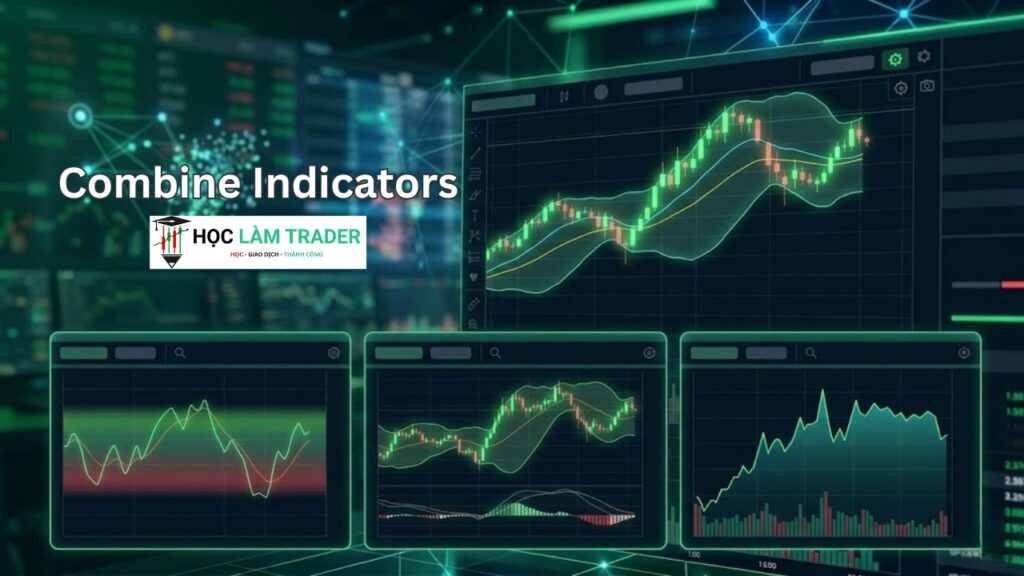
Here’s the core principle: use indicators from different categories to avoid redundancy.
If you add RSI, Stochastic, and MACD to your chart simultaneously, you’ve added three momentum indicators. They’ll largely confirm each other, and when they don’t, the conflict will confuse rather than inform.
A more useful combination approach:
RoleExample IndicatorPurpose
Trend filter 200 EMA defines the overall market bias
Momentum confirmation RSI Confirms entry timing and divergence
Volatility context: ATR or Bollinger Bands, Sizes, stops, and flags, squeeze conditions
Entry precision, Fibonacci, or price action level identifies a specific entry trigger
A working example:
Imagine EUR/USD on a 4-hour chart. Price is above the 200 EMA (bullish bias). RSI pulled back to the 40–45 zone (a healthy pullback in an uptrend, not an oversold breakdown). Price is retesting the 61.8% Fibonacci retracement of the last upswing. ATR suggests the stop placement should be at least 40 pips away.
Each tool is answering a different question:
- Should I be looking for longs? (Yes, 200 EMA says trend is up)
- Is momentum supportive? (Yes, RSI pulled back to range, not broken)
- Where’s a logical entry level? (61.8% Fib retracement)
- Where’s my stop? (ATR-based)
That’s a cohesive setup. Not four redundant signals, four different lenses on the same trade.
When Indicators Fail
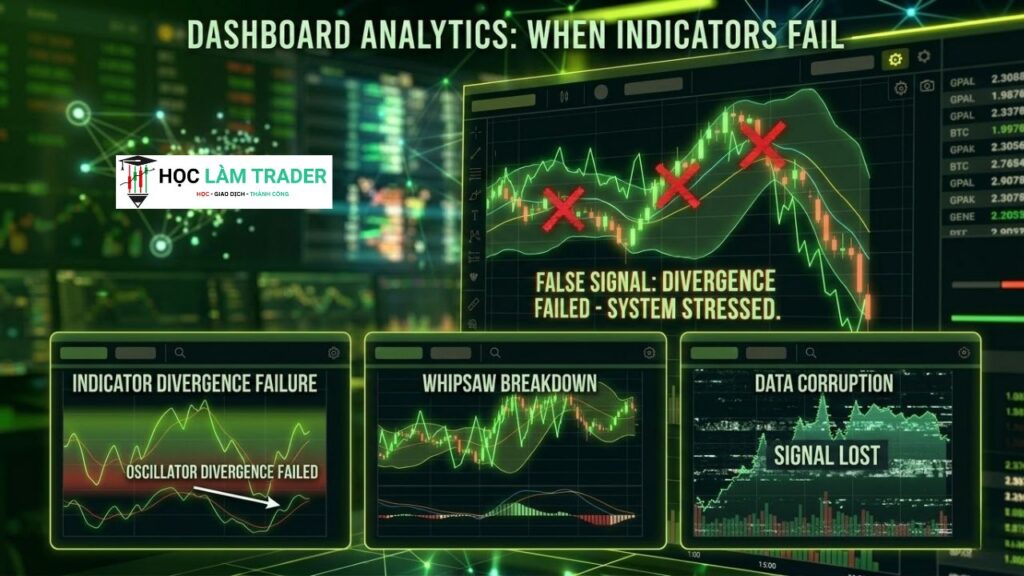
Understanding indicator failure is as important as understanding indicator signals. Here are the conditions where most indicators lose their reliability:
Ranging markets with undefined boundaries. Most momentum and trend indicators are tuned for directional movement. In markets grinding sideways without a clear structure, you’ll generate constant whipsaw signals. Before trusting any indicator reading, assess whether the market has a definable trend or is stuck in a range.
News-driven moves. Fundamental catalysts, such as central bank decisions, earnings surprises, and geopolitical events, can override any technical setup within seconds. Indicators are built on historical price data; they lack a mechanism to price in surprise events.
Very low liquidity conditions. During thin trading sessions (pre-market hours, holiday periods), small orders move the price dramatically. The resulting erratic candles produce meaningless indicator readings.
Lagging during fast breakouts. Trend indicators like moving averages, by design, react after the fact. In a fast breakout, you may get confirmation only well into the move, leaving poor risk-reward at entry. This is where leading indicators and price action skills become more useful.
Parameter mismatch. A 14-period RSI on a 1-minute chart is a completely different animal than the same RSI on a daily chart. If your indicator settings don’t match your trading timeframe and style, the signals will be unreliable regardless of the indicator’s underlying logic.
Indicator Setups for Different Trading Styles
Not every indicator is equally useful for every trading approach. Here’s a simplified pairing guide:
Day Trading (intraday, 5-minute to 1-hour charts)
- VWAP: critical institutional reference level for intraday direction
- EMA (9 and 20): fast-responding trend direction on lower timeframes
- RSI or Stochastic: momentum timing for entries within the trend
- ATR: position sizing and realistic target-setting
Swing Trading (4-hour to daily charts)
- 50 and 200 EMA: trend structure and key dynamic levels
- MACD: momentum shifts and divergence on the daily
- Bollinger Bands: squeeze identification and volatility context
- Fibonacci: precise pullback entry levels
- RSI divergence: early warning of trend exhaustion
Long-Term Investing (weekly charts)
- 200-week SMA: long-term trend filter for crypto and equities
- OBV or Accumulation/Distribution: institutional money flow confirmation
- RSI monthly: identifying major cycle extremes
Common Mistakes Traders Make With Technical Indicators
1. Using too many indicators. More indicators don’t create more certainty. They create analysis paralysis and contradictory signals. Three well-understood indicators used consistently beat ten poorly understood ones every time.
2. Treating overbought/oversold as automatic sell/buy signals. RSI at 75 in a strong uptrend is not a sell signal; it’s confirmation of momentum. Context determines what any reading means. An RSI at 75 in a choppy range after an exhaustion spike is a very different situation.
3. Optimizing settings obsessively, changing your RSI to 11 periods because backtesting showed slightly better results over a specific dataset, is a path to curve-fitting. Standard settings (RSI-14, MACD 12/26/9, BB 20/2) exist because they’ve been robust across decades and millions of instruments. Deviate with real justification, not wishful backtesting.
4. Ignoring the trend context before reading a signal, A MACD crossover means something very different in an established trend versus a choppy sideways market. Never read an indicator signal in isolation from the broader market structure.
5. Not adjusting for the timeframe. An ATR value of 0.0050 on a EUR/USD 5-minute chart doesn’t translate to the same real-world implication as the same number on a daily chart. Always contextualize indicator readings within the timeframe you’re trading.
FAQ
What is the most reliable technical indicator for trading?
No single indicator is universally reliable. The most consistently useful ones, RSI, MACD, and moving averages, work well when conditions match what they’re designed to detect. RSI divergence in trending markets and moving average crossovers during clear trends have historically provided more reliable signals than most alternatives. That said, reliability depends heavily on context, market conditions, and how indicators are combined.
Can you trade using only technical indicators without reading charts?
You can, but it’s rarely the smarter approach. Technical indicators are derived from price data, which means price action itself, candlestick patterns, support and resistance zones, and trend structure contain the raw information that the indicators process. Using indicators without reading the underlying chart often leads to late entries and stops placed without a clear price structure to support them.
How many technical indicators should I use at one time?
Most experienced traders settle on two to four. A practical combination might include one trend indicator (e.g., 200 EMA), one momentum indicator (e.g., RSI), and one volatility or risk tool (e.g., ATR). Adding a fourth, like a Fibonacci level or VWAP, for intraday can add precision without redundancy, as long as each tool answers a different question.
What’s the difference between RSI and MACD?
Both are momentum indicators, but they measure different things. RSI measures the magnitude of recent price changes relative to its own history, producing a normalized 0–100 reading. MACD measures the relationship between two moving averages to show momentum shifts and directional bias. RSI is more useful for identifying overbought/oversold conditions and divergence; MACD is more useful for confirming trend direction and timing entries aligned with momentum shifts.
Do technical indicators work for crypto trading?
Yes, but with caveats. The same indicators used for forex and equities apply to crypto. Still, crypto markets are more prone to extreme volatility, manipulation of low-liquidity smaller coins, and sudden sentiment shifts driven by social media or regulatory news. ATR-based stops are especially important given crypto’s wide daily price range. Indicators that perform well on Bitcoin’s daily chart may not translate reliably to low-cap altcoins.
What is Fibonacci retracement, and is it reliable?
Fibonacci retracement identifies potential pullback levels within a trend by drawing horizontal lines at the key ratios 38.2%, 50%, and 61.8% between a swing high and swing low. Its reliability is tied to market liquidity and the clarity of the preceding move. In highly liquid markets with a clean swing structure, these levels often attract price because many institutional and retail traders place orders around them. They work best when combined with other confirming signals rather than used alone.
Conclusion
Technical indicators trading comes down to using the right tools for the right conditions, not accumulating as many indicators as possible.
The traders who get the most from technical analysis understand their indicators well enough to know when to trust them and when to set them aside. RSI divergence in a mature trend, MACD confirming a momentum shift at key support, ATR guiding stop placement; each of these applications is grounded in logic, not magic.
Start with a small, complementary set of indicators. Learn their strengths and failure modes. Apply them within a broader framework that includes market structure, price action, and sound risk management. That combination will take you further than any elaborate indicator stack ever could.
This article is for educational purposes only and does not constitute financial or investment advice. All trading involves risk. Past performance of any indicator or strategy is not a guarantee of future results.