


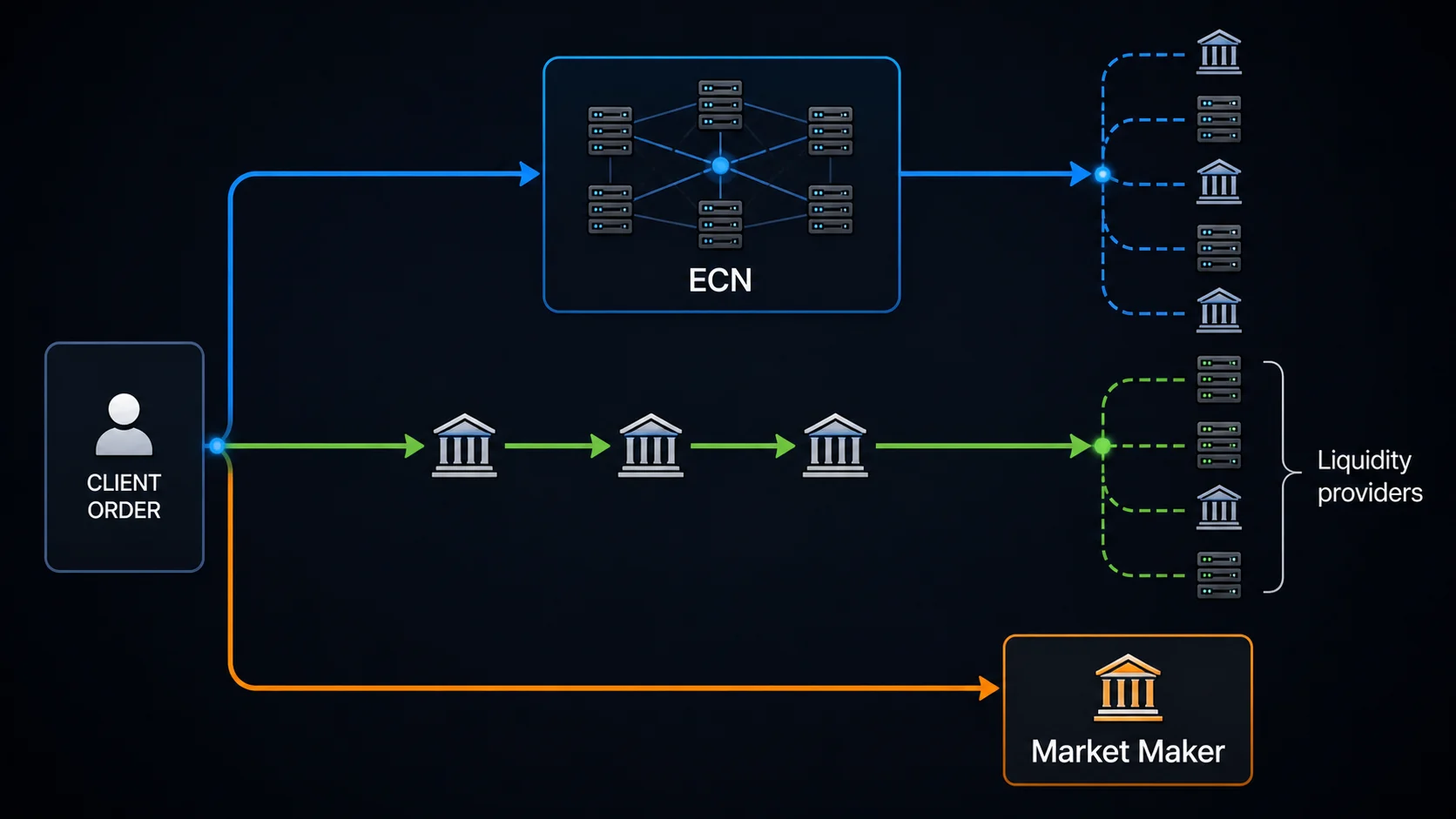
ECN, STP and Market Maker are labels used to describe different order-routing or dealing arrangements, but their meaning varies by broker, product and legal entity. No label alone establishes execution quality or eliminates conflicts. A trader should read the broker’s execution policy, order handling, costs, liquidity disclosures and regulatory status for the specific account.
Key takeaways
- ECN generally refers to an electronic system that matches buy and sell interest, but retail-FX branding may not map directly to securities-market definitions.
- STP commonly describes automated routing to one or more liquidity providers.
- Market Maker can quote prices and may act as principal to a client trade.
- Spread, commission, fill quality, rejection policy and slippage treatment matter more than a marketing label.
- Conflicts and protections depend on the entity, jurisdiction, client agreement and actual order-handling policy.
What each execution model can mean
| Label | Common description | What to verify |
|---|---|---|
| ECN | Electronic matching or display of order interest | Venue, eligible participants, fees and routing role |
| STP | Automated forwarding/routing process | Liquidity sources, routing discretion and fill policy |
| Market Maker | Dealer may quote prices and may be principal to a client trade | Principal capacity, conflicts and execution obligations |
In securities markets, the SEC describes ECNs as electronic systems that automatically match buy and sell orders at specified prices. Retail FX is decentralized and contracts, liquidity arrangements and terminology can differ, so do not assume the same market structure from an account name alone.
Order routing and possible conflicts
A broker can route, internalize, hedge or otherwise manage orders according to its business model and client agreement. Acting as principal can create a potential conflict because the firm is on the other side of a transaction; it does not, by itself, prove poor execution. Conversely, routing to liquidity providers does not guarantee a better fill in every market condition. The right question is whether the firm clearly discloses the arrangement and whether the execution record matches the stated policy.
Depth, quotes and available liquidity
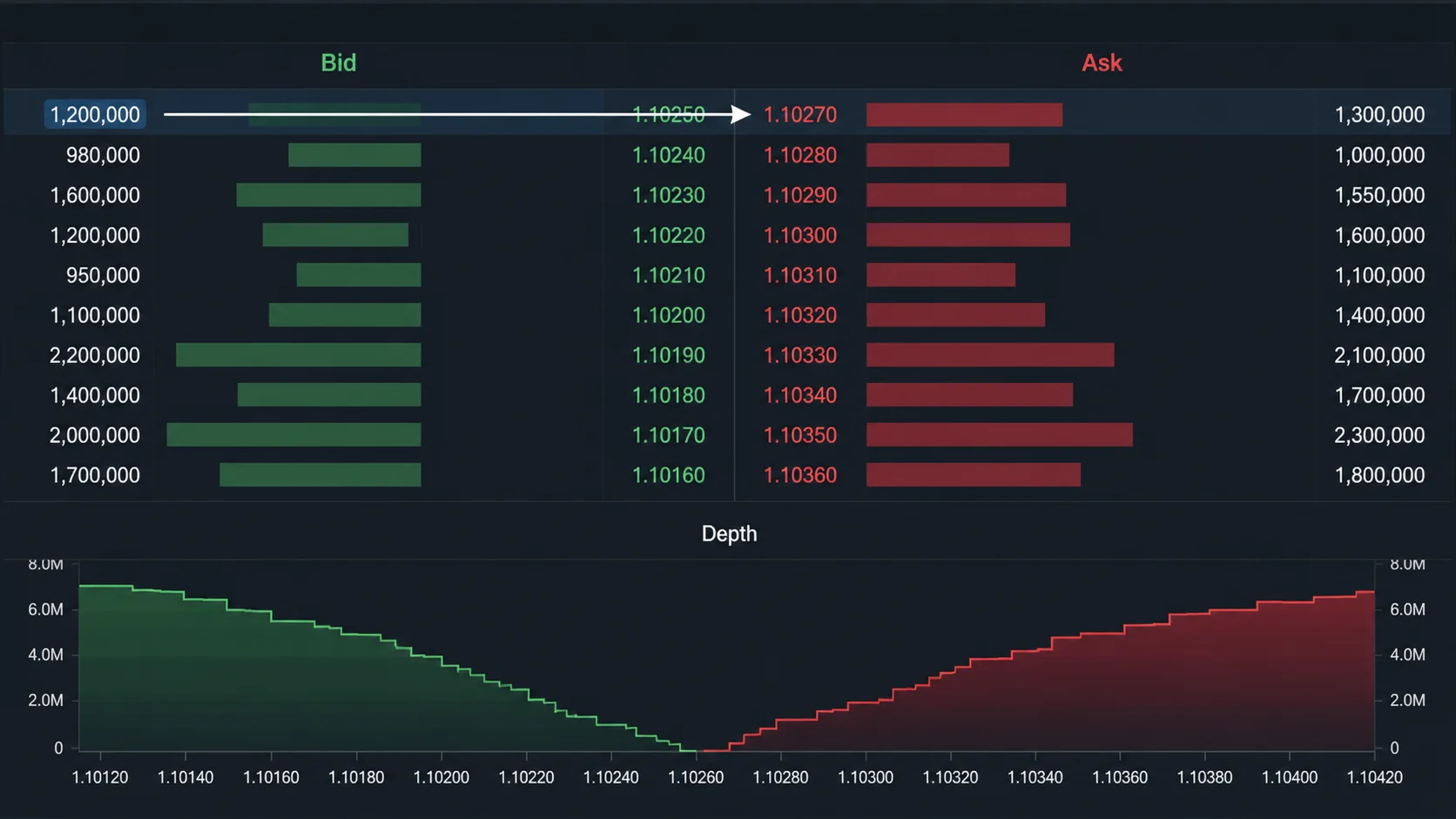
Displayed depth, where available, shows quoted size at price levels from a particular source or aggregation. It may not represent all global liquidity and can change quickly. A visible bid/ask ladder is informative only if the provider, symbol, data coverage and update behavior are known. During fast markets, the best displayed quote may disappear before a market order reaches it.
Spread, commission and total cost
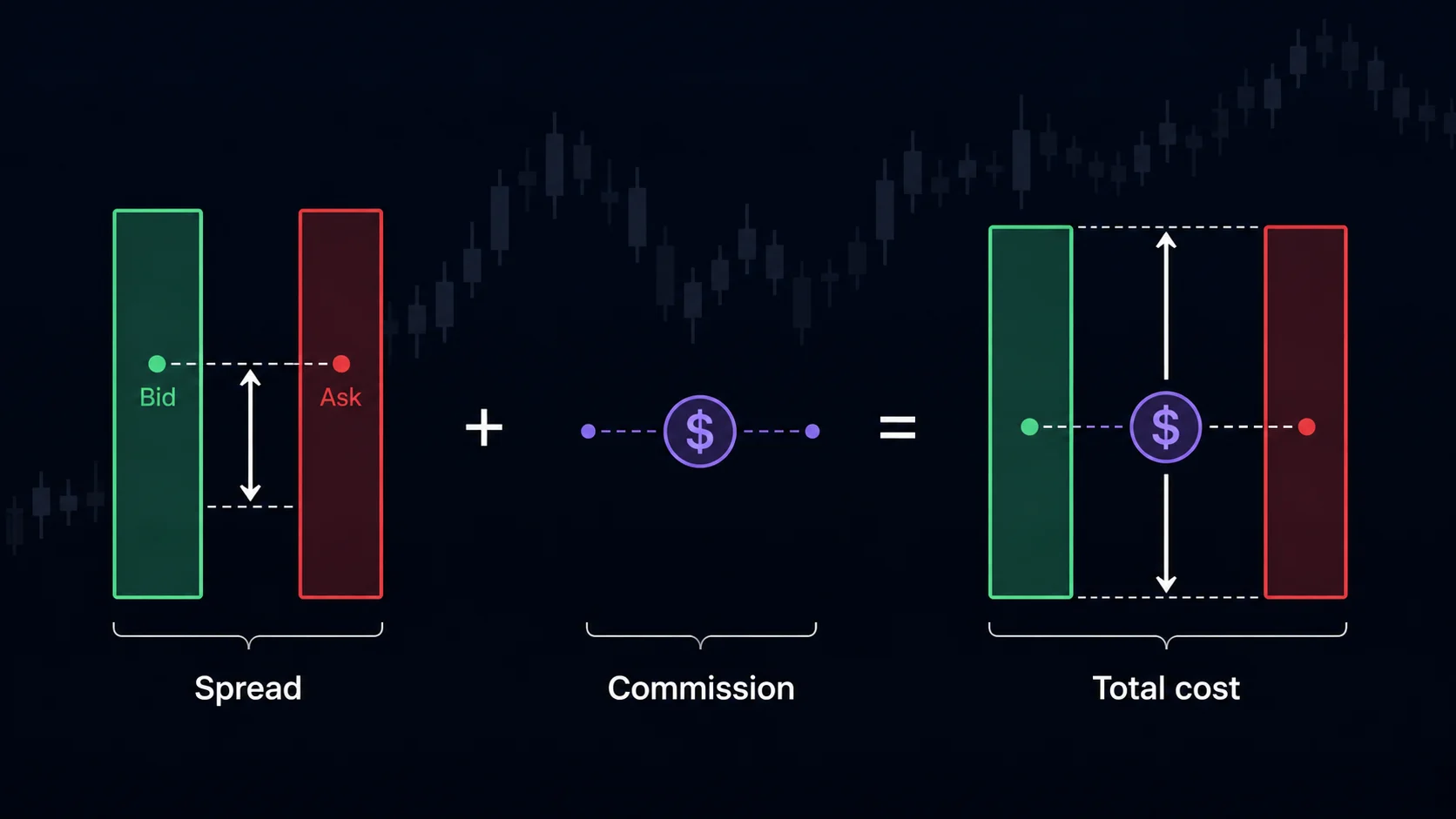
A tight raw spread account can charge a separate commission; a wider-spread account may include more of the charge in the quote. Financing, conversion charges, minimum commission and slippage can also matter. Compare total cost under the same instrument, size and conditions, instead of calling one account “cheaper” from its advertised spread alone.
The Forex slippage guide explains why requested and filled price should be reviewed separately from the visible spread.
Execution conditions change with active sessions and available liquidity. Read the site’s guides to liquidity and execution risk and choosing Forex timeframes alongside the broker’s own policy.
How to assess an execution claim

- Identify the exact regulated legal entity that holds the account.
- Read the order-execution and conflict-of-interest disclosures for that entity.
- Check whether the broker acts as agent, principal or may use both capacities.
- Compare spreads, commissions, swaps and fill records over similar conditions.
- Test a small, appropriate process only after understanding risks; do not infer global quality from one trade.
Common mistakes
- Treating ECN, STP or “no dealing desk” as a universal quality guarantee.
- Comparing advertised minimum spreads with another account’s typical all-in cost.
- Assuming displayed depth is the whole Forex market.
- Ignoring the relevant legal entity and jurisdiction.
- Claiming a broker has a conflict without reading its actual disclosures.
FAQ
Is ECN always better than a Market Maker?
No. Each label can cover different arrangements. Execution quality and suitability depend on costs, order handling, liquidity, regulation and the trader’s use case.
Does STP mean there is no conflict of interest?
Not necessarily. Routing and hedging arrangements vary. Read the specific firm’s policy and disclosures.
Sources and further reading
- U.S. SEC — ECNs and Alternative Trading Systems
- CFTC — retail foreign currency trading information
- Investor.gov — orders and market mechanics
Risk disclosure: This article is educational information, not investment advice or a solicitation to trade. Testing methods and broker terminology do not eliminate trading risk. Historical samples and simulations do not guarantee future results. Verify data and product terms, assess risk and make your own decisions.