


The Moving Average Convergence Divergence indicator is one of the most widely used technical tools in retail and professional trading. Gerald Appel developed it in the late 1970s to track changes in the strength, direction, momentum, and duration of a trend. Today, a solid MACD indicator strategy remains a foundational element of technical analysis.
Many new traders add this tool to their charts and start trading every line crossover they see. This usually leads to poor results. The indicator works best when you understand the math behind the lines and how those lines interact with actual price action.
Key Takeaways
- The MACD is a trend-following momentum indicator that shows the relationship between two moving averages of a security’s price.
- A basic MACD crossover occurs when the fast MACD line crosses the slow MACD line.
- The MACD histogram provides early clues about momentum shifts before a crossover occurs.
- MACD divergence is a powerful tool for identifying weakening trends and upcoming price reversals.
- The MACD is a lagging indicator. You should never use it in isolation.
What is the MACD Indicator?
The term “MACD indicator explained” often results in confusing mathematical formulas. At its core, the indicator measures the distance between a fast-moving average and a slow-moving average.
When the fast-moving average pulls away from the slow-moving average, momentum is increasing. When the fast-moving average slows and approaches the slow-moving average, momentum is decreasing.
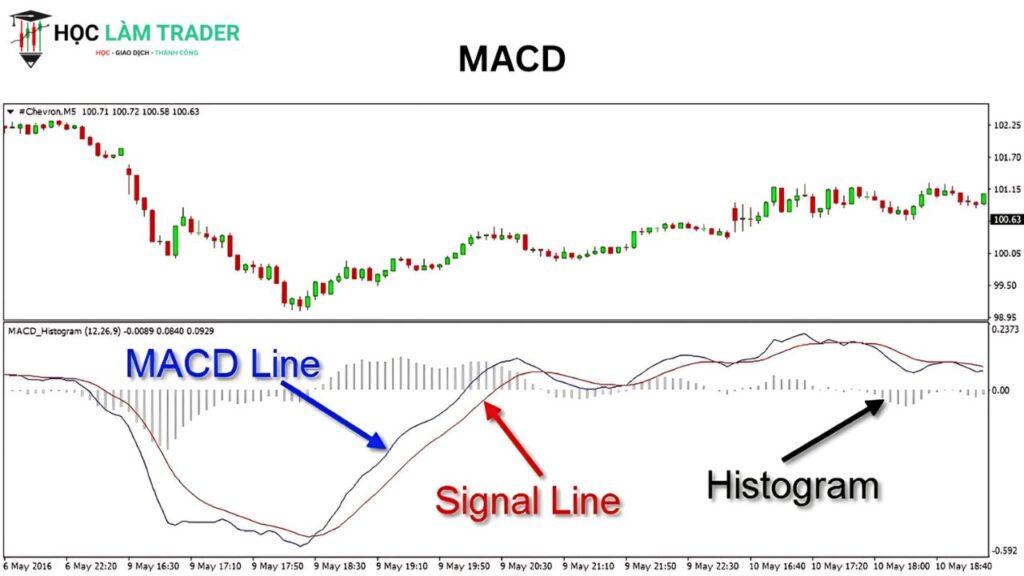
The indicator consists of three distinct parts. You need to understand what each part does to build a reliable MACD trading strategy.
MACD Line = EMA12 – EMA26Because it uses exponential moving averages, the line reacts quickly to recent price changes. When the 12 EMA is above the 26 EMA, the MACD line is positive. When the 12 EMA is below the 26 EMA, the MACD line is negative.
The Signal Line
The Signal line is a 9-period Exponential Moving Average of the MACD line itself.
Signal Line = EMA9 (MACD Line)Plotting a moving average of the MACD line smooths out the data. It makes it easier to spot indicator turns. The interaction between the MACD line and the Signal line generates the most common trading signals.
The MACD Histogram
The histogram visually shows the distance between the MACD and Signal lines.
Histogram = MACD Line – Signal LineWhen the MACD line is above the Signal line, the histogram is positive and prints above the zero line. When the MACD line is below the Signal line, the histogram is negative and prints below the zero line.
Traders use the histogram to anticipate crossovers of the moving averages. If the histogram bars are getting shorter, the MACD line is catching up to the Signal line.
MACD Crossover Strategy
A MACD crossover is the most basic signal the indicator provides. Traders look for two specific types of crossovers.
Signal Line Crossovers
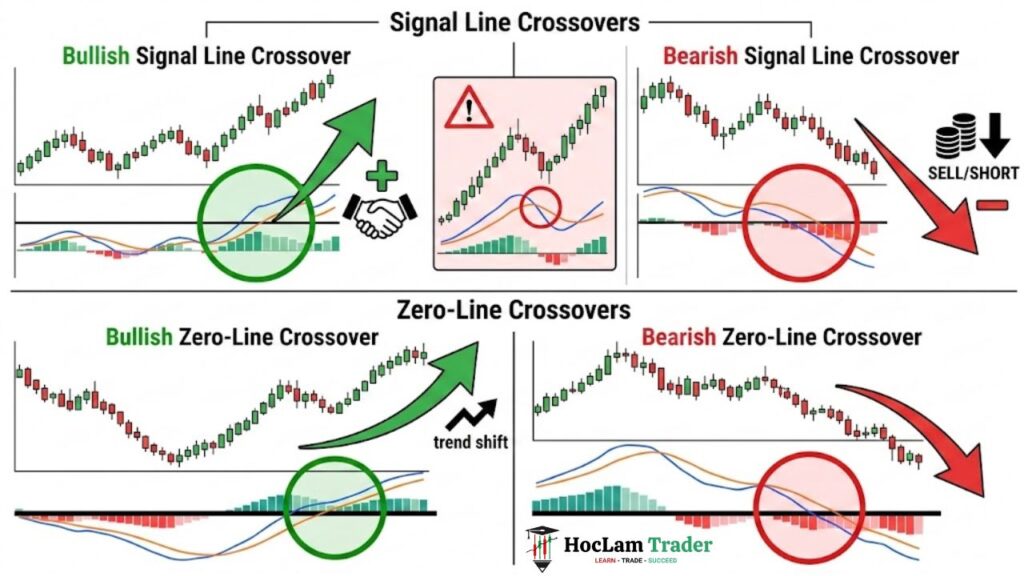
A bullish crossover occurs when the MACD line crosses above the Signal line. This suggests that bullish momentum is accelerating. Traders often interpret this as a buy signal.
A bearish crossover occurs when the MACD line crosses below the Signal line. This indicates that bearish momentum is accelerating. Traders view this as a sell or short signal.
You must exercise caution with signal line crossovers. In a strong uptrend, you will see multiple bearish crossovers that result in tiny pullbacks before the price rockets higher again. Trading every crossover in a ranging market will result in back-to-back losses.
Zero-Line Crossovers
A zero-line crossover happens when the MACD line crosses the zero axis.
If the MACD line crosses from negative territory to positive territory, it means the 12 EMA has crossed above the 26 EMA on the price chart. This is a sign of a long-term trend shift.
If the MACD line crosses below zero, the 12 EMA has crossed below the 26 EMA. This signals a transition to a downtrend.
Zero-line crossovers happen less frequently than signal line crossovers. They offer a broader view of market direction.
The MACD Histogram as a Momentum Indicator
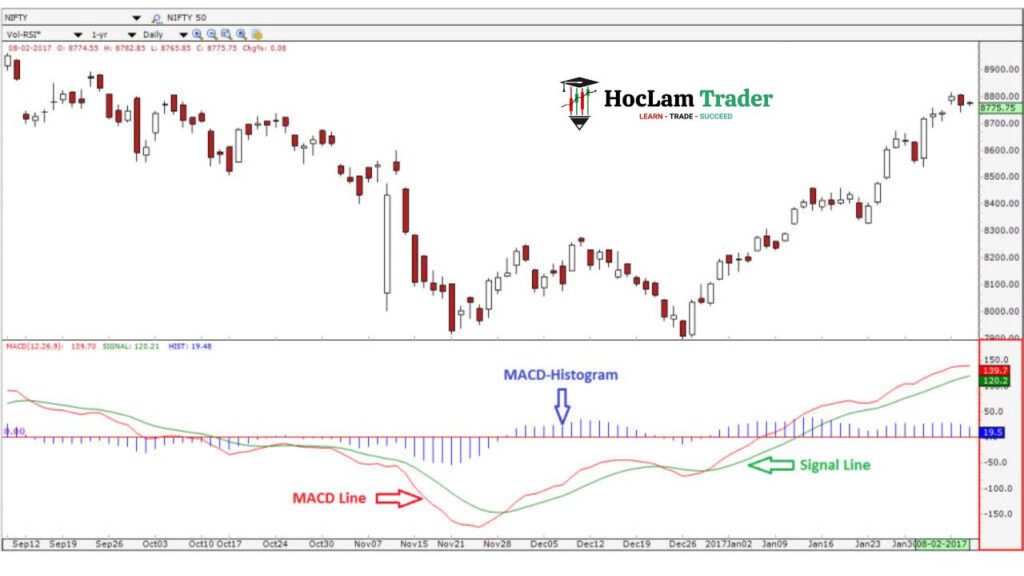
Many traders ignore the histogram entirely. This is a mistake. The MACD histogram is an excellent momentum indicator. It shows you the speed of price movement.
When a new trend begins, the MACD line will pull away from the Signal line aggressively. The histogram bars will grow taller. This expansion confirms the trend is strong.
Eventually, the price will lose momentum. The MACD line will slow down. The distance between the MACD line and the Signal line will shrink. The histogram bars will start getting shorter.
This contraction is an early warning sign. The trend is losing steam. A shorter histogram bar tells you a crossover might be coming soon. You can use this information to tighten your stop-loss orders or take partial profits before the actual crossover happens.
Using MACD for Trend Confirmation
Using the MACD trend confirmation technique helps filter out bad trade setups. The indicator works remarkably well as a directional filter.
If you are looking for long positions, you want the broader trend to be up. You can define an uptrend by looking for a MACD line that is above the zero line. As long as the MACD line is positive, the overall momentum favors buyers. You can then look for bullish signal line crossovers as entry points.
If you want to short the market, look for the MACD line to be below zero. This confirms the longer-term momentum is down. You then wait for a bearish signal line crossover to time your entry.
By aligning the short-term crossover with the long-term zero-line position, you increase the probability of a successful trade.
MACD Divergence Strategy
The MACD divergence strategy is an advanced technique. It is often considered the most reliable signal the indicator produces.
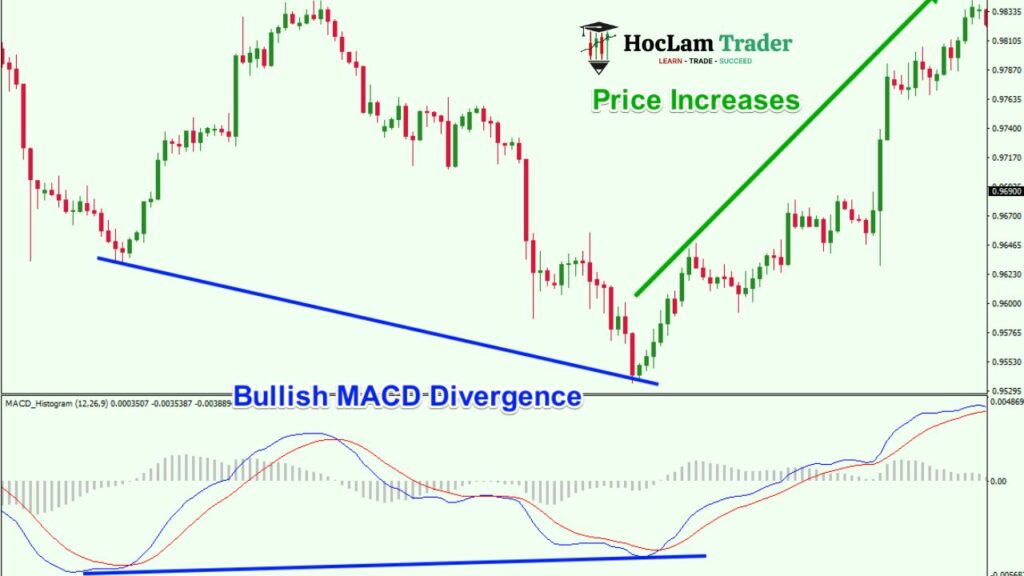
Divergence happens when the price of an asset moves in the opposite direction from the MACD indicator. This disagreement signals that the current price trend is weak and likely to reverse.
Bullish Divergence
Bullish divergence occurs during a downtrend. The price forms lower lows on the chart. At the same time, the MACD indicator forms higher lows.
The price is falling, but the momentum indicator is refusing to drop further. This tells you the selling pressure is drying up. A bullish reversal is highly probable.
Bearish Divergence
Bearish divergence happens during an uptrend. The price pushes to higher highs on the chart. However, the MACD indicator prints lower highs.
The market is making new highs, but there is no momentum behind the move. The buyers are exhausted. A bearish reversal or a deep pullback is imminent.
Divergence does not guarantee an immediate reversal. A market can stay in a state of divergence for weeks. You should always wait for a break in price structure or a confirming MACD crossover before entering a divergence trade.
Comparison: MACD Crossovers vs. MACD Divergence
| Feature | MACD Crossovers | MACD Divergence |
| Signal Type | Trend-following | Reversal / Exhaustion |
| Frequency | High | Low |
| Reliability in Trends | Good if traded with the trend | Low (trends often ignore divergence initially) |
| Skill Level Required | Beginner | Intermediate to Advanced |
| Primary Use | Entry timing | Warning of trend change |
MACD Settings for Different Trading Styles
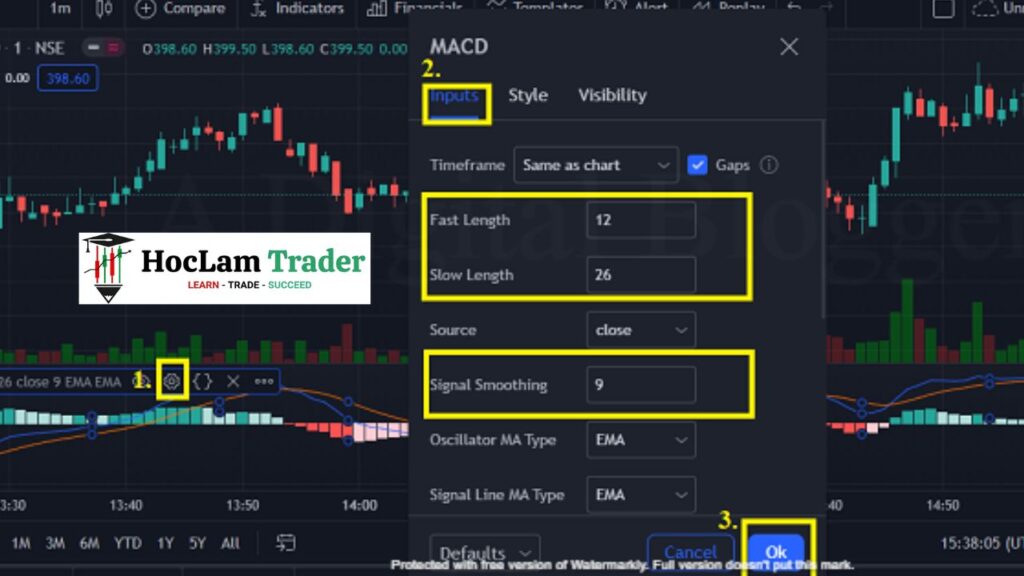
The default settings for the MACD are 12, 26, and 9. These settings were originally designed for daily charts. They work exceptionally well for swing trading and position trading.
Traders often search for the best MACD settings for day trading. Because day traders operate on 5-minute or 15-minute charts, they sometimes find the default settings too slow.
Some day traders speed up the indicator by using settings like 5, 35, and 5. This makes the indicator highly sensitive to rapid intraday price swings.
Speeding up the indicator comes with a high cost. You will get earlier signals, but you will also get significantly more false signals. Most professional traders stick to the default 12, 26, 9 settings regardless of the timeframe. Instead of changing the settings, they change their criteria for taking a trade.
Building a Complete MACD Trading Strategy
A profitable strategy requires more than just waiting for lines to cross. You need context.
If you want to trade a MACD forex strategy or apply it to stocks, you need a rule-based system. Here is a practical framework for building a complete strategy.
Step 1: Identify the Market Phase
The MACD is terrible in choppy, sideways markets. Before looking at the indicator, look at the price chart. Are you making higher highs and higher lows? If the market is ranging, ignore the MACD.
Step 2: Determine the Higher Timeframe Trend
Look at a timeframe higher than your trading timeframe. If you trade the 1-hour chart, check the 4-hour chart as well. Ensure the higher timeframe MACD is pointing in the direction of your intended trade.
Step 3: Look for Confluence
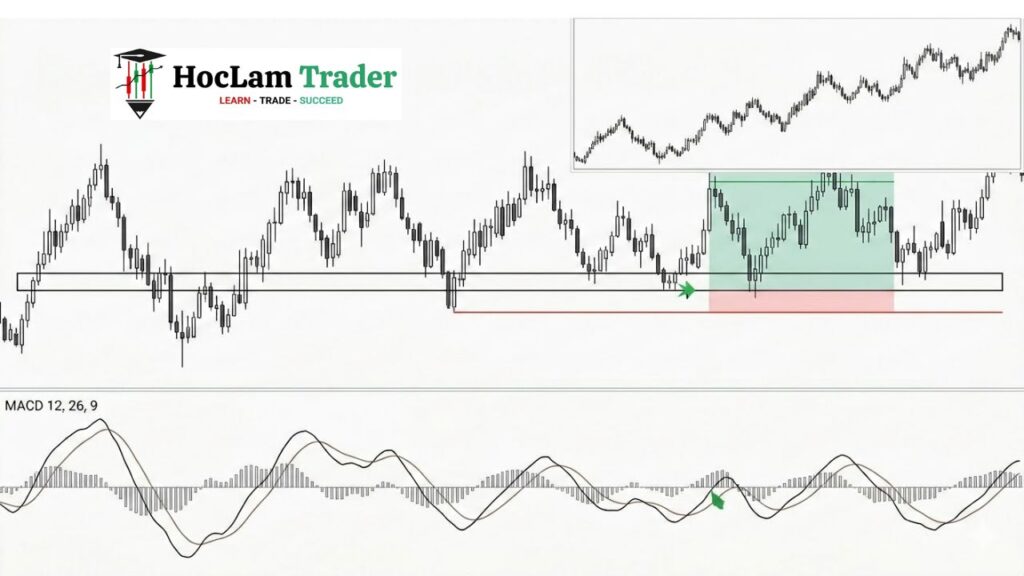
Do not use the MACD alone. Combine it with horizontal support and resistance levels. If a bullish MACD crossover happens exactly when the price bounces off a major support zone, the signal is much stronger.
Step 4: Manage Your Risk
Place your stop-loss below the recent swing low for a long trade. Place it above the recent swing high for a short trade. Calculate your position size so you never risk more than 1% to 2% of your account on a single setup.
You can learn more about combining tools in our complete guide to Technical Indicators for Traders: The Complete Guide.
Limitations and Common Mistakes
You need to understand the MACD’s weaknesses to use it effectively.
The biggest limitation is that the MACD is a lagging indicator. It is calculated using moving averages based on historical data. By the time the MACD lines cross, the price has already moved. You will never catch the exact bottom or top using a MACD crossover.
The second major flaw is its performance in ranging markets. When the price moves sideways, the fast and slow moving averages converge. The MACD and Signal lines will cross around the zero line. This produces constant whipsaw signals. If you take every crossover during a range, you will drain your account quickly.
A common mistake beginners make is treating the MACD as an overbought or oversold indicator. Unlike the RSI or Stochastic oscillator, the MACD has no upper or lower bounds. It can continue to stretch further in one direction as long as the trend remains strong.
Next Steps
To master the MACD indicator, you need to spend some time on the screen. Open your charting platform and pull up the daily chart of your favorite asset.
Look back over the last year of price data. Mark every MACD crossover. Observe what happened to the price immediately after. Then, try to spot periods of MACD divergence. Notice how the histogram predicted crossovers before they happened.
Once you are comfortable reading historical data, build a simple crossover strategy combined with basic support and resistance. Test it thoroughly on a demo account before committing real capital.
FAQ
What are the best MACD settings for day trading?
The default settings of 12, 26, and 9 work well for most day traders. Some traders prefer a faster setting, like 5, 35, 5, to catch intraday moves more quickly, but this increases the number of false signals.
Can I use the MACD indicator for crypto trading?
Yes. The MACD can be applied to any freely traded asset with sufficient liquidity. The mechanics of the indicator remain the same whether you are trading crypto, forex, or stocks.
What is the difference between MACD and RSI?
The MACD measures the relationship between two moving averages to gauge trend direction and momentum. The RSI (Relative Strength Index) measures the speed and change of price movements to identify overbought or oversold conditions. Traders often use them together.
Why did my MACD crossover trade fail?
MACD crossovers fail frequently in ranging markets. They also fail when you trade a crossover that goes against the dominant long-term trend. The indicator is lagging, so entering late on a weak signal often leads to a loss.