


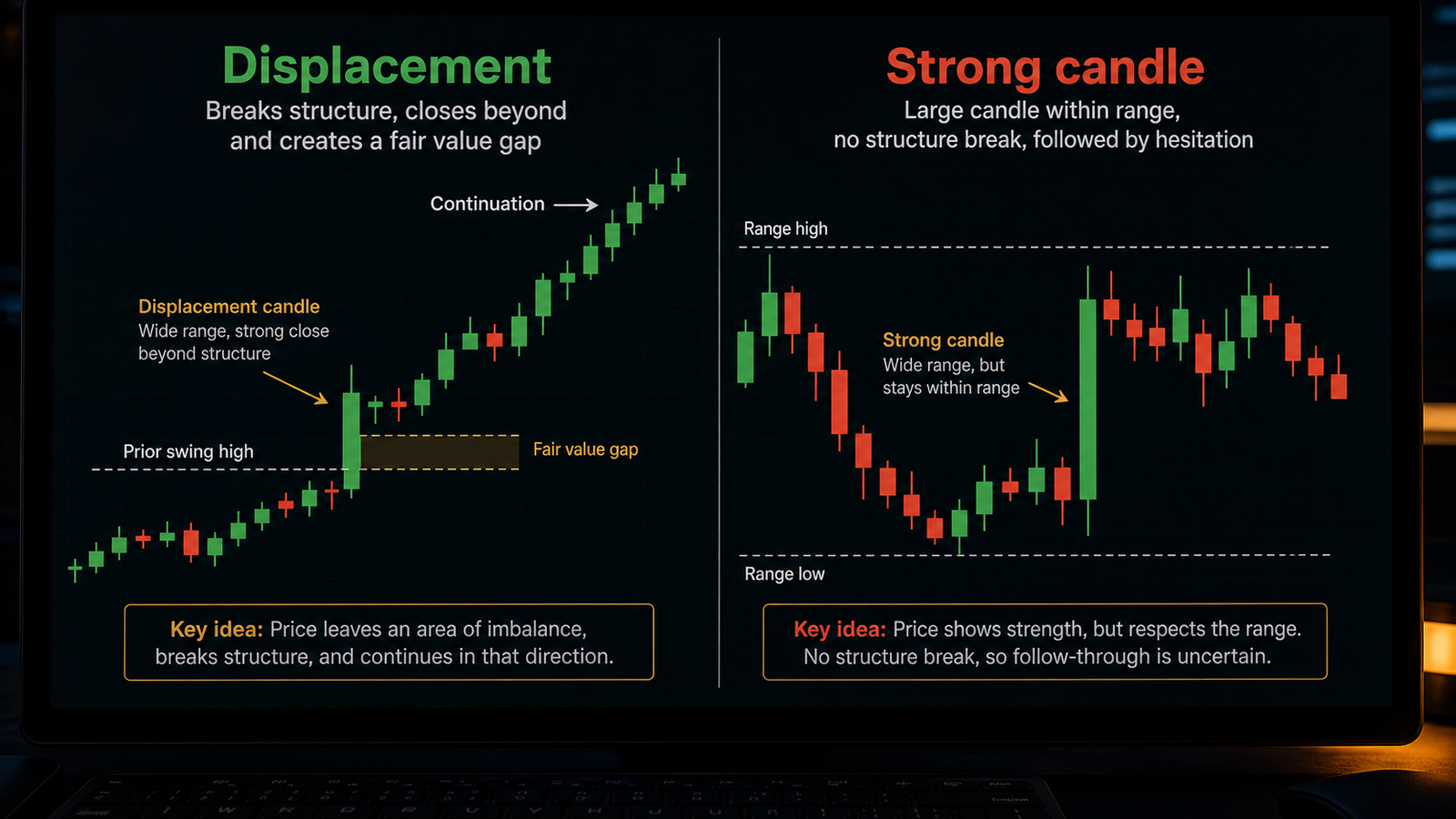
Displacement is a forceful price move that leaves an area, closes beyond a meaningful structure point and usually shows follow-through. A strong candle is simply large relative to nearby candles. Size alone cannot confirm a market shift. The distinction matters because entering every wide candle can turn ordinary range noise into a false signal.
Three tests for displacement
- Location: the move begins at a meaningful level or after a defined liquidity event.
- Structure: the close breaks a swing or range boundary that was identified beforehand.
- Delivery: subsequent candles hold or continue the move instead of immediately returning through the origin.
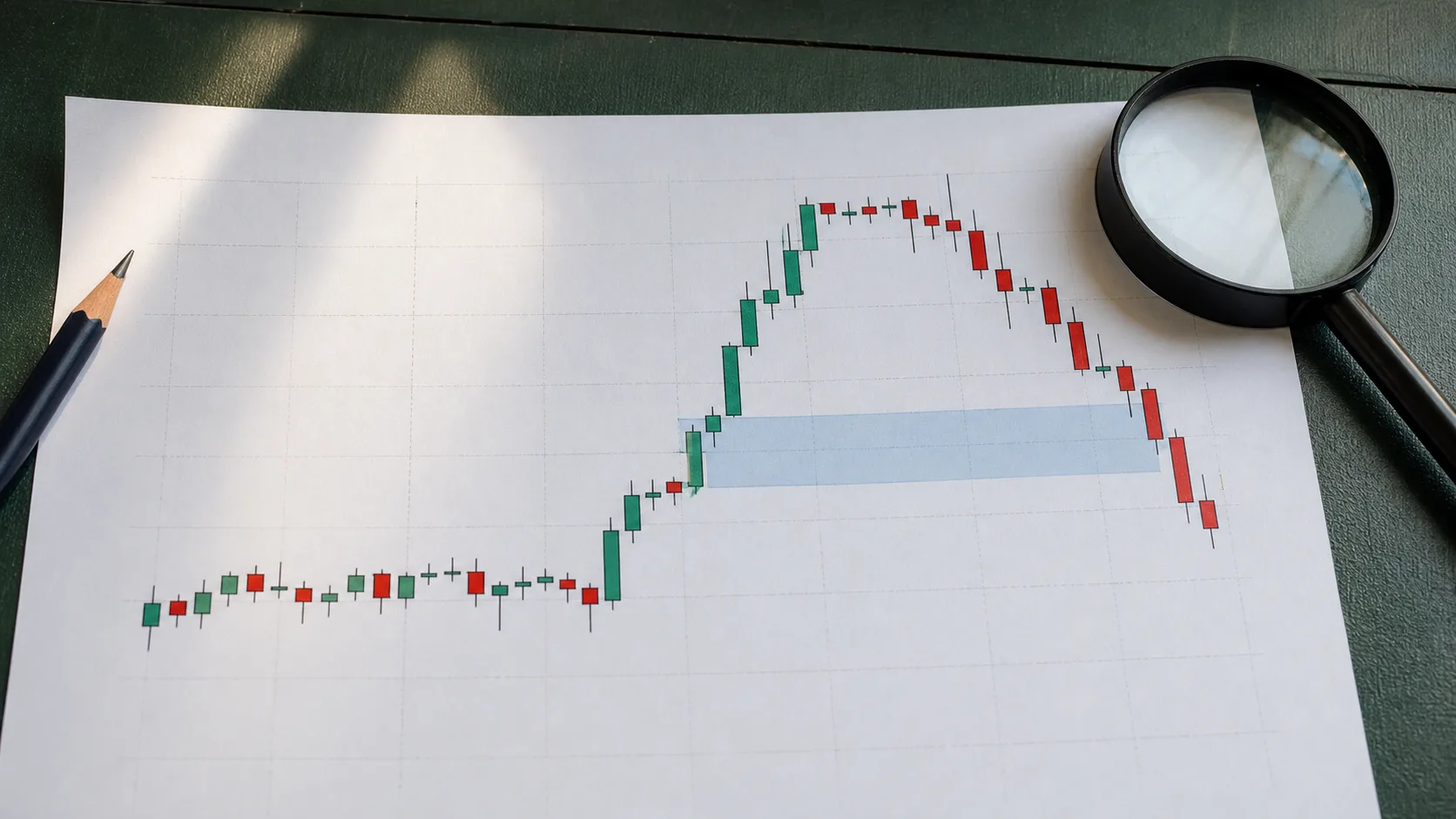
Why a large candle can be misleading
News, a thin session or a spread change can create a wide candle without a durable change in order flow. If the candle closes inside the prior range and the next bars retrace it, the observation is better classified as volatility than displacement.
Confirmation rules you can test
Write the rule in measurable language: for example, “a candle must close beyond the last confirmed swing, and the next two candles must not close back inside the broken range.” You can test other definitions, but do not switch between them after seeing the result.
Hypothetical comparison
On the left side of the illustration, price breaks a prior swing high, leaves an imbalance and continues. On the right, a large green candle appears in the middle of a range, but price stalls below the range high. The first may qualify as displacement under a written rule; the second is only a strong candle until further evidence appears.
Failure cases
- A candle breaks a minor internal swing while the higher-timeframe range is unchanged.
- Follow-through occurs only because of a scheduled release and cannot be filled at the tested price.
- The apparent gap disappears after a deep retracement.
- The trader defines displacement by body size after the fact.
Continue learning: the Smart Money Concepts hub, ICT market structure, the Fair Value Gap guide, liquidity sweeps, trading tools and the English learning hub.
FAQ
Does displacement always create a fair value gap?
No. A gap can be a useful observation, but it is not a requirement unless your model includes it.
Is a large candle a bad signal?
Not necessarily. It is a data point. Its meaning depends on location, structure, close and follow-through.
Can displacement predict the next candle?
No. It can define a testable condition and a possible imbalance, but the next outcome remains uncertain.
Sources and further reading
- CFTC customer advisory on retail Forex risks
- CME Group technical-analysis education
- TradingView Help Center
Risk notice: This article is for education only. It is not investment advice, a trading signal or an invitation to trade. Trading can result in the loss of capital. Examples are hypothetical and past results do not guarantee future results.