


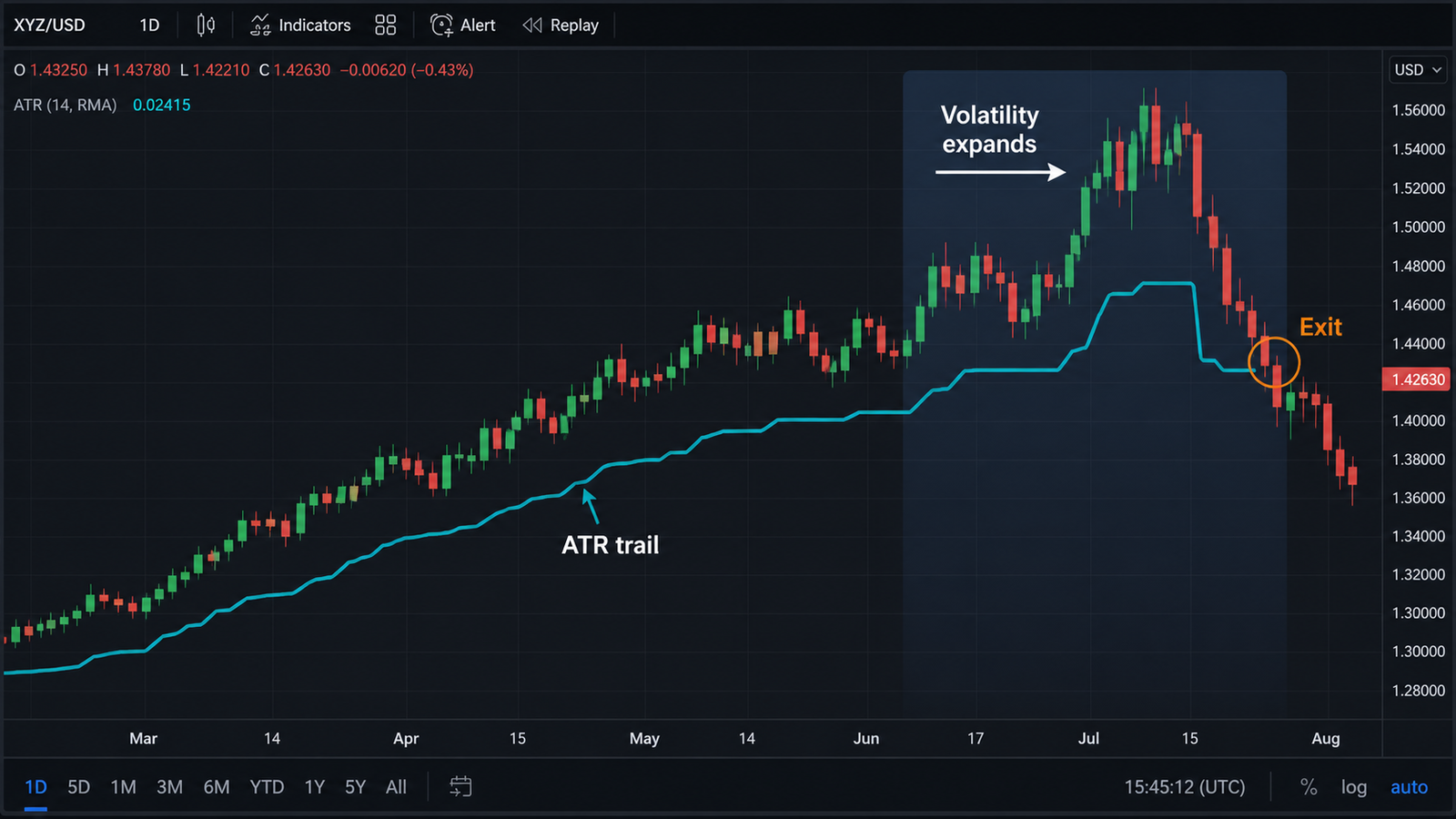
An ATR trailing stop moves a protective exit using the Average True Range, a volatility measure based on recent price ranges. In a long position, a common rule places the stop below a reference price by a multiple of ATR and only ratchets upward. It can give a trend more room in volatile periods, but it also returns open profit and may exit before a reversal is complete.
ATR in plain language
True Range considers the current high–low range and gaps from the prior close. ATR is a moving average of True Range over a chosen period. It measures typical movement; it does not predict direction.
A simple long-position rule
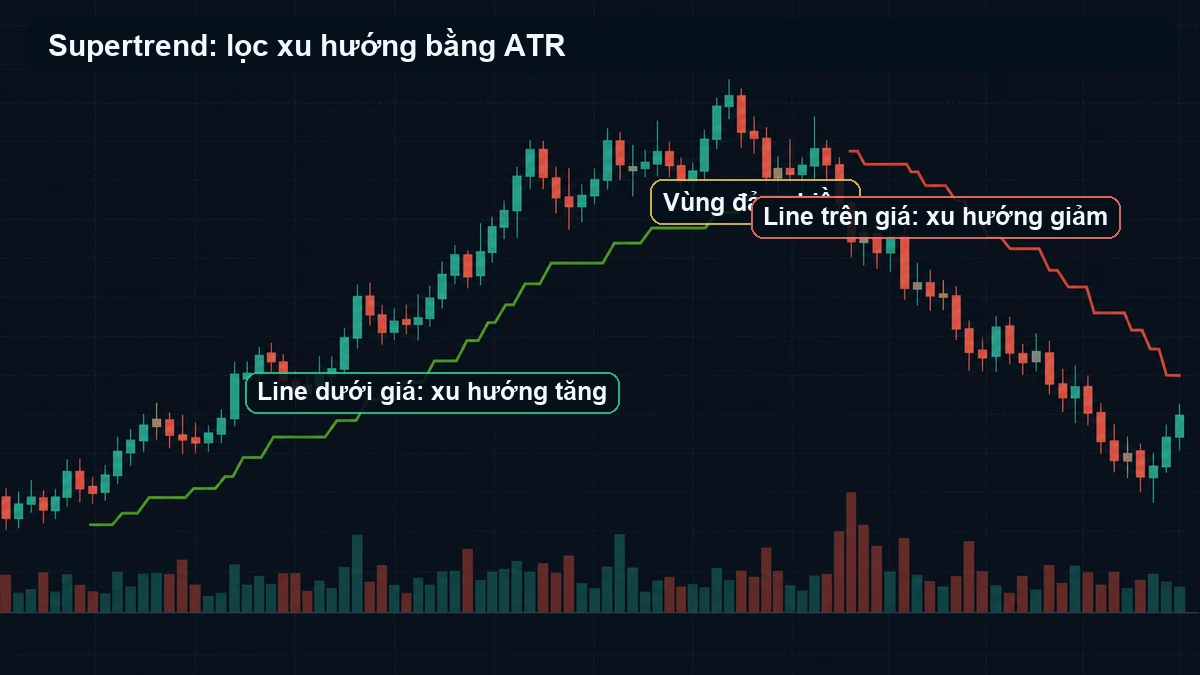
One testable version is: trail = highest close since entry − multiplier × ATR. The stop can move up when the formula rises, but it should not move down during a long trade. For a short trade, reverse the logic. This is a framework, not a mandatory formula; document the exact reference price and update timing.
Choosing period and multiplier
| Choice | Trade-off | Question to test |
|---|---|---|
| Short ATR period | Responds quickly but can be noisy | Does normal noise trigger premature exits? |
| Long ATR period | Smoother but slower | Does the stop remain too far from current risk? |
| Small multiplier | Tighter protection, more exits | Does the strategy survive ordinary pullbacks? |
| Large multiplier | More room, larger giveback | Is the planned loss still acceptable? |
Hypothetical example
Suppose a long trade is open while ATR expands during a strong move. The trailing line widens rather than jumping directly under every candle. When price later closes through the line, the plan exits. The exit is a risk-control event, not proof that the indicator predicted the top.
Failure cases
- ATR expands after a news spike and pushes the stop farther away than the account plan allows.
- The trader manually loosens the stop after a loss.
- The reference price is changed from close to wick without updating the backtest.
- Different symbols use different point values, making the same multiplier incomparable.
- Commission, swap and slippage turn a theoretically positive exit into a poor fill.
Testing checklist
- Keep ATR period, multiplier and update frequency fixed.
- Include realistic spread, commission and slippage.
- Compare fixed, structure-based and ATR exits on the same sample.
- Report average win, average loss, drawdown and giveback—not only win rate.
Continue learning: the Smart Money Concepts hub, ICT market structure, the Fair Value Gap guide, liquidity sweeps, trading tools and the English learning hub.
FAQ
Does ATR trailing stop guarantee more profit?
No. It only defines an adaptive exit rule. Its result depends on market regime, entry, costs and implementation.
What multiplier should beginners use?
There is no universal value. Start with a small, clearly labelled test range and choose only after out-of-sample review.
Can ATR set the initial stop too?
Yes, if the plan defines it and the resulting position size remains acceptable. Do not let the formula override a maximum loss limit.
Sources and further reading
- CFTC customer advisory on retail Forex risks
- CME Group technical-analysis education
- TradingView Help Center
Risk notice: This article is for education only. It is not investment advice, a trading signal or an invitation to trade. Trading can result in the loss of capital. Examples are hypothetical and past results do not guarantee future results.