


An SMC trading checklist is a written sequence for reviewing market context, liquidity, displacement, an entry zone and invalidation before a trade is considered. It does not turn Smart Money Concepts into a prediction engine. The checklist is useful because it separates observations from assumptions and makes the same decision process easier to test across charts.
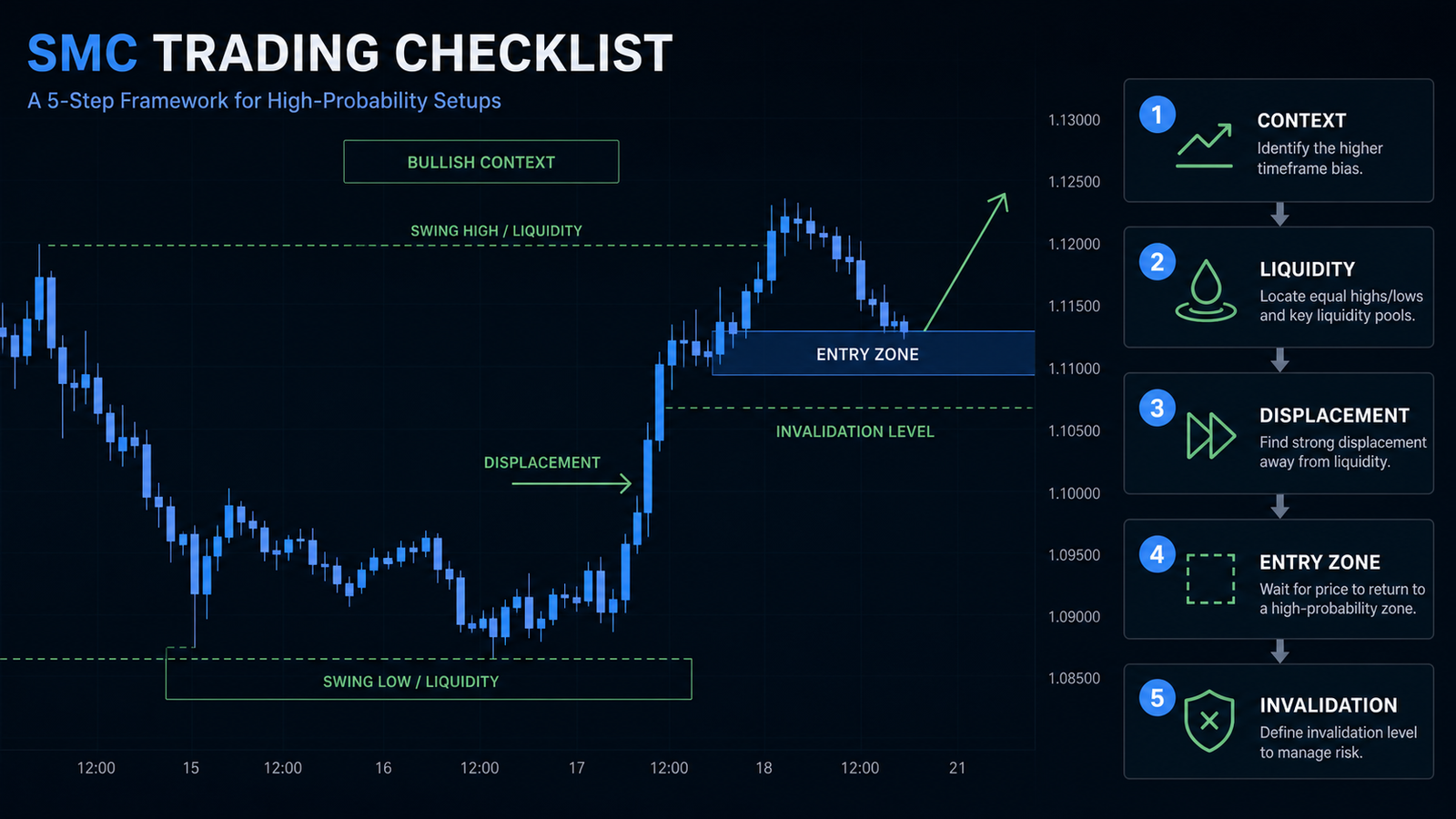
What the checklist is designed to prevent
SMC terms such as order block, fair value gap and liquidity sweep can encourage hindsight. A checklist forces you to mark the higher-timeframe context first, then define what evidence is still missing. If a condition cannot be described before the outcome is known, it is not a reliable rule yet.
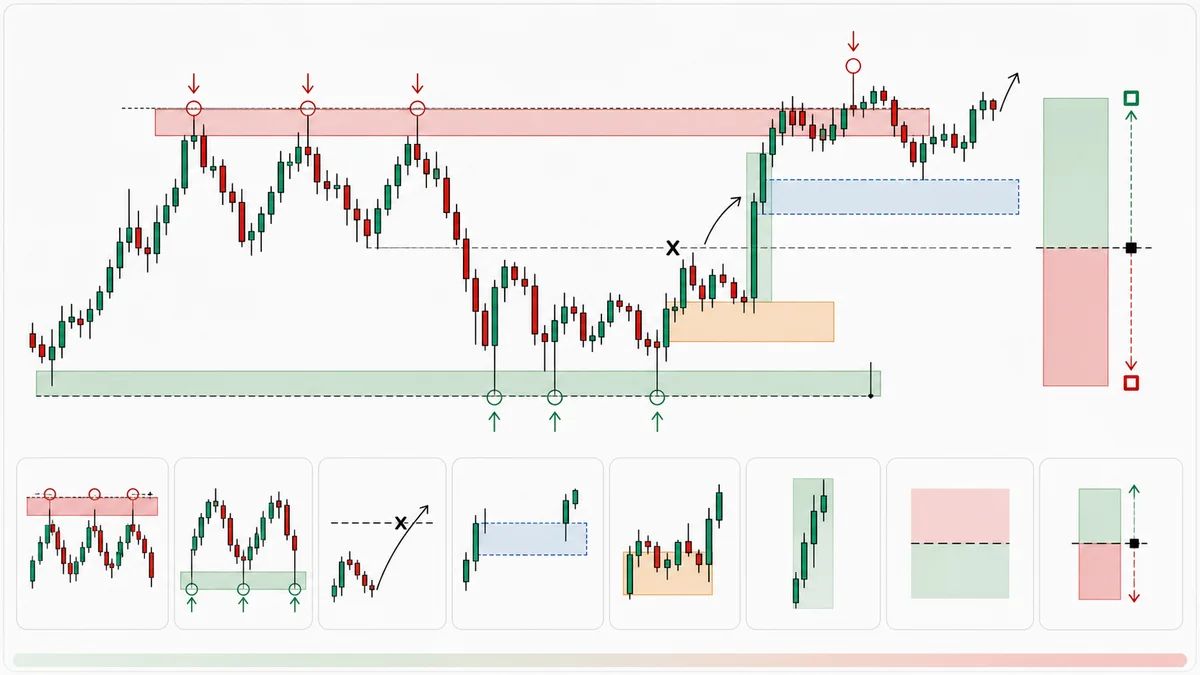
The six-step SMC review
- Context: record the instrument, session, timeframe and whether price is trending or ranging.
- External liquidity: mark obvious swing highs, swing lows, equal highs and equal lows that are visible before the move.
- Reaction: wait for a sweep, rejection or other event defined in your plan; do not label every wick a stop hunt.
- Displacement: look for a decisive close through a meaningful swing or range boundary, with follow-through.
- Entry zone: define the fair value gap or order block, the entry trigger and the exact invalidation point.
- Risk and review: calculate size, note scheduled news and record the outcome without editing the rules.
How to score a setup
Use a simple pass, fail or not-tested label for each condition. “Not tested” is not a pass. A setup may be technically interesting but still be a no-trade when the invalidation is too wide, liquidity is thin or the entry is late.
Common failure cases
- Calling a random high or low “liquidity” after the move has already happened.
- Using a small internal swing to justify a large higher-timeframe bias.
- Entering an order block without a displacement or close rule.
- Moving the invalidation because the narrative feels compelling.
- Assuming “smart money” is a proven explanation for every price movement.
A journal template
Save a chart before entry and write: context, target liquidity, trigger, entry zone, invalidation, expected cost, and the reason for standing aside if no trade is taken. Review a fixed sample rather than selecting only attractive screenshots.
Continue learning: the Smart Money Concepts hub, ICT market structure, the Fair Value Gap guide, liquidity sweeps, trading tools and the English learning hub.
FAQ
Does every SMC setup need an order block?
No. The required components depend on your tested model. Adding labels without a decision rule increases complexity, not evidence.
How many confirmations are enough?
There is no universal number. Use the smallest set of conditions that has a defined historical test and an understandable failure point.
Can a checklist guarantee consistency?
It can make process errors easier to spot, but execution, liquidity, costs and market regime can still change results.
Sources and further reading
- CFTC customer advisory on retail Forex risks
- CME Group technical-analysis education
- TradingView Help Center
Risk notice: This article is for education only. It is not investment advice, a trading signal or an invitation to trade. Trading can result in the loss of capital. Examples are hypothetical and past results do not guarantee future results.