


Displacement in SMC is not simply a very large green or red candle. This worksheet defines a test model using relative body/range, a pre-marked swing and follow-through. An FVG and tick volume are optional filters, not universal requirements for displacement. This worksheet uses a hypothetical EURUSD H1 sequence to separate a strong candle from a testable structure shift.
Example status: The prices, timestamps and tick-volume figures below are hypothetical teaching inputs, not verified historical market data or backtest results.
The figures use illustrative tick volume; one broker’s volume is not independent proof.
How displacement differs from a strong candle
A strong candle describes one bar’s size. Displacement describes its structural effect: price closes beyond a marked swing, leaves an imbalance and is not immediately pulled back into the range. If a large body is followed by a close back inside the range, it is rejection or a stop run—not confirmed displacement.
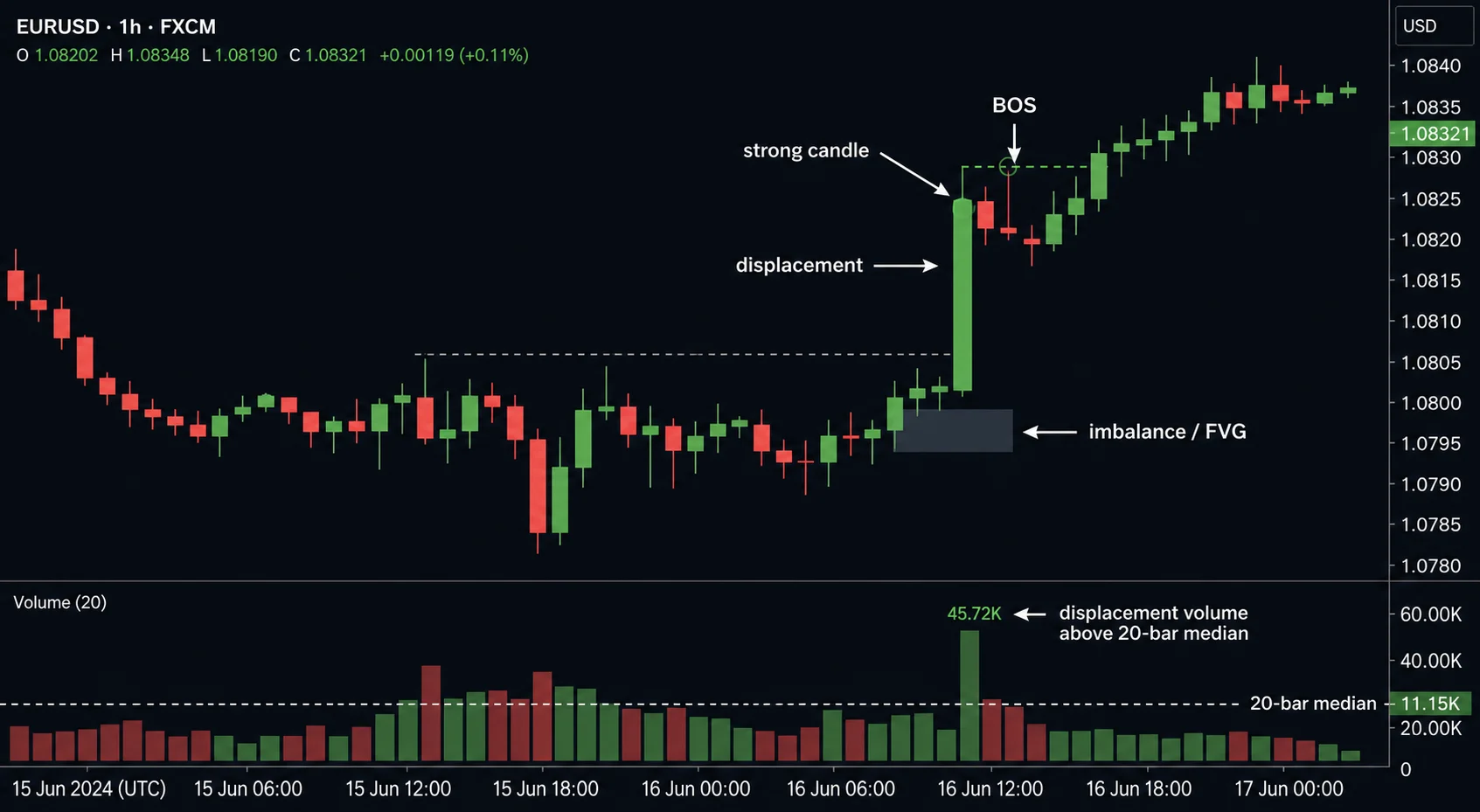
A six-condition test
| Condition | How to measure it | Illustrative example | If missing |
|---|---|---|---|
| Body/range | Compare with the 20-bar median | Body 0.00042; median 0.00016 | Large candle may be a spike |
| Close | Close beyond the marked swing | Close above 1.0832 | No confirmed BOS |
| Imbalance/FVG | Three-candle non-overlap area | FVG 1.0803–1.0811 | Less evidence of urgency |
| Volume | Compare with the same-session median | 18.4K versus 9.2K | Do not use a fixed threshold |
| Follow-through | Next 10 bars hold the break side | 7/10 closes above swing | False-break risk rises |
| Retest | FVG/level is defended | Retest does not close back in range | Do not chase |
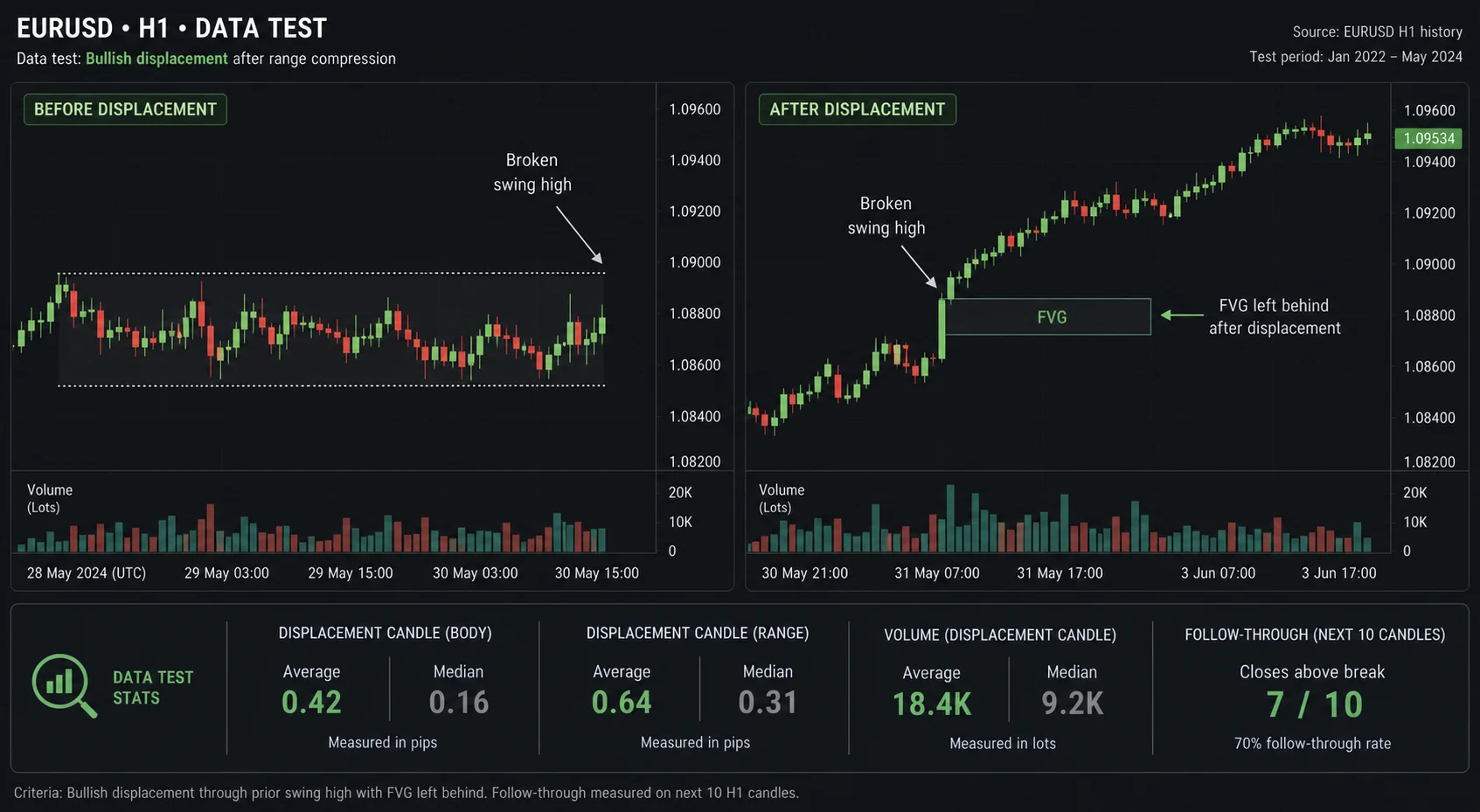
A before-and-after displacement example
In a hypothetical teaching scenario, EURUSD H1 compressed around 1.0790–1.0802. The 02:00 UTC candle closed at 1.0826, expanded beyond the local baseline and left a 1.0803–1.0811 FVG. The illustrated tick volume was 7.68K versus a nearby 20-bar median near 5K. Seven of the next ten candles closed above the 1.0802 swing. That is displacement with follow-through, not just a long candle.
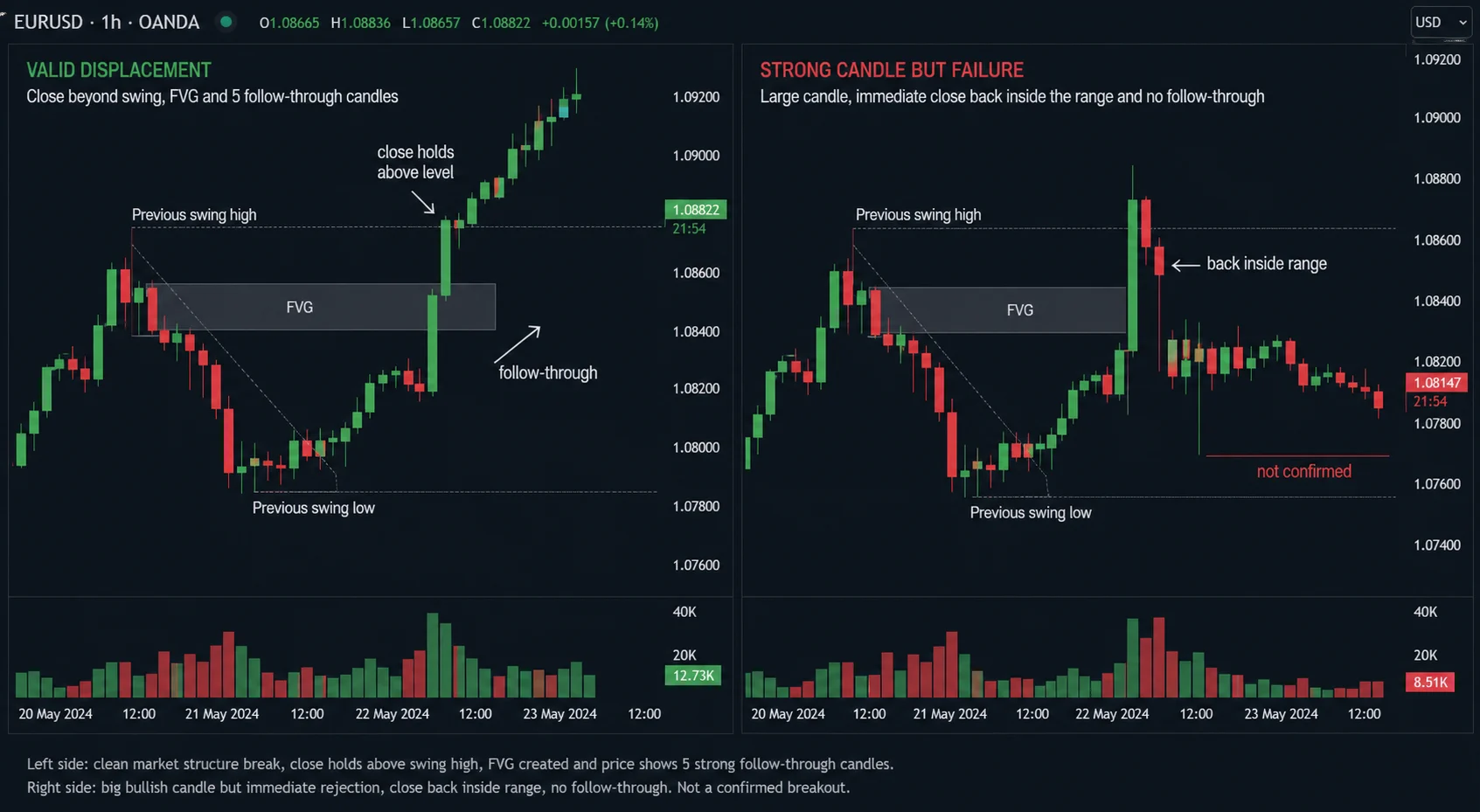
When not to label displacement
- A large bar appears around news but does not break a pre-marked swing.
- The break is only a wick and the next bar closes back inside the range.
- The FVG is completely filled immediately and no defended retest follows.
- Volume spikes while the candle is opposite the intended direction or spreads are abnormal.
For context, read ICT Market Structure and the companion MSS in SMC. Displacement is evidence about break quality, not a stand-alone entry trigger.
Frequently asked questions
Is high volume mandatory?
No. Volume is a supporting filter because tick volume varies by broker. Evaluate close, FVG and follow-through together.
How large must the body be?
There is no universal pip number. Compare it with the same-session 20-bar median or percentile and document the rule in your backtest.
Editorial note: Học Làm Trader Editorial Team. Educational content only, not investment advice; test your data and cap risk.
For the conceptual distinction, start with displacement versus a strong candle. This page focuses on recording and testing a six-condition example.