


Smart Money Concepts Smart Money Concepts (SMC) is practitioner terminology for reading liquidity, market structure, displacement and potential reaction zones on a price chart. A candle chart cannot prove who placed an order, so SMC labels should describe observable price behavior rather than claim knowledge of institutional intent. The method should be treated as a testable chart-reading framework rather than a forecast. Before using it, define the market condition, confirmation event, invalidation price, transaction costs and maximum risk. This guide explains the rules, a repeatable workflow, common failure modes and the most relevant supporting concepts.
Definition: What Are Smart Money Concepts?

Smart Money Concepts, often shortened to SMC, is a trading framework that focuses on how price may move toward liquidity, shift market structure, and react around areas where large participation may have influenced price. Traders who use SMC often study liquidity pools, stop runs, break of structure, change of character, order blocks, fair value gaps, premium and discount zones, and higher-timeframe context.
The phrase “smart money” generally refers to well-capitalized market participants such as institutions, banks, funds, market makers, and professional desks. However, retail traders should be careful with the term. You cannot truly see every institutional order on a normal candlestick chart. What you can see is price behavior: where stops may be resting, where price accelerates, where it rejects, where it leaves imbalance, and where structure changes.
That distinction matters. SMC is not about pretending you know the private intention of every large trader. It is about building a logical interpretation of price action. If price sweeps a previous high, quickly reverses, breaks short-term structure, and leaves a strong displacement leg, an SMC trader may read that as a possible liquidity grab followed by a shift in control. The trade idea is still a hypothesis, not a certainty.
At its best, Smart Money Concepts gives traders a clean sequence:
- Identify the higher-timeframe context.
- Mark obvious liquidity pools.
- Wait for a sweep, displacement, or structural shift.
- Find a logical reaction area such as an order block, fair value gap, or retracement zone.
- Plan entry, invalidation, and risk before taking the trade.
At its worst, SMC becomes a vocabulary trap. Traders mark every candle as an order block, every gap as a fair value gap, every wick as liquidity, and every small move as confirmation. That creates confusion. Beginners should treat SMC as a structured way to read price, not as a magic language that makes every chart predictable.
If you are completely new to technical analysis, it helps to first understand basic price action trading. Smart Money Concepts builds on market structure, support and resistance, candle behavior, and risk management. Without that foundation, advanced SMC terms often become noise.
Why Smart Money Concepts Matter

Smart Money Concepts matters because it pushes traders to ask a deeper question: where is price likely trying to go before the next meaningful move? Many beginners only ask whether price will go up or down. SMC traders often start by asking where liquidity sits and what price may need to do before a move becomes cleaner.
Liquidity is central because markets need orders to move. Stop losses, breakout orders, resting limit orders, and clustered positions can create areas of interest. Previous highs and lows are obvious examples. A high may attract breakout buyers and hold stop losses from short sellers. A low may attract breakout sellers and hold stop losses from long traders. When price moves through these areas and then reverses, SMC traders may interpret it as a liquidity sweep.
This perspective can help beginners avoid one of the most common traps: entering exactly where many other traders are entering. A breakout above an obvious high may be real, but it may also be a trap. A breakdown below an obvious low may continue, but it may also reverse sharply after collecting liquidity. SMC does not tell you which outcome is guaranteed. It teaches you to wait for more evidence.
SMC also matters because it connects entries to context. A fair value gap in the middle of a messy range is not the same as a fair value gap after a clean liquidity sweep and strong displacement. An order block inside a weak, sideways market is not the same as an order block that forms near a higher-timeframe discount area after structure shifts. Location changes quality.
The framework also helps with risk. A good SMC setup should have a logical invalidation point. If a long idea depends on a bullish displacement and demand area holding, then a clean break below that area may invalidate the idea. If a short idea depends on price rejecting a premium area after sweeping buy-side liquidity, then a strong continuation above that sweep area may invalidate it. This is more disciplined than entering because a box looks good.
Another reason SMC matters is that it can improve patience. Many traders lose money because they react to every candle. Smart Money Concepts encourages a sequence: context first, liquidity next, confirmation after that, entry last. When used well, that sequence filters out low-quality trades.
Still, it is important to keep expectations realistic. SMC does not make trading easy. It can be subjective, and different traders may mark different zones on the same chart. A concept can be valid and still fail. Risk management remains non-negotiable. Educational resources from regulators such as the CFTC remind traders to be cautious of claims involving guaranteed returns or low-risk trading systems. Smart Money Concepts should never be treated as a guarantee.
Core Concepts Every Beginner Should Learn First
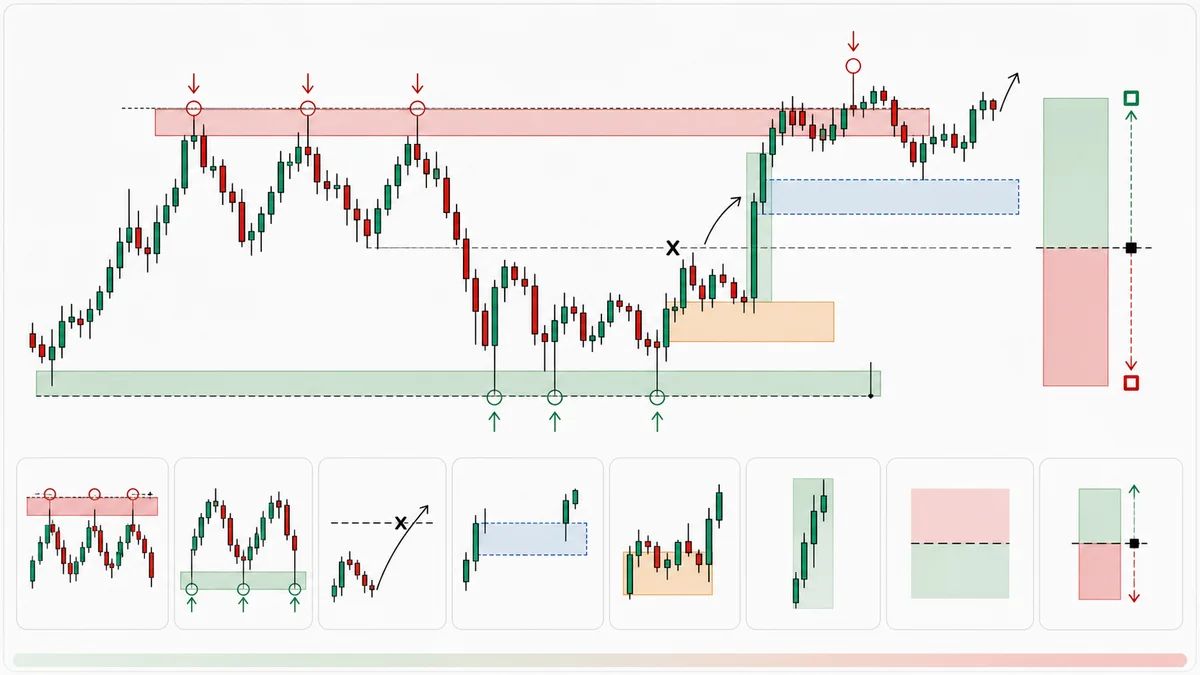
Beginners should not start Smart Money Concepts by collecting every advanced term. Start with the ideas that make the rest of the framework easier to understand.
Liquidity
Liquidity refers to areas where orders may be clustered. In chart reading, traders often look at previous swing highs, swing lows, equal highs, equal lows, range boundaries, session highs and lows, and obvious breakout points. These areas can attract stops and breakout entries. SMC traders often expect price to move toward liquidity before a larger move develops.
There are two common categories: buy-side liquidity and sell-side liquidity. Buy-side liquidity often sits above highs, where buy stops and breakout buys may be waiting. Sell-side liquidity often sits below lows, where sell stops and breakdown sells may be waiting. Price may take liquidity and continue, or take liquidity and reverse. The reaction after the sweep is critical.
Market Structure
Market structure describes the sequence of highs and lows. In an uptrend, price generally forms higher highs and higher lows. In a downtrend, price generally forms lower highs and lower lows. When price breaks meaningful structure, it may signal continuation or a possible shift.
SMC uses terms such as Break of Structure and Change of Character. A Break of Structure often confirms continuation in the direction of the trend. A Change of Character may suggest that the previous rhythm is weakening and a new direction may be developing. Beginners should not treat every tiny break as important. Focus on clear swings and meaningful context.
Displacement
Displacement is a strong, decisive price move. It often appears as large candles moving quickly away from a level or through structure. Displacement matters because it can show urgency, imbalance, or a sudden shift in control. A weak move through structure is less convincing than a clean displacement leg.
Many SMC setups rely on displacement before looking for an entry zone. For example, price may sweep a high, reverse strongly, and displace below a short-term low. That displacement can become evidence that sellers have taken control, at least temporarily.
Fair Value Gap
A Fair Value Gap, often called FVG, is an imbalance area created when price moves quickly and leaves a gap-like inefficiency between candles. Traders often watch these areas because price may later return to rebalance or mitigate the move. Not every FVG is tradable. Quality depends on context, displacement, higher-timeframe direction, and nearby liquidity.
Order Block
An order block is commonly described as the last opposing candle or zone before a strong displacement move. Traders may use it as a potential reaction area when price returns. The idea is that significant participation may have occurred around that zone before price moved away.
Beginners often mark too many order blocks. A useful order block usually has strong context: it appears before meaningful displacement, relates to structure, sits in a logical premium or discount area, and offers clear invalidation.
Premium and Discount
Premium and discount help traders judge whether price is relatively expensive or cheap inside a selected dealing range. In a bullish context, traders often prefer looking for longs in discount areas. In a bearish context, traders often prefer looking for shorts in premium areas. This does not guarantee success, but it helps avoid buying too high or selling too low.
Invalidation
Every Smart Money Concepts setup needs invalidation. If you cannot explain where your idea is wrong, you do not have a complete plan. Invalidation may be beyond a sweep high, below an order block, through a fair value gap, or past a structural level. The exact location depends on the model, but the principle is the same: risk must be defined before entry.
Main Subcategories of Smart Money Concepts

Smart Money Concepts is not one single setup. It is a family of related ideas. Understanding the main subcategories helps beginners organize their study.
Liquidity Sweep Trading
Liquidity sweep trading focuses on price moving beyond an obvious high or low, triggering orders, and then reacting. A bullish example may involve price sweeping a previous low, rejecting strongly, and breaking short-term structure to the upside. A bearish example may involve price sweeping a previous high, rejecting strongly, and breaking short-term structure to the downside.
The sweep alone is not enough. Price can sweep liquidity and continue in the same direction. Beginners should look for reaction, displacement, and structure confirmation before planning a trade.
Order Block Trading
Order block trading uses zones that appear before strong movement. A bullish order block may be a down candle or demand area before price rallies. A bearish order block may be an up candle or supply area before price sells off. Traders watch for price to return to these areas and react.
The key is selectivity. An order block near a strong liquidity event and displacement leg is more meaningful than a random candle in the middle of a range. The cleaner the context, the easier it is for beginners to review the setup.
Fair Value Gap Trading
Fair Value Gap trading focuses on imbalance areas created by strong displacement. Traders may wait for price to retrace into the gap and then look for continuation. This style can create precise entries, but it can also lead to overtrading because gaps appear frequently.
A beginner should ask: what created the gap, where is it located, what liquidity was taken before it formed, and what structure supports the idea?
Break of Structure and Change of Character
Structure-based SMC trading uses breaks of important swings to identify continuation or transition. A Break of Structure can confirm that the trend is still active. A Change of Character can suggest that the previous direction is weakening. These ideas are useful, but only when applied to meaningful swings.
Premium and Discount Trading
This subcategory uses a dealing range to divide price into premium, equilibrium, and discount. In bullish scenarios, discount areas may offer better long opportunities. In bearish scenarios, premium areas may offer better short opportunities. This helps traders avoid poor location.
Session and Killzone Models
Some SMC traders focus on specific sessions, such as London or New York, and study how liquidity forms around session highs, lows, and opening ranges. This can be useful, especially in forex and indices, but it requires discipline. Session timing does not replace structure or risk management.
A Beginner Workflow for Reading Smart Money Setups

The easiest way to make Smart Money Concepts practical is to follow a repeatable workflow. Without a workflow, traders jump from concept to concept and convince themselves that every chart contains a fully specified setup.
Step 1: Start With Higher-Timeframe Bias
Begin with the higher timeframe. If you plan trades on a 15-minute chart, study the 4-hour and daily charts first. If you plan trades on a 1-hour chart, study the daily and weekly charts first. Ask whether price is bullish, bearish, ranging, or near a major decision area.
This step prevents you from taking a lower-timeframe setup directly into a higher-timeframe obstacle. A beautiful bullish FVG on a small timeframe may be low quality if price is pressing into major resistance.
Step 2: Mark Obvious Liquidity
Mark the clearest highs and lows. Look for equal highs, equal lows, previous session extremes, range boundaries, and swing points that many traders can see. Keep this simple. If you mark every tiny wick, your chart becomes useless.
Step 3: Wait for a Liquidity Event or Structural Clue
Do not assume price will reverse at liquidity. Wait for a clue. This may be a sweep and rejection, a strong displacement candle, a change of character, or a break of short-term structure. The goal is to avoid entering just because price touched a level.
Step 4: Identify the Reaction Area
After displacement, look for the area price may return to: an order block, fair value gap, breaker area, or premium/discount zone. This is where many SMC traders plan entries. The area should make sense relative to the liquidity event and structure shift.
Step 5: Define Invalidation and Position Size
Before entry, define where the idea fails. Invalidation may be beyond the swept high, below the swept low, beyond the order block, or past the structural point that supports the trade. Then calculate position size based on your risk limit. A precise entry is dangerous if position size is uncontrolled.
Step 6: Manage the Trade Based on Structure
Once in a trade, avoid reacting to every candle. Decide in advance how you will manage partial profits, stop movement, and target areas. Many SMC traders use opposing liquidity as a target. For example, after a bullish reversal from sell-side liquidity, buy-side liquidity above the range may become a logical target.
Step 7: Journal the Setup
Save screenshots before, during, and after the trade. Record the higher-timeframe bias, liquidity area, sweep, displacement, entry zone, invalidation, result, and emotional state. Over time, your journal will show which SMC models you actually execute well.
Common Smart Money Concepts Mistakes
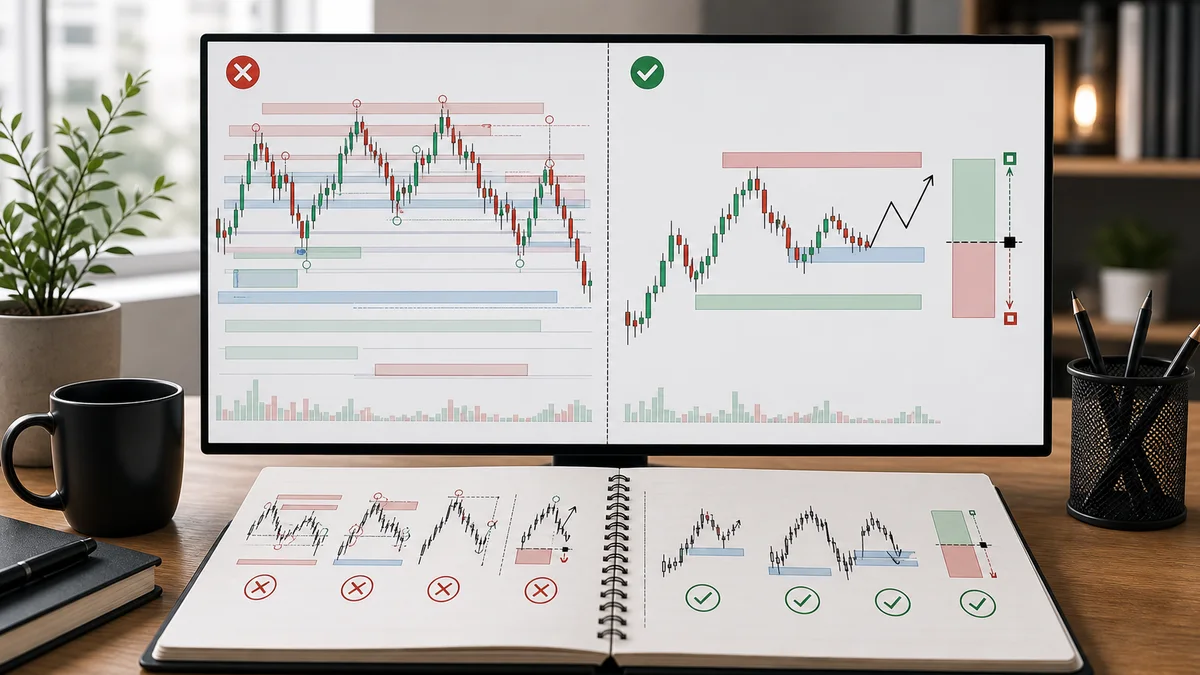
Smart Money Concepts can be powerful, but it can also become messy very quickly. These are the mistakes beginners should avoid first.
Mistake 1: Marking Every Candle as an Order Block
Not every candle before a move is an important order block. If you mark too many zones, price will always appear to react somewhere. This creates false confidence. A quality order block should have context, displacement, structure, and a logical risk point.
Mistake 2: Trading Every Fair Value Gap
Fair Value Gaps appear often. Many are low quality. A gap that forms in the middle of chop may not matter. A gap that forms after a liquidity sweep and strong break of structure may be more meaningful. Beginners should filter FVGs by context, not trade them automatically.
Mistake 3: Treating Liquidity Sweeps as Guaranteed Reversals
A sweep can lead to reversal, but it can also lead to continuation. Price may take liquidity and keep moving because the breakout is real. The reaction after the sweep is what matters. Wait for displacement or structure confirmation instead of entering blindly.
Mistake 4: Ignoring Higher-Timeframe Direction
Lower-timeframe SMC setups can look perfect while going against a dominant higher-timeframe move. Countertrend trades require more caution. Beginners should first learn to align lower-timeframe entries with higher-timeframe context.
Mistake 5: Using Tiny Timeframes Too Early
SMC content often shows precise entries on very small timeframes. That can look attractive, but tiny timeframes are noisy. Spreads, commissions, execution speed, and emotional pressure become more important. Beginners usually learn better on higher timeframes where structure is clearer.
Mistake 6: Forgetting Basic Price Action
SMC is built on price action. If you cannot read trend, range, support, resistance, and candle behavior, SMC terminology will not help. A liquidity sweep still needs market context. An order block still needs structure. A fair value gap still needs location.
Mistake 7: Risking Too Much Because the Setup Looks Precise
Precision can be dangerous. A tight stop may create a high reward-to-risk ratio, but it can also get hit easily. A setup that looks institutional can still fail. Risk should be based on your account plan, not on confidence in one model.
Next Learning Path for Smart Money Traders

If you are new to Smart Money Concepts, learn in layers. Do not start with the most advanced entry model. Build the foundation first.
Start with basic price action. Learn how trends, ranges, support, resistance, swing highs, swing lows, and candle behavior work. This foundation makes every SMC concept easier. The Price Action Trading beginner guide should be the first internal pillar to connect with this page.
Next, study liquidity. Spend time marking obvious highs and lows, equal highs and lows, and session extremes. Watch how price behaves around these areas. Do not trade yet. Just observe whether price sweeps, rejects, continues, or consolidates.
After liquidity, learn market structure. Identify Break of Structure and Change of Character using meaningful swings. Avoid tiny noise. Your goal is to understand when price is continuing, weakening, or transitioning.
Then study displacement. Look for strong moves that break structure and leave imbalance. Compare clean displacement with weak movement. This helps you avoid treating every small break as confirmation.
Once those ideas are clear, learn Fair Value Gaps and order blocks. Do not trade every zone. Study which ones work best after liquidity events and structural shifts. Track examples in a journal.
After that, add premium and discount. Learn to place setups inside a dealing range so you are not buying too high or selling too low. This gives your entries better location.
Finally, build one simple model. For example: higher-timeframe bias, liquidity sweep, displacement, retracement into FVG or order block, clear invalidation, target opposing liquidity. Practice that model repeatedly before adding another. Consistency beats complexity.
As the English Smart Money category grows, this hub should link to deeper cluster articles on liquidity sweeps, BOS and CHoCH, order blocks, fair value gaps, premium and discount, session models, trade journaling, and risk management. Every cluster should also link back to this hub so the category has a strong internal structure.
Smart Money Concepts is useful when it improves clarity. It becomes harmful when it turns every candle into a theory. Keep the chart clean, wait for context, respect invalidation, and review your trades. The trader who understands a few concepts deeply will usually progress faster than the trader who memorizes every acronym without a process.
Within the imbalance branch of SMC, the fair value gap validation guide defines the three-candle condition, partial-fill outcomes and failure rules without treating every gap as an entry.
Within the SMC liquidity branch, the liquidity sweep guide explains why trading beyond a high or low is not automatically a reversal.
Key takeaways
- Smart Money Concepts (SMC) is practitioner terminology for reading liquidity, market structure, displacement and potential reaction zones on a price chart.
- A candle chart cannot prove who placed an order, so SMC labels should describe observable price behavior rather than claim knowledge of institutional intent.
- Start with structure, mark a location, wait for an observable trigger and define the price that invalidates the idea.
- A valid plan separates location, trigger, invalidation, position size and exit logic.
A validation workflow you can reproduce
- Define the sample: choose the market, timeframe, session and date range before reviewing outcomes.
- Write the rule: Start with structure, mark a location, wait for an observable trigger and define the price that invalidates the idea.
- Record invalidation: identify the observable price event that disproves the setup.
- Include execution costs: account for spread, commission and slippage where relevant.
- Validate separately: test the finished rule on data that was not used to create it.
When this concept is unreliable
SMC becomes unreliable when every wick is labelled a liquidity hunt or every opposing candle is treated as an order block after the outcome is known. Keep failed and skipped examples in the journal so the review is not limited to attractive winners.
Use this concept within a complete analysis
This method should remain connected to its parent framework and adjacent decision steps. Use ICT Market Structure Explained, ICT Trading: Complete Beginner Guide, Liquidity in Trading: Complete Guide, Point of Interest in Trading: Complete Guide, Order Block Trading: How to Find High-Probability POIs and Breaker Block Trading Guide to compare definitions, establish context and avoid treating one signal as a complete trading system.
References and methodology
Terminology note: SMC, ICT and MSNR terms are practitioner conventions, not standardized exchange or regulatory definitions. This article defines the convention it uses and avoids inferring participant identity from candles alone.
Practise before considering real capital
Use historical charts or a demo account to test the written rules before considering live execution. Review the Exness account and demo information. Availability, protections and trading conditions depend on jurisdiction, so review the applicable legal documents yourself.
Affiliate disclosure: Học Làm Trader may receive a commission if you open an account through this link, at no additional cost to you. This relationship does not determine the educational conclusions.
Risk warning: This article is for education and general information only. It is not investment advice, a trade signal or an invitation to trade. Trading can result in loss of capital, and past examples do not guarantee future results. Assess your own circumstances and risk tolerance.
To turn concepts into a repeatable reading process, continue with Inducement in SMC/ICT: Confirmation and Failure; SMC Trading Checklist for Beginners: A Repeatable Process; SMC on XAUUSD: How to Read Liquidity and Displacement on Gold; Displacement vs a Strong Candle: How to Confirm a Real Structure Shift; MSS in SMC: How It Differs from BOS and CHOCH.