


Forward testing trading means running a frozen rule set on new, unseen market data after the backtest period. It can expose execution friction, timing errors and behavioral deviations that historical testing misses. Forward testing is a validation step, not proof of future profitability or a reason to increase risk automatically.
Where forward testing fits in the research process
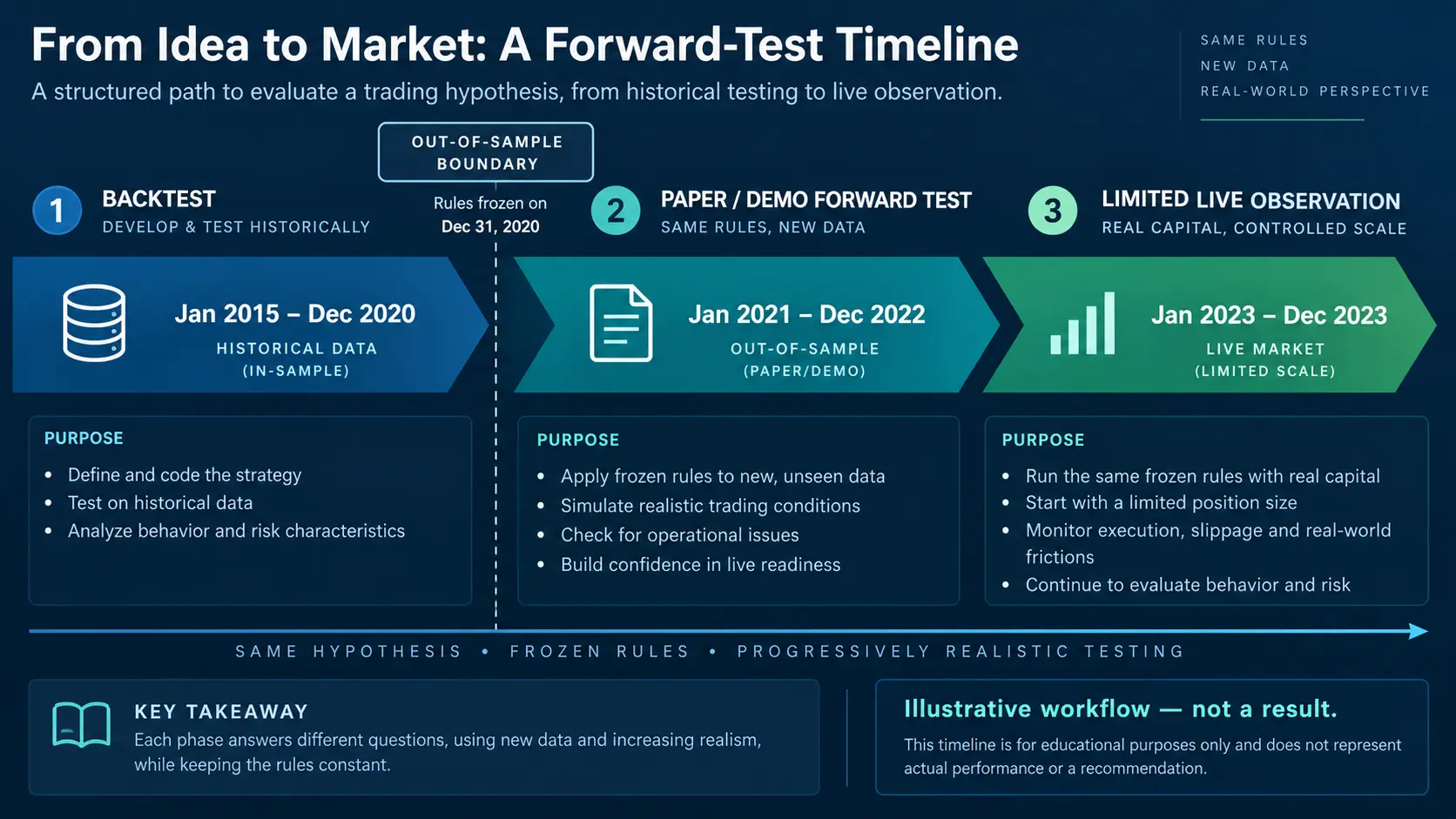
Write the hypothesis, eligible setup, entry/exit rules, costs, risk limit and review date before the test starts. A forward period should use data that was not used to tune the rules. Demo or paper execution can reveal platform behavior, while live size introduces additional financial risk and should not be assumed equivalent.
Mark the out-of-sample boundary on the chart
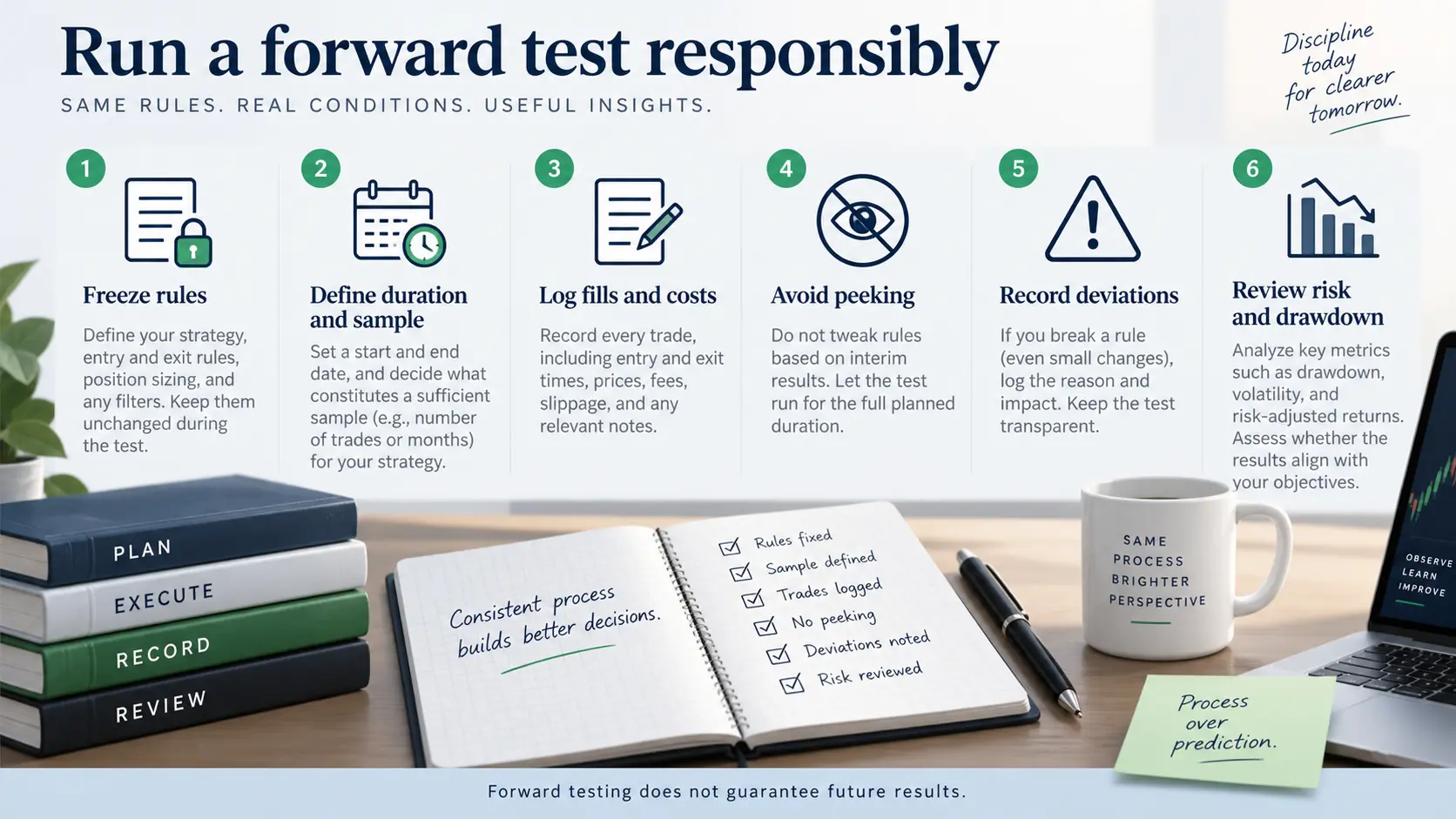
The boundary is a governance control: do not move it after seeing an unfavorable result. Log the timestamp, quote, spread, order status, slippage, missed trades and any manual intervention. If the platform cannot provide a reliable record, state the limitation instead of filling gaps from memory.
Backtest and forward test answer different questions
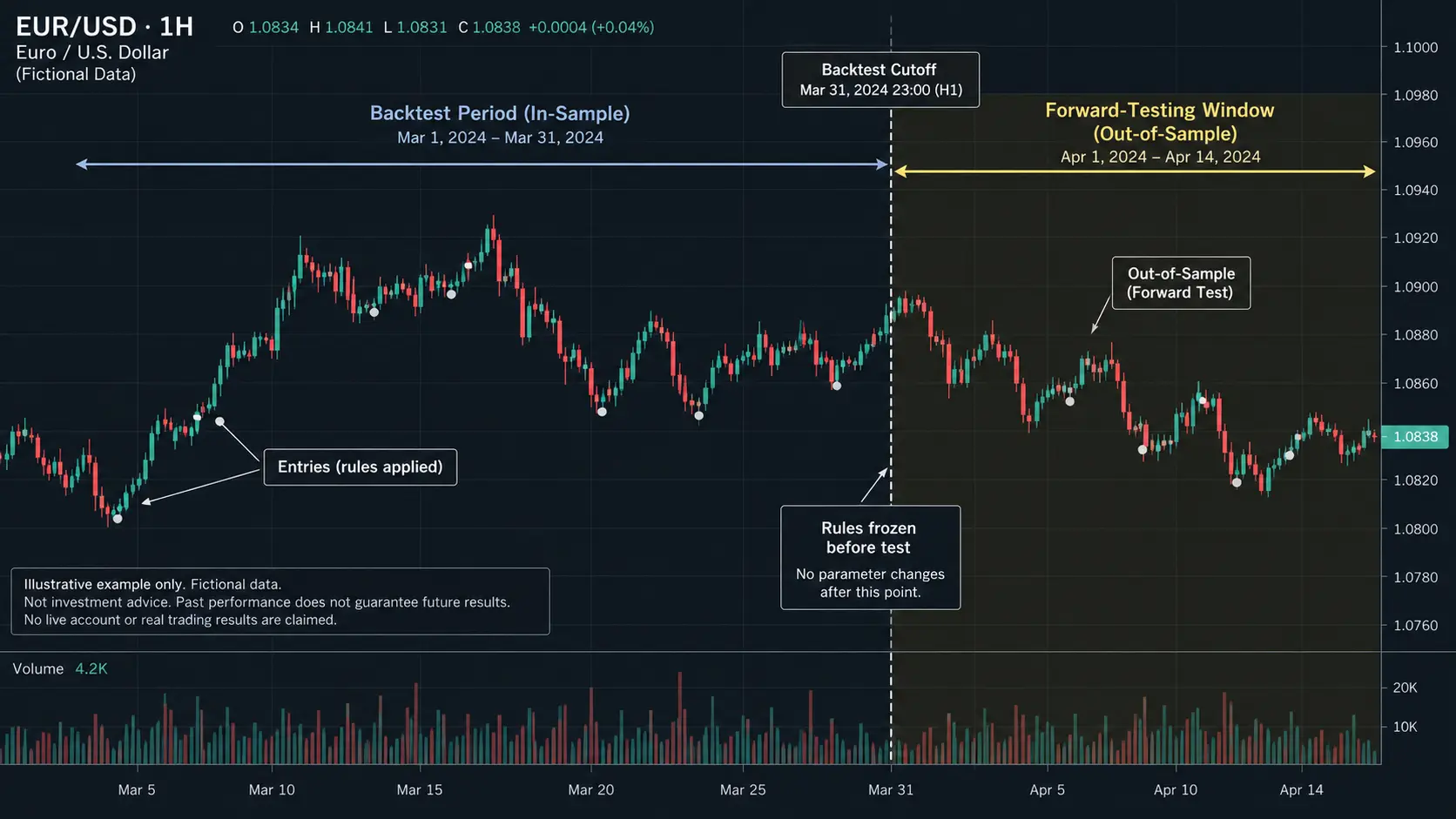
| Dimension | Backtest | Forward test |
|---|---|---|
| Data | Historical bars/ticks | New observations after cutoff |
| Rule changes | Can be iterated before freeze | Should be prohibited or logged |
| Execution | Modeled assumptions | Observed platform friction |
| Main risk | Look-ahead and selection bias | Small sample and behavior drift |
Pair the result with risk–reward planning and position sizing. A forward test can falsify an operational assumption; it does not turn an unverified strategy into a recommendation.
Run a forward test responsibly
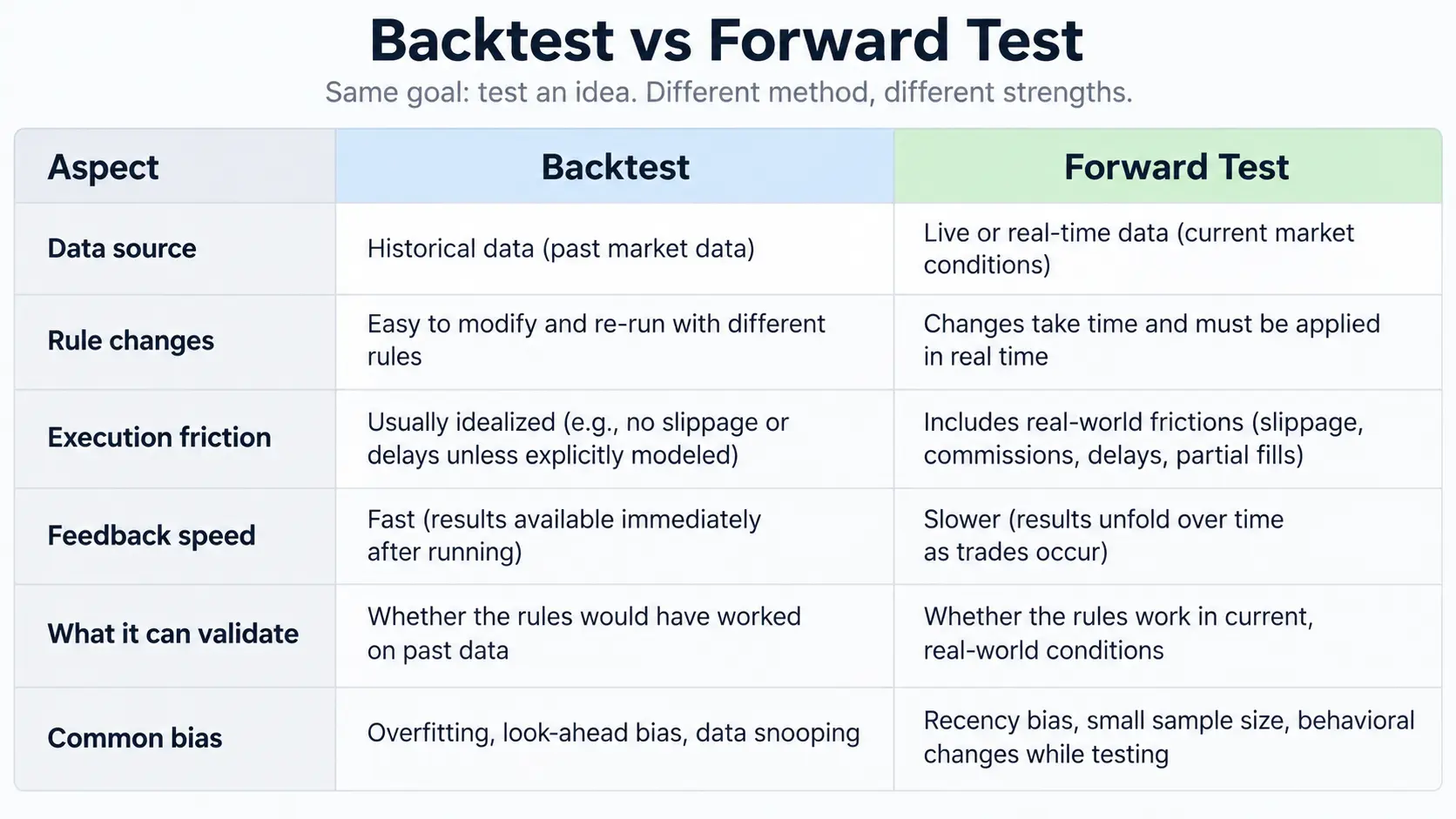
- choose a duration and minimum sample before starting;
- freeze parameters and record every exception or discretionary override;
- log fills, spread, commission, swap, slippage and missed signals;
- review results only at scheduled checkpoints, not after every trade;
- stop if data quality, platform behavior or risk limits become invalid.
Failure cases and interpretation
- changing rules after each loss turns a test into another in-sample exercise;
- a calm market window may not represent other regimes;
- demo fills may differ from live liquidity and latency;
- a short test cannot estimate long-run drawdown or tail risk.
A worked forward-testing protocol
Before starting, write the version of the rules, the symbol list, eligible sessions, maximum risk per trade, minimum duration and review date. During the test, record every signal—including skipped or missed trades—together with the quote, spread, fill, commission, swap, slippage and reason for any manual intervention. Do not move the start date after seeing an unfavorable sequence.
At the checkpoint, compare the out-of-sample observations with the backtest descriptively: rule adherence, execution friction, trade frequency, drawdown path and data quality. A difference is a prompt to investigate, not permission to tune until the result looks familiar. If the platform, data feed or risk limit changes, close the test and start a new version.
When to stop or restart the test
Stop when the data becomes unavailable, the account entity or instrument changes materially, the written rules are changed, or the observed risk exceeds the pre-defined limit. Document the reason and preserve the raw log. A short, transparent test is more useful than a long test whose rules changed silently.
Risk note: This is educational content, not investment advice. Forward testing and leveraged trading involve risk; keep exposure small and verify conditions for your jurisdiction.
Pingback: RSI Divergence: Regular Vs Hidden Signals Explained