


Wyckoff Ice is a conceptual support boundary beneath a distribution or trading range. A Fall Through the Ice (FTI) is a decisive move below that boundary, and a retest from underneath tests whether former support is now accepted as resistance. These labels organize observations; they do not guarantee a markdown or prescribe a short trade.
What is the Wyckoff Ice?
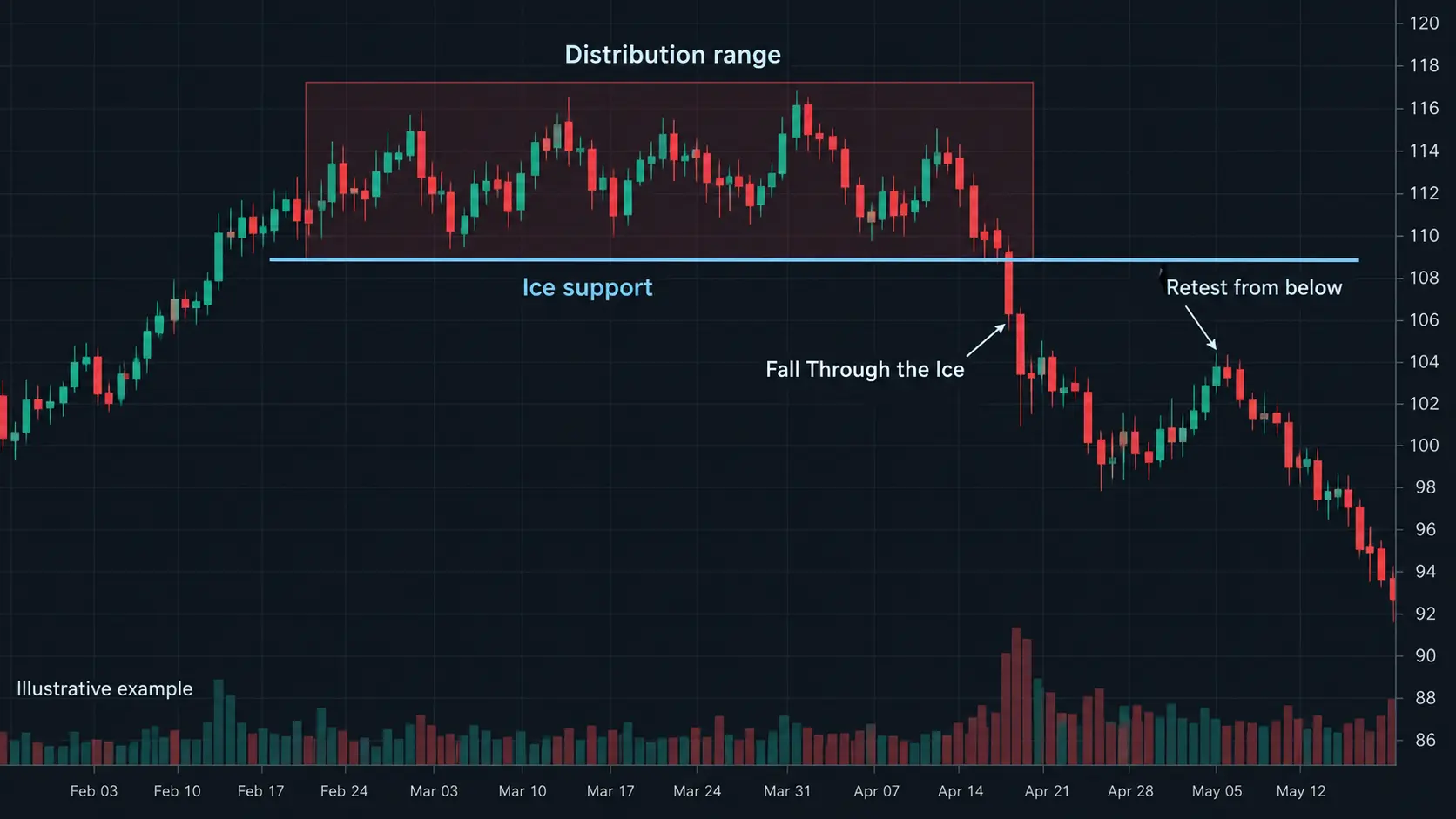
The “ice” metaphor refers to support that has held repeated tests while supply and demand balance inside a range. Treat it as a zone built from swing lows, closing prices and failed breakdowns—not an exact tick. Define the range and timeframe before deciding whether a boundary deserves the label.
FTI, acceptance and the retest from below
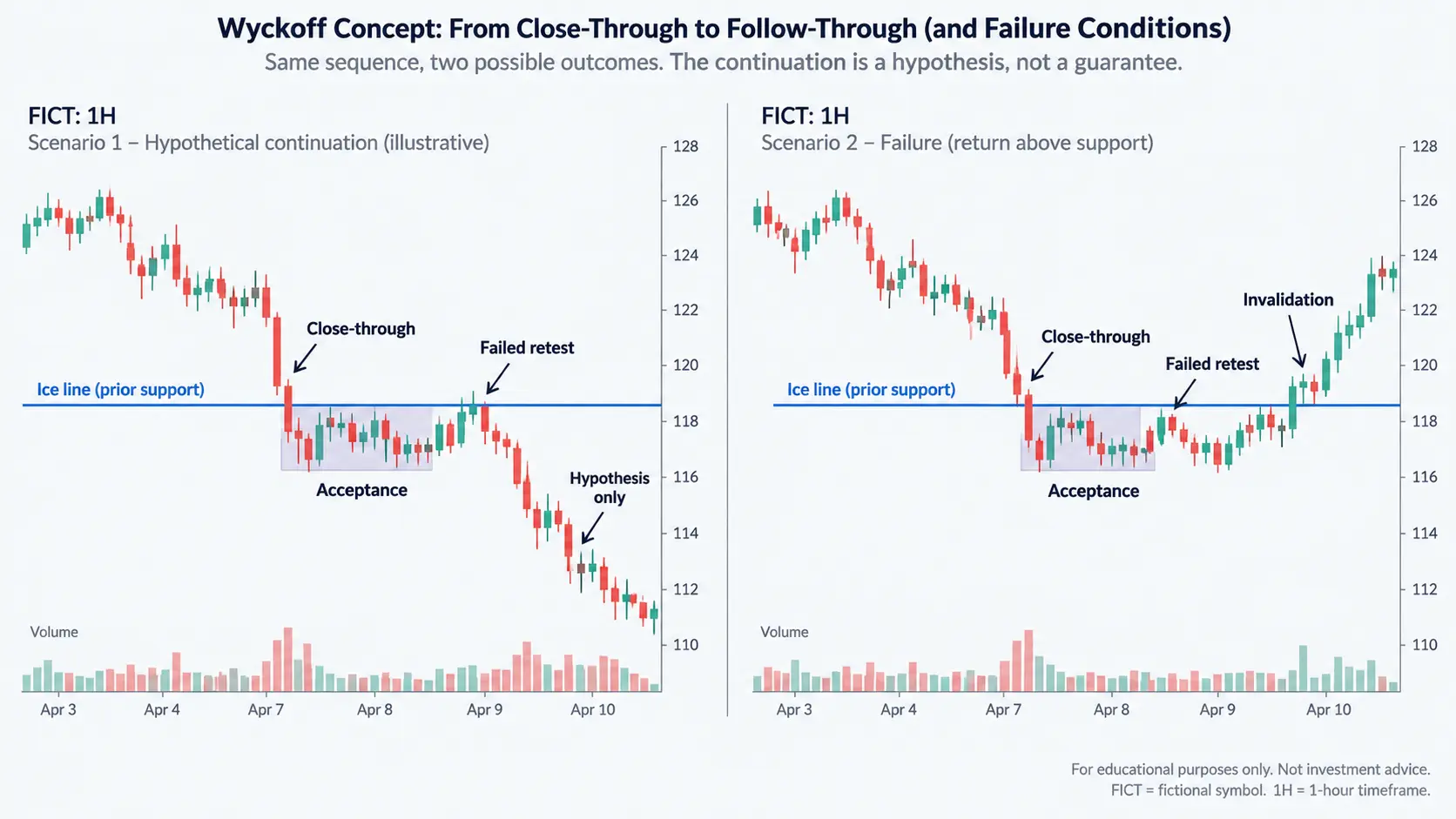
Sequence to observe
- a close-through below the ice with a spread and context that can be described;
- some evidence of acceptance below, rather than an isolated wick;
- a retest from underneath that stalls below the former support zone;
- a failure condition such as a close back above the zone or renewed acceptance inside the range;
- the instrument, timeframe, date range and data source for every chart example.
The Wyckoff Method overview explains how events fit inside a larger phase hypothesis. An FTI without a documented range is simply a downside break; a retest that closes back above the ice weakens the bearish interpretation.
Creek versus Ice: same metaphor, opposite boundary
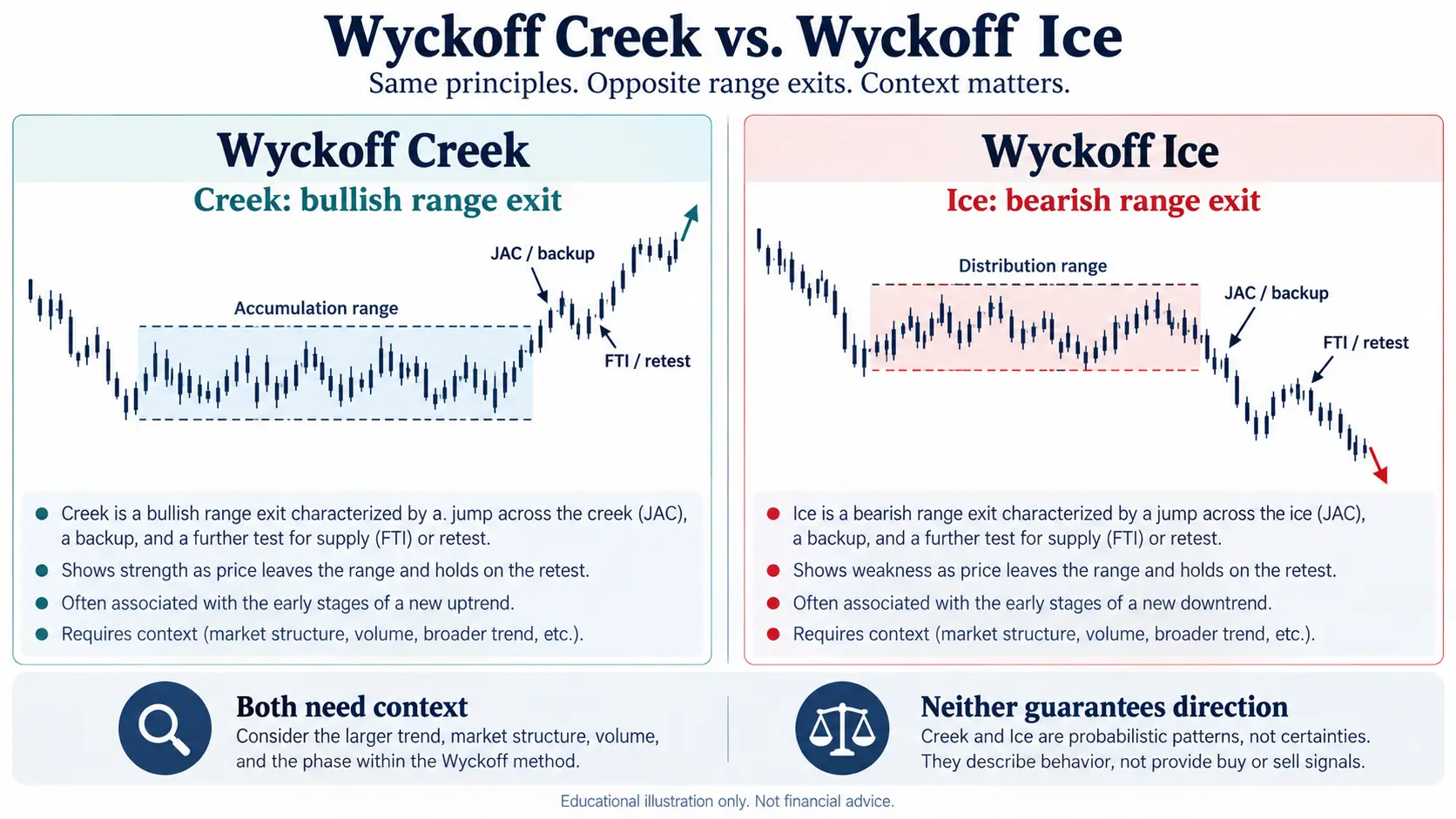
| Dimension | Creek | Ice |
|---|---|---|
| Boundary | Resistance across a range | Support across a range |
| Event label | Jump Across the Creek (JAC) | Fall Through the Ice (FTI) |
| Follow-up test | Backup from above | Retest from below |
| Failure observation | Close back inside or below the range | Close back above or inside the range |
Both metaphors require a defined range, a timeframe and a falsifiable hypothesis. For demand/supply context, review Wyckoff accumulation and Upthrust/UTAD failure cases; use the latter as a contrast, not as proof that every range is distribution.
A due-diligence checklist for Wyckoff Ice
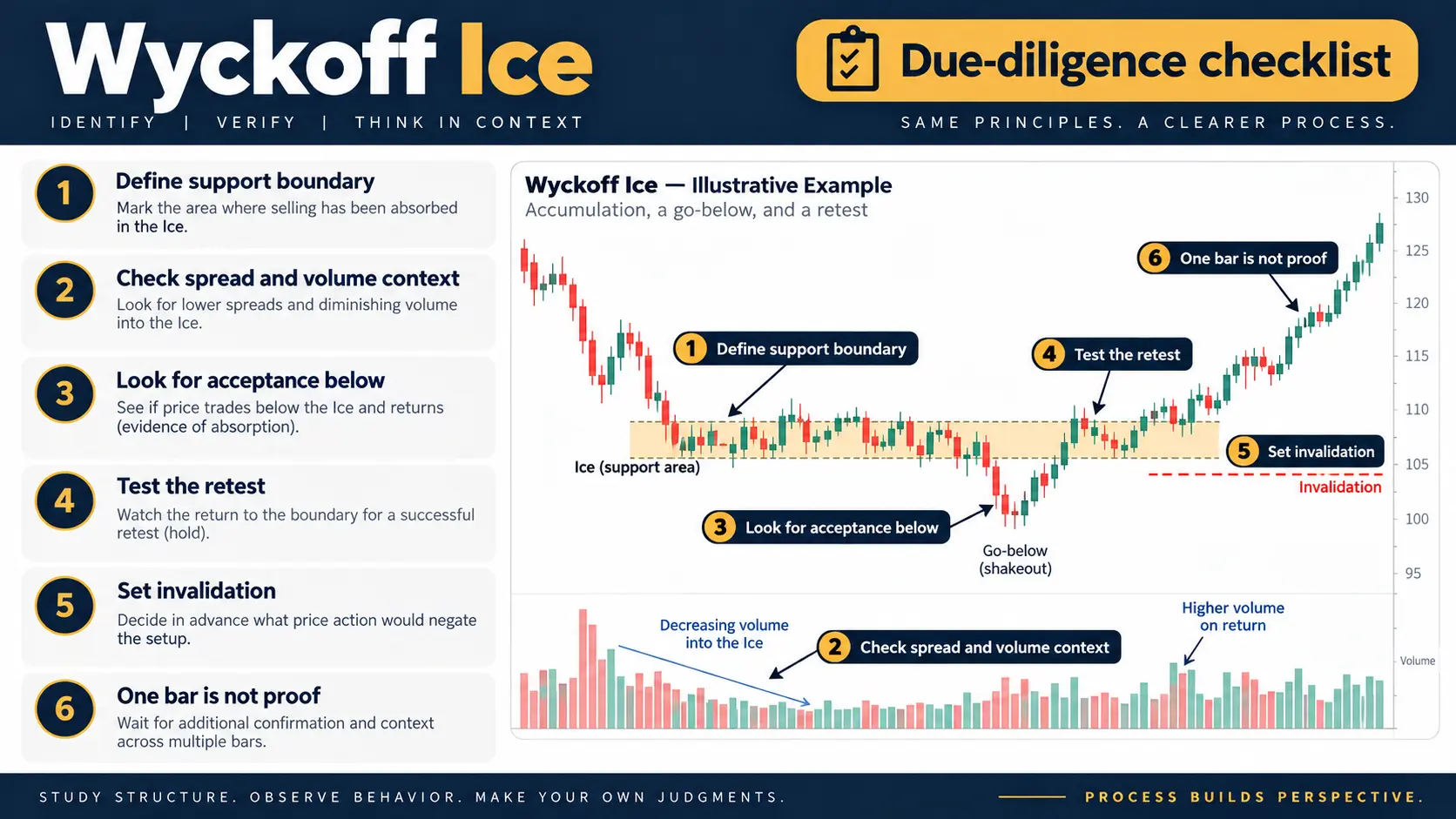
- define the support zone from repeated tests and closes;
- check spread, volume source and session context around the close-through;
- look for acceptance below over more than one observation when data allows;
- evaluate whether the retest holds below the zone or re-enters the range;
- write invalidation, costs and position-risk limits before any hypothetical plan.
Failure cases and data limits
- a sharp news move can break support without representing a durable supply shift;
- low-liquidity sessions can exaggerate wicks and make acceptance ambiguous;
- tick volume in spot Forex is not centralized exchange volume;
- phase/event labels are interpretive and can be revised with new information;
- a single timeframe or chart cannot establish a general probability of continuation.
If you are testing a hypothesis, combine it with Spring/Test failure logic and risk–reward planning. Do not convert a visual label into a guaranteed target, win rate or trading instruction.
Key takeaways
- Ice is a support zone under a range, not one exact price;
- FTI requires a close-through and context; a wick alone is insufficient;
- acceptance and the retest help test the breakdown hypothesis;
- Creek and Ice are complementary metaphors with symmetric failure conditions;
- data coverage, costs and risk limits matter as much as the label.
Risk note: This is educational content, not investment advice. A breakdown can fail and leveraged trading can cause losses. Verify data and manage risk for your circumstances.
Pingback: Wyckoff Spring And Test: Validation Guide
Pingback: Wyckoff Method: Phases, Events And Market Context