


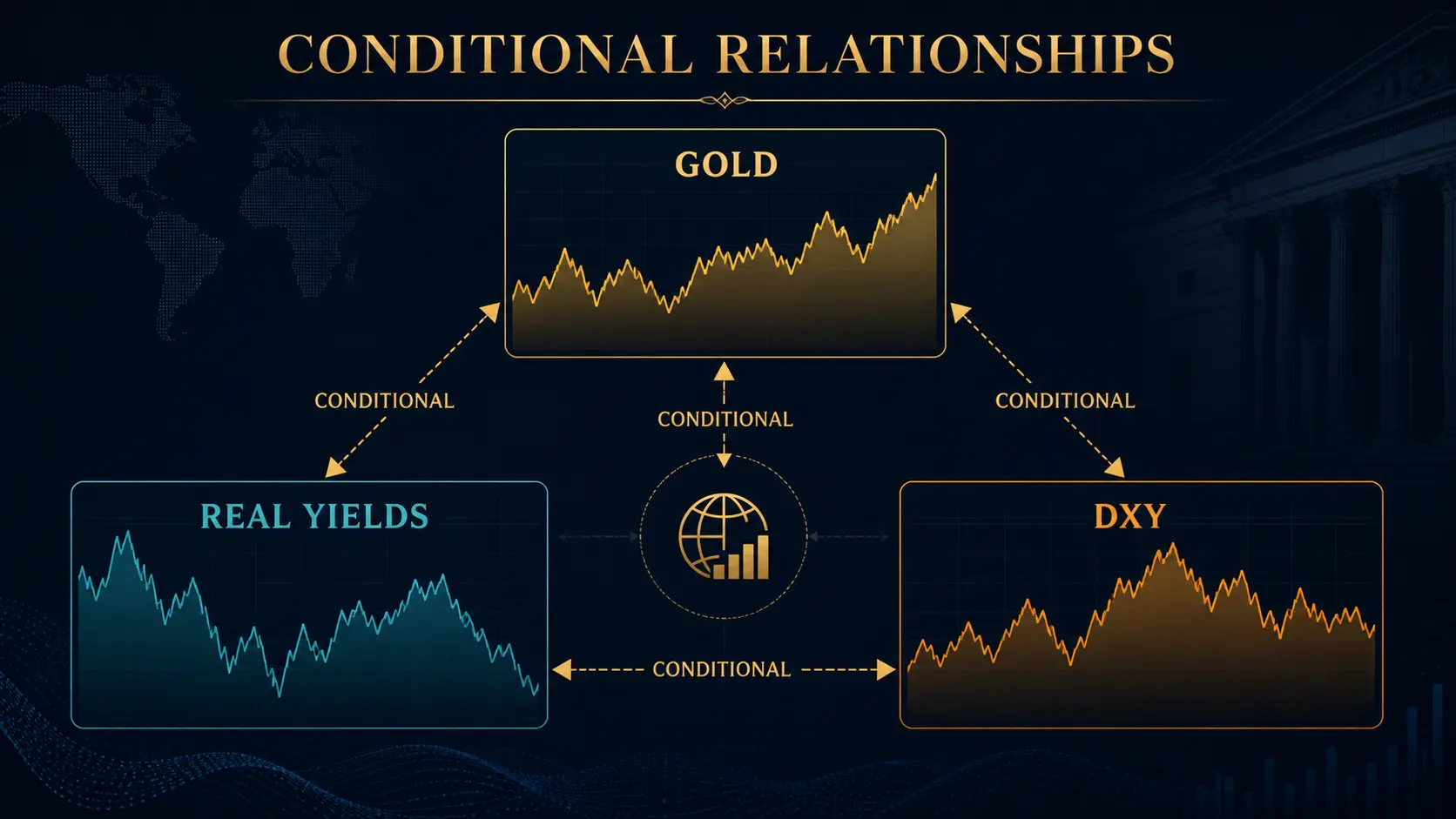
Gold, U.S. real yields and DXY often move in related ways, but the relationships are conditional rather than fixed correlations. Real yields can frame the opportunity cost of holding a non-yielding asset, while DXY affects the dollar price and global-currency context for gold. Inflation expectations, risk events, liquidity and positioning can weaken, delay or reverse the usual relationship.
Key takeaways
- Real yield is not identical to a nominal Treasury yield.
- TIPS-based real-yield measures are market estimates with methodology and liquidity limitations.
- DXY is a six-currency fixed basket, not a universal measure of all dollar conditions.
- Gold can move with, against or independently of real yields and DXY in different regimes.
- Use macro variables to form scenarios, then evaluate the actual gold price structure and risk.
Why real yields are relevant to gold
Gold does not pay a coupon. A common macro framework therefore compares gold with real returns available on assets such as inflation-protected Treasuries. If real yields rise, the relative opportunity cost of holding a non-yielding asset may increase; if they fall, that pressure may ease. This is a framework for context, not a rule that produces a trade direction.
Nominal yield, inflation expectations and real yield
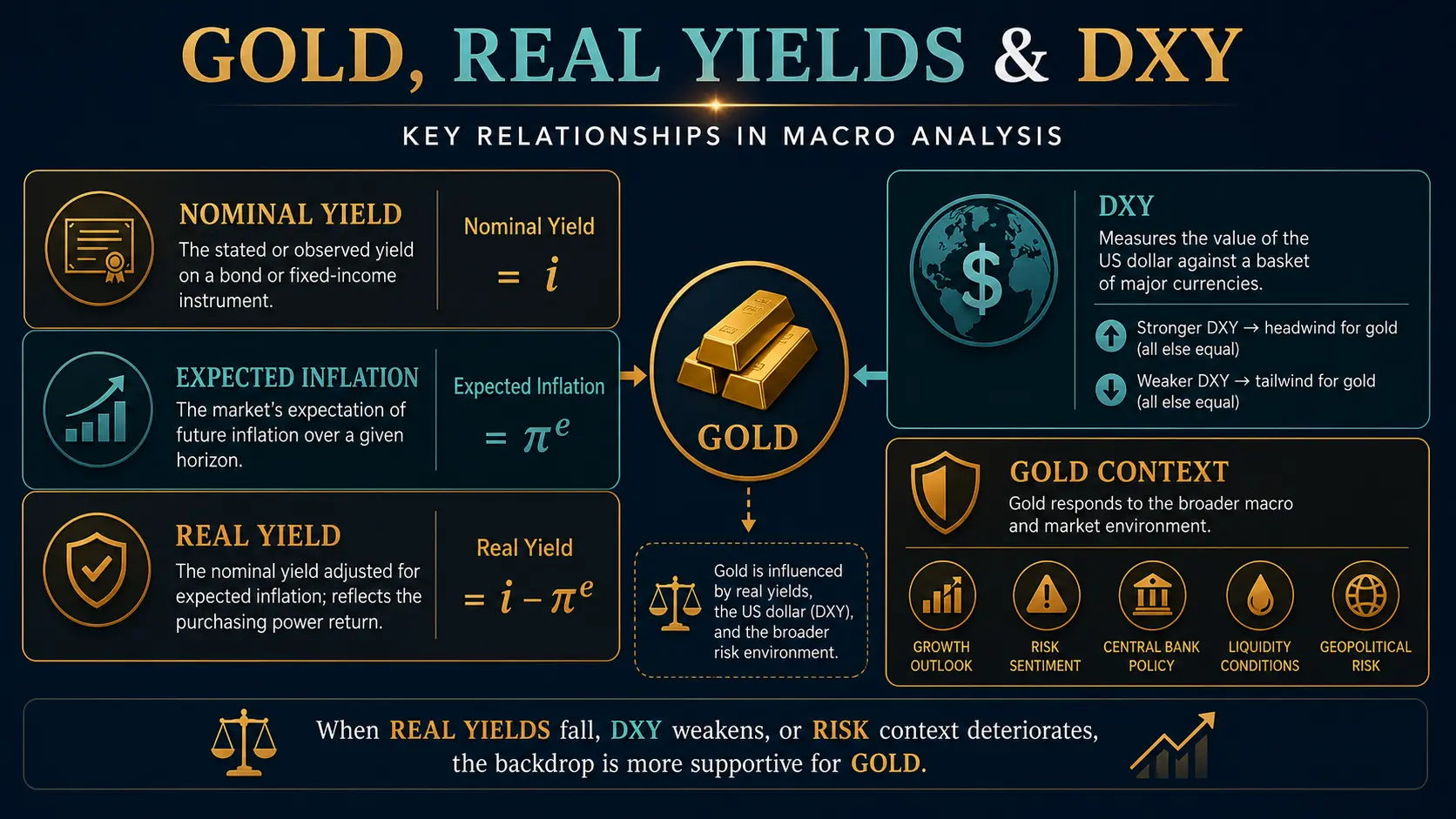
A useful approximation is that a nominal yield reflects a real-yield component, expected inflation and risk premia. TIPS yields are often treated as real yields, but the Federal Reserve notes that TIPS-based measures and inflation compensation can include liquidity and risk-premium effects. Use a matched maturity and record the source/date rather than treating a headline yield as one exact economic truth.
The U.S. Treasury publishes Daily Treasury Par Real Yield Curve Rates for TIPS-based real yields. These are valuable data references but should not be turned into an automatic XAUUSD signal.
Where DXY fits
Gold is commonly priced in US dollars, so dollar strength is an important part of the context. A stronger dollar can make gold more expensive in other currencies if other factors are unchanged. But DXY is heavily weighted toward EUR, and gold demand is shaped by more than the six currencies in that index. Treat DXY as a narrow but useful benchmark rather than a complete global-dollar measure.
When correlations can fail
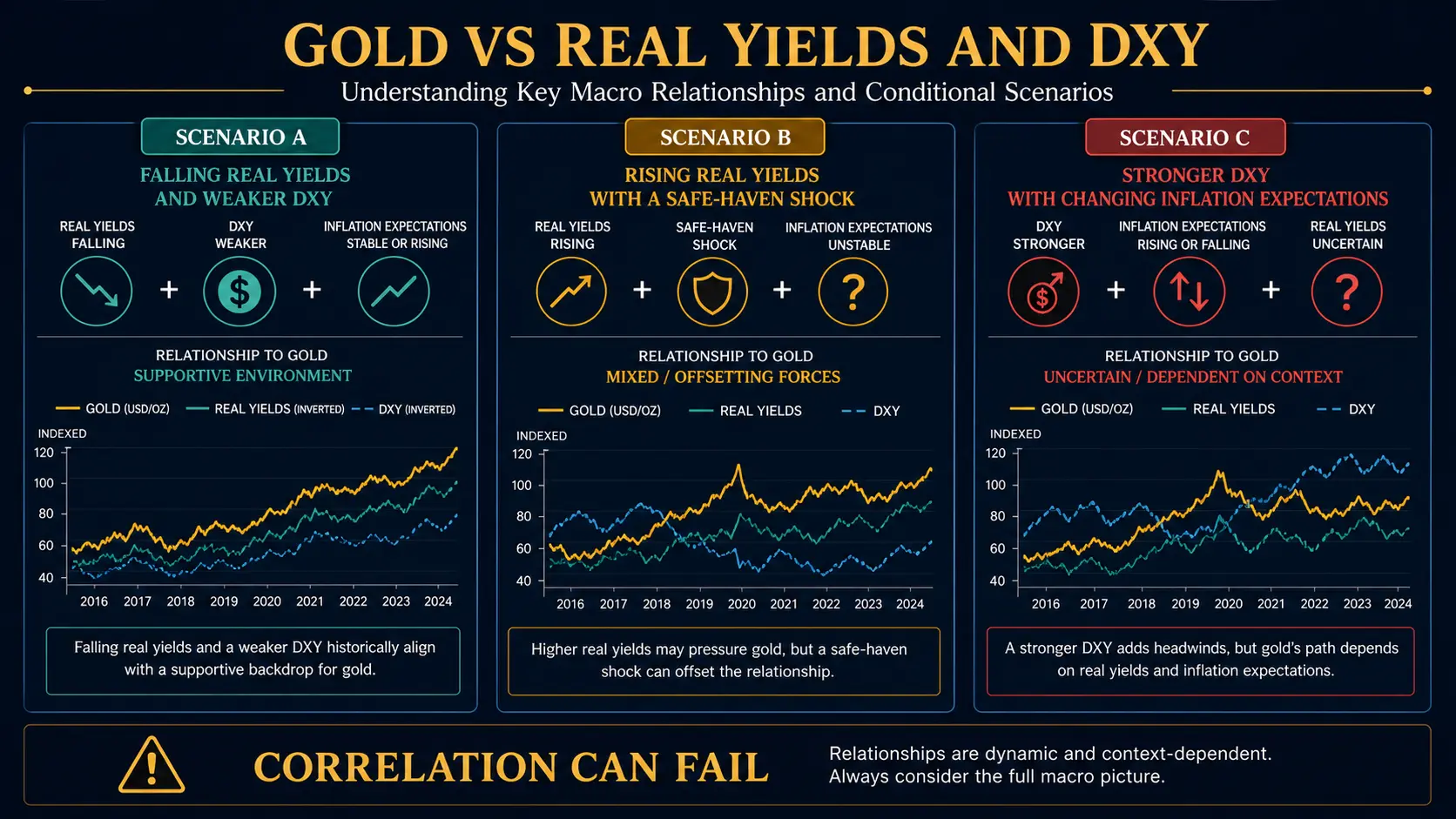
| Condition | Why a simple relationship may fail |
|---|---|
| Safe-haven shock | Gold and USD can both attract demand while yields move differently. |
| Inflation expectation shift | Nominal yields can rise even if the real-yield interpretation is not straightforward. |
| Liquidity stress or positioning | Forced flows and thin liquidity can dominate short-term price action. |
| Gold-specific demand | Physical, central-bank, ETF or futures flows may change the balance. |
These are examples of conditions that can alter the relationship; they do not identify a future regime in advance.
A conditional reading workflow
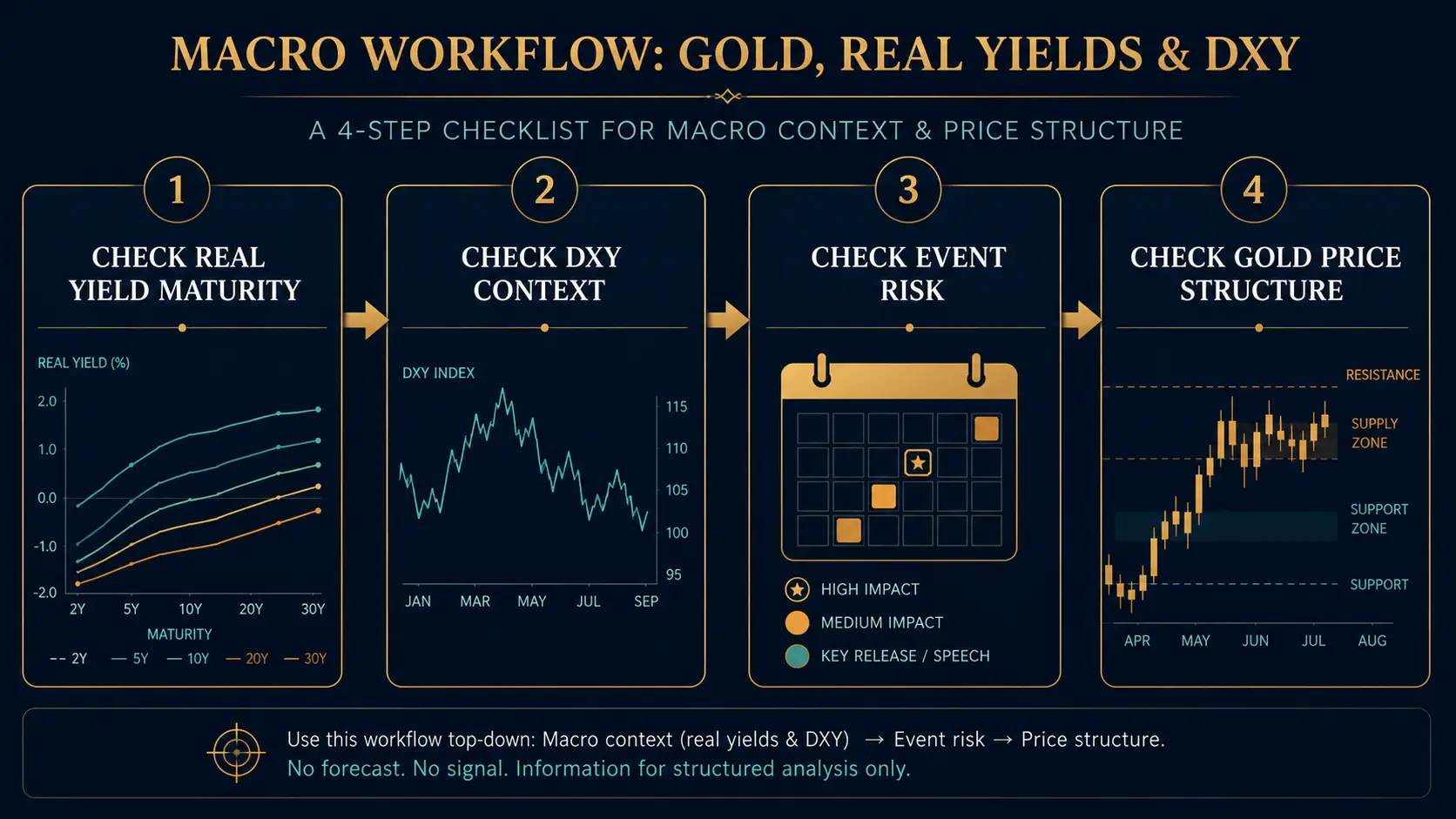
- Choose the real-yield series and maturity; note the source and observation time.
- Check DXY as one dollar-context input, while remembering its euro-heavy basket.
- Review the event calendar for inflation, labor and central-bank information that can change expectations.
- Read XAUUSD structure, liquidity conditions and the relevant timeframe.
- Define the scenario’s invalidation and risk before considering an execution decision.
Common mistakes
- Using nominal yields as if they were real yields.
- Assuming every DXY move has the same effect on gold.
- Ignoring maturity, source timing and revisions in yield data.
- Calling correlation a causal law or a trade signal.
- Using macro context without a clear risk limit or price-based invalidation.
FAQ
Which real yield should I watch for gold?
There is no universal answer. State the maturity and source, then use it consistently in your analysis. Different maturities can reflect different parts of the rate curve.
Can gold rise while real yields and DXY rise?
Yes. Relationships can be affected by risk demand, inflation expectations, liquidity, flows and timing. That is why a single-variable rule is unreliable.
Use scenarios rather than a one-line correlation rule
A useful macro note might read: “Real yields eased, DXY weakened and gold held above a relevant structure level; the context is supportive, but the scenario fails if price loses that level or an event changes the rate/dollar response.” This is more robust than writing “yields down, buy gold.” It separates observations, conditions and invalidation.
In a different regime, an acute risk event can support both gold and the dollar while the normal correlation becomes less visible. The point of a scenario is to remain open to this possibility and avoid forcing price into an old relationship.
Data and timing checklist
- Use a clearly identified real-yield series and maturity, such as a Treasury TIPS-based reference.
- Record the data time; daily yield observations and intraday gold prices are not identical clocks.
- Distinguish nominal-yield moves from changes in real yields or inflation compensation.
- Remember that DXY is a fixed, euro-heavy basket rather than every dollar flow.
- Check macro events, liquidity and XAUUSD price structure before considering risk.
Where to validate a macro claim
For yield data, use the U.S. Treasury or Federal Reserve source named in this article rather than an unattributed social-media chart. For the dollar basket, use ICE’s USDX documentation. Keeping the underlying series and date visible makes the discussion easier to review and update.
Sources and further reading
- Federal Reserve — TIPS Yield Curve and Inflation Compensation
- U.S. Treasury — Daily Treasury Real Yield Curve Rates
- ICE — U.S. Dollar Index
Risk disclosure: This article is educational information, not investment advice or a solicitation to trade. Derivatives, macro relationships and historical observations have limits and do not guarantee future outcomes. Trading can result in loss of capital. Verify your data, assess risk and make your own decisions.
Related reading: Trading tools and position sizing for Forex and CFDs.