


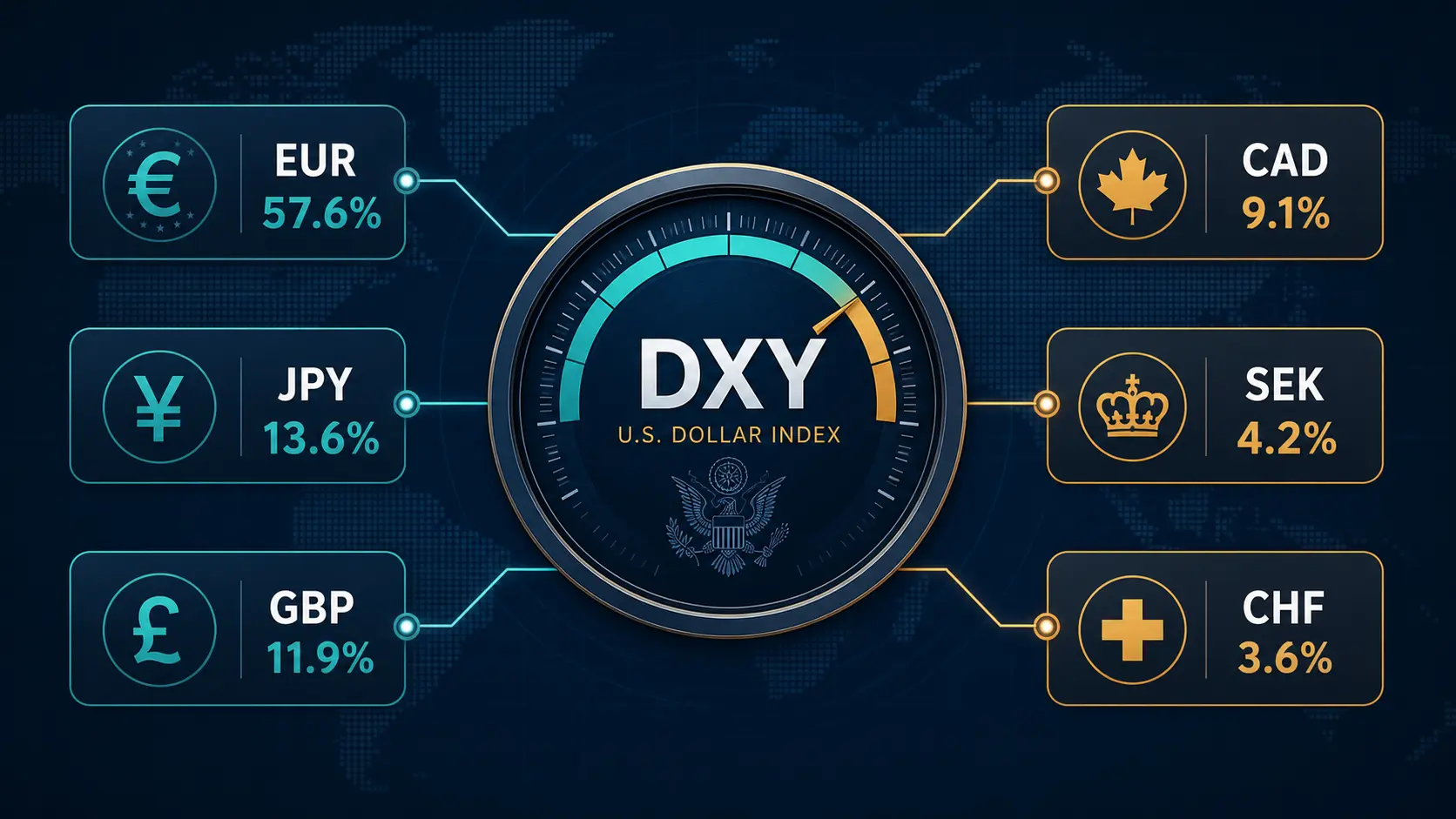
DXY, commonly called the U.S. Dollar Index or USDX, is a fixed-weight index measuring the U.S. dollar against six currencies: EUR, JPY, GBP, CAD, SEK and CHF. It is a useful benchmark for dollar context, especially because EUR has the largest weight. It is not a complete measure of every currency, every trading partner or every individual USD pair.
Key takeaways
- DXY is a geometrically weighted index with six constituent currencies.
- EUR carries 57.6% of the fixed basket, so EURUSD is especially important to DXY behavior.
- DXY is not the same as a broad trade-weighted dollar index.
- A stronger DXY does not force EURUSD, XAUUSD or any other instrument to move by a fixed amount.
- Use DXY as macro context alongside price structure and event risk.
What does the DXY Index measure?
USDX measures the dollar relative to a specified basket rather than against one currency. ICE notes that the index uses a fixed composition and was changed only once in 1999 when the euro replaced several European currencies. Because the basket is fixed, the index is stable as a benchmark but does not automatically reflect the present-day breadth of US trade relationships.
DXY composition and weights
| Currency | Fixed weight |
|---|---|
| Euro (EUR) | 57.6% |
| Japanese yen (JPY) | 13.6% |
| British pound (GBP) | 11.9% |
| Canadian dollar (CAD) | 9.1% |
| Swedish krona (SEK) | 4.2% |
| Swiss franc (CHF) | 3.6% |
The weights above are from ICE’s USDX documentation. The euro’s large share explains why DXY and EURUSD often show an inverse relationship, but “often” is not “always.”
DXY versus broader dollar measures
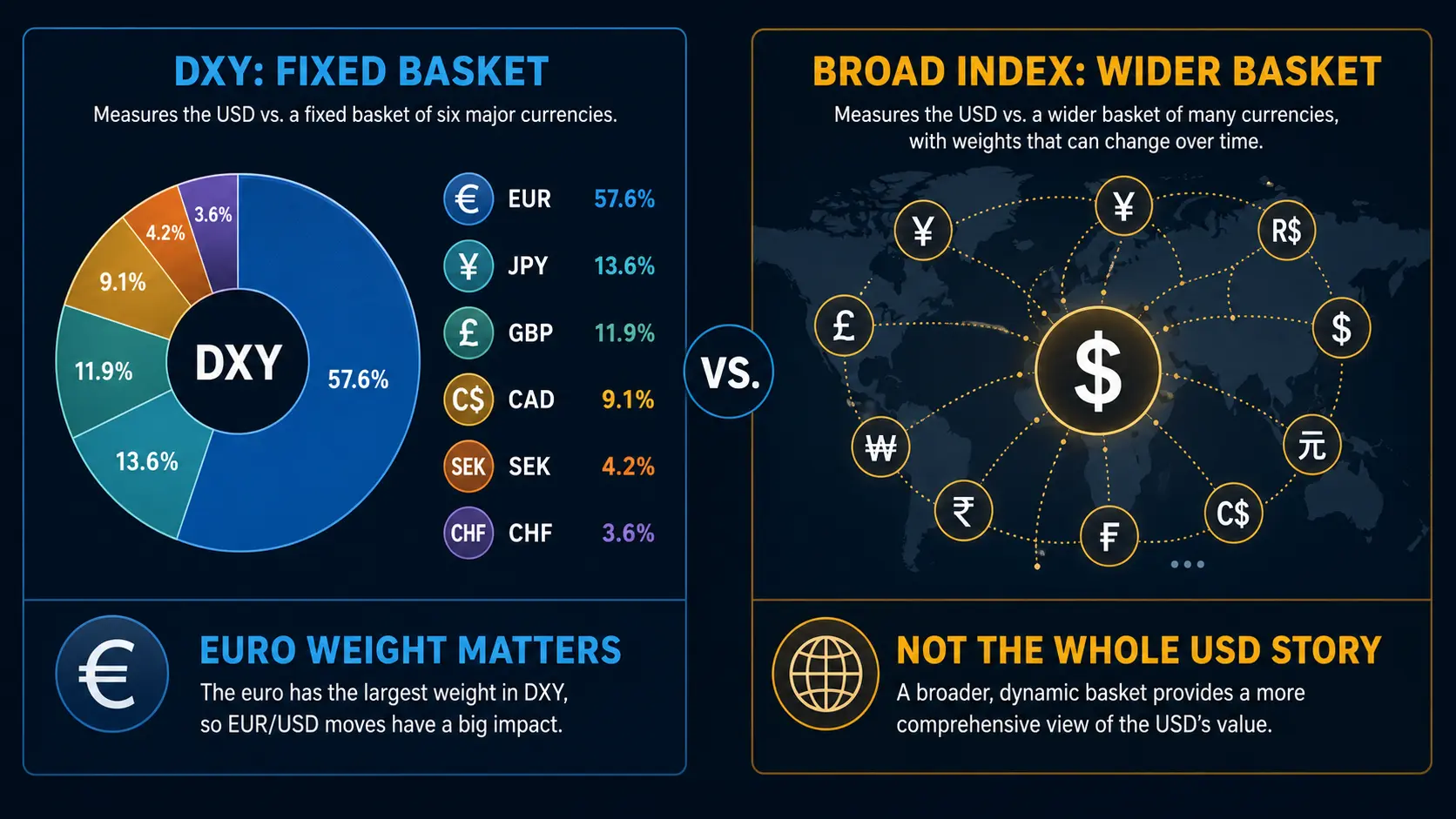
A broad trade-weighted dollar index generally uses a wider set of currencies and may update weights over time. DXY is narrower and fixed. Neither is automatically the correct tool for every question. If the question concerns a currency not represented in DXY, a broader measure or the actual relevant FX pair may provide more direct context.
How to use DXY as context
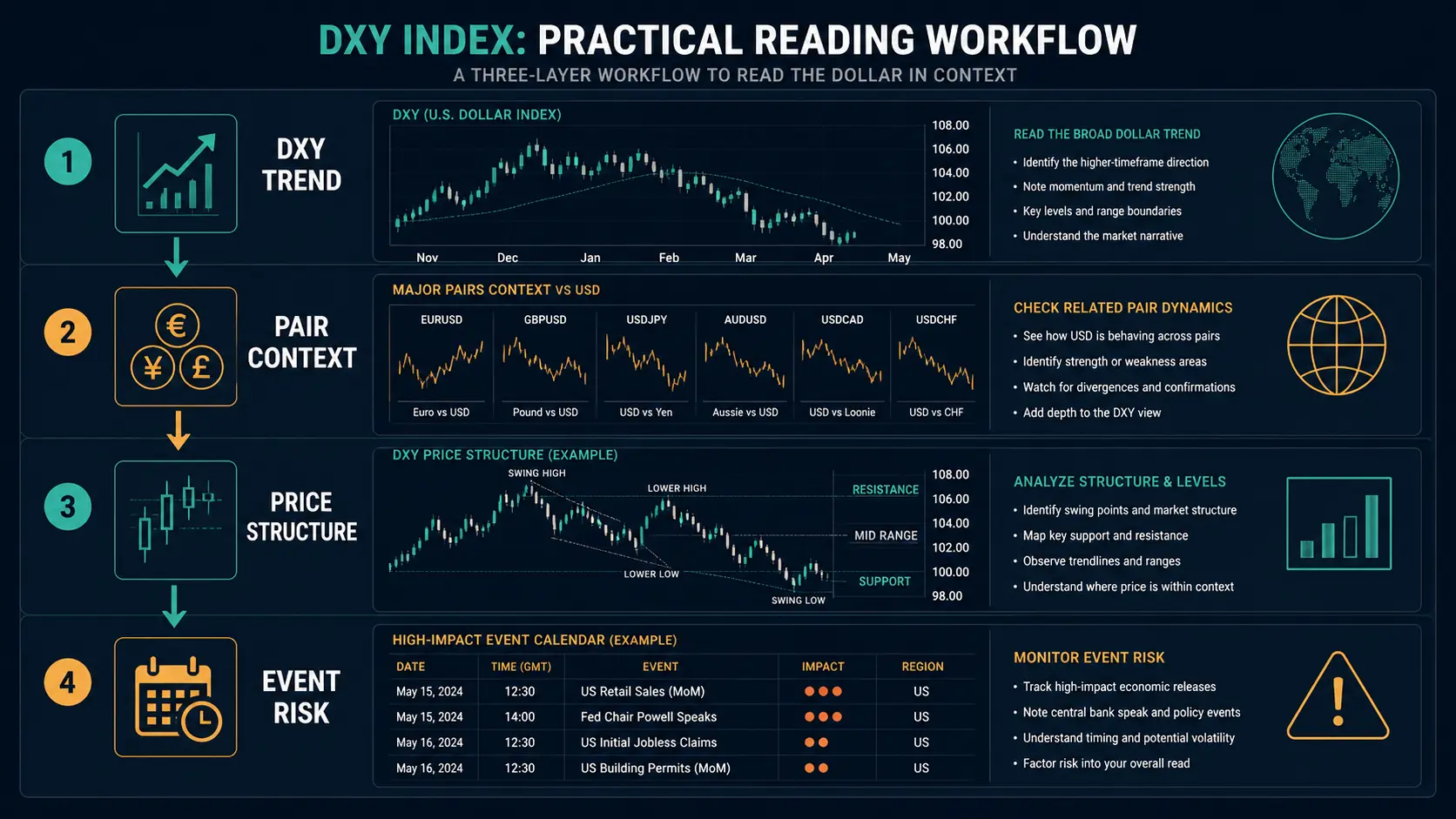
Start with the DXY trend or range, then examine the specific market. For EURUSD, the euro’s high DXY weight is relevant. For XAUUSD, DXY is one macro input among several, including real yields, inflation expectations, risk appetite and gold-specific flows. Finally, check price structure and scheduled macro events before drawing a conclusion.
Keep chart structure separate from macro context. The site’s technical analysis frameworks guide provides a useful foundation for that separation.
Practical limitations
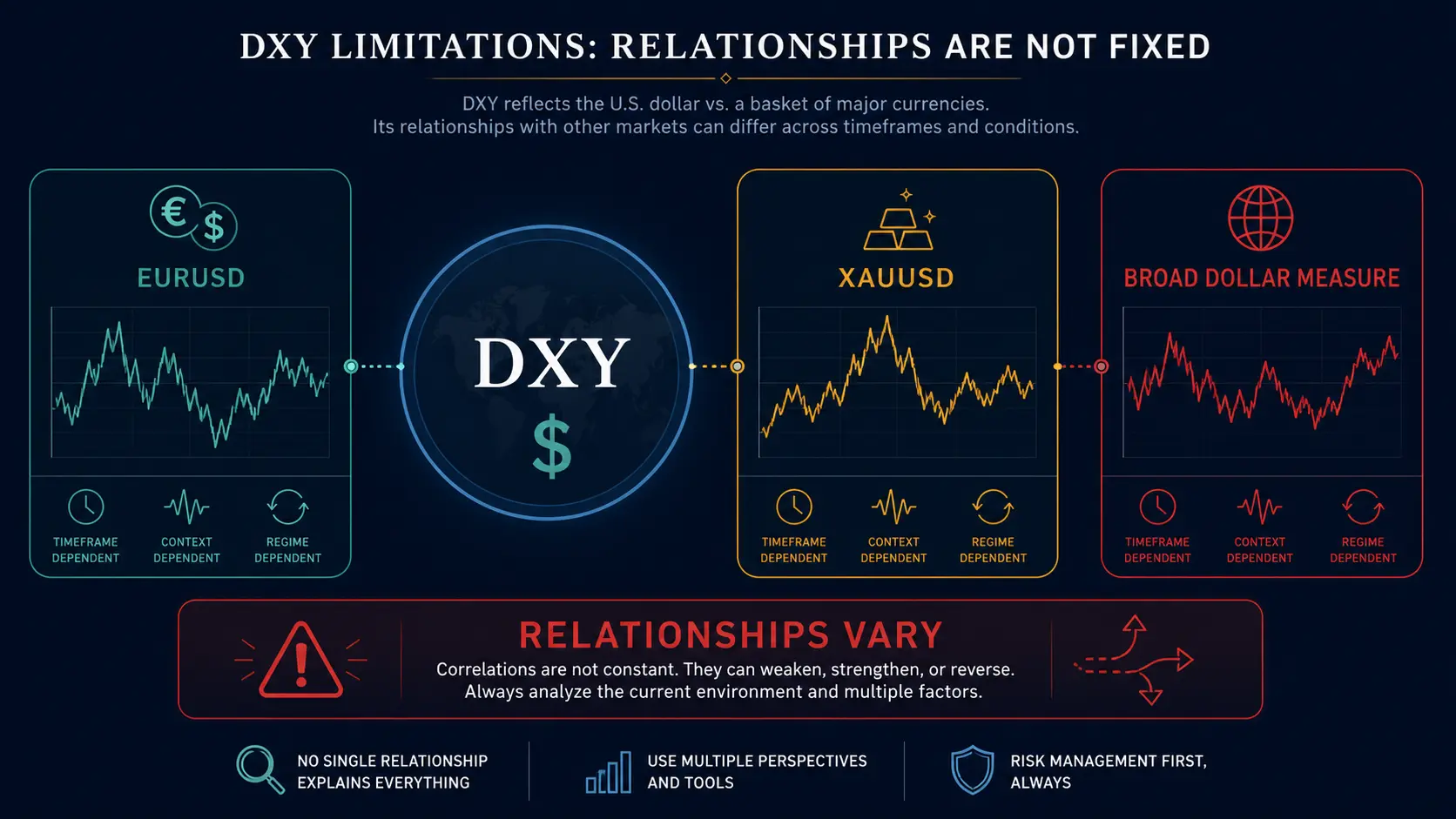
- DXY does not include every major trading partner or emerging-market currency.
- EUR’s weight can dominate day-to-day movement.
- Correlation with gold and individual USD pairs can weaken, reverse or lag.
- A DXY quote can differ slightly by provider, product or timing convention.
- News can change price relationships faster than a historical correlation can describe them.
FAQ
Is DXY the same as the Dollar Index?
In trading use, DXY commonly refers to the ICE U.S. Dollar Index / USDX benchmark. Check a platform’s symbol description because naming and data presentation can vary.
Does a rising DXY mean gold must fall?
No. Gold and DXY can be inversely related in some periods, but yields, inflation expectations, risk events and flows can change the relationship.
Why EURUSD often matters most to DXY
Because the euro has 57.6% of the USDX basket, an important EURUSD move can have a large influence on the index. That does not make DXY a substitute for EURUSD analysis. The pair has its own price structure, European and US event risk, liquidity conditions and cross-currency influences. Use the index to frame the broader dollar backdrop, then check the actual pair.
Likewise, a DXY move can be modest even while a USD pair outside the basket moves sharply. This is not necessarily a contradiction; it reflects the basket’s scope.
Event risk changes the context
Monetary-policy decisions, inflation data, employment releases and risk shocks can move rates, currencies and commodities at the same time. In these periods, a historical correlation can be less useful than observing spreads, volatility and the market’s response after the release. The site’s Forex trading sessions guide can help place such events in a liquidity and timing context.
DXY reading checklist
- Confirm the symbol and provider represent the intended USDX/DXY benchmark.
- Note the EUR-heavy fixed composition before generalizing about the dollar.
- Compare DXY with the specific pair or asset being analyzed.
- Check the event calendar and relevant yield context.
- Use price structure and an invalidation point instead of a correlation rule.
Sources and further reading
- ICE — U.S. Dollar Index futures and index composition
- ICE — U.S. Dollar Index brochure and weights
- Federal Reserve — H.10 foreign exchange rates
Risk disclosure: This article is educational information, not investment advice or a solicitation to trade. Derivatives, macro relationships and historical observations have limits and do not guarantee future outcomes. Trading can result in loss of capital. Verify your data, assess risk and make your own decisions.