


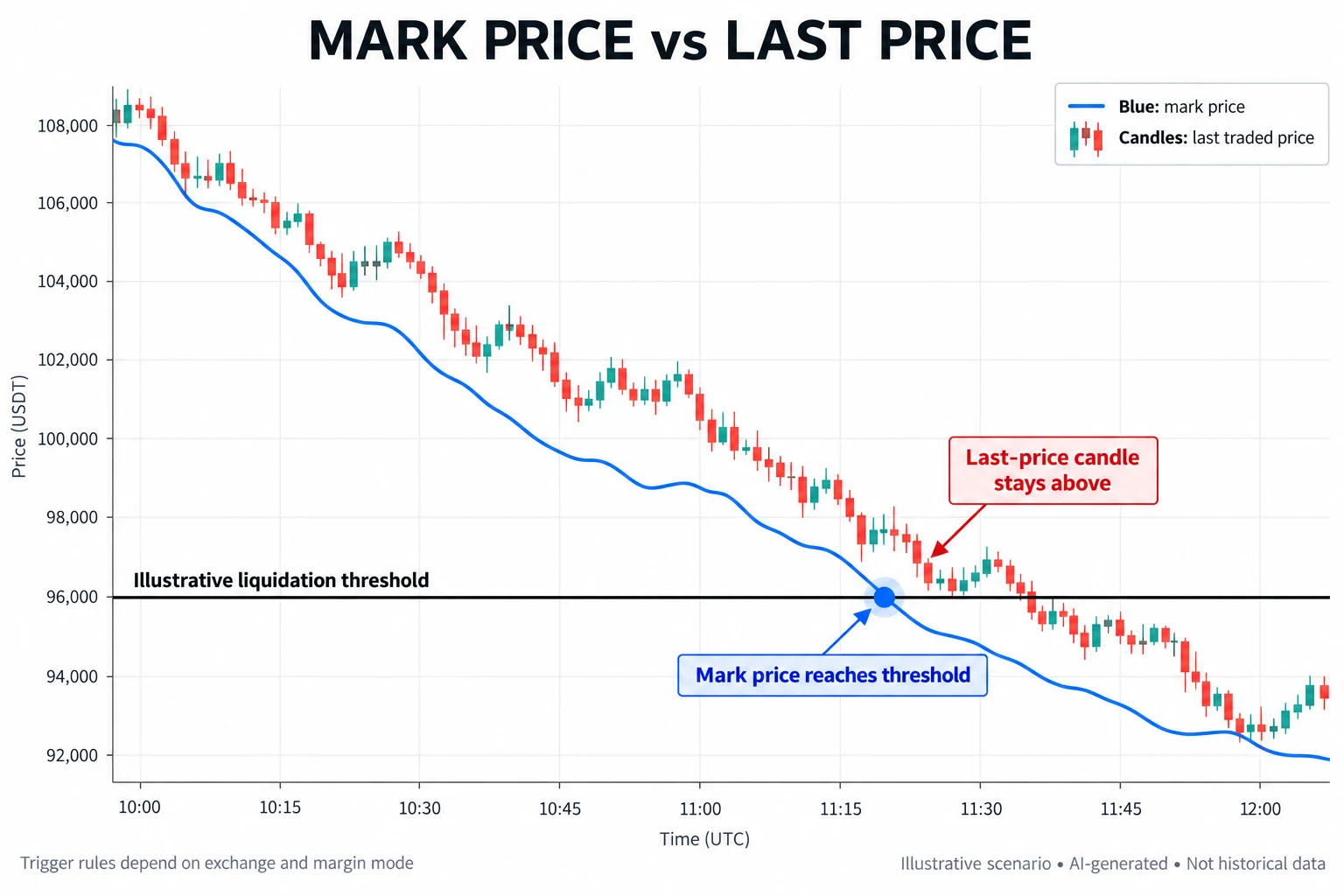
A position can be liquidated before a Last Price candle touches the displayed liquidation level when the exchange uses Mark Price for the relevant trigger. Those prices are different series. Check which price your chart displays, which source triggers your stop and which margin rules apply before concluding that the event is inconsistent.
This guide uses Bybit’s documented mechanisms as a bounded example. It does not claim that every exchange, product and margin mode works identically. The task is reconstructing an event from the correct data, not selecting a supposedly safe leverage number.
Distinguish Mark, Last and Index
Last Traded Price records the most recent matched trade for the contract. Index Price is a reference constructed according to the exchange’s index methodology. Mark Price is a calculated contract reference rather than simply the latest matched trade.
| Data | Question it helps answer | Check |
|---|---|---|
| Last Price | Where did the most recent trade occur? | Same venue and contract |
| Index Price | What reference does the index represent? | Components and methodology |
| Mark Price | What calculated mark applies? | Product formula and margin role |
| Actual exit price | Where did the position close? | Execution records and charges |
Bybit’s order execution and liquidation FAQ distinguishes the relevant prices in its own product context. A trigger reference does not by itself guarantee a final execution price, so one chart line cannot replace the full event history.
Reconstruct a hypothetical long position
Assume an illustrative long liquidation threshold of USDT 96,000. To isolate the price-source issue, hold that threshold fixed and omit margin adjustments, fees and risk-tier changes. This is not a liquidation formula for a real account.
| Hypothetical time | Mark Price | Last Price | Interpretation in this example |
|---|---|---|---|
| T0 | 96,300 | 97,700 | Both remain above the threshold |
| T1 | 96,000 | 97,500 | Mark reaches it while Last does not |
| T2 | 95,800 | 97,200 | The series continue to differ |
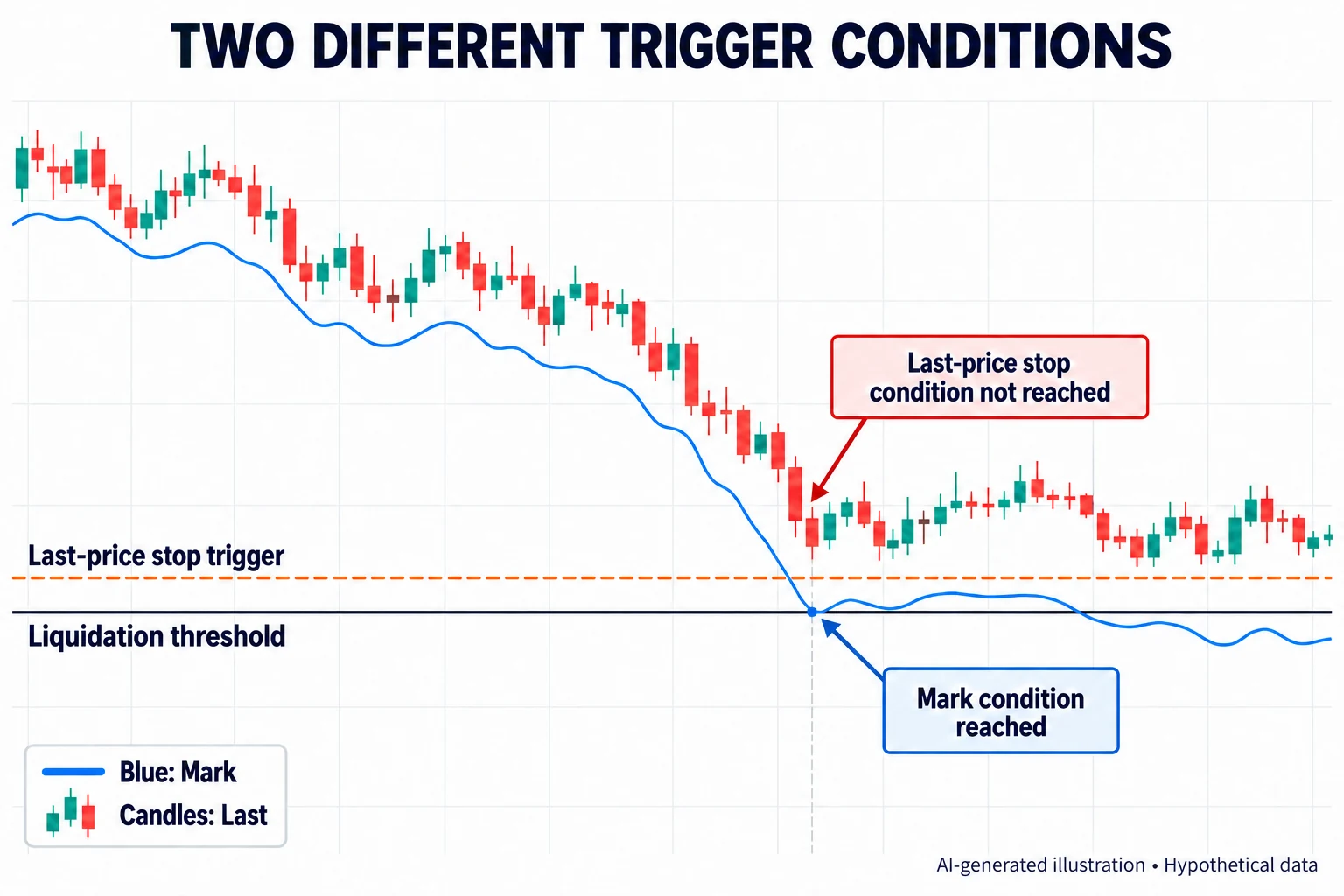
In a model that triggers on Mark, with the other liquidation conditions met, T1 can be the trigger time. A Last Price candle does not need a low of 96,000 at T1. The table does not establish the executed liquidation price, charges or remaining balance; those belong in the account records.
The illustration deliberately separates the two series for readability. The gap shown is not an estimate of a typical market spread and is not evidence that this event occurred historically.
Why might a stop loss not have triggered first?
Read the order’s trigger-source setting where the product offers one. A stop based on Last and a liquidation mechanism based on Mark evaluate different conditions. In the hypothetical sequence, Mark can reach its threshold before Last reaches the stop trigger.
Even after a stop condition is met, the order still encounters the venue’s submission and execution mechanics. Stop-market and stop-limit orders also have different execution properties. Do not assume that placing a stop guarantees exit ahead of liquidation without reviewing the relevant rules and event sequence.
Bybit’s Mark Price documentation is a starting point for checking the mark’s role in the selected product. Recheck the current documentation because product terms and calculation methods can change.
Margin mode changes the wider calculation
The fixed threshold above exists only to explain two price series. A real displayed estimate may change with account state, collateral and contract rules. Under cross margin, isolating one position from the rest of the account can omit essential information.
The isolated liquidation estimate calculator is a simplified linear-contract model using its stated inputs. It does not recreate every risk tier, fee, open order or cross-account mechanism. Compare its estimate with the venue’s own information for the exact contract.
Funding deserves a separate check. A debit or credit can affect account conditions, but funding is not another name for the gap between Mark and Last. For background, see crypto funding rates; keep the funding calculation distinct from this price-source investigation.
A practical event-review checklist
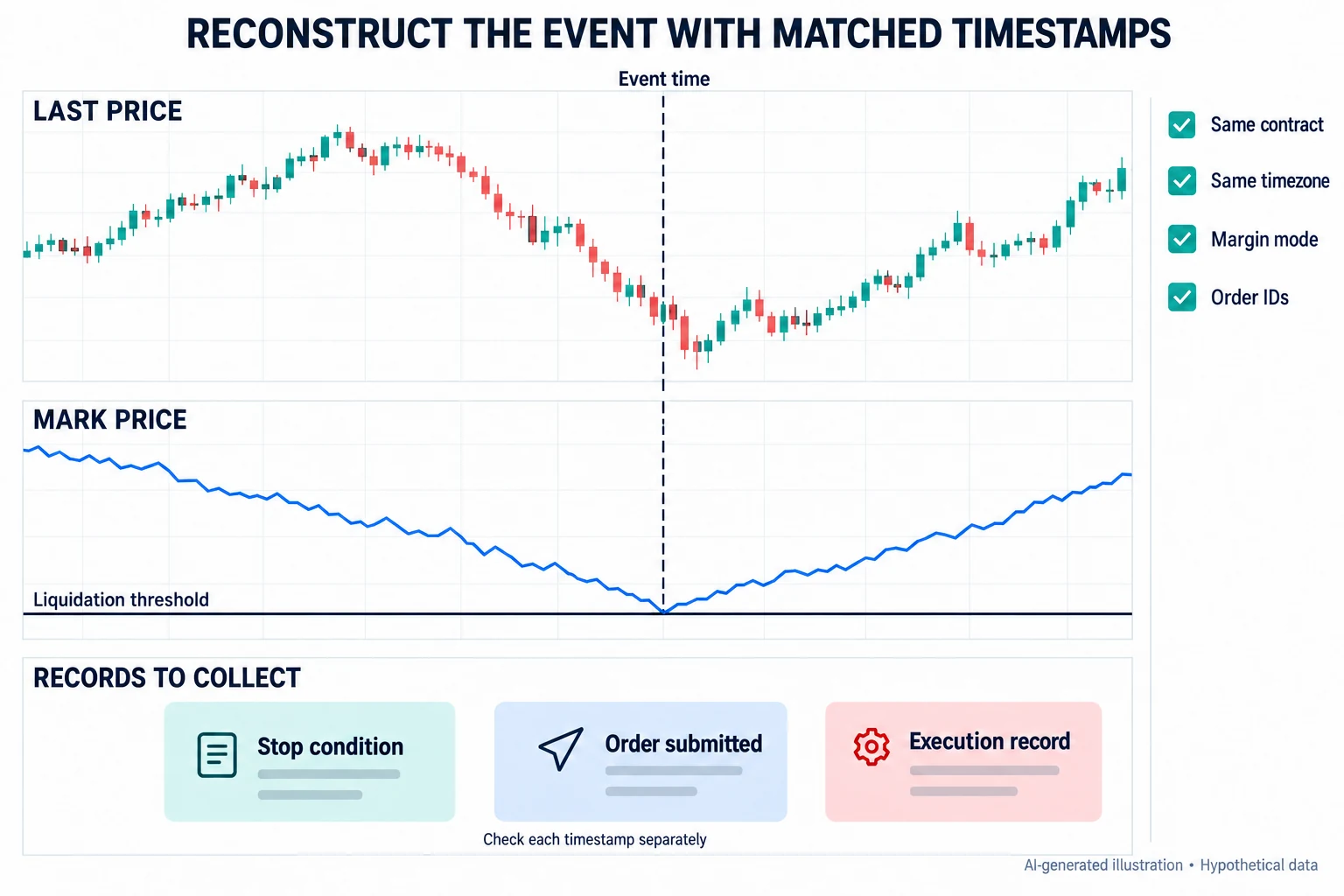
- Record venue, contract, direction, margin mode and timestamps with an explicit timezone.
- Obtain Mark and Last data for the same interval and identify the candle type displayed.
- Preserve the relevant threshold and margin state at the event time, rather than only the values shown afterward.
- Review the stop trigger source, order type and submission, cancellation and execution history.
- Reconcile liquidation records, execution prices and charges against the correct product documentation.
- If contacting support, supply order identifiers and a reproducible timeline. A candle screenshot alone is incomplete.
The trading tools hub can support arithmetic checks. The exchange’s account records remain necessary for investigating an actual event.
Frequently asked questions
Is Mark Price a price I am guaranteed to receive?
No. It is a calculated reference under the contract rules. Actual exit execution depends on the venue’s process and market conditions.
Does switching the chart to Mark prevent liquidation?
No. It changes the information displayed. Margin, exposure, triggers and execution still require separate checks; no chart setting guarantees safety.
Is the illustration a real liquidation case?
No. It is AI-generated from a hypothetical scenario to explain why the two price series can produce different observations.