


A broadening pattern forms when successive swing highs rise while swing lows fall, creating diverging boundaries. It describes expanding disagreement and volatility, not a guaranteed reversal or continuation. Confirmation requires a close, context, data quality and a written invalidation condition.
What Is a Broadening Pattern?
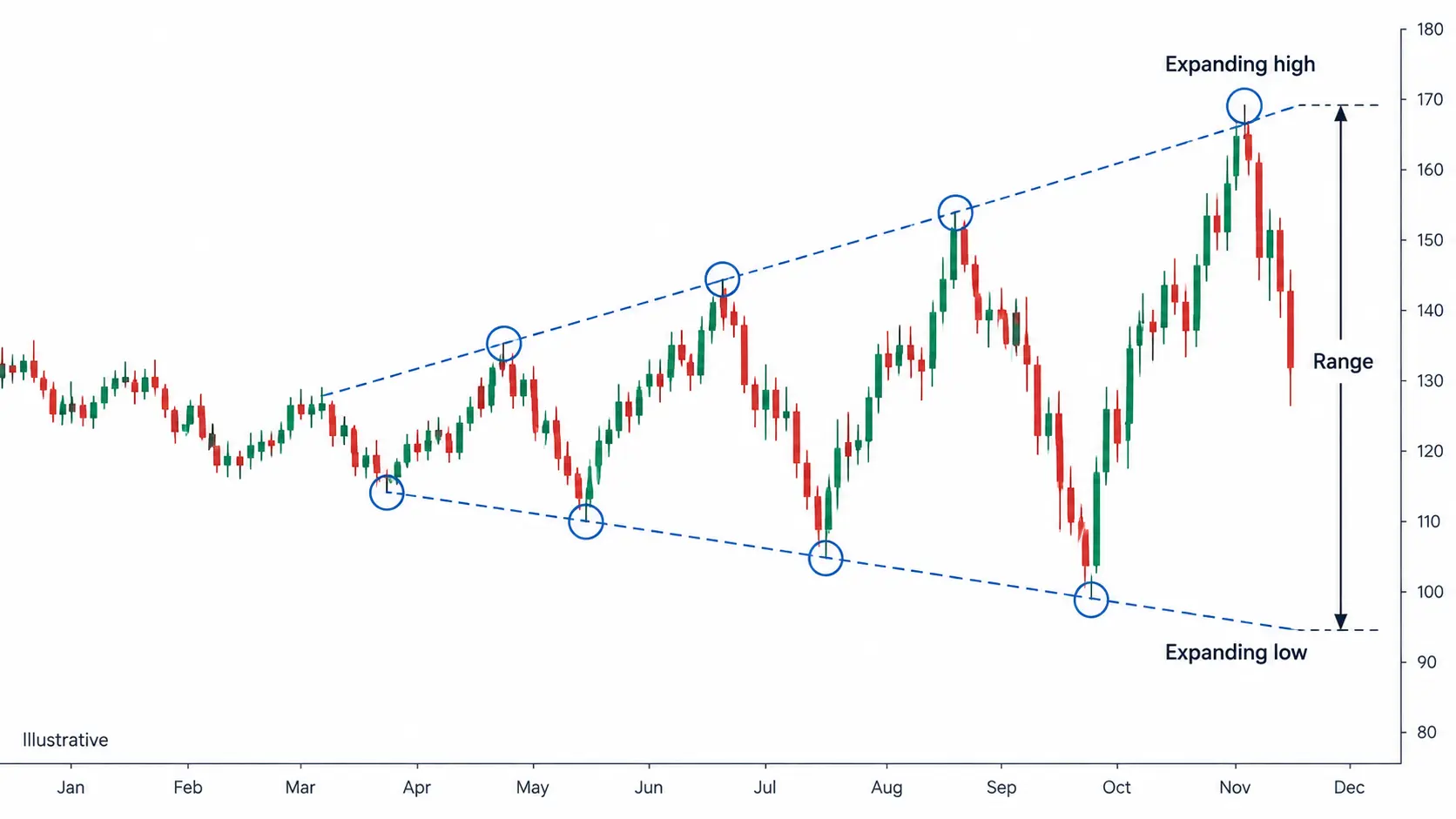
A broadening structure normally has at least two expanding swing highs and two expanding swing lows. Its boundaries can slope at different rates, and its appearance changes with timeframe and data feed. Mark the swings first and name the structure second; otherwise an ordinary volatile range can be overfit into a pattern.
Use market structure to frame the swings and candlestick context to inspect closes. Neither page turns the pattern into a forecast.
Broadening Tops, Bottoms and Confirmation
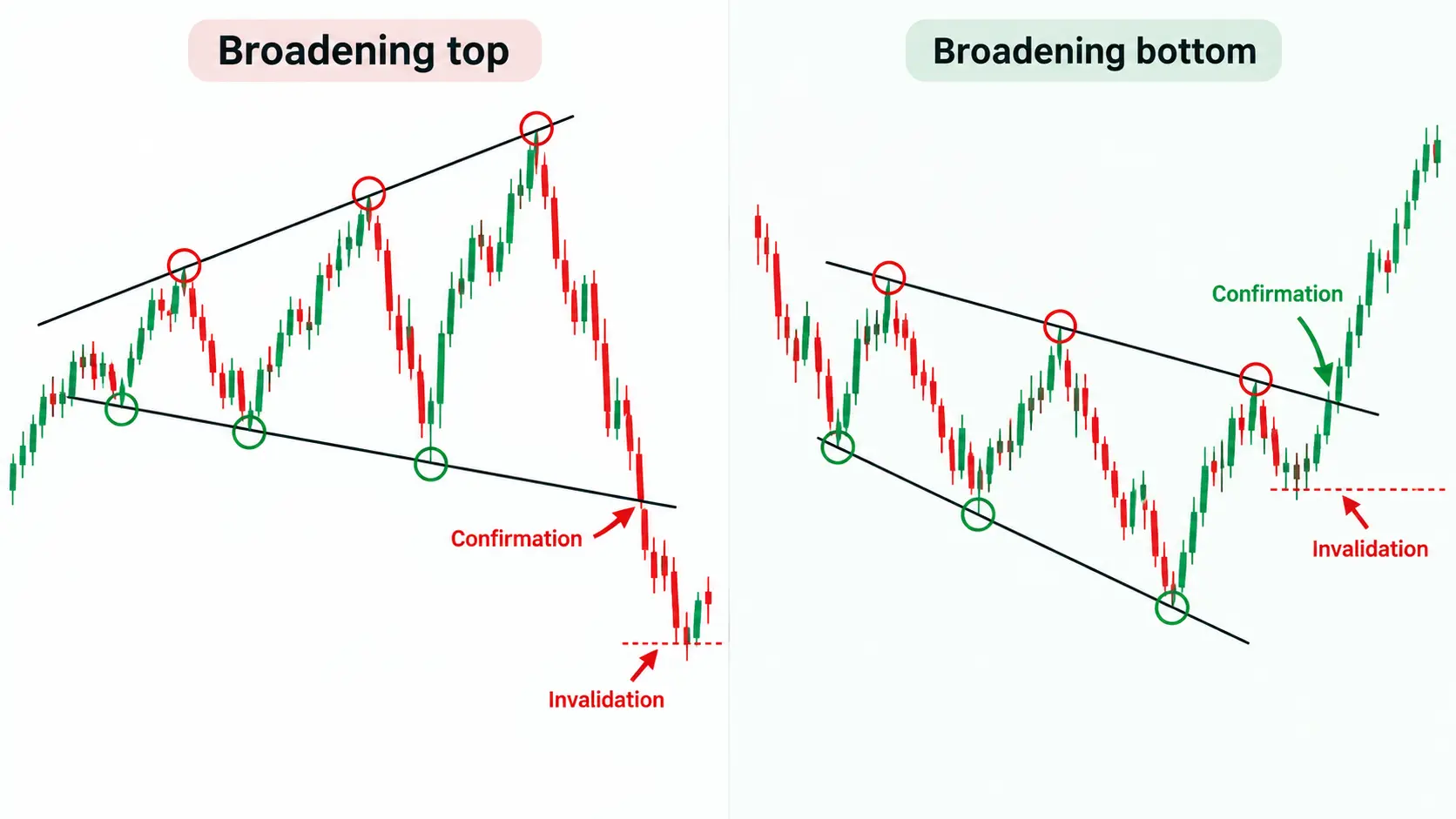
| Form | Observation | Not established |
|---|---|---|
| Broadening top | Expanding highs during a volatile or distributing range | A reversal is certain |
| Broadening bottom | Expanding lows during a volatile or accumulating range | A durable low exists |
| Both | Diverging swing boundaries | An automatic price target |
Record the symbol, timeframe, date range and volume source. More activity near a boundary may indicate participation, but it does not identify the winning side. A close beyond a boundary needs follow-through and, when present, a retest; a single wick is insufficient.
Illustrative Example: A Failed Boundary Break
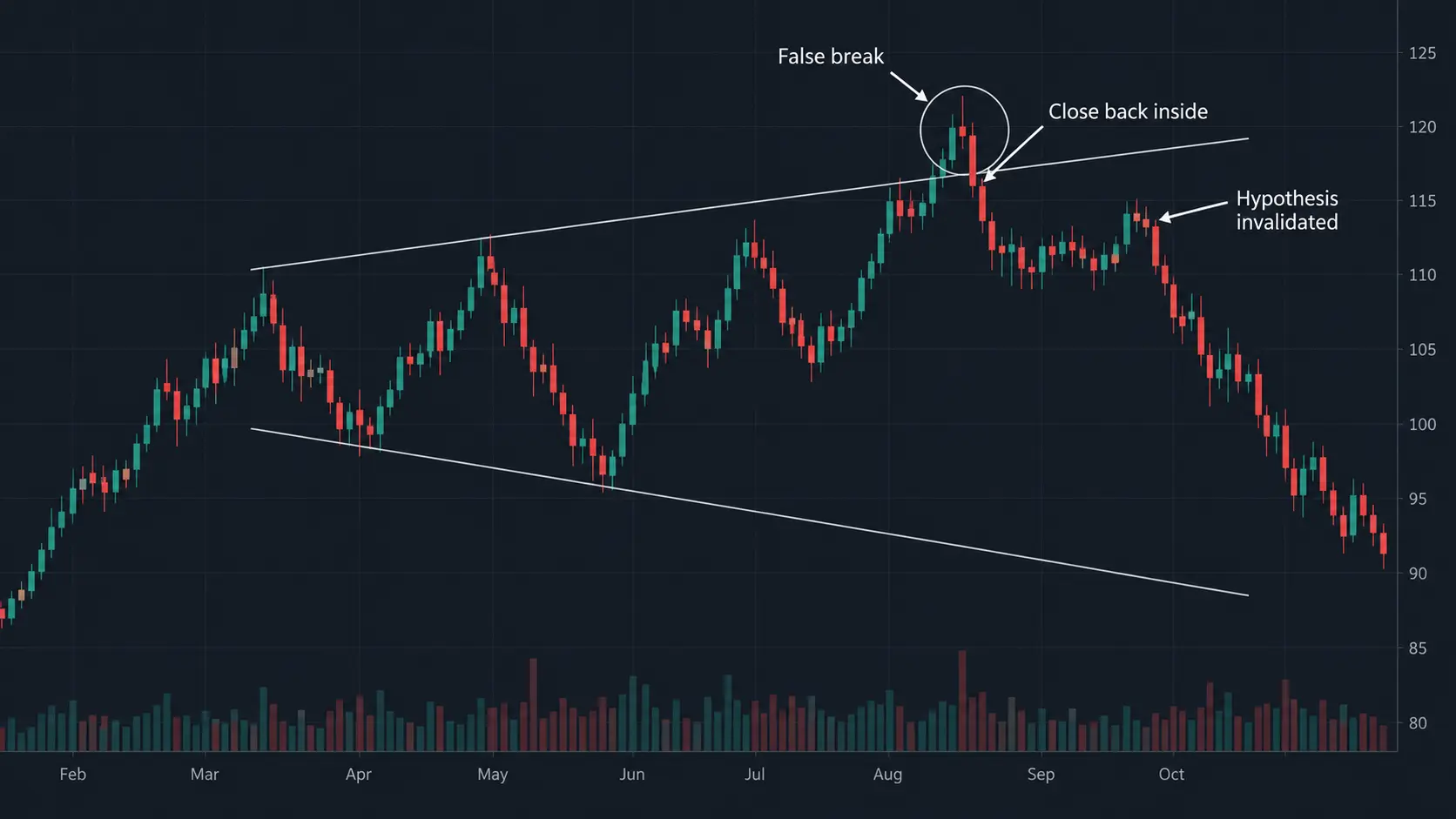
Imagine a fictional EUR/USD H1 sample from 3–10 June 2025 with expanding highs at 1.0900, 1.0960 and 1.1030 and lows at 1.0780, 1.0710 and 1.0640. Price briefly trades above 1.1050 but closes back inside the upper boundary. That observation weakens acceptance above the range; it does not prove a short or a fixed target. Check the next retest, structure and liquidity. A sustained close outside the boundary would require revising the hypothesis.
Document costs and invalidation in risk–reward planning; do not convert pattern width into an untested target.
A Confirmation Checklist and Limits
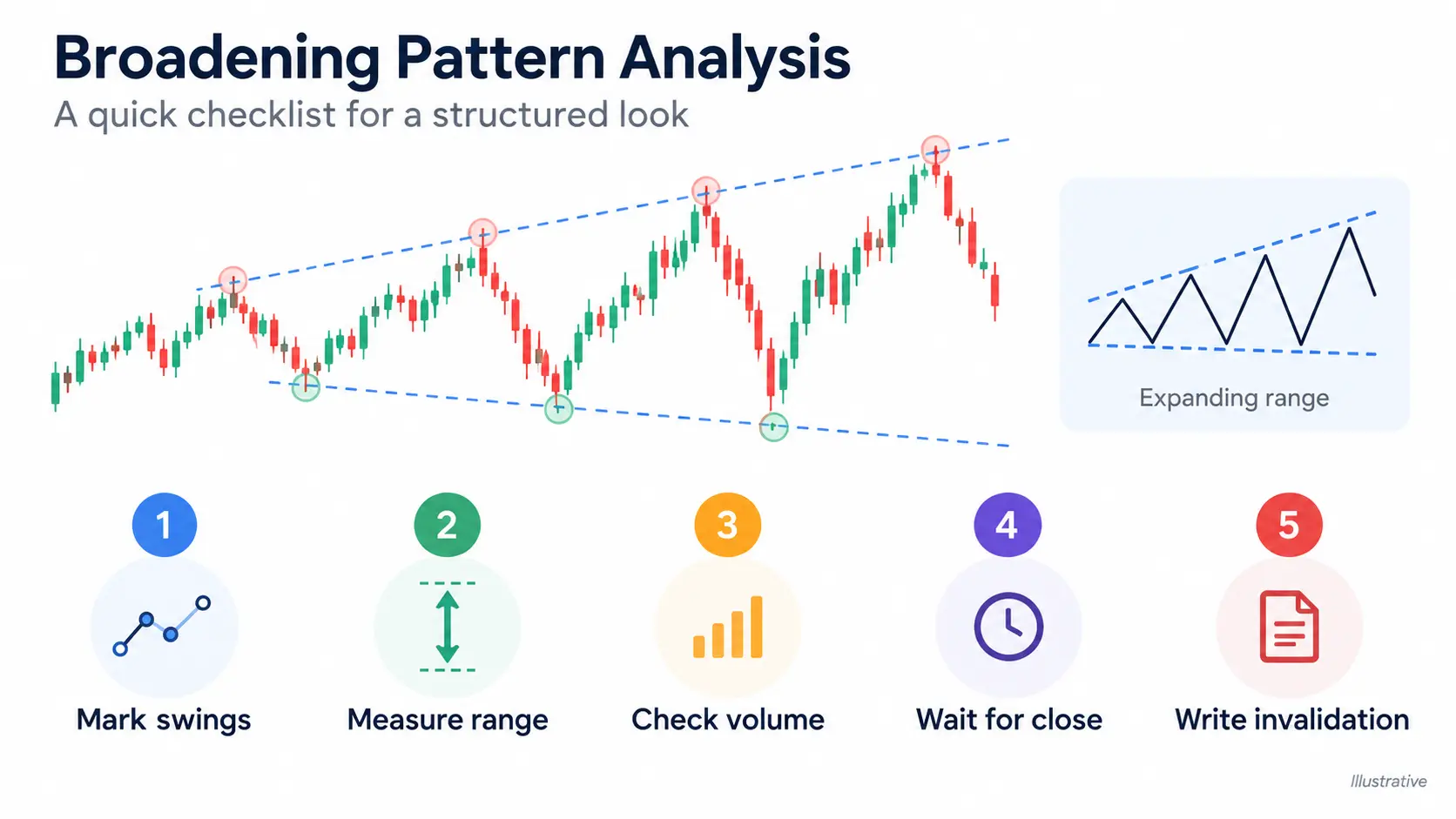
- mark swing highs and lows with one consistent rule;
- check that boundaries truly diverge rather than reflect a noisy lower timeframe;
- record close, spread, volume and follow-through at each boundary test;
- define failure as a close back inside, acceptance on the other side or a break of the opposite swing;
- test multiple examples, including structures that never complete.
Limits
- boundaries and swing labels are interpretive;
- news and thin liquidity can create false expansion;
- spot-Forex volume is often broker-specific tick activity;
- no broadening pattern guarantees reversal or continuation;
- the pattern does not replace position sizing or risk management.
Key takeaways
- A broadening pattern is a diverging, expanding range;
- mark swings before naming the structure;
- close and follow-through matter more than a boundary wick;
- write invalidation for failed breaks;
- the pattern is context, not a promise of outcome.
References
Risk note: This is educational content, not investment advice. Pattern failure and trading losses are possible.
Pingback: MSNR Trading Strategy: Rules, Workflow And Risk