


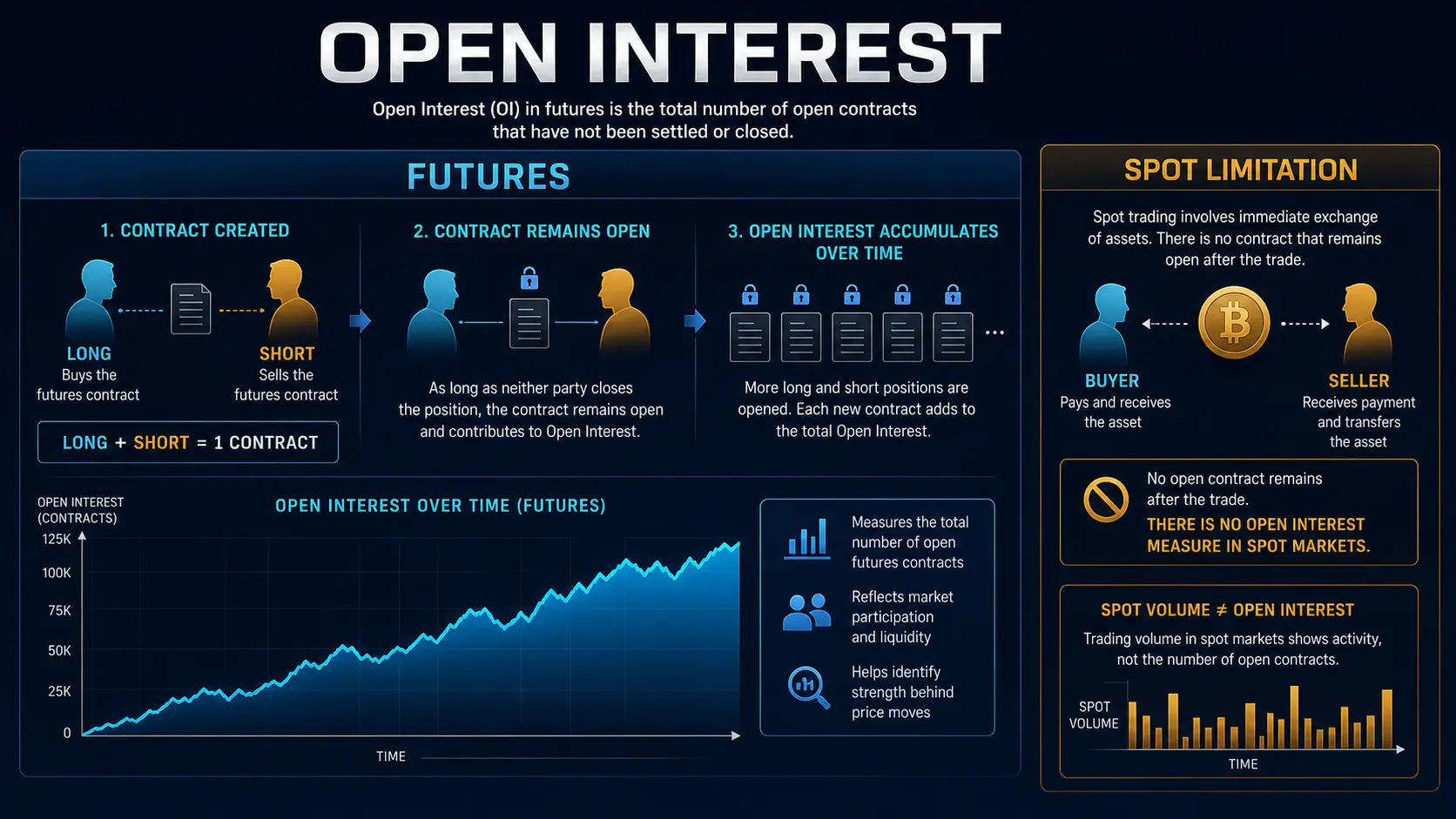
Open Interest (OI) is the total number of futures or options contracts that remain open rather than being offset, exercised, delivered or otherwise closed. It is a derivatives-market measure. It can describe participation in a specific contract or venue, but it does not reveal who is right, where liquidation will occur, or what price must do next.
Key takeaways
- Every open derivative contract has a long and a short; aggregate long OI equals aggregate short OI.
- OI is different from volume: volume counts transactions during a period; OI counts contracts still open.
- Exchange-traded futures OI is contract-specific; crypto OI is often venue-specific or provider-aggregated.
- There is no consolidated global open-interest measure for decentralized spot FX.
- Price and OI combinations are context clues, not standalone signals.
What Open Interest measures
When a new buyer and a new seller create a futures or options position, open interest can increase by one contract. When an existing long and existing short close against each other, OI can decrease. A transaction between one existing participant and one new participant may leave OI unchanged. This is why OI cannot be inferred from price alone.
The CFTC defines open interest as futures and/or options contracts entered into and not yet offset by transaction, delivery, exercise or another closing event. That definition also explains why total long open interest equals total short open interest in the aggregate.
Open Interest, volume and funding rate are different
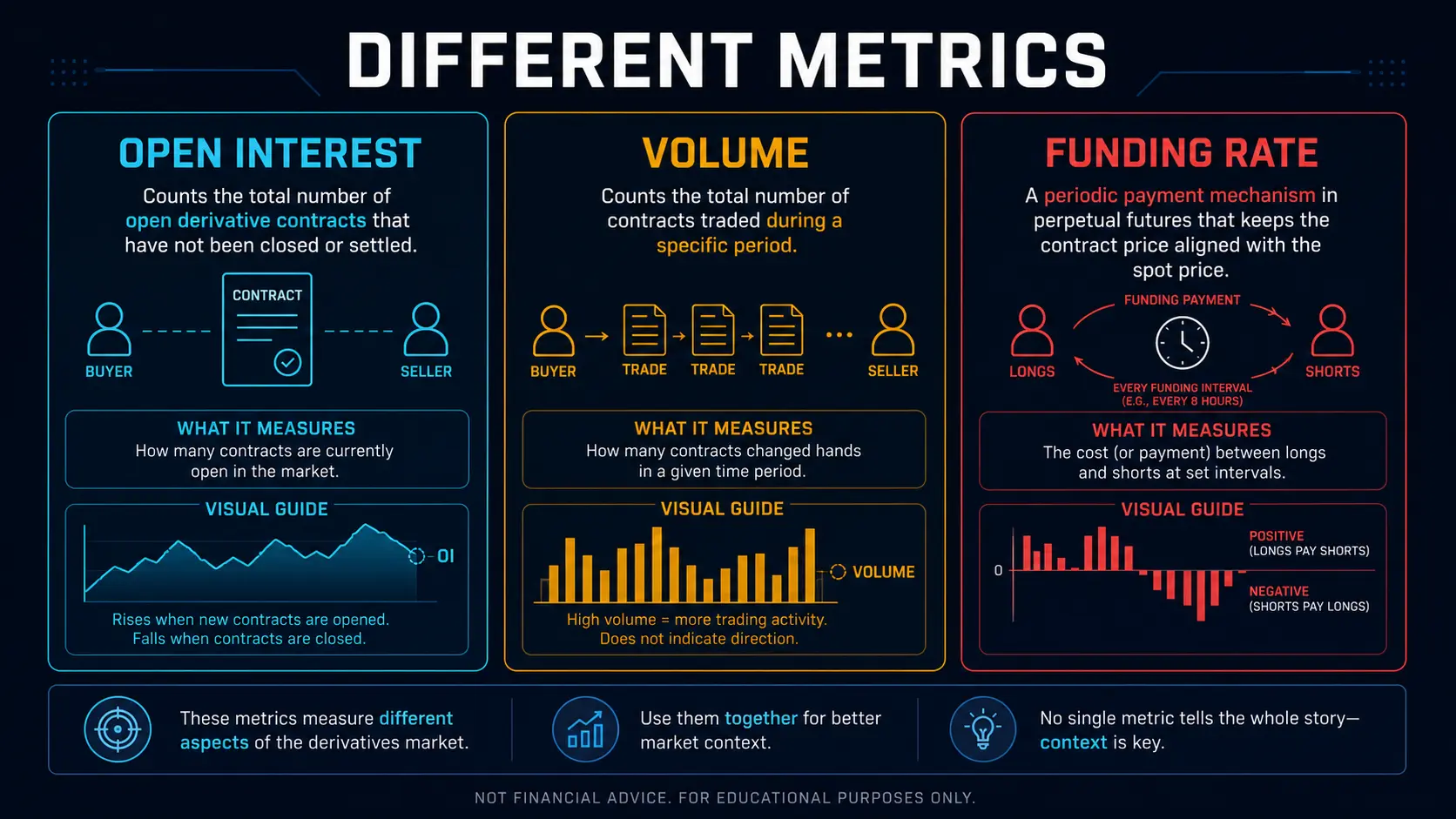
| Metric | What it usually measures | Important limit |
|---|---|---|
| Open Interest | Open derivative contracts | Does not show directional conviction by itself |
| Volume | Transactions during a chosen period | High volume can include opening and closing activity |
| Funding rate | A periodic mechanism on many perpetual futures venues | Not a futures-market OI measure and varies by venue |
How to read price and OI without turning it into a signal
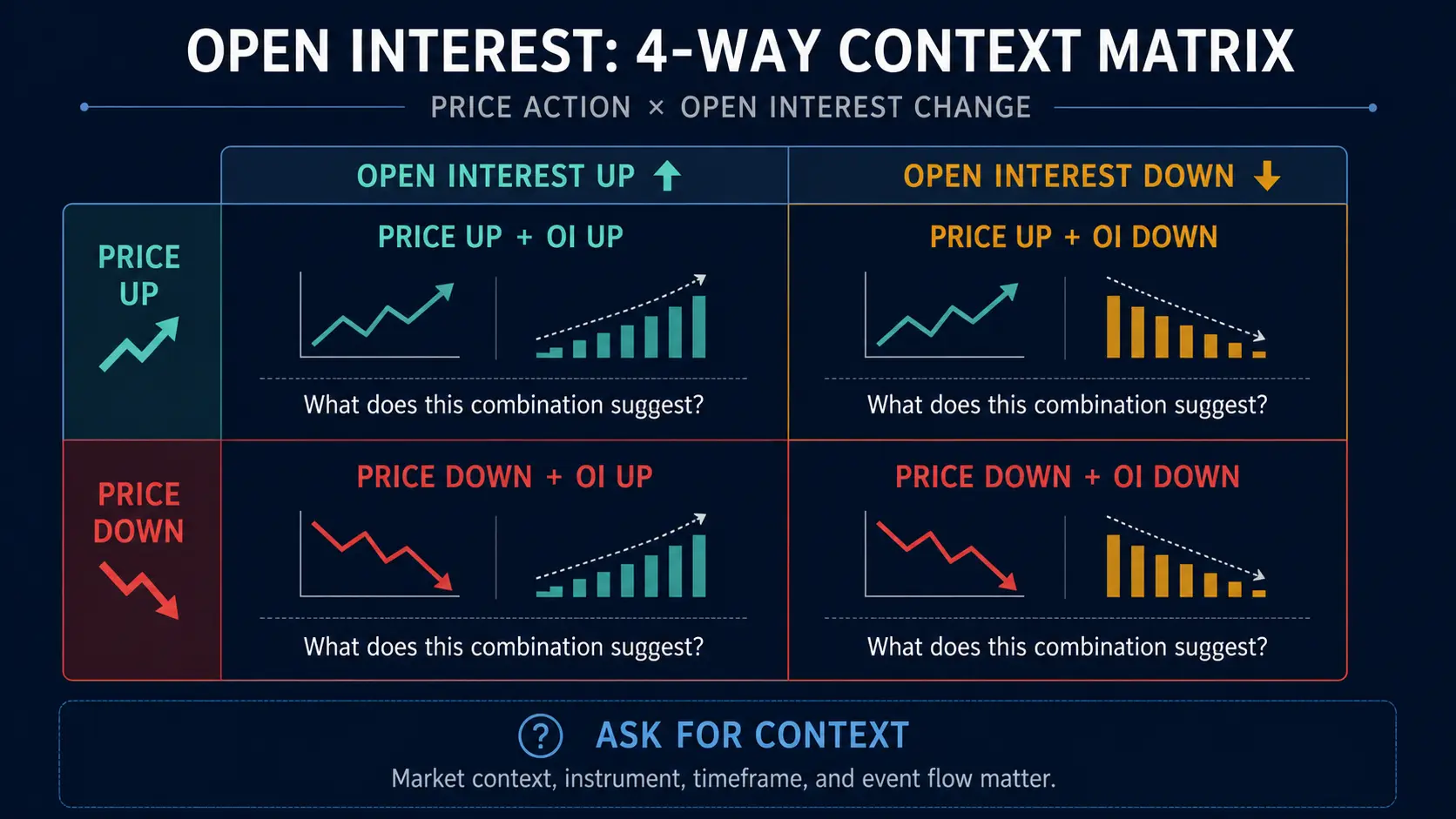
Price rising with OI rising can coincide with new positions entering, but it does not identify whether the market is becoming sustainably stronger. Price falling with OI rising can occur in a range of conditions as well. The safer question is: what is price doing at a relevant level, how liquid is the market, and what would invalidate the scenario?
Use normal structure and liquidity context before interpreting OI. The site’s liquidity in trading guide is useful for separating a data observation from a claim about future movement.
Any hypothetical execution still needs risk–reward planning and position sizing; Open Interest does not replace either control.
Futures, crypto and spot-FX limitations
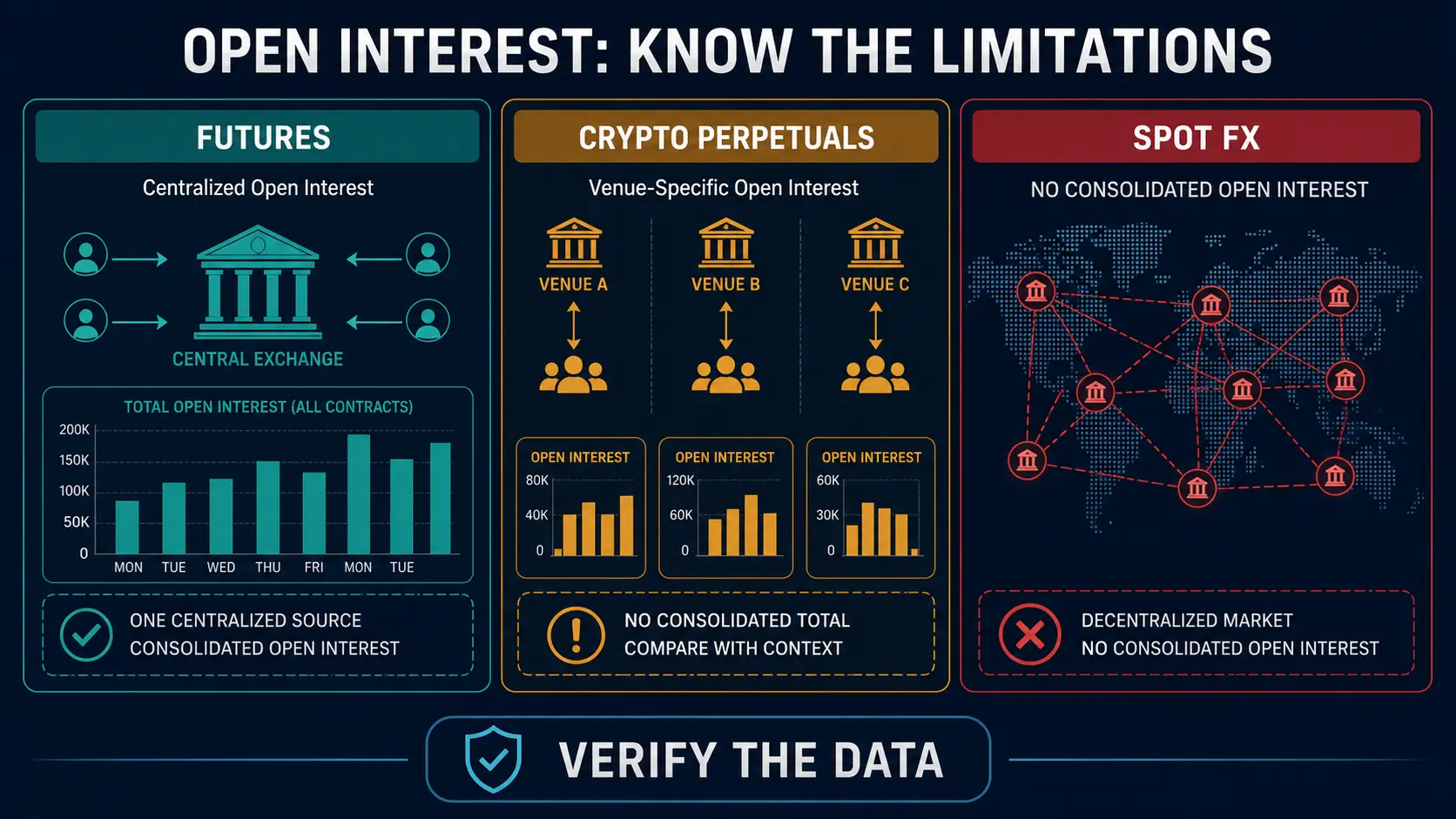
For a listed futures contract, reported OI relates to that contract and exchange. In crypto, OI may be shown per exchange, per perpetual contract or as an aggregation from selected venues; check provider coverage and timestamps. Spot FX is decentralized, so there is no single global OI number comparable to exchange futures OI. Futures OI can be informative for a related currency or metal contract, but it is not identical to activity in a retail spot quote.
A practical OI workflow
- State the exact contract, venue or data provider and time of the OI reading.
- Separate OI from volume, funding and price movement.
- Mark price structure and event risk before attaching meaning to an OI change.
- Compare a series over consistent contract and roll conditions.
- Log both continuation and failure examples before treating a pattern as useful.
Common mistakes
- Calling rising OI automatically bullish or falling OI automatically bearish.
- Comparing OI from different contracts, venues or timestamps.
- Using a crypto OI dashboard as a complete measure of all market positioning.
- Applying futures OI directly to spot FX without disclosing the proxy limitation.
- Ignoring contract expiration, roll periods and the possibility of fast liquidations.
FAQ
Can Open Interest tell me whether traders are net long or net short?
No. Every open contract contains one long and one short. OI measures open contracts, not aggregate directional exposure.
Is Open Interest useful for spot Forex?
There is no consolidated spot-FX OI. A trader may use futures OI as related context, but it must be treated as a proxy with different market structure and participants.
Example: why a large OI move needs more than one explanation
Consider a futures contract after a large news release. Price may fall while reported OI rises. One explanation is new short exposure; another is new long exposure being met by shorts; another is activity related to hedging or contract-roll mechanics. The data cannot identify the motive on its own. A useful journal would note the event, contract month, volume, spread and whether price later accepted or rejected the level.
Open Interest is most useful as a descriptive input inside a repeatable review process. It should not be used to make claims about an unnamed group of traders or to assert that a reversal is inevitable.
Contract rolls and reporting timing
Futures OI can shift as liquidity moves from an expiring contract to a later contract. A continuous chart can hide this transition unless the analyst checks which contract the OI series represents. Daily reporting timestamps may also differ from intraday price observations. Compare like with like: same contract, same reporting convention and a clearly documented period.
Open Interest checklist
- What exact derivative contract or crypto venue does the reading cover?
- Is the change adjusted for expiration or contract roll behavior?
- Is the OI timestamp aligned with the price and volume data?
- What price behavior would support or weaken the scenario?
- What execution and risk limits apply if volatility accelerates?
Sources and further reading
Risk disclosure: This article is educational information, not investment advice or a solicitation to trade. Derivatives, macro relationships and historical observations have limits and do not guarantee future outcomes. Trading can result in loss of capital. Verify your data, assess risk and make your own decisions.