


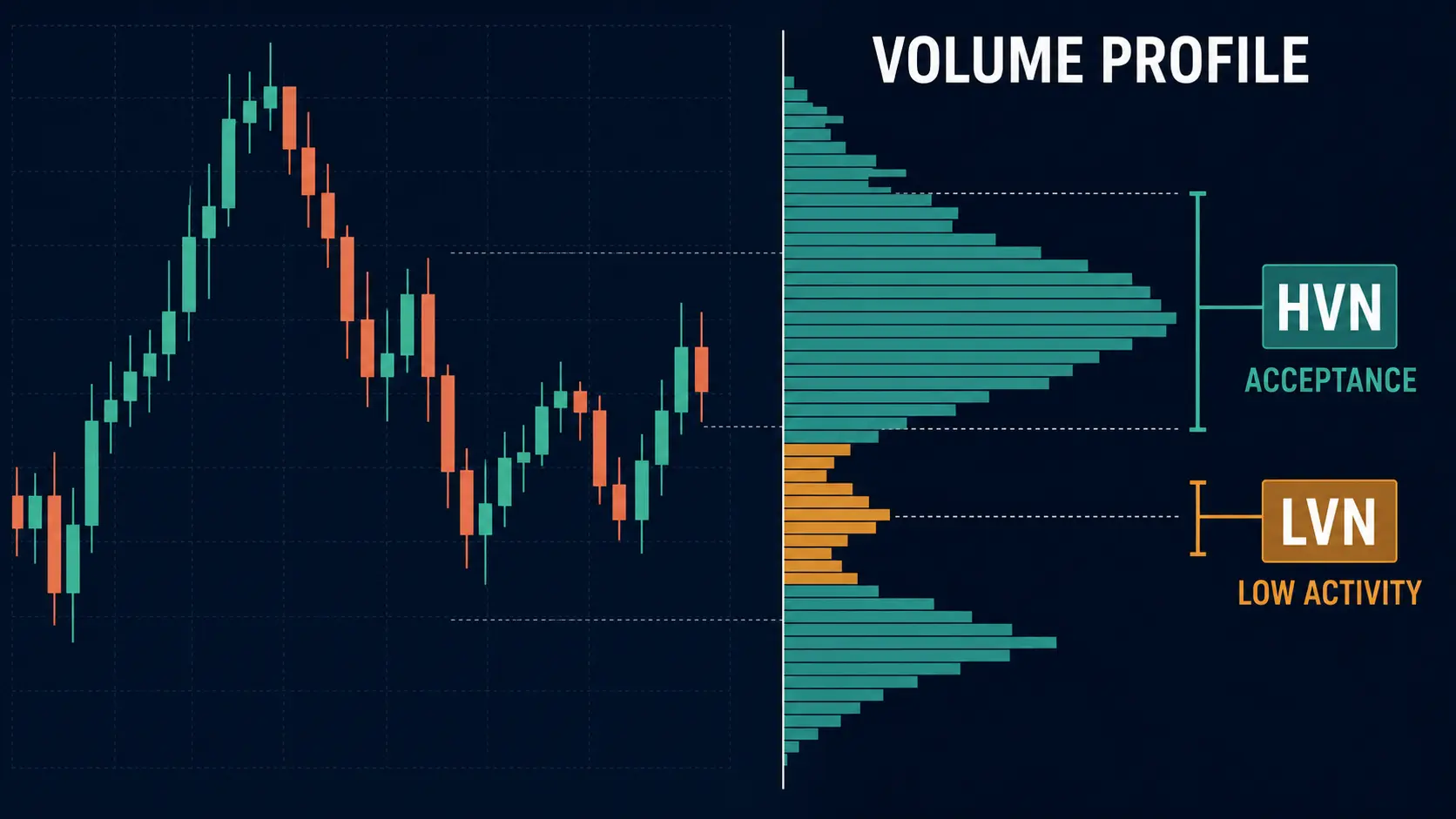
A High Volume Node (HVN) is a price area with relatively high reported volume in a selected Volume Profile, while a Low Volume Node (LVN) is a thinner area between concentrations. These nodes describe volume-at-price within a chosen range and data feed. They can frame questions about acceptance and travel, but they are not guaranteed support, resistance or price targets.
Key takeaways
- HVNs are broad volume concentrations; LVNs are relatively low-volume areas on a selected profile.
- The shape changes if the data feed, contract, session or profile range changes.
- HVN can coincide with rotation or acceptance; LVN can coincide with faster travel, but neither behavior is guaranteed.
- A Naked POC is usually a prior POC that has not yet been revisited under a chosen definition.
- Use price response and invalidation, not a node label alone.
HVN and LVN explained
Volume Profile aggregates reported executed volume at each price level. A broad area of bars is often called an HVN; a thin valley between broader areas is often called an LVN. They are visual summaries of where the chosen market data concentrated, not direct measurements of hidden liquidity or institutional intent.
The key distinction is simple: HVN and LVN belong to volume-at-price analysis. Keep this separate from time-based auction tools and ordinary support/resistance so the data source and meaning stay clear.
For a reproducible profile workflow, compare the Volume Profile POC, VAH and VAL guide and keep the chosen range aligned with market structure context.
Acceptance, rotation and travel are conditional
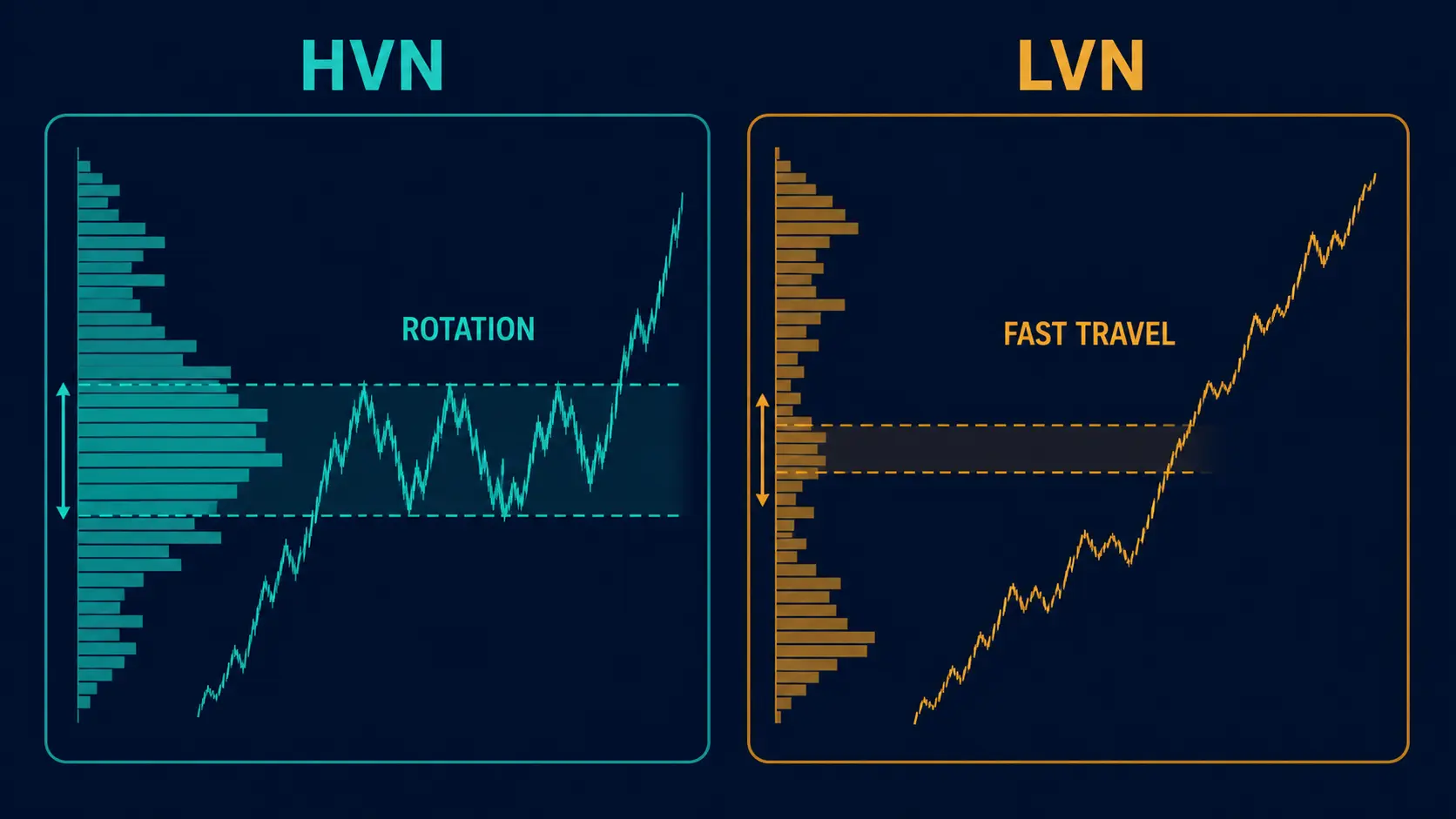
Price can rotate around an HVN if the market continues accepting that area. It can move through an LVN quickly if participation remains thin. But price may also pause at an LVN, cut through an HVN during news, or reverse for reasons the profile does not capture. The node provides a location to observe; price response provides the evidence.
What is a Naked POC?
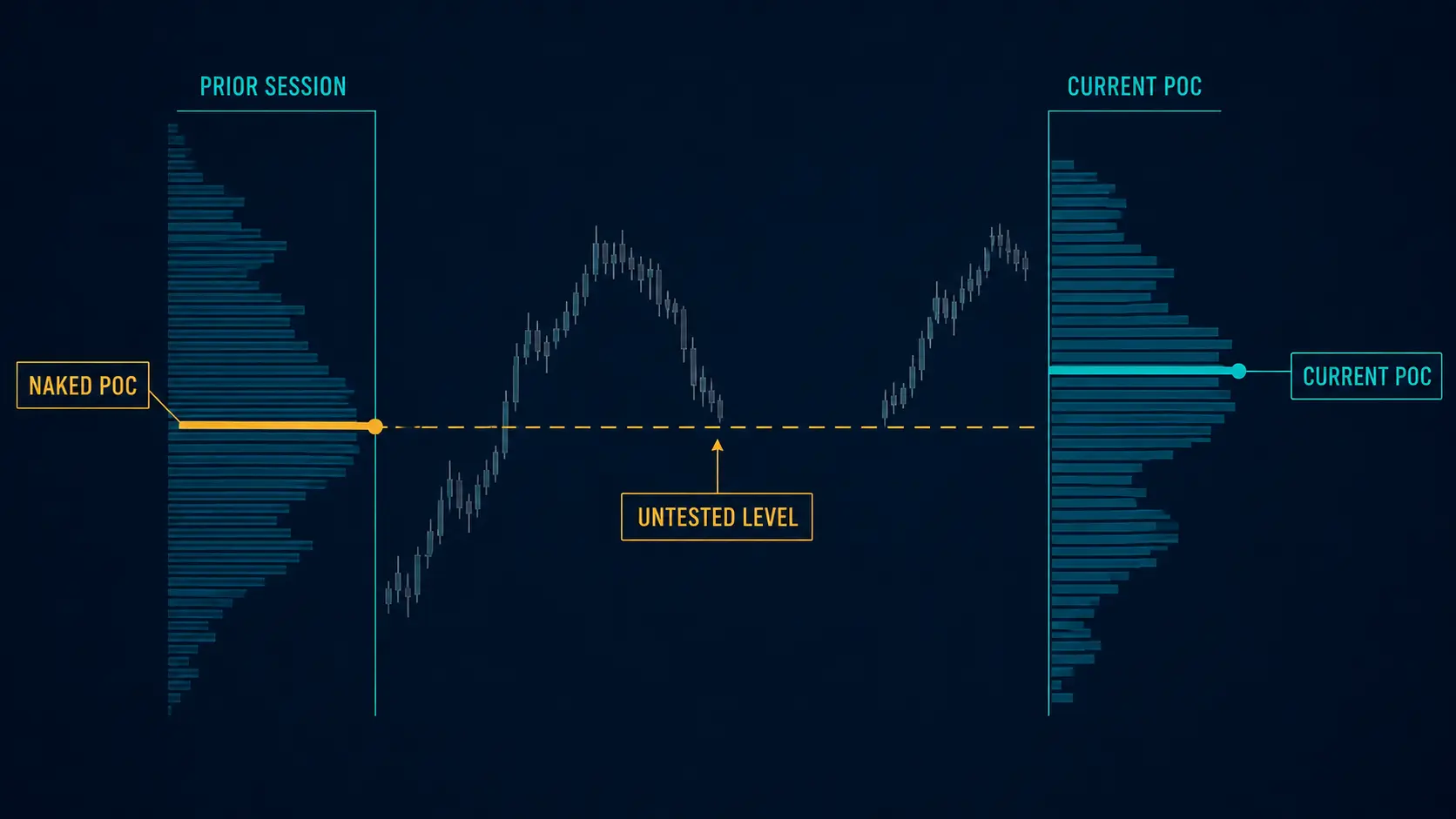
A Point of Control (POC) is the price of greatest reported volume under the platform’s profile settings. A “Naked POC” commonly refers to a prior session’s POC that later price has not revisited. It is a reference level, not a magnet. Whether it remains relevant depends on the chosen session definition, subsequent market development, liquidity and the price response if it is revisited.
Define the profile before interpreting it
A daily profile, a swing profile and a multi-session composite can produce different HVNs, LVNs and POCs. Record the instrument, contract, data feed, session timezone, chosen range and tick grouping. Without those settings, another analyst cannot reproduce the level or evaluate the claim.
A practical HVN/LVN workflow
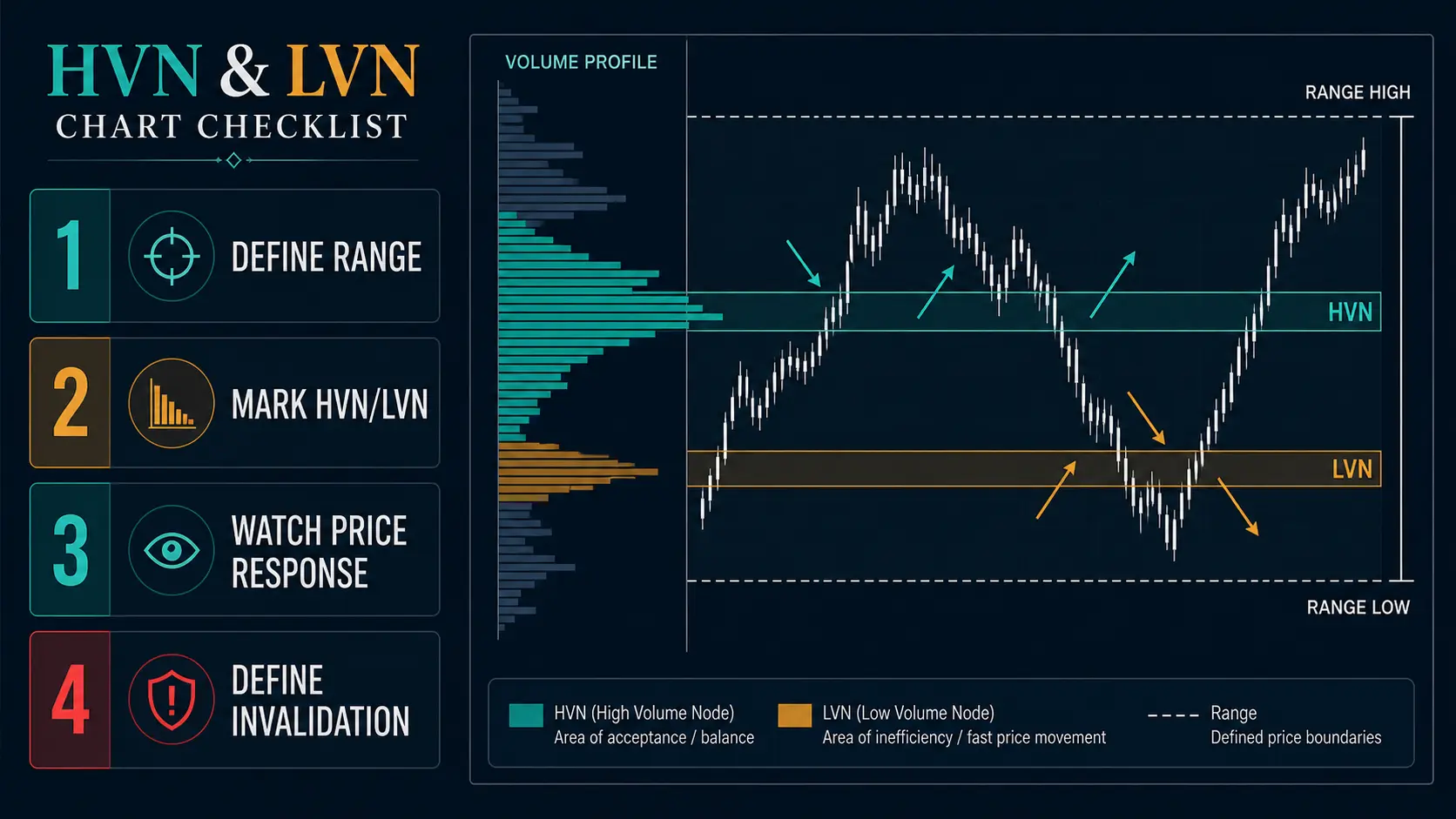
- Define the range and verify what volume the feed reports.
- Mark meaningful HVNs, LVNs and POCs without assuming they will hold.
- Compare the levels with ordinary market structure and scheduled event risk.
- Observe acceptance, rejection or failed follow-through when price reaches the area.
- Define invalidation and realistic execution conditions before considering a trade.
Common mistakes
- Calling every profile bulge an HVN without a consistent range.
- Assuming price must fill an LVN or revisit a Naked POC.
- Using profile references from a different contract or session than the active chart.
- Confusing volume at price with time at price.
- Ignoring spread, slippage and event-driven liquidity changes.
FAQ
Is HVN support or resistance?
It can become a relevant area on a chart, but it is not inherently support or resistance. Its role depends on price response, context and the selected profile.
Does an LVN always mean fast price movement?
No. LVN describes low reported volume in the chosen range. It can coincide with fast movement, but price can still pause or reverse there.
Worked conceptual example: one profile, several possible outcomes
Suppose a session has a broad HVN in the middle and a thin LVN above it. If price returns to the HVN and continues trading on both sides, the market may be accepting that area. If price moves through the LVN but quickly returns, the prior low volume does not by itself explain what will happen next. The useful note is the response: acceptance, rejection or failed continuation.
High and low volume areas are better used to prepare questions than to predict a path. The analyst still needs ordinary structure, event context and a point at which the idea is invalid.
Composite profiles and data consistency
A composite profile can reveal volume concentrations across several sessions, but it also combines different market conditions. Document the start and end of the range and avoid extending or shortening it merely because a level looks more attractive. If contract roll or feed coverage changes during the range, the resulting node can be less comparable than it appears.
Checklist for a Naked POC reference
- What profile range and data source created the POC?
- What counts as a later test under the chosen rule?
- Has a new event or structural break changed the original context?
- What would acceptance or rejection look like on price?
- Can the expected execution conditions support the planned risk?
Sources and further reading
Risk disclosure: This article is educational information, not investment advice or a solicitation to trade. Derivatives, macro relationships and historical observations have limits and do not guarantee future outcomes. Trading can result in loss of capital. Verify your data, assess risk and make your own decisions.