


Price action trading analyzes the movement of price through swings, trends, ranges, candles, support and resistance rather than relying primarily on indicator signals. It is not a single setup and it does not make the next candle predictable. A useful price-action process separates context, location, trigger and invalidation: first classify the market, then mark a relevant area, wait for observable confirmation and define where the idea is wrong. This foundation article explains each component, compares common setup families and provides a repeatable chart-reading workflow for beginners across Forex, gold, crypto and index markets.
Definition: What Is Price Action Trading?
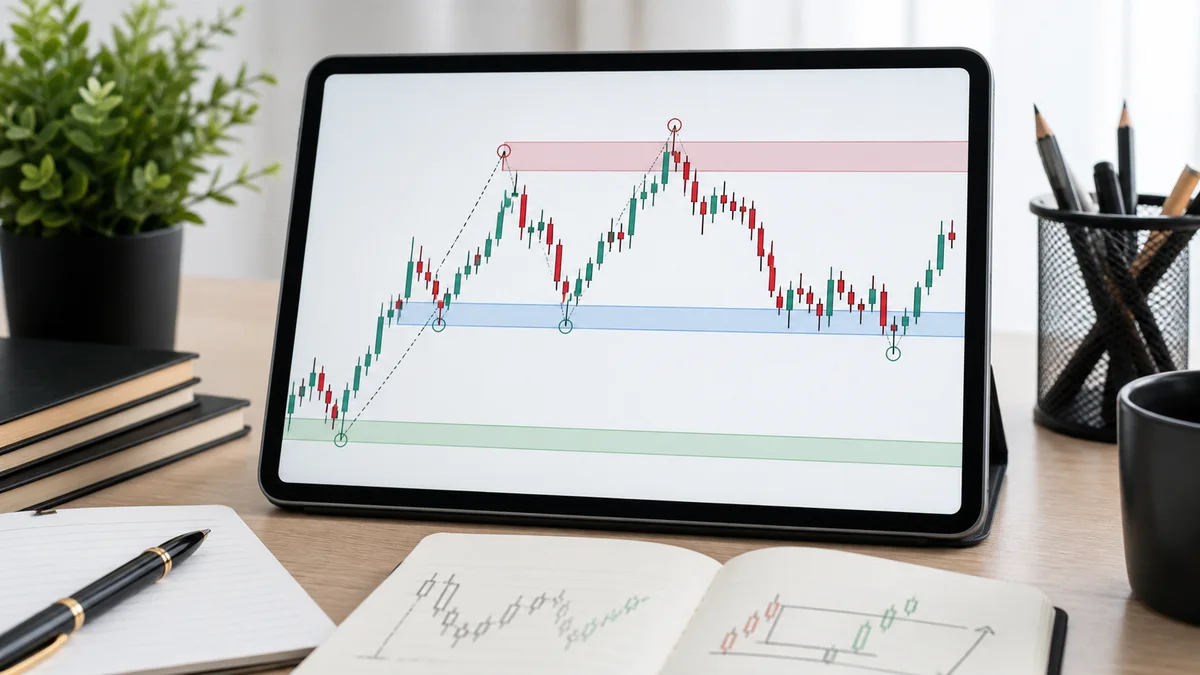
Price action trading is a method of analyzing a market by focusing mainly on the movement of price itself. Instead of building a decision around several indicators, a price action trader studies candles, swing highs and swing lows, support and resistance, trend structure, ranges, breakouts, pullbacks, and the way price reacts around important areas.
In simple terms, price action trading asks a few direct questions:
- Is the market trending, ranging, or transitioning?
- Where has price reacted strongly before?
- Are buyers or sellers currently showing more control?
- Is the current move strong, weak, impulsive, or corrective?
- Where would the trade idea be proven wrong?
This approach belongs to the broader field of technical analysis. It does not require you to ignore fundamentals, news, macro conditions, or risk events. It simply means that your chart decision is based primarily on how price is behaving. A trader may still check economic calendars, earnings dates, session timing, liquidity conditions, or higher-timeframe market context before making a decision.
The phrase “price action” is sometimes used loosely online. Some people use it to mean candlestick patterns only. Others use it to describe support and resistance trading, supply and demand, market structure, Smart Money Concepts, Wyckoff-style reading, or even pure naked-chart trading. For beginners, it is more useful to think of price action trading as a chart-reading framework rather than a single strategy.
A candlestick pattern by itself is not a complete price action setup. A pin bar, engulfing candle, inside bar, or breakout candle can mean very different things depending on where it forms. A bullish candle at a strong support area after a controlled pullback is not the same as a bullish candle in the middle of a messy range. Context changes everything.
That is the first major lesson: price action trading is not about memorizing candle names. It is about understanding the story behind the movement.
Why Price Action Trading Matters
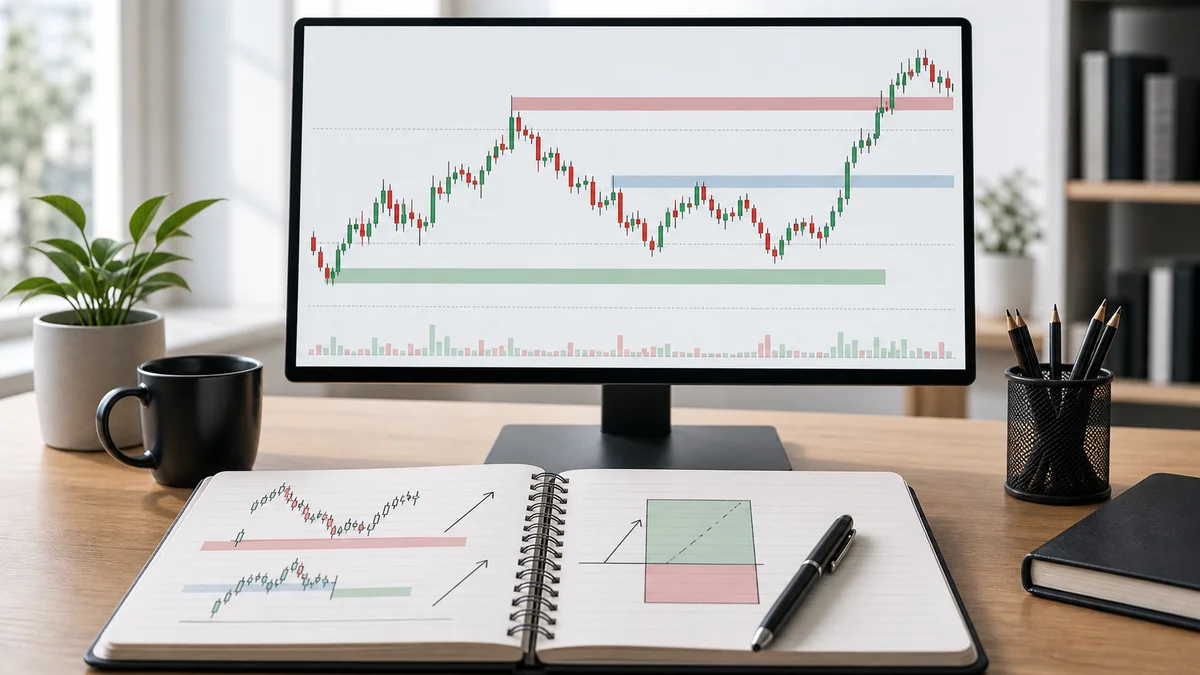
Price action matters because every market decision eventually appears on the chart. Buyers and sellers can have different reasons for acting, but their actions are reflected through movement: expansion, rejection, hesitation, compression, breakout, pullback, continuation, or reversal. Learning to read those changes gives a trader a cleaner view of market behavior.
For beginners, price action trading has several advantages.
First, it reduces dependency on lagging signals. Many indicators are calculated from price, volume, or both. They can be useful, but if a beginner uses too many indicators too early, the chart becomes confusing. One indicator says buy, another says wait, another says trend is strong, and the trader ends up making decisions from noise. Price action forces you to start with the chart itself.
Second, it teaches structure. A trader who understands structure can look at a chart and describe what is happening: higher highs and higher lows, lower highs and lower lows, a sideways range, a failed breakout, a deep pullback, or a possible trend transition. This skill is useful even if you later add indicators, order flow tools, or fundamental filters.
Third, it helps with risk placement. A good trade idea needs a point of invalidation. Price action can help you define that point more logically. If your long idea depends on support holding, then a clear break below that support may invalidate the idea. If your short idea depends on a lower high, then a strong break above that lower high may invalidate it. You still need position sizing, but at least your stop placement is connected to chart logic.
Fourth, price action concepts can be studied across many markets and timeframes because it is based on behavior rather than one fixed indicator setting. Stocks, forex, crypto, commodities, indices, and futures all move through trends, ranges, breakouts, pullbacks, and failed moves. The details differ, but the basic language of price movement is widely transferable.
That said, price action is not perfect. It does not predict the future with certainty. It can produce false signals, especially during low-liquidity periods, news events, and choppy markets. Two skilled traders can read the same chart differently. This is why risk management must sit beside every price action decision.
A useful external reminder comes from regulators such as the CFTC’s forex fraud education resources, which warn traders to be cautious of claims involving high returns with low risk. Good price action trading does not remove risk. It helps you define and manage it more clearly.
Core Concepts Every Beginner Should Learn First
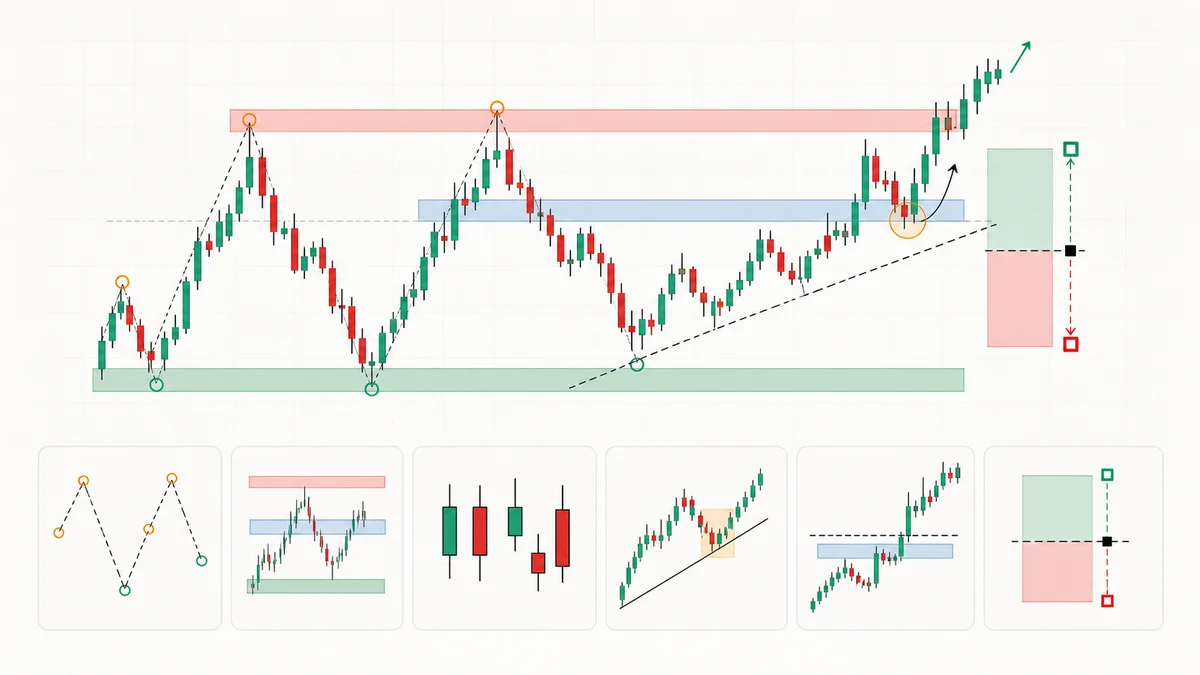
Most beginners make price action harder than it needs to be. They jump straight into advanced patterns, secret setups, or complicated terminology before they understand the foundation. A better path is to master a small group of core concepts first.
Market Structure
Market structure is the basic skeleton of price movement. In an uptrend, price often forms higher highs and higher lows. In a downtrend, it often forms lower highs and lower lows. In a range, price moves sideways between areas where buying and selling pressure repeatedly appear.
Structure helps you answer the first question: what type of environment am I in? A pullback setup makes more sense in a trend. A mean-reversion setup makes more sense in a range. A breakout setup makes more sense when price has compressed near a key level. Without structure, traders often apply the wrong tactic to the wrong environment.
Support and Resistance
Support is an area where price has previously attracted enough buying interest to slow or reverse a decline. Resistance is an area where price has previously attracted enough selling interest to slow or reverse a rally. These areas are better treated as zones, not exact lines.
Support and resistance matter because they show where market participants have reacted before. Price may bounce, break, retest, reject, or slice through these areas. The reaction is often more important than the level itself. A level that looks strong on the left side of the chart still needs confirmation from current behavior.
Britannica Money’s overview of support and resistance is a useful beginner-friendly reference for understanding why traders watch these areas.
Candlestick Behavior
Candles show the battle between buyers and sellers during a selected period. A candle with a large body suggests directional pressure. A candle with a long wick may suggest rejection, profit-taking, or temporary exhaustion. A small candle may show hesitation or reduced volatility.
Beginners often memorize candlestick pattern names but miss the behavior behind them. Instead of asking, “Is this candle a pin bar?” ask, “What did price try to do, and how did the market respond?” If price pushes below support but quickly closes back above it, that is useful information. If price breaks resistance with a strong close and later holds above it, that is also useful information.
Trends and Pullbacks
A trend is not a straight line. Even strong trends pause, retrace, and shake out late entries. Pullbacks are temporary moves against the dominant direction. For many beginners, learning to read pullbacks is more practical than chasing breakouts after price has already moved far.
A healthy pullback often shows controlled movement, reduced momentum against the trend, and a reaction near a logical area. A dangerous pullback may break structure, expand aggressively, or move straight through areas that should have held. Price action trading helps you compare those behaviors.
Breakouts and Failed Breakouts
A breakout happens when price moves beyond a significant area such as resistance, support, a range boundary, or a trendline. Breakouts can start powerful moves, but they can also fail. A failed breakout occurs when price moves beyond a level, attracts traders in one direction, and then reverses back into the previous area.
New traders often enter too early because they fear missing the move. A more patient approach is to study the quality of the breakout: Was there momentum? Did price close clearly beyond the level? Was there a retest? Did the retest hold? Is there room before the next obstacle? These questions reduce impulsive entries.
Confluence
Confluence means several pieces of evidence support the same trade idea. For example, a bullish setup may have higher-timeframe support, an uptrend structure, a controlled pullback, and a strong rejection candle. None of those factors guarantees a winning trade, but together they can create a clearer decision.
The danger is overdoing it. Too much confluence becomes confirmation hunting. Beginners should keep confluence simple: structure, level, reaction, risk. If those four do not make sense, adding five more indicators will not fix the trade.
Risk and Invalidation
Risk is the part beginners most often skip, but it is the part that keeps a trader alive long enough to improve. Every setup should answer: where is my idea wrong? That point is the invalidation area. Your stop loss, position size, and target planning should be built around it.
A setup with a beautiful entry but unclear invalidation is not beginner-friendly. If you cannot explain where the idea fails, you are probably reacting emotionally rather than trading a plan.
Main Subcategories of Price Action Trading
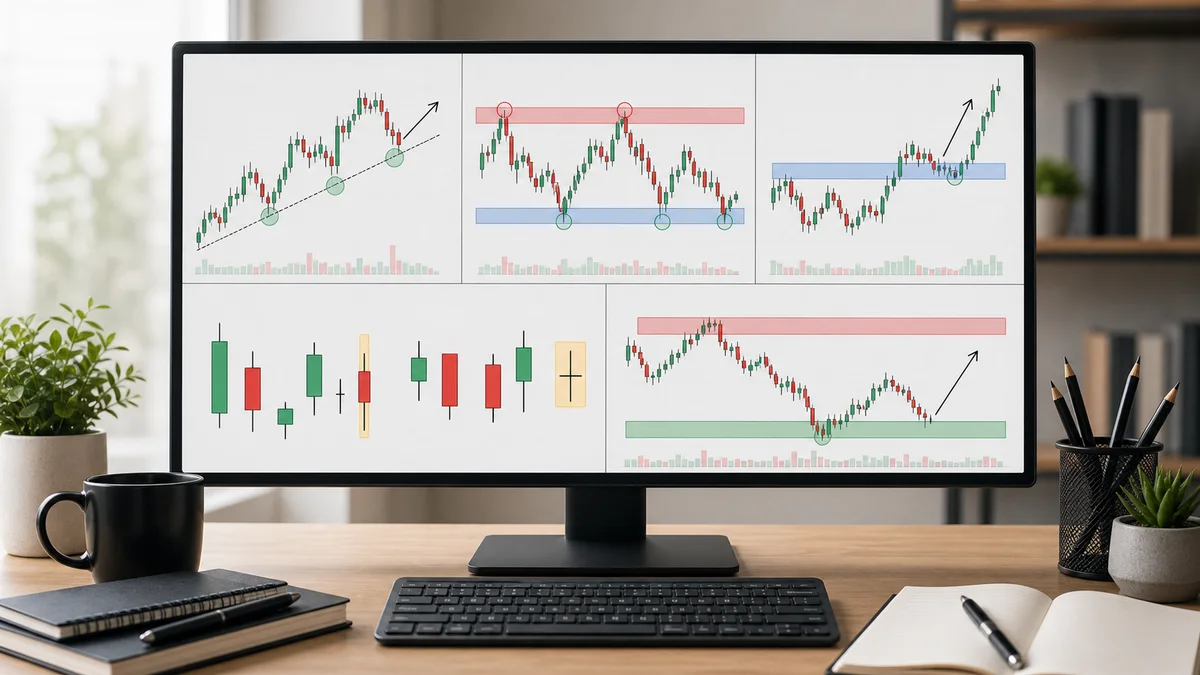
Once the foundation is clear, price action trading branches into several subcategories. These categories overlap, and many traders combine them, but separating them helps beginners organize their learning.
Support and Resistance Trading
This is the classic form of price action trading. The trader identifies important zones, waits for price to reach them, and studies the reaction. Setups may include rejection candles, failed breakdowns, retests, range bounces, or breakout continuations.
The beginner mistake is drawing too many lines. If every level is important, no level is important. Focus on the cleanest areas: obvious swing points, repeated reactions, range highs and lows, and levels visible on higher timeframes.
Trend Continuation Trading
Trend continuation trading focuses on joining an existing trend after a pause or pullback. Instead of predicting a reversal, the trader waits for price to correct and then looks for signs that the dominant side is stepping back in.
This style teaches patience. In an uptrend, the trader does not buy every green candle. They wait for a pullback, a logical area, and a reaction. In a downtrend, they do not short after every red candle. They wait for a rally into resistance or a lower-high area.
Breakout and Retest Trading
Breakout traders look for price to escape a range or important level. Retest traders wait for price to break, return to the level, and show that the old resistance may now act as support, or old support may now act as resistance.
The retest approach can be useful for beginners because it creates a clearer invalidation point. If price breaks resistance and later retests it as support, a failure back below that zone may invalidate the long idea. The structure is easier to define than a chase entry in the middle of a fast candle.
Candlestick Pattern Trading
Candlestick pattern trading uses formations such as engulfing candles, pin bars, inside bars, doji candles, and strong momentum candles. These patterns are easy to learn but easy to misuse. They should be studied as behavior, not signals by themselves.
A bullish engulfing candle at a random location may not mean much. A bullish engulfing candle at higher-timeframe support after a controlled pullback may be more meaningful. Location and context come first; pattern name comes second.
Market Structure Trading
Market structure traders focus on swings, breaks of structure, changes in character, trend transitions, and range development. This subcategory is popular because it helps traders avoid treating every candle as equally important.
Structure-based trading is useful for building directional bias. If price keeps making higher highs and higher lows, a beginner should be careful about shorting too aggressively. If price keeps making lower highs and lower lows, a beginner should be careful about buying every dip.
Supply and Demand or Zone-Based Trading
Supply and demand trading focuses on areas where price previously moved away with strength. Traders interpret these zones as places where orders, imbalance, or strong participation may have existed. When price returns, they watch for a reaction.
This can be helpful, but beginners should avoid marking every strong candle as a zone. A good zone usually needs context: trend, location, freshness, reaction strength, and room for price to move.
Smart Money and Liquidity Concepts
Some traders study liquidity sweeps, stop runs, fair value gaps, order blocks, and related Smart Money Concepts. These ideas can be useful, but they can also become overwhelming if learned too early. A beginner should first understand basic structure, support and resistance, and risk. Advanced terminology is not a substitute for clear chart reading.
A Beginner Workflow for Reading Any Chart

The best way to learn price action trading is to follow the same workflow repeatedly. A repeatable process reduces emotional decisions and makes your review more useful. Here is a simple beginner workflow.
Step 1: Start With the Higher Timeframe
Before looking for entries, identify the larger context. If you trade on a 15-minute chart, check the 4-hour or daily chart. If you trade on a 1-hour chart, check the daily and weekly charts. You are not looking for perfection. You are asking: is the bigger picture trending, ranging, or near a major decision area?
This step helps you avoid taking low-quality trades directly into higher-timeframe resistance or selling directly into higher-timeframe support.
Step 2: Mark Only the Most Important Zones
Draw the cleanest support and resistance zones. Keep the chart simple. Mark major swing highs, swing lows, range boundaries, and areas where price reacted strongly. Avoid filling the chart with lines from every tiny candle.
Good zones should be visible without forcing them. If you have to explain too much, the level may not be useful for a beginner plan.
Step 3: Define the Current Market Structure
Ask whether price is making higher highs and higher lows, lower highs and lower lows, or moving sideways. Then ask whether that structure is clean or messy. Clean structure is easier for beginners. Messy structure often means uncertainty, overlapping candles, and poor follow-through.
If the structure is unclear, skipping the trade is a valid decision. Price action trading is not about forcing a setup every day.
Step 4: Wait for Price to Reach a Decision Area
Many bad trades happen in the middle of nowhere. A better habit is to wait for price to reach a zone where a decision makes sense: support, resistance, a pullback area, a range boundary, a breakout retest, or a higher-timeframe level.
Waiting is difficult because beginners often feel that every candle is an opportunity. In reality, most candles are just movement. A setup becomes more meaningful when price reaches a location where buyers or sellers may have a reason to act.
Step 5: Read the Reaction
When price reaches the area, study the reaction. Does price reject quickly? Does it hesitate? Does it break with strength? Does it break and return? Does it form a weak bounce that gets sold immediately? The reaction tells you whether the area is being respected, challenged, or ignored.
This is where price action becomes active. You are no longer predicting from a static line. You are observing how the market behaves at that line.
Step 6: Plan Entry, Stop, and Target Before Entering
Before entering, define the trade idea in one sentence. For example: “I am looking for a long because price is in an uptrend, pulling back into support, and showing rejection.” Then define invalidation: “This idea is wrong if price breaks and holds below this support zone.”
Only after that should you calculate position size and target. Your risk per trade should be decided before the trade, not after price starts moving against you.
Step 7: Journal the Outcome
A trading journal turns experience into feedback. Record screenshots, market context, reason for entry, stop placement, target, result, and emotional state. Over time, you will see patterns in your own behavior. You may discover that you trade trends well but lose money in ranges, or that you enter too early before confirmation.
Price action skill develops through repetition and review. Without review, beginners often repeat the same mistake while believing they are learning.
Common Price Action Trading Mistakes
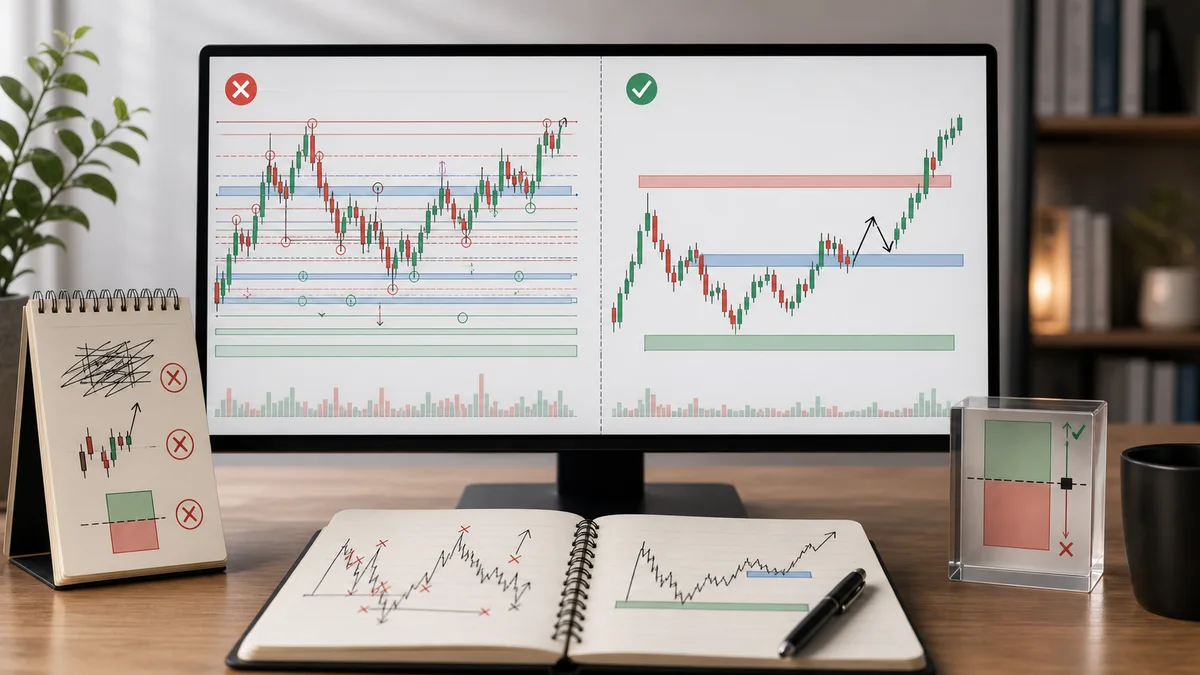
Most beginner mistakes are not caused by lack of information. They are caused by using information in the wrong way. Here are the mistakes to avoid first.
Mistake 1: Trading Candle Patterns Without Context
A candle pattern is not a strategy. A strong candle can appear at the end of a move, in the middle of a range, during a news spike, or at a meaningful level. The same pattern can have different meaning depending on context.
Fix this by asking three questions before every pattern: Where is it forming? What is the market structure? What would prove the idea wrong?
Mistake 2: Drawing Too Many Levels
Beginners often mark every high and low. The result is a chart full of lines and no clear decision. Good price action trading requires selective attention. You want the levels that many traders can see, not the levels that only exist because you zoomed in too far.
Fix this by limiting yourself to major zones first. If a level is not connected to a clear reaction or structure point, remove it.
Mistake 3: Chasing Breakouts
Breakouts are exciting, but chasing them late often creates poor risk-to-reward. By the time a beginner enters, price may be near the next resistance or support. If the breakout fails, the stop is often too wide or placed randomly.
Fix this by waiting for a close, a retest, or a clean continuation structure. Missing a trade is better than entering with no plan.
Mistake 4: Ignoring Higher-Timeframe Context
A setup may look perfect on a lower timeframe but sit directly inside a higher-timeframe obstacle. For example, a bullish 5-minute pattern under daily resistance may have limited room. A bearish lower-timeframe setup into weekly support may be risky.
Fix this by checking at least one higher timeframe before every trade idea.
Mistake 5: Moving the Stop Loss
Price action trading can make traders feel very involved with every candle. That attention becomes dangerous if it leads to moving stops emotionally. A stop should represent invalidation. If you move it only because you do not want to lose, the plan has already broken.
Fix this by deciding risk before entry and accepting the outcome. A controlled loss is part of trading. An uncontrolled loss is a process failure.
Mistake 6: Believing Price Action Is Always Clean
Charts often look clean in examples because educators choose clear historical moments. Live markets are messier. Candles overlap. Levels fail. News changes conditions. Liquidity dries up. A beginner should expect uncertainty instead of assuming every chart will follow a textbook pattern.
Fix this by trading only the clearest setups during your learning phase. Your job is not to trade everything. Your job is to build skill under conditions you can understand.
Mistake 7: Skipping Risk Management
Even a strong method can fail without risk control. A trader can read the market reasonably well and still damage an account by using oversized positions, revenge trading, or refusing to take losses. Risk management is not separate from price action. It is what allows the method to survive real outcomes.
Fix this by setting a fixed risk limit per trade, using position sizing, and reviewing whether your stop placement matches the chart structure.
Next Learning Path for Price Action Traders
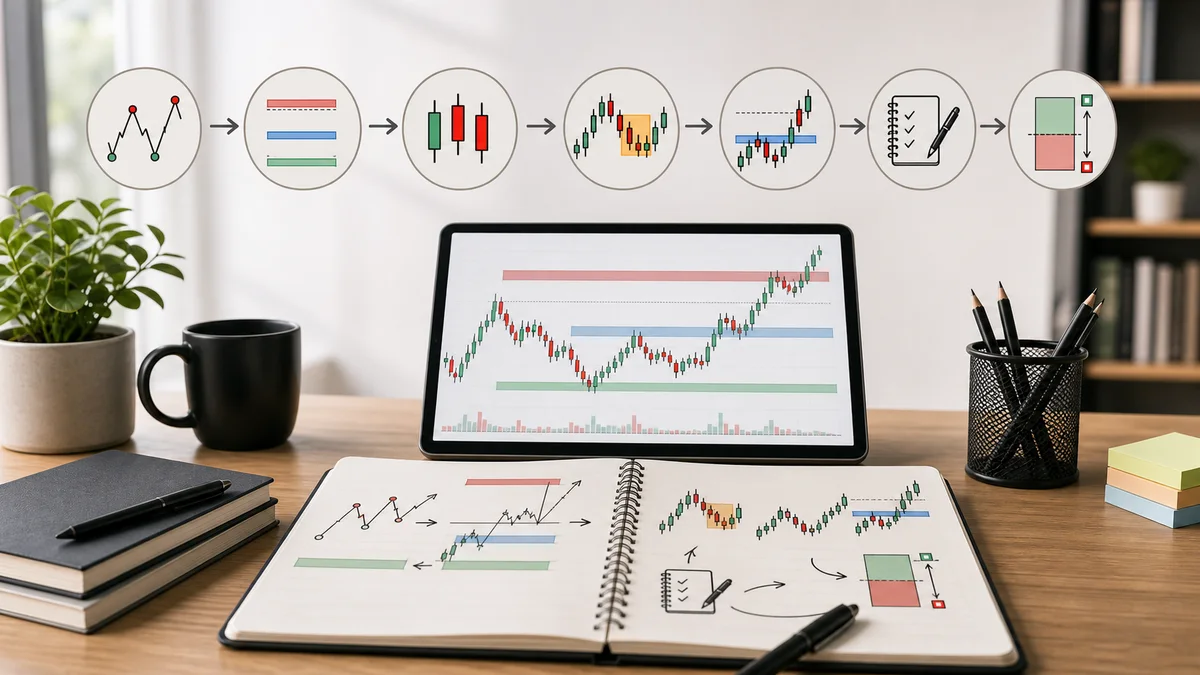
If you are new, do not try to learn everything at once. Price action trading becomes much easier when you follow a sequence. The right order matters because each skill supports the next one.
Start with market structure. Learn to identify trends, ranges, swing highs, swing lows, higher highs, higher lows, lower highs, and lower lows. Spend time labeling charts without taking trades. If you cannot describe structure, entries will feel random.
Next, learn support and resistance. Practice drawing zones instead of exact lines. Study how price reacts when it returns to these zones. Notice the difference between a clean rejection, a weak bounce, a strong breakout, and a failed breakout.
After that, study candlestick behavior. Focus on the message behind the candle rather than the name. A long wick, strong body, inside candle, or engulfing move only matters when it appears in the right context.
Then move to trend continuation and pullbacks. This is often more beginner-friendly than trying to call reversals. Learn how healthy pullbacks look, where they tend to pause, and how continuation attempts fail.
Once those skills are comfortable, study breakout and retest trading. Breakouts can be powerful, but they require patience. Learn the difference between a real breakout, a weak breakout, and a trap.
Finally, explore advanced frameworks such as supply and demand, liquidity concepts, Smart Money Concepts, or Wyckoff-style analysis. These can add depth, but they should not replace the basics. Advanced language without basic structure usually creates confusion.
As this English Price Action hub grows, this guide should link to deeper lessons on support and resistance, candlestick patterns, market structure, pullback trading, breakout trading, trading journals, and risk management. For now, use this page as the foundation. Every cluster article should point back here, and this hub should become the main internal-link target for the category.
Final Thoughts

Price action trading is not a shortcut to easy profits. It is a way to read market behavior with fewer distractions. The beginner path is simple, but not easy: understand structure, mark key zones, wait for price to reach meaningful areas, read the reaction, define invalidation, manage risk, and review your trades.
Progress is better assessed through a documented process than by the number of patterns memorized. They are the ones who can explain what the market is doing, why a setup makes sense, where the idea is wrong, and what they will do if the trade fails. That is the real value of price action trading.
If you are just starting, keep your chart clean. Focus on one market, one or two timeframes, and a small number of setups. Build a journal. Review your screenshots. Let the market teach you through repetition. Over time, price action will stop looking like random candles and start looking like a readable sequence of decisions.
Evidence hierarchy for a price-action decision
| Layer | Question | Example evidence |
|---|---|---|
| Context | Trend, range or transition? | Swing structure |
| Location | Where is the decision occurring? | Prior reaction zone or range boundary |
| Trigger | What changed now? | Structure break or rejection close |
| Invalidation | What disproves the idea? | Acceptance beyond the defining swing or zone |
| Risk | Is the loss tolerable? | Predefined size and exit rule |
The layers should be written before entry. Adding a new explanation after price moves against the position makes the process impossible to evaluate. A screenshot, timestamp and brief reason for the setup provide more useful evidence than a perfect chart annotated after the outcome is known.
Sources and further reading
- CME Group — Technical Analysis
- Fidelity Learning Center — What Is Technical Analysis?
- CFTC — Foreign Currency Trading Advisory
Practise the rules before using real capital
If you decide to practise these chart rules, start in a demo environment and record each setup before considering a live account. Open the Exness account information page. Products, availability and trading conditions vary by jurisdiction; review the applicable terms and regulatory information yourself.
Affiliate disclosure: Học Làm Trader may receive a commission if you open an account through this link, at no additional cost to you. The relationship does not change the educational analysis or remove trading risk.
Risk warning: This article is for education and general information only. It is not investment advice, a trade signal, or an invitation to trade. Technical-analysis tools are based on historical market data and can fail. Trading can result in loss of capital; test rules, define invalidation, and size risk before using real money.
Related guides in this topic
- MSNR Trading Strategy: Complete Beginner-to-Advanced Guide
- What Is MSNR Trading? Meaning, Logic and Beginner Rules
- MSNR Terminology: SNR, Fresh Level, Storyline, Rejection and Confluence