


trading theories Trading theories are frameworks for organizing observations about trend, cycles, market phases, geometry or price behavior. They provide scenario language rather than a verified forecast, and different theories can describe the same chart in conflicting ways. The method should be treated as a testable chart-reading framework rather than a forecast. Before using it, define the market condition, confirmation event, invalidation price, transaction costs and maximum risk. This guide explains the rules, a repeatable workflow, common failure modes and the most relevant supporting concepts.
Definition: What Are Trading Theories?

Trading theories are structured ideas used to interpret financial markets. They give traders a way to classify what price is doing, why certain areas may matter, and how a setup might develop. In technical analysis, trading theories often focus on chart behavior: trend direction, market cycles, waves, phases, momentum, volatility, volume, liquidity, and repeated human behavior.
A theory is not the same thing as a signal. A moving average crossover is a signal. A candlestick pattern is a signal. A trading theory is broader. It gives you a lens for understanding the market before you decide whether a signal is worth trading. For example, a breakout candle inside a strong trend may mean something different from a breakout candle at the end of an exhausted move. The theory helps you judge context.
Common technical analysis frameworks include Dow Theory, Elliott Wave Theory, Wyckoff Method, Gann Theory, price action trading, Smart Money Concepts, auction market theory, volume spread analysis, market profile, and intermarket analysis. Each framework has its own language and focus. Dow Theory emphasizes trend phases and confirmation. Elliott Wave studies wave structure and crowd psychology. Wyckoff focuses on accumulation, distribution, and the relationship between effort and result. Smart Money Concepts focuses on liquidity, structure, displacement, and reaction zones.
Beginners often ask which trading theory is the best. A better question is: which framework helps you make clearer decisions? The best theory for one trader may not fit another trader. A swing trader may prefer higher-timeframe structure and market cycles. A day trader may care more about session behavior, liquidity sweeps, and intraday volatility. A long-term investor may use technical frameworks only as a timing tool alongside fundamental analysis.
Trading theories exist because markets are complex. Price is shaped by many forces: supply and demand, liquidity, positioning, news, sentiment, macro conditions, institutional activity, retail behavior, and risk appetite. A chart condenses those forces into movement. A theory helps you turn that movement into a map.
However, the map is not the territory. A theory can simplify the market, but it can also mislead you if you force it onto every chart. A clean framework should help you ask better questions, define risk, and know when conditions are unclear. If a theory makes you more confident but less disciplined, you are using it incorrectly.
A practical trading theory should answer four basic questions. First, what market condition am I seeing? Second, where are the important decision areas? Third, what evidence would support a trade idea? Fourth, what evidence would prove the idea wrong? If a theory cannot help answer those questions, it may be interesting academically but weak as a trading tool.
This is why experienced traders often simplify theories into operating rules. They may study broad ideas from Dow, Elliott, Wyckoff, or auction market logic, but when it is time to trade, they reduce the theory into a plan: bias, setup, trigger, invalidation, target, and review. The theory provides the lens. The trading plan provides the execution.
Why Trading Theories Matter
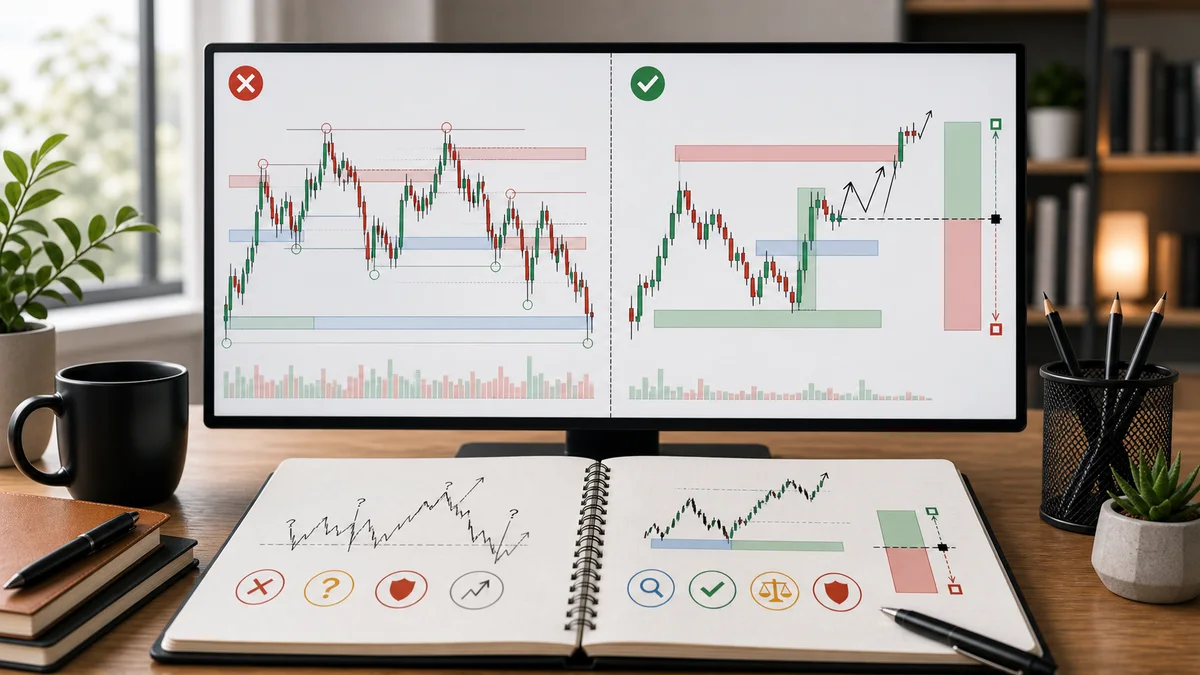
Trading theories matter because they turn chart analysis from random observation into a repeatable process. Without a framework, beginners often react to the latest candle. They buy because price is rising, sell because price is falling, or enter because a pattern looks familiar. A theory forces them to step back and ask: what environment is this market in?
That question is powerful. A trend-following setup works better in a trending environment. A mean-reversion setup works better inside a range. A breakout strategy needs compression, participation, and room to move. A reversal strategy needs exhaustion, failed continuation, or a structural shift. Trading theories help match tactics to market conditions.
They also improve communication. If two traders discuss a chart using a shared framework, they can explain their thinking more clearly. One trader may say price is in a Wyckoff accumulation phase. Another may say Elliott Wave suggests a corrective structure. Another may say price is taking liquidity before a possible market structure shift. They may not agree, but they are no longer speaking in vague emotions.
Trading theories also help traders review their work. If you trade without a framework, your journal becomes a list of wins and losses with no pattern. If you trade with a framework, you can ask better review questions: Did I correctly identify the trend? Did the wave count make sense? Was the Wyckoff phase clear? Did price confirm the breakout? Did my invalidation match the theory?
Another reason trading theories matter is that they help beginners avoid indicator overload. Many new traders add more and more indicators because they want certainty. The chart becomes crowded, but decision quality does not improve. A sound theory can reduce the need for clutter by giving structure to what price is already showing.
That said, trading theories can become dangerous when they are treated as belief systems. A trader may become loyal to a theory instead of loyal to evidence. They may keep adjusting an Elliott Wave count until it fits their bias, or label every sideways market as Wyckoff accumulation, or draw Gann angles without a clear risk plan. The market does not care about your preferred theory. Your job is to use the theory as a tool, not as an identity.
Good trading theory should make your analysis simpler, not more mystical. It should help you know where you are wrong. It should help you wait for better conditions. Most importantly, it should keep risk visible. If a framework cannot tell you where the trade idea fails, it is incomplete.
Trading theories also matter because they protect traders from short-term emotional pressure. When price moves quickly, beginners often feel that they must react immediately. A framework slows the decision down. It reminds the trader to check the higher timeframe, identify the environment, compare the setup with the rules, and decide whether the risk is acceptable. That pause can be the difference between a planned trade and an impulsive one.
Another benefit is consistency. A trader cannot improve a method they keep changing. When you use a defined theory, you can collect similar trades and compare them. You may discover that your Elliott Wave ideas work better on daily charts than intraday charts, or that your Wyckoff range reads are useful only when volume confirms them, or that your liquidity models fail in low-volatility sessions. This kind of feedback is impossible if every trade is based on a different idea.
Core Concepts Behind Technical Analysis Frameworks
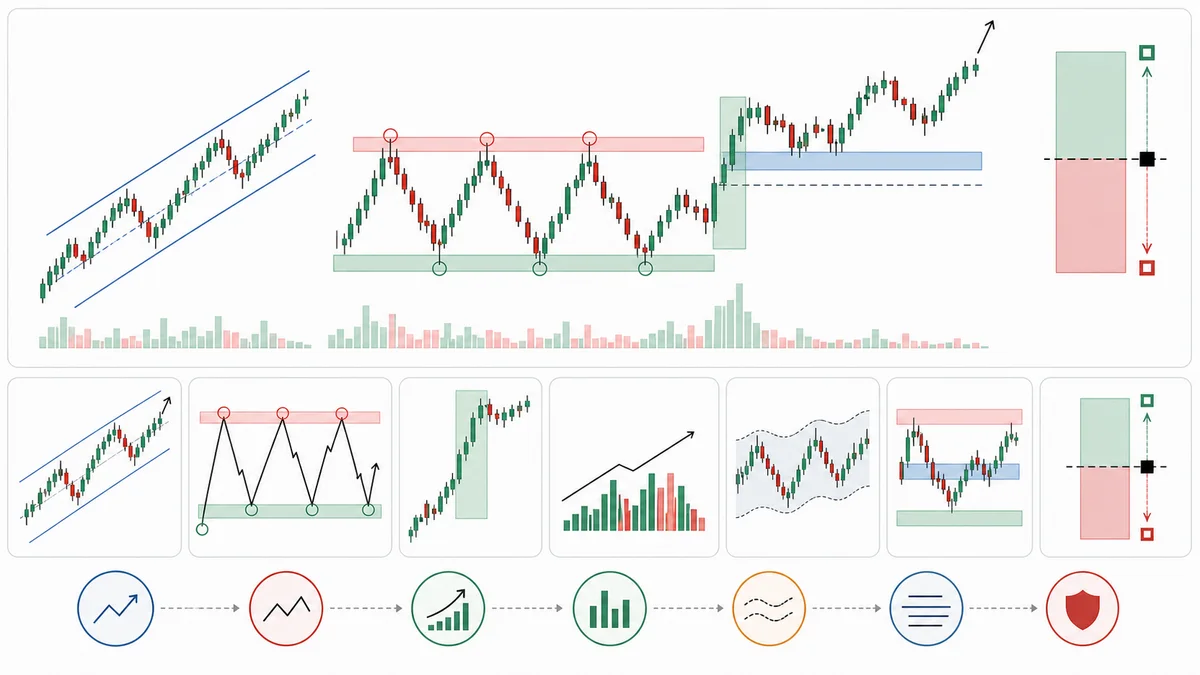
Different trading theories use different language, but many share the same foundation. Learning these core concepts first makes every framework easier to understand.
Trend
Trend is the direction of the market over a chosen timeframe. A market may be trending up, trending down, or moving sideways. Dow Theory, price action, moving average systems, and many breakout strategies all depend heavily on trend recognition. Beginners should learn to identify higher highs and higher lows, lower highs and lower lows, and range behavior before studying advanced patterns.
Market Structure
Market structure is the arrangement of swings, highs, lows, breakouts, pullbacks, and ranges. It tells you whether price is continuing, weakening, or transitioning. Structure is the bridge between simple price action and more advanced frameworks such as Smart Money Concepts, Wyckoff, and Elliott Wave.
Cycles
Markets often move in cycles: expansion and contraction, accumulation and distribution, impulse and correction, optimism and fear. Elliott Wave, Wyckoff, and broader market cycle theories all study how these phases may repeat. Cycles do not repeat perfectly, but they help traders avoid thinking every move is isolated.
Support and Resistance
Support and resistance are areas where price has previously reacted. They matter across almost every technical framework. A wave count may be judged around support. A Wyckoff spring occurs near a range low. A breakout setup depends on resistance breaking. A Gann level may overlap with a historical reaction zone. Levels are not magic lines, but they help define decision areas.
Volume and Participation
Volume shows participation. Some theories treat volume as essential. Wyckoff traders compare effort and result. Volume spread analysis studies the relationship between candle spread, closing location, and volume. Breakout traders often want increased volume to confirm participation. Even traders who do not use volume should understand why participation matters.
Momentum and Volatility
Momentum describes the force of movement. Volatility describes the size and speed of price movement. A strong impulse wave has momentum. A range with shrinking candles may show contraction. A breakout after volatility compression may have more potential than a breakout from noisy conditions. Many frameworks rely on the shift between quiet and active markets.
Invalidation and Risk
Every theory must lead to invalidation. If a Dow Theory trend is broken, the thesis changes. If an Elliott Wave count violates a key rule, the count must be revised. If a Wyckoff accumulation fails and price breaks down, the scenario is wrong. Trading theories become useful only when they help you define where your idea fails.
These core concepts are also connected. Trend gives direction, structure gives shape, levels give location, volume shows participation, momentum shows urgency, volatility defines the trading environment, and invalidation controls risk. A theory becomes stronger when it combines these concepts in a simple way. It becomes weaker when it hides behind terminology without explaining what price is actually doing.
For beginners, the best exercise is to annotate charts without entering trades. Mark the trend, the key levels, the current structure, the major cycle or phase, and the invalidation point for a possible idea. Then watch what happens. This builds pattern recognition without the emotional pressure of live execution.
Main Subcategories of Trading Theories
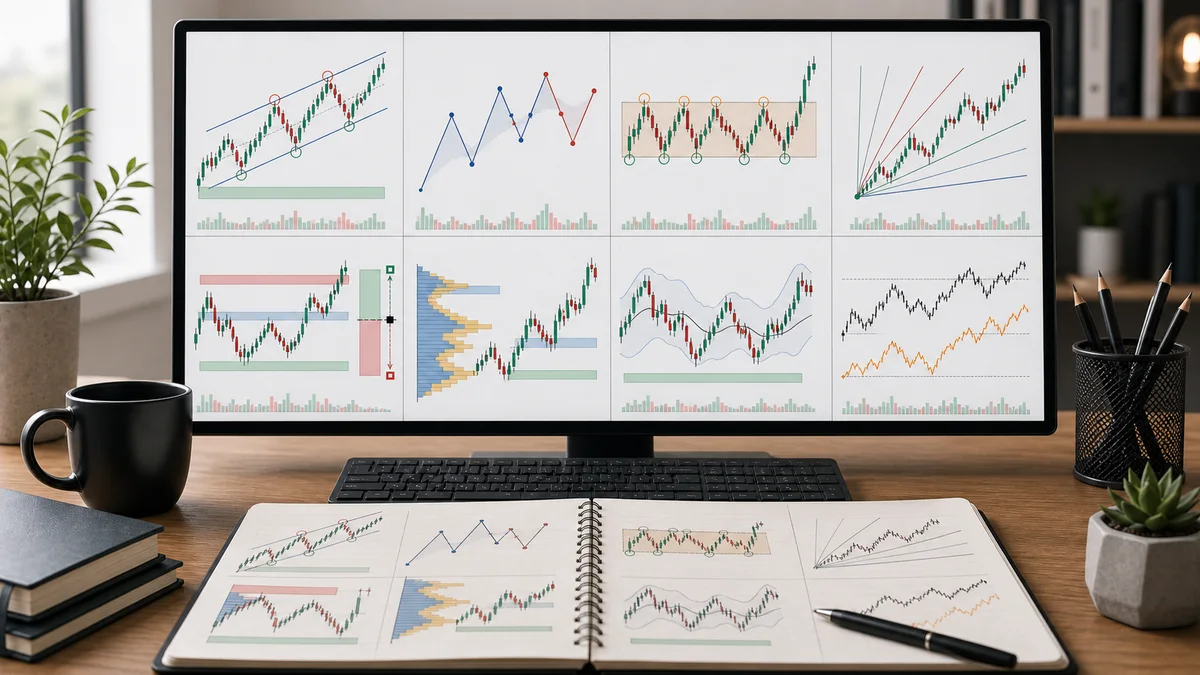
Trading theories can be grouped into several families. Each family emphasizes a different aspect of market behavior.
Trend and Market Structure Theories
These frameworks focus on direction, swing structure, and trend phases. Dow Theory is the classic example. Price action trading also belongs here because it studies higher highs, higher lows, lower highs, lower lows, support, resistance, and trend continuation. If you are new, this is usually the best starting point because it creates a simple chart-reading foundation.
Wave and Cycle Theories
Wave and cycle frameworks study repeating patterns in crowd behavior. Elliott Wave Theory is the most famous. It proposes that markets often move in impulsive and corrective waves. Cycle theories may also study timing, rhythm, and repeated expansion-contraction patterns. These frameworks can be powerful, but they can become subjective if a trader forces the count.
Wyckoff and Accumulation-Distribution Models
The Wyckoff Method studies how large operators may accumulate positions before an uptrend and distribute positions before a downtrend. It emphasizes phases, volume, trading ranges, springs, upthrusts, signs of strength, and signs of weakness. Wyckoff is useful because it teaches traders to study the relationship between effort and result instead of reacting to every candle.
Geometry, Time, and Gann-Based Theories
Gann Theory uses geometry, angles, time cycles, and price relationships. Some traders use Gann fans, squares, and time-price projections. This category is more advanced and can be highly interpretive. Beginners should first understand trend, structure, and support/resistance before moving into geometric timing methods.
Liquidity and Institutional Behavior Frameworks
Smart Money Concepts and related liquidity models focus on where orders may be resting, how price sweeps highs and lows, and how displacement may reveal shifts in control. This family connects well with price action but requires discipline. Without clear rules, traders may mark every wick as liquidity and every candle as an order block.
Volume and Auction-Based Frameworks
Auction market theory, market profile, volume profile, and volume spread analysis focus on participation and fair value. They ask where business has been accepted, where price has been rejected, and where volume is concentrated. These frameworks are useful for traders who want to understand market balance, imbalance, and auction behavior.
Intermarket and Macro-Technical Frameworks
Some theories study relationships between markets: currencies, bonds, commodities, equities, indices, and volatility. Intermarket analysis can help traders understand risk-on and risk-off behavior. It is especially useful for swing traders and macro-aware traders, but it should be paired with technical execution rules.
No subcategory is automatically superior. A trader can fail with a sophisticated framework and succeed with a simple one. What matters is fit. If you trade after work and can only check charts once or twice a day, a fast intraday liquidity model may be difficult to execute. If you enjoy detailed chart study, Elliott Wave or Wyckoff may fit your personality. If you want clean rules, trend structure and support-resistance frameworks may be easier to maintain.
Theories can also be combined, but only after each one is understood separately. For example, a trader might use Dow Theory for higher-timeframe trend, Wyckoff for range context, and price action for execution. Another trader might use Smart Money Concepts for liquidity and market profile for auction context. The danger is combining frameworks too early and creating analysis paralysis.
A Beginner Workflow for Studying Trading Theories
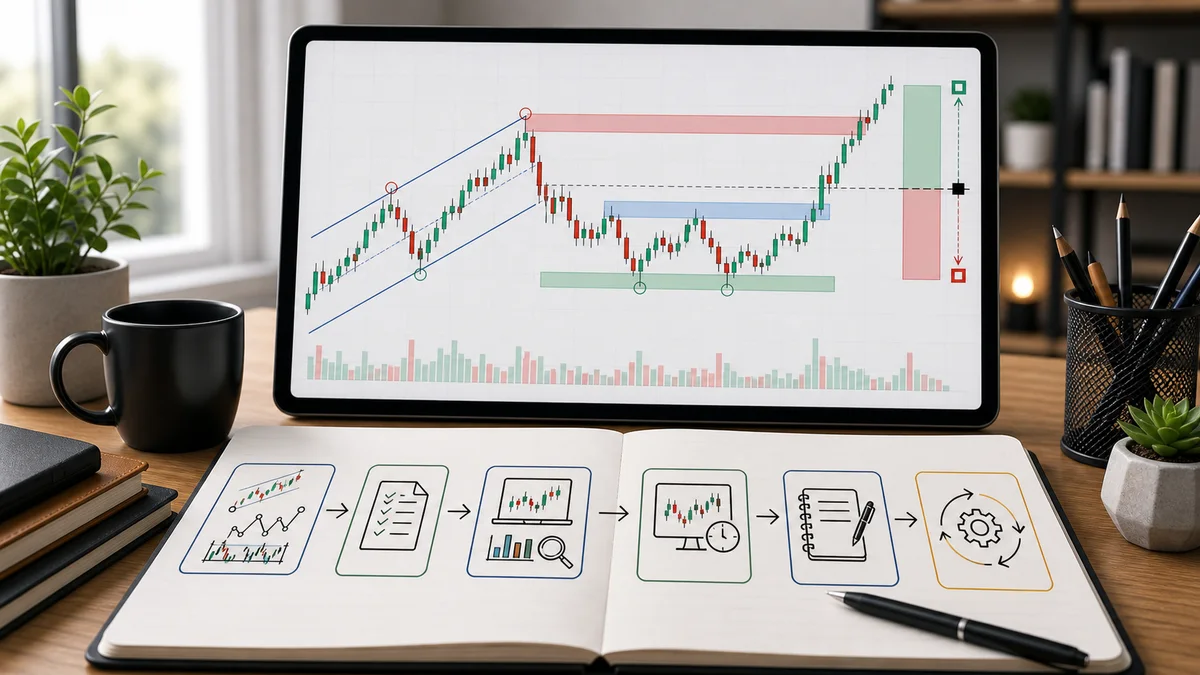
The biggest mistake beginners make is trying to learn every trading theory at once. They watch Dow Theory, Elliott Wave, Wyckoff, Gann, Smart Money Concepts, and volume profile videos in the same week. The result is not mastery. It is confusion. A better workflow is slower and more deliberate.
Step 1: Start With Price Structure
Before studying advanced theories, learn basic price structure. Identify trends, ranges, swing highs, swing lows, support, resistance, pullbacks, and breakouts. This foundation helps you understand every other framework. The Price Action Trading beginner guide is a useful internal starting point for this layer.
Step 2: Choose One Primary Framework
Pick one theory to study deeply for a period of time. If you like structure and simplicity, start with Dow Theory or price action. If you like patterns and psychology, study Elliott Wave. If you like ranges, volume, and phases, study Wyckoff. If you like liquidity and precision, study Smart Money Concepts.
Step 3: Write the Rules in Plain English
Do not rely on vague impressions. Write down what your framework requires. What is the setup? What is the context? What confirms the idea? What invalidates it? Where is the stop? Where is the target? If you cannot explain it clearly, you are not ready to trade it.
Step 4: Backtest Examples
Go through historical charts and collect examples. Save screenshots of clean setups, failed setups, confusing setups, and missed setups. Backtesting helps you see whether the theory is practical for your market and timeframe. It also exposes subjective areas where your rules need improvement.
Step 5: Forward Test With Small or Simulated Risk
Historical examples are cleaner than live markets. Forward testing shows how the framework feels in real time. Use a demo account, paper trading, or very small risk while learning. Your goal is not to make fast money. Your goal is to see whether you can follow the framework under pressure.
Step 6: Keep a Theory-Specific Journal
Your journal should track the theory you are testing. If you study Wyckoff, record phase, range, volume behavior, and spring/upthrust logic. If you study Elliott Wave, record wave count, invalidation, and alternate scenarios. If you study SMC, record liquidity, displacement, reaction zone, and invalidation.
Step 7: Refine or Replace the Framework
After enough review, decide whether the theory fits you. Some traders love wave counting. Others find it too subjective. Some traders love Wyckoff. Others prefer direct price action. A framework should match your personality, schedule, market, and risk tolerance.
This workflow may feel slow, but it prevents shallow learning. The internet makes it easy to collect theory after theory without ever building skill. Real progress comes from narrowing your focus, testing one idea long enough to understand its strengths and weaknesses, and then deciding whether it deserves a place in your plan.
A useful rule is to study one framework for at least 50 to 100 chart examples before judging it. Those examples do not all need to be trades. They can include clean setups, failed setups, unclear charts, and skipped scenarios. The goal is to train your eye and build a realistic sample, not to prove that the theory is perfect.
Common Mistakes When Learning Trading Theories
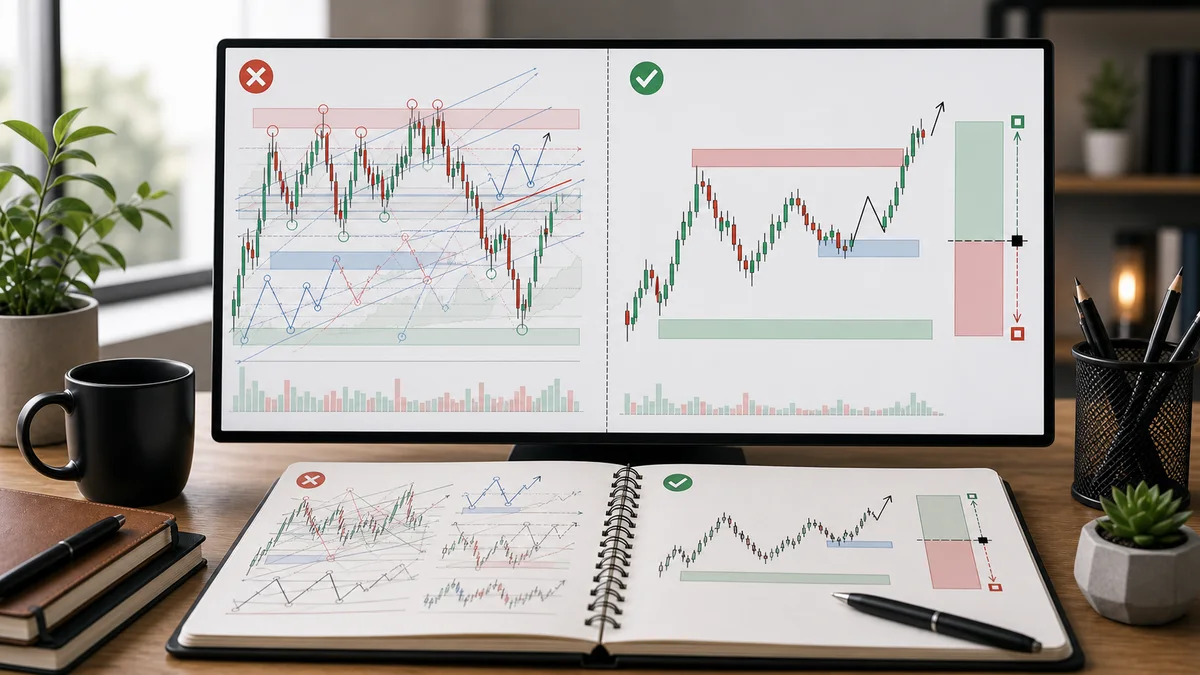
Trading theories can improve your analysis, but they can also create bad habits if learned the wrong way. These are the mistakes to avoid first.
Mistake 1: Treating a Theory as a Prediction Machine
No theory predicts the future with certainty. A wave count can fail. A Wyckoff range can break the wrong way. A liquidity sweep can continue instead of reverse. A Gann level can be ignored. A trading theory gives you a scenario, not a guarantee.
Mistake 2: Forcing the Chart to Fit the Theory
This is extremely common. Traders adjust wave counts, redraw ranges, move levels, or reinterpret signals until the chart supports their bias. A good framework should challenge your bias, not protect it. If the chart does not fit the theory cleanly, skip the trade.
Mistake 3: Mixing Too Many Frameworks
Combining frameworks can be useful after you understand them. It is dangerous when you are new. A beginner may use Elliott Wave for direction, SMC for entry, Gann for timing, and volume profile for confirmation, then become unable to make a decision. Start with one primary framework and one simple risk model.
Mistake 4: Ignoring Timeframe Differences
A theory may look bullish on the daily chart and bearish on the 15-minute chart. That does not mean the theory is broken. It means timeframes have different structures. Beginners should decide their trading timeframe first, then use higher timeframes for context and lower timeframes for execution only when needed.
Mistake 5: Forgetting Risk Management
Many traders learn theory because they want certainty, but risk management exists because certainty does not exist. Every framework needs a stop point, position size, and maximum loss rule. A complex theory without risk control is just a complicated way to lose money.
Mistake 6: Learning From Perfect Examples Only
Educational charts often show perfect historical examples. Live markets are messy. A theory must be tested on unclear charts, failed setups, and choppy conditions. Study the failures as much as the textbook examples.
Mistake 7: Changing Theories After Every Loss
A losing trade does not automatically mean the theory is bad. It may mean the setup failed, your execution was poor, or the market environment was unsuitable. Review a sample of trades before judging a framework. Constantly switching theories prevents real learning.
Next Learning Path for Technical Analysis Frameworks
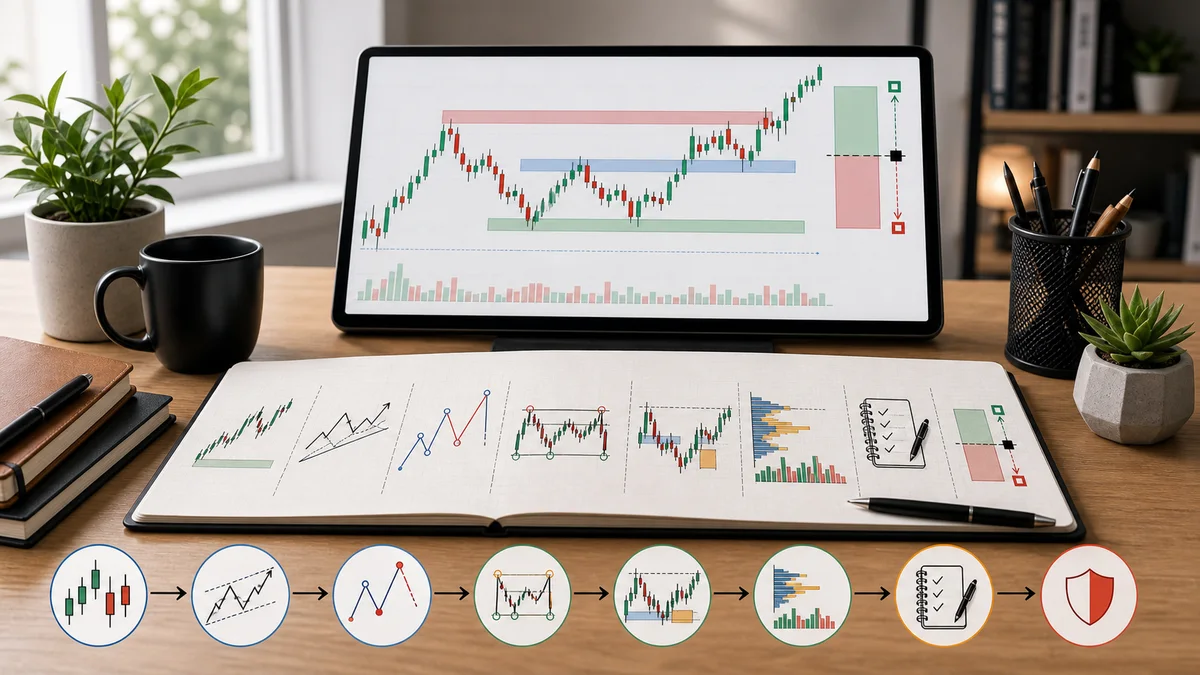
If you are new to trading theories, follow a sequence. The order matters because advanced frameworks depend on basic chart-reading skills.
Start with price action and market structure. Learn how trends, ranges, pullbacks, breakouts, support, and resistance behave. This is the base layer for almost every technical theory. Without it, advanced language becomes confusing.
Next, study Dow Theory. It is one of the simplest ways to understand primary trends, secondary reactions, and confirmation. Even if you do not trade Dow Theory directly, it teaches a disciplined way to think about trend phases.
After that, learn Elliott Wave as a framework for impulse and correction. Do not rush into advanced wave counting. First understand the basic idea that markets often move in directional legs and corrective pauses. If the English Elliott Wave cluster is live, it should link back to this theories hub.
Then study Wyckoff. Wyckoff helps you understand accumulation, distribution, ranges, springs, upthrusts, effort, and result. It is especially useful for traders who struggle with sideways markets.
Once those frameworks are familiar, move into liquidity-based models such as Smart Money Concepts. SMC becomes much easier when you already understand structure, support and resistance, and market phases. Use the Smart Money Concepts complete guide as the pillar for that category.
After that, explore volume and auction-based frameworks. Volume profile, market profile, and auction logic help explain acceptance, rejection, value areas, and participation. These tools are useful, but they require careful study and clean rules.
Finally, build your own framework stack. Choose one primary theory, one confirmation method, and one risk model. For example, a trader may use price action for structure, Wyckoff for range context, and fixed-risk position sizing for execution. Another may use Smart Money Concepts for setup logic and market structure for bias. The goal is not to collect theories. The goal is to create a repeatable process.
As the THEORIES category grows, this hub should link to deeper articles on Dow Theory, Elliott Wave, Wyckoff, Gann, auction market theory, volume spread analysis, intermarket analysis, and risk-based framework design. Every cluster article should also link back here so the category has a strong internal-link target.
Trading theories are valuable when they make your decisions clearer. They are harmful when they make your chart busier and your risk less defined. Start simple, test slowly, journal honestly, and let evidence decide which framework deserves a place in your trading plan.
Key takeaways
- Trading theories are frameworks for organizing observations about trend, cycles, market phases, geometry or price behavior.
- They provide scenario language rather than a verified forecast, and different theories can describe the same chart in conflicting ways.
- Choose one framework, translate it into plain rules and test whether those rules improve decisions after costs.
- A valid plan separates location, trigger, invalidation, position size and exit logic.
A validation workflow you can reproduce
- Define the sample: choose the market, timeframe, session and date range before reviewing outcomes.
- Write the rule: Choose one framework, translate it into plain rules and test whether those rules improve decisions after costs.
- Record invalidation: identify the observable price event that disproves the setup.
- Include execution costs: account for spread, commission and slippage where relevant.
- Validate separately: test the finished rule on data that was not used to create it.
When this concept is unreliable
A theory fails as a decision tool when its labels can be changed indefinitely to explain any outcome. Keep failed and skipped examples in the journal so the review is not limited to attractive winners.
Use this concept within a complete analysis
This method should remain connected to its parent framework and adjacent decision steps. Use Elliott Wave Theory: Rules, 5–3 Structure and Limits, Gann Theory: Complete Beginner Guide, Wyckoff Method: Complete Beginner Guide, Gann Fan Trading Strategy Explained, Elliott Wave Impulse Waves Explained and Wyckoff Accumulation Explained to compare definitions, establish context and avoid treating one signal as a complete trading system.
References and methodology
Practise before considering real capital
Use historical charts or a demo account to test the written rules before considering live execution. Review the Exness account and demo information. Availability, protections and trading conditions depend on jurisdiction, so review the applicable legal documents yourself.
Affiliate disclosure: Học Làm Trader may receive a commission if you open an account through this link, at no additional cost to you. This relationship does not determine the educational conclusions.
Risk warning: This article is for education and general information only. It is not investment advice, a trade signal or an invitation to trade. Trading can result in loss of capital, and past examples do not guarantee future results. Assess your own circumstances and risk tolerance.
Related reading: Market Cycle Analysis: Accumulation, Markup, Distribution and Markdown