


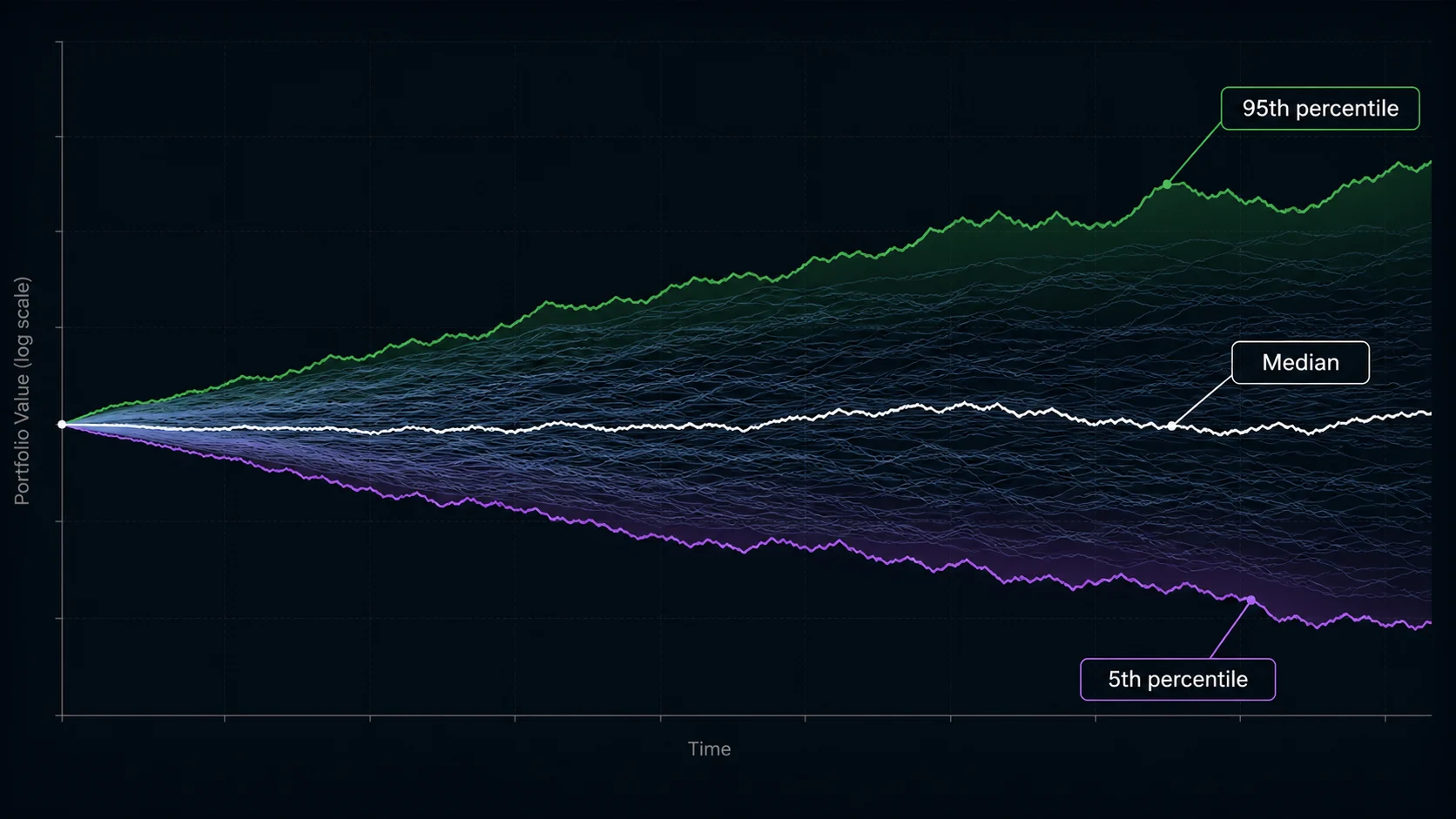
A Monte Carlo trading simulation creates many possible paths from assumptions about a strategy’s trades, returns or costs. Its main value is showing uncertainty in trade sequence and drawdown—not forecasting the next trade. When the same outcomes arrive in a different order, account paths and maximum drawdowns can differ substantially.
Key takeaways
- Monte Carlo generates scenarios; it does not discover a guaranteed result.
- Reshuffling a trade sequence can reveal sequence-of-returns risk.
- Drawdown distributions are often more useful for risk review than one average outcome.
- Results are only as credible as the data, assumptions and dependence structure used.
- Fat tails, changing volatility and serial dependence can make simple simulations overconfident.
What Monte Carlo simulation tests
For a trade-level simulation, you might resample historical trade returns, vary slippage assumptions or shuffle their order. For each path, calculate metrics such as maximum drawdown, longest losing streak or final equity. After many paths, summarize a distribution rather than presenting a single “expected” curve.
One common output is a percentile: a 5th-percentile result describes a result near the lower end of the simulated set under the stated model. It is not a guarantee of a worst-case outcome.
Drawdown distributions
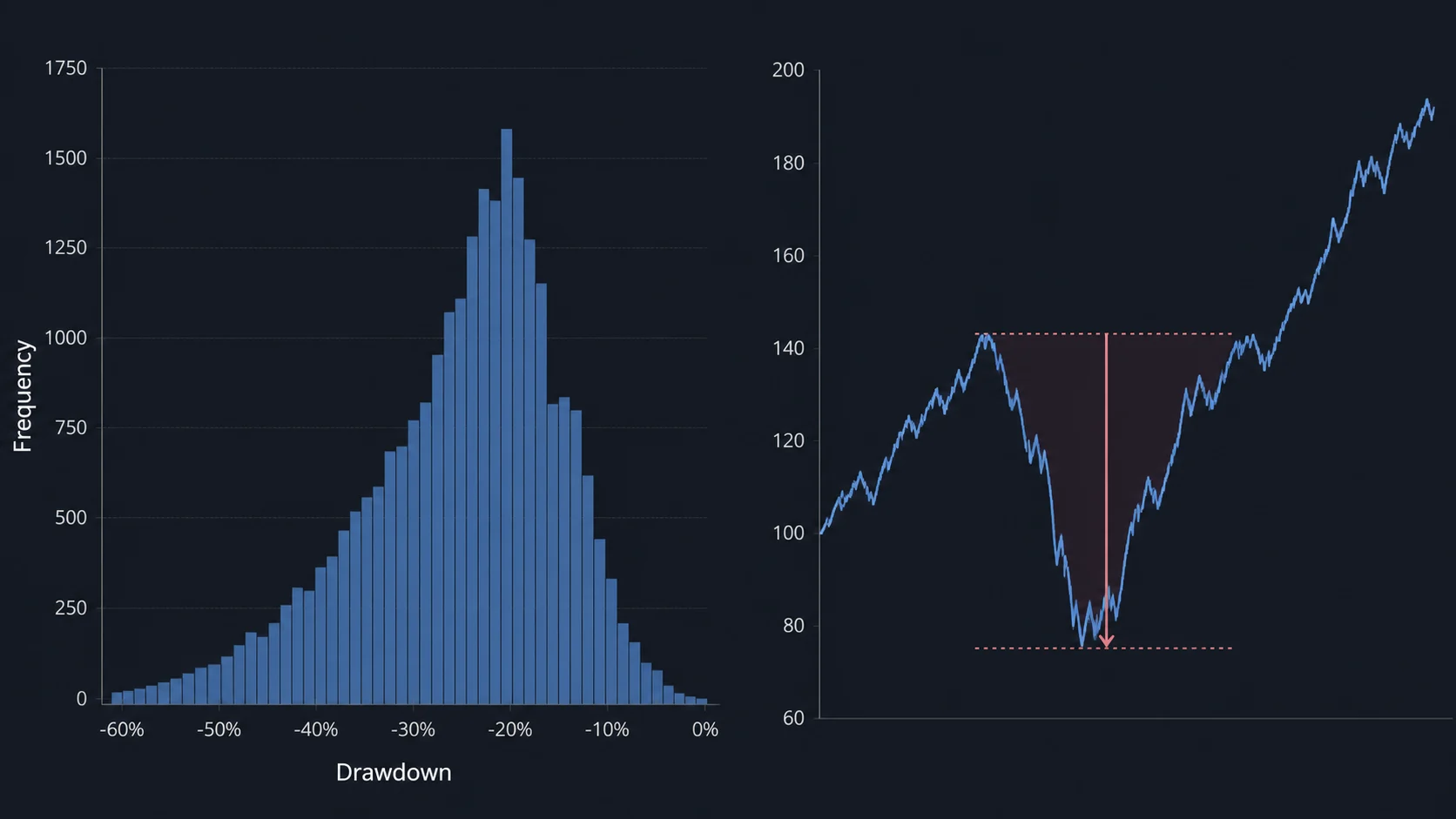
A maximum drawdown distribution can show how frequently different drawdown ranges occurred across simulated paths. This is useful for asking whether position size, leverage and emotional tolerance are consistent with adverse-but-plausible histories. It does not capture every future shock, especially when the model assumes independent trade outcomes that are actually clustered.
Same trades, different sequence
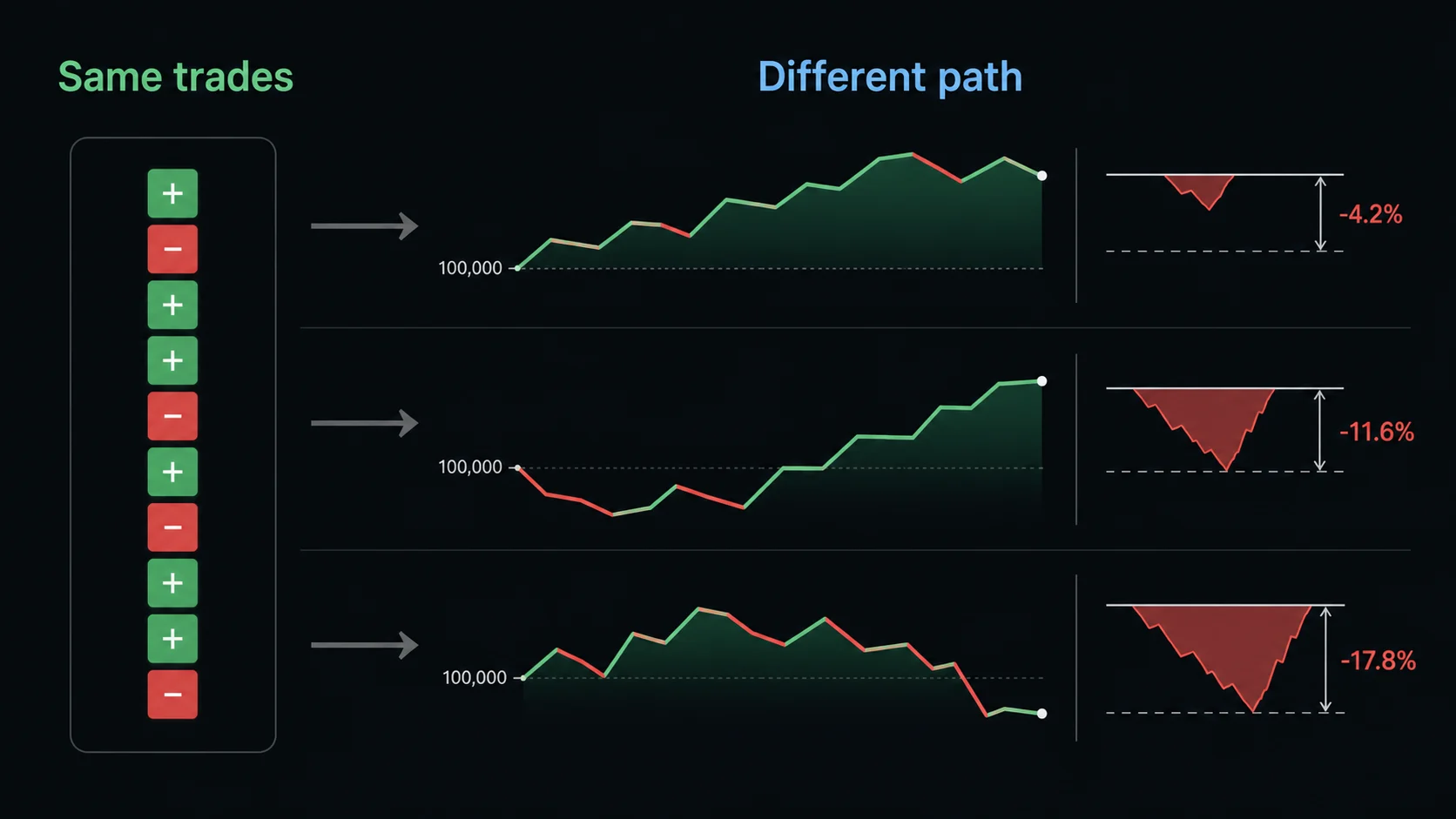
Consider an identical set of wins and losses. Losses that cluster early can generate a deeper drawdown than the same losses dispersed between wins. That is sequence risk. It is why average win rate and average expectancy alone do not describe the experience of holding a strategy through a difficult period.
Before simulating, first evaluate whether the underlying backtest is credible. Use the walk-forward analysis guide alongside this process; a polished simulation cannot repair a biased research sample.
A responsible simulation workflow
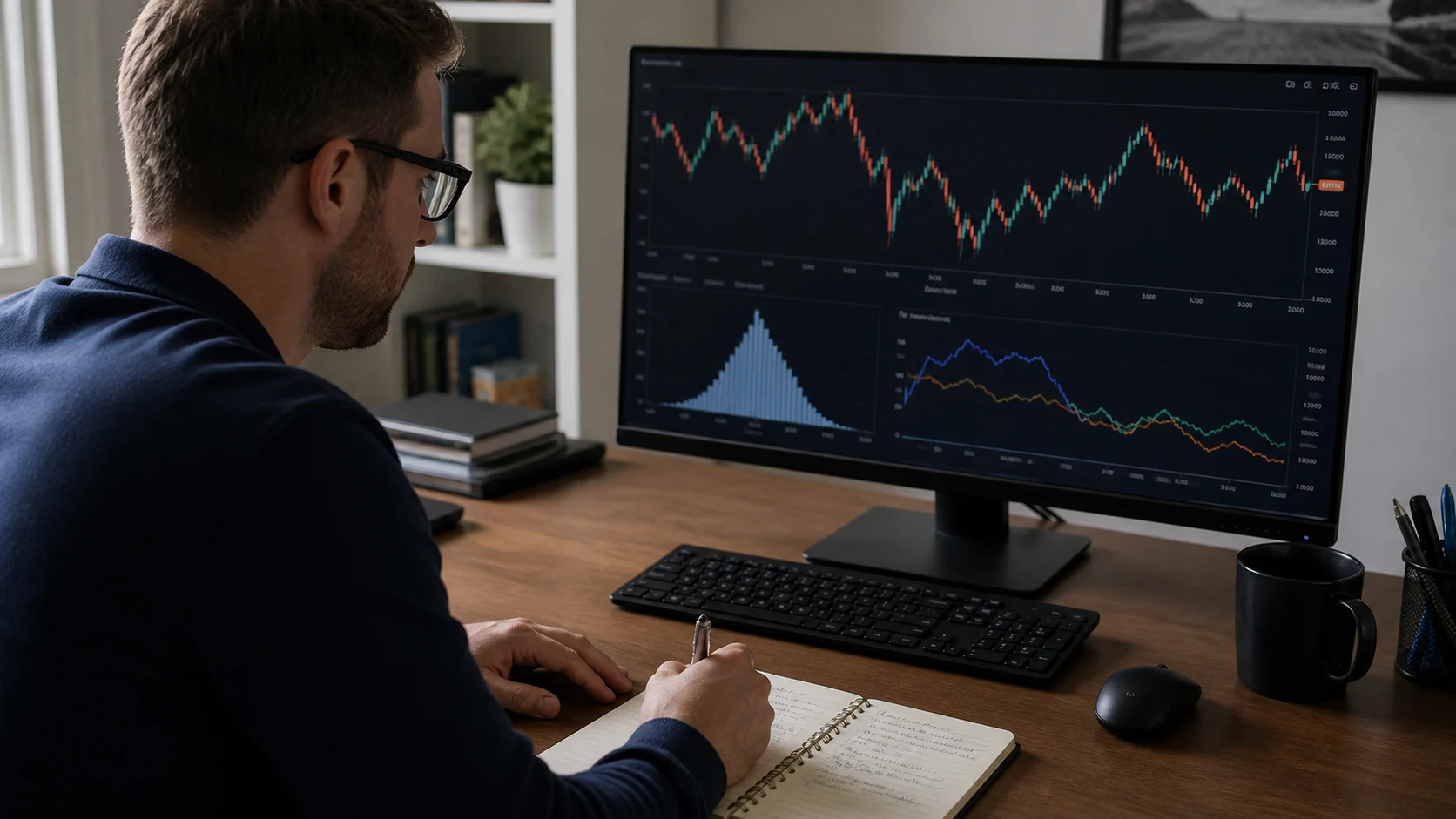
- Document the original trade sample, market, dates, strategy rules and costs.
- Choose a resampling model and explain whether it preserves trade clustering.
- Run scenarios for realistic spreads, slippage and execution delays.
- Review distributions for drawdown, losing streaks and recovery time—not just ending values.
- Use the output to stress-test risk limits, not to justify a desired position size.
Before running a simulation, document how a rule is applied across timeframes and conditions. The multi-timeframe analysis guide and top-down analysis workflow explain how that context can be defined without turning a simulation into a prediction.
Important limitations
- Random reshuffling can understate risk when losses cluster by market regime.
- A short historical sample may omit important conditions.
- Parameter choices can be optimized until the simulation says what the analyst wants.
- Historical execution costs can be unavailable or different from future costs.
- A percentile is conditional on model assumptions, not a promise.
FAQ
How many Monte Carlo paths are enough?
More paths reduce sampling noise in the simulation, but they cannot correct an unrealistic input model. Explain the number of paths and test stability rather than relying on a universal count.
Can Monte Carlo predict my maximum drawdown?
No. It estimates a distribution under assumptions. Future behavior can fall outside historical patterns and model choices.
Sources and further reading
- Technical Analysis of Stocks & Commodities — sequence randomization and drawdown
- Stanford — Risk-Constrained Kelly Gambling
- Journal of Empirical Finance — simulation techniques for maximum drawdown
Risk disclosure: This article is educational information, not investment advice or a solicitation to trade. Testing methods and broker terminology do not eliminate trading risk. Historical samples and simulations do not guarantee future results. Verify data and product terms, assess risk and make your own decisions.