


top-down analysis trading Top-down analysis begins with a broader chart to establish context, then moves to a setup chart and finally an execution chart. Its value comes from assigning one role to each timeframe rather than searching across charts for agreement. The method should be treated as a testable chart-reading framework rather than a forecast. Before using it, define the market condition, confirmation event, invalidation price, transaction costs and maximum risk. This guide explains the rules, a repeatable workflow, common failure modes and the most relevant supporting concepts.
Definition: What Is Top-Down Analysis in Trading?
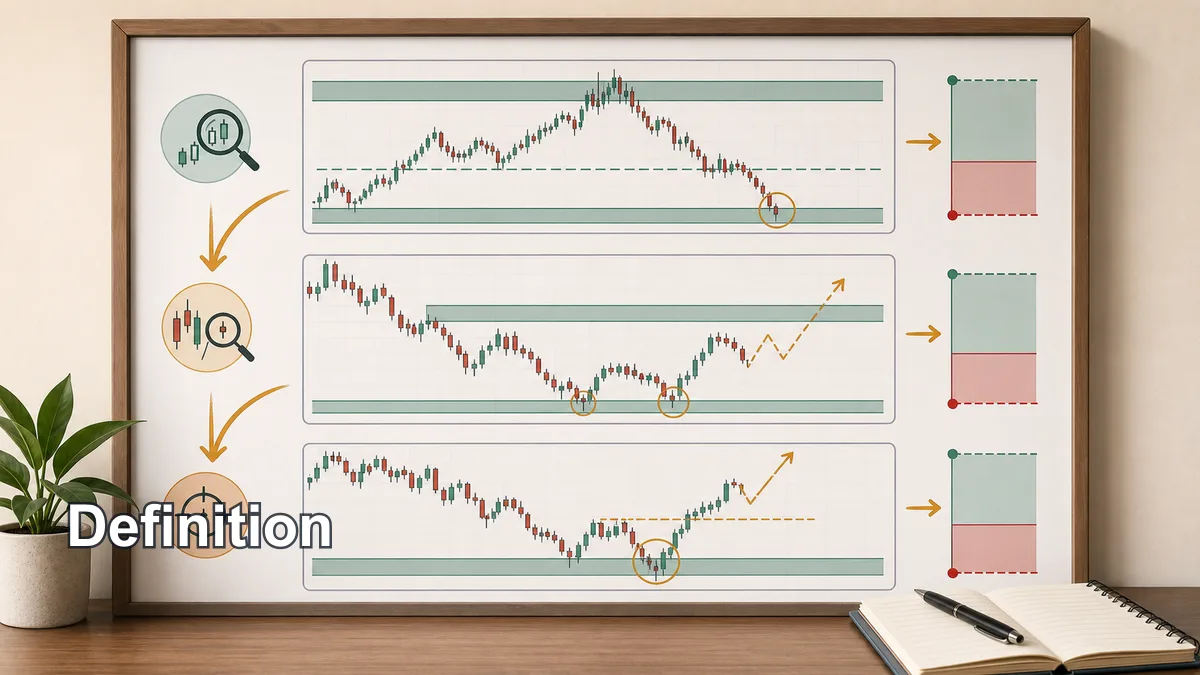
Top-down analysis is the process of analyzing a market from a higher timeframe down to a lower timeframe. The higher timeframe defines context. The middle timeframe helps locate the setup. The lower timeframe helps refine entry, confirmation, and invalidation.
For example, a swing trader may start with the weekly chart, then move to the daily chart, and finally use the four-hour chart for execution. A day trader may start with the daily chart, plan on the one-hour chart, and execute on the fifteen-minute chart. The exact stack depends on the trader, but the order stays the same: big picture first, entry last.
The main advantage is clarity. A lower-timeframe breakout can look attractive until you notice it is moving directly into daily resistance. A small bearish candle can look scary until you notice it is only a pullback inside a higher-timeframe uptrend. Top-down analysis helps each chart do its job.
This method works well with price action because support, resistance, market structure, candlestick patterns, and liquidity all depend on context. The higher timeframe tells you whether the lower-timeframe signal is aligned, countertrend, or too close to an obstacle.
How to Identify the Right Timeframe Stack
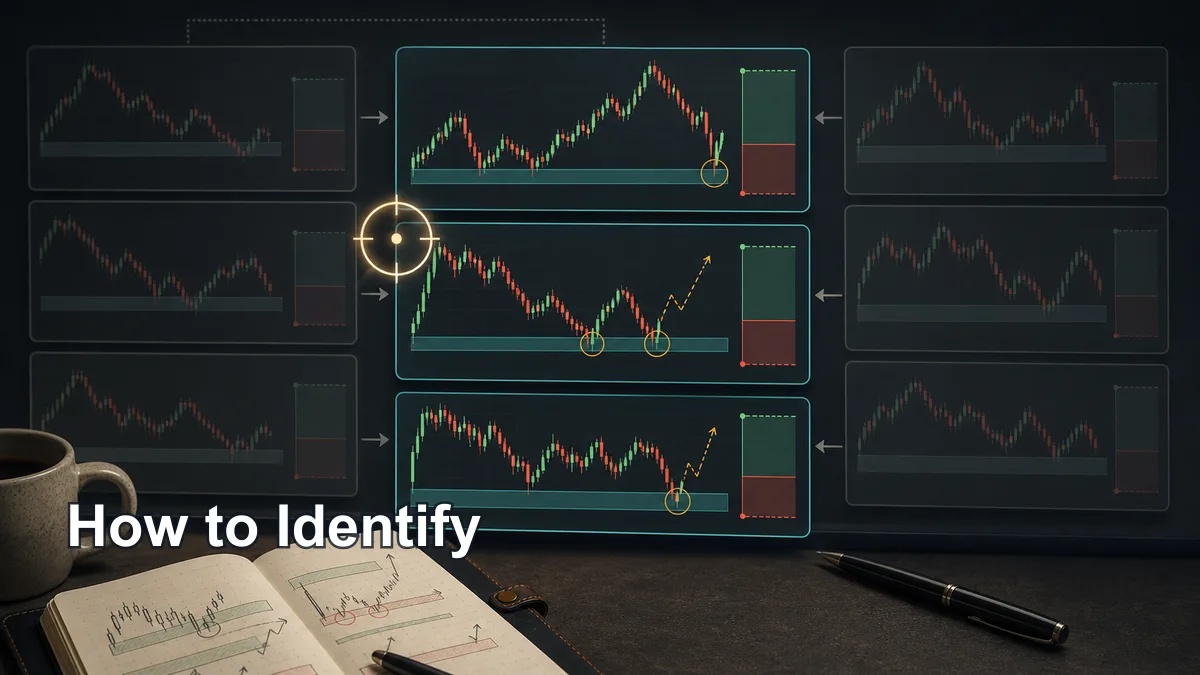
Start by choosing your trading style. If you hold trades for days or weeks, your higher timeframe may be weekly or daily. If you day trade, your higher timeframe may be daily or four-hour. If you scalp, your higher timeframe may be one-hour or fifteen-minute. The timeframe should match how long you realistically hold trades.
A simple rule is to use three timeframes. The highest chart gives bias. The middle chart gives the setup. The lowest chart gives the trigger. A swing trader might use weekly, daily, and four-hour. A day trader might use daily, one-hour, and fifteen-minute. A short-term trader might use four-hour, fifteen-minute, and five-minute.
Avoid using too many charts. More timeframes do not automatically create better analysis. They often create conflict and hesitation. If you check seven timeframes, you can always find one reason to enter and one reason to avoid the trade.
Also avoid changing your stack whenever the market moves. Consistency matters because it lets you collect comparable examples. If your journal always uses the same top-down stack, you can review whether your higher-timeframe bias, setup timeframe, or trigger timeframe needs improvement.
Why Top-Down Analysis Works
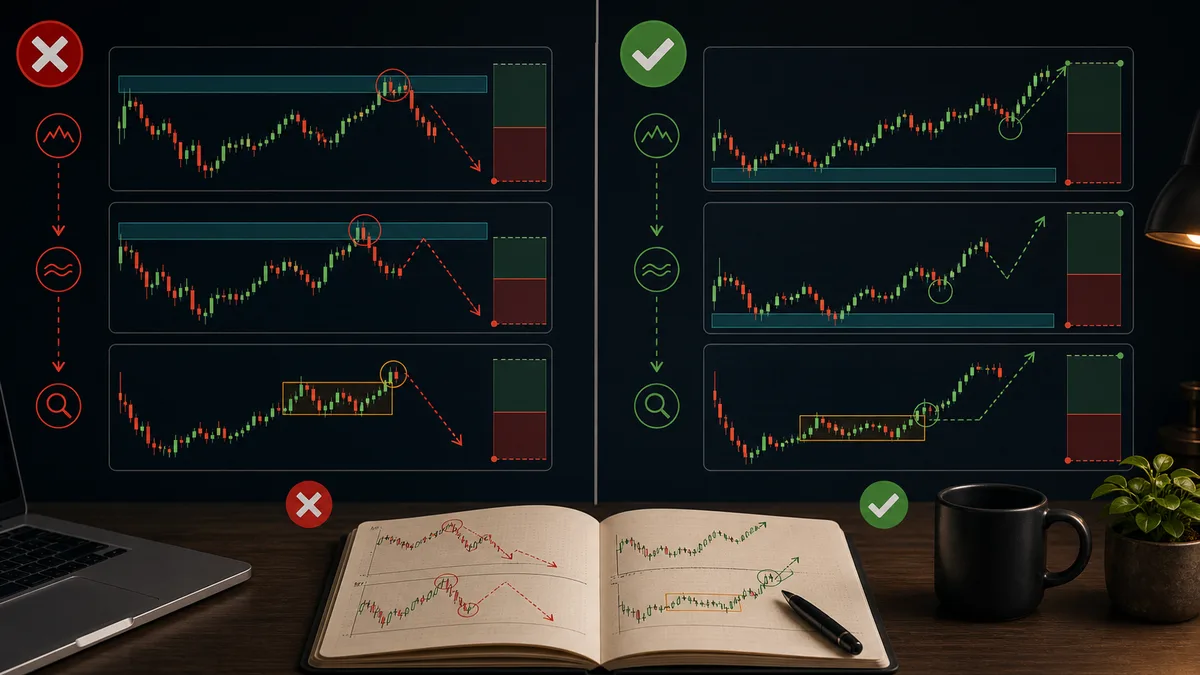
Top-down analysis works because markets are nested. A small five-minute move may be part of a one-hour pullback. A one-hour rally may be part of a daily downtrend. A daily breakout may be running into a weekly level. When traders ignore this relationship, they often misread the importance of the signal in front of them.
The higher timeframe helps filter direction. If the daily chart is in a clean uptrend and price pulls back into support, lower-timeframe bullish confirmation may deserve attention. If the daily chart is in a downtrend and the lower chart shows a small bullish candle under resistance, the signal may be weaker.
The method also helps with target planning. A lower-timeframe setup may look good, but if the next higher-timeframe level is very close, there may not be enough room. Top-down analysis helps you see obstacles before entry.
Finally, top-down analysis improves risk placement. If the trade idea depends on a higher-timeframe support zone, invalidation should respect that zone. If the idea depends only on a lower-timeframe candle, the stop and trade management should match that smaller context. Mixing these roles creates confusion.
Step-by-Step Top-Down Analysis Method
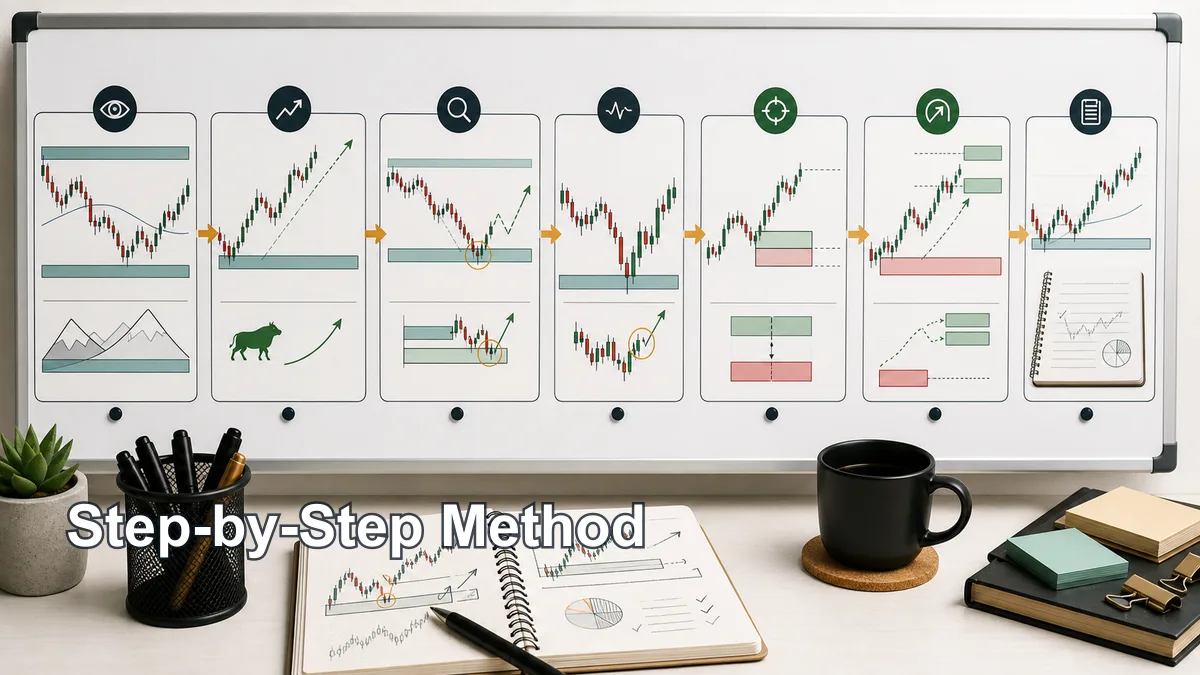
Step one: open the highest timeframe and define the environment. Is price trending up, trending down, ranging, or transitioning? Mark only the major support, resistance, previous highs, previous lows, and range boundaries.
Step two: decide the directional bias. Bias does not mean prediction. It means the preferred direction if price reaches a useful area and confirms. If the higher timeframe is unclear, write “no clear bias” and wait.
Step three: move to the middle timeframe. Look for the setup area. This may be a pullback into support, a retest of broken resistance, a range edge, or a liquidity sweep near a higher-timeframe level. The middle timeframe should organize the trade idea.
Step four: drop to the execution timeframe only after price reaches the setup area. Look for confirmation such as a candlestick rejection, structure shift, failed breakout, retest, or displacement. Do not use the lower timeframe to invent trades in the middle of nowhere.
Step five: define entry, invalidation, and target. The stop should match the reason for the trade. The target should respect higher-timeframe obstacles and opposing liquidity. Step six: journal all three timeframes before and after the trade so you can review the full decision path.
A useful journal note is to write the role of each timeframe in one line. For example: “Daily bias, one-hour setup, fifteen-minute trigger.” If a trade fails, this note helps you diagnose the weak link. Maybe the bias was forced. Maybe the setup was in the middle of a range. Maybe the trigger was late. Without this record, traders often remember only the entry candle and miss the bigger mistake.
Confirmation Rules for Top-Down Analysis
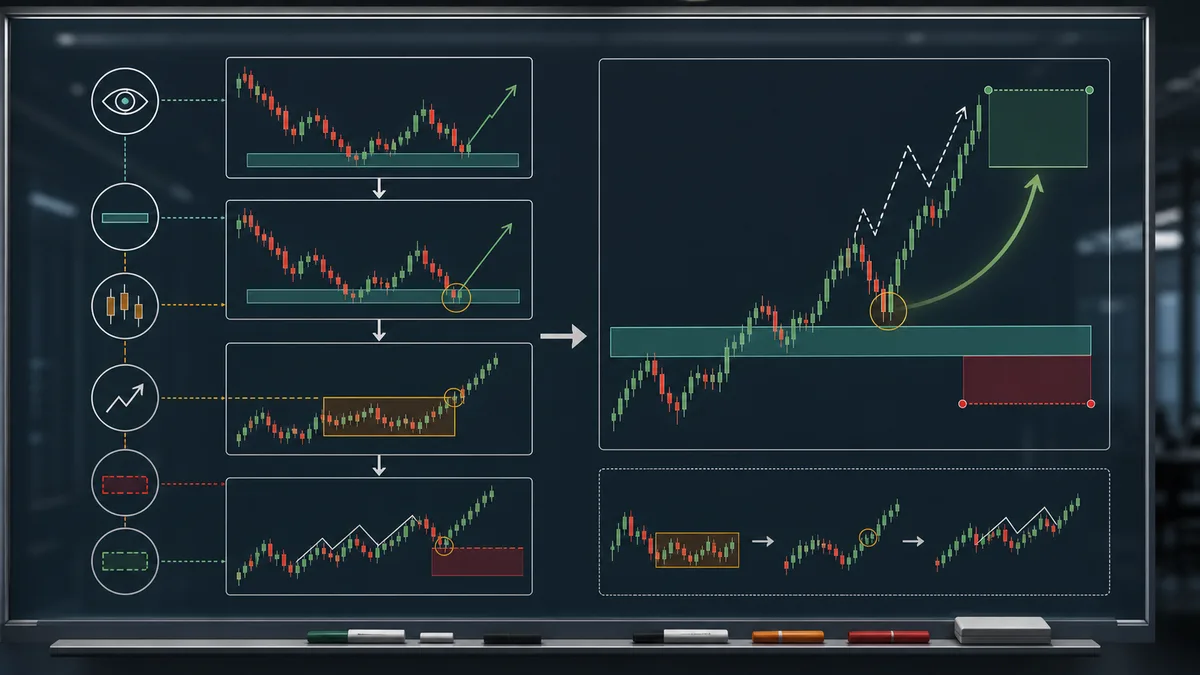
The first confirmation rule is location. Lower-timeframe confirmation matters most when price is at a higher-timeframe decision area. A signal in the middle of the chart is usually weaker than a signal at support, resistance, or a range boundary.
The second rule is alignment. The higher timeframe and setup timeframe should support the same idea, or the trader should clearly understand that the trade is countertrend. Countertrend trades are not impossible, but they usually need stronger confirmation and more conservative targets.
The third rule is reaction quality. A useful lower-timeframe reaction should show rejection, structure shift, displacement, or a clean retest. A tiny candle with no follow-through is rarely enough. The fourth rule is target space. If the next higher-timeframe obstacle is too close, skip the trade or reduce expectations.
The fifth rule is execution quality. Fast markets can produce slippage and poor fills. Investor.gov notes that market orders guarantee execution but not price. This matters when a lower-timeframe confirmation candle moves quickly.
The sixth rule is invalidation. If you cannot explain where the top-down idea is wrong, the setup is not ready. A good plan should say: higher-timeframe bias, setup area, lower-timeframe trigger, invalidation, and target.
Examples of Top-Down Analysis
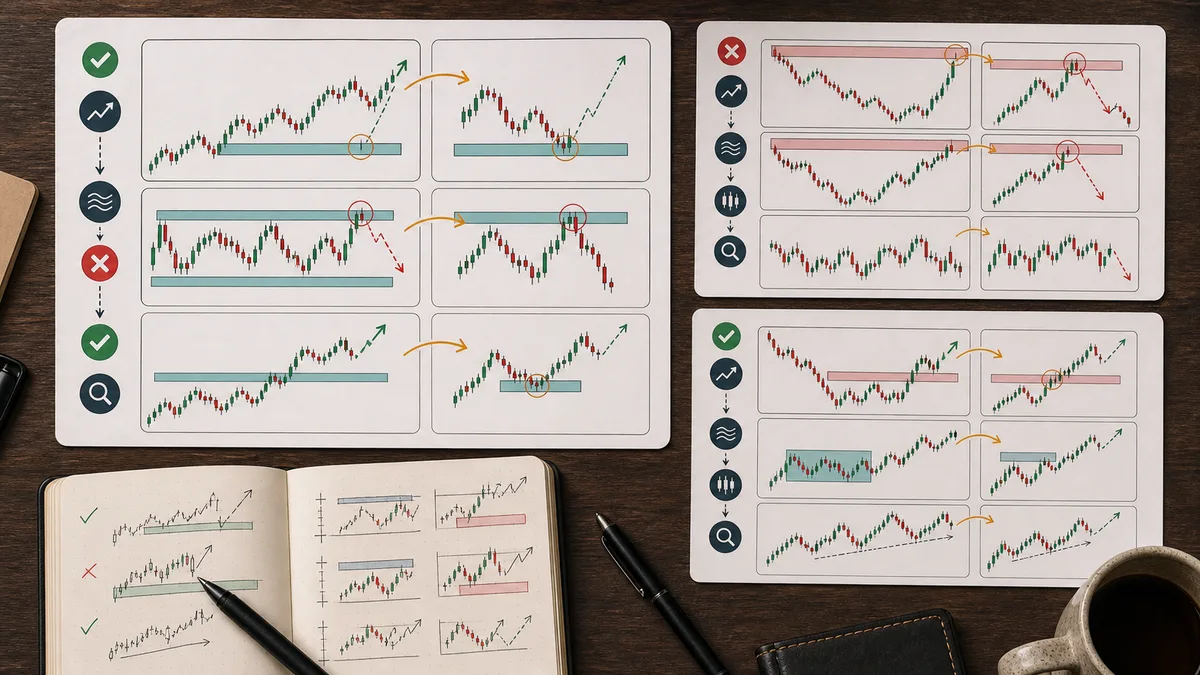
Example one: the daily chart is in an uptrend. Price pulls back into a previous resistance zone that may now act as support. On the four-hour chart, the pullback slows. On the one-hour chart, price forms a bullish rejection and breaks a minor high. This is a top-down long idea because bias, location, and trigger align.
Example two: the daily chart is ranging. Price is near the range high. The one-hour chart shows a bullish breakout candle, but the higher timeframe shows limited room and a history of failed moves near that area. The trader waits for a retest or skips the trade. Avoiding a weak setup is part of good analysis.
Example three: the weekly chart shows major resistance above. The daily chart is bullish but extended. The four-hour chart sweeps above a previous high and closes back below it. The one-hour chart breaks short-term structure lower. This may support a short-term bearish reaction, but the trader should manage it as a reaction trade, not assume a full trend reversal.
Example four: the four-hour chart breaks resistance after consolidation. Instead of chasing, the trader waits for the one-hour chart to retest the broken level. A fifteen-minute bullish rejection forms at the retest. The entry has clearer invalidation than buying the breakout candle late.
Example five: the higher timeframe is unclear and price sits in the middle of a range. The lower timeframe forms a strong candle, but there is no clean location. The best top-down decision may be no trade. A method that keeps you out of poor conditions is doing its job.
Common Mistakes in Top-Down Analysis
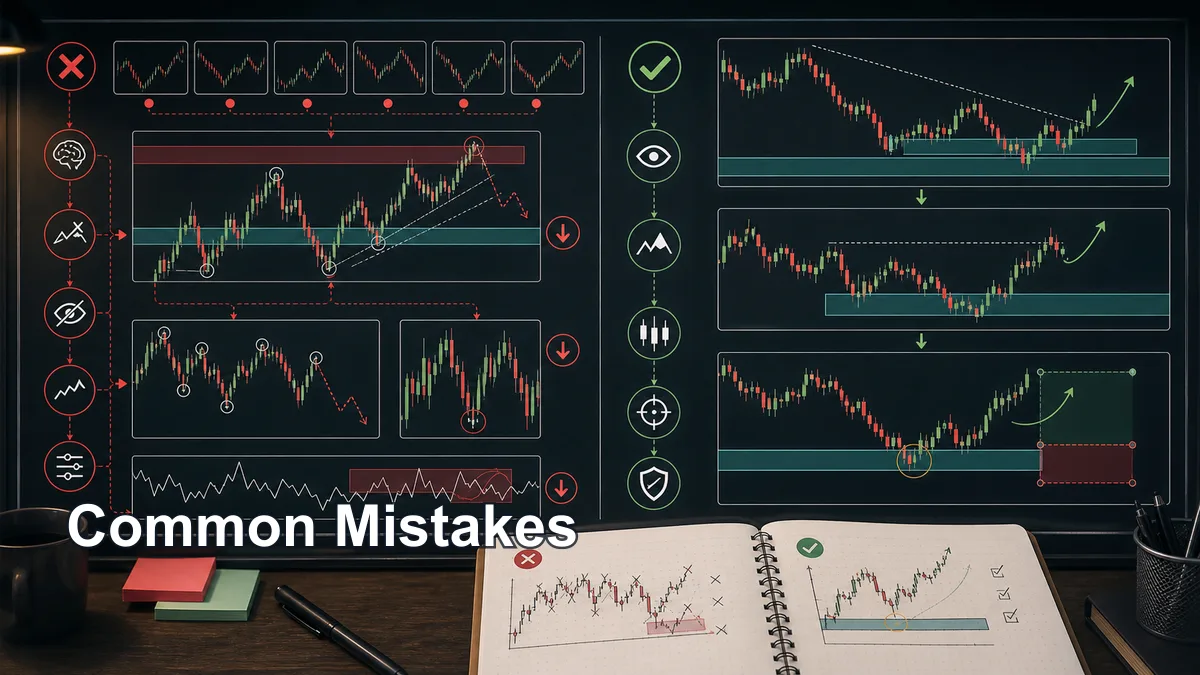
The first mistake is checking too many timeframes. More charts can create more confusion. Use a simple three-chart stack and give each chart a job: bias, setup, trigger.
The second mistake is forcing a bias. If the higher timeframe is unclear, do not pretend it is clear. Write down that the market is ranging or messy. Waiting is a valid trading decision.
The third mistake is letting the lower timeframe override the higher timeframe. A small entry candle should not make you forget daily resistance or weekly support. Lower timeframes refine execution; they should not erase the map.
The fourth mistake is entering before price reaches the higher-timeframe area. Top-down analysis works best when the trader waits for price to arrive at a decision zone. Entering in the middle of nowhere removes the main benefit of the method.
The fifth mistake is managing the trade from the wrong timeframe. If the idea came from a daily level, do not panic over every five-minute candle. If the idea is a short-term scalp, do not hold it for days because the daily chart looks interesting. Match management to the original plan.
The clean method is simple: choose a timeframe stack, start from the top, mark the key areas, wait for price to reach them, confirm on the lower chart, define risk, and journal the result. That is how top-down analysis becomes a repeatable trading skill.
Key takeaways
- Top-down analysis begins with a broader chart to establish context, then moves to a setup chart and finally an execution chart.
- Its value comes from assigning one role to each timeframe rather than searching across charts for agreement.
- Write the timeframe hierarchy, directional condition, location and trigger before opening the execution chart.
- A valid plan separates location, trigger, invalidation, position size and exit logic.
A validation workflow you can reproduce
- Define the sample: choose the market, timeframe, session and date range before reviewing outcomes.
- Write the rule: Write the timeframe hierarchy, directional condition, location and trigger before opening the execution chart.
- Record invalidation: identify the observable price event that disproves the setup.
- Include execution costs: account for spread, commission and slippage where relevant.
- Validate separately: test the finished rule on data that was not used to create it.
When this concept is unreliable
Top-down analysis becomes unreliable when the trader changes the hierarchy mid-trade or keeps moving lower to find a confirming pattern. Keep failed and skipped examples in the journal so the review is not limited to attractive winners.
Use this concept within a complete analysis
This method should remain connected to its parent framework and adjacent decision steps. Use Multi-Timeframe Analysis: Complete Guide, Best Timeframes for Forex Trading, Trading Sessions: Complete Guide for Forex Traders, Asian Session Trading Strategy, New York Session Liquidity Sweep Strategy and Price Action Trading: Structure, Setups and Risk to compare definitions, establish context and avoid treating one signal as a complete trading system.
References and methodology
Practise before considering real capital
Use historical charts or a demo account to test the written rules before considering live execution. Review the XM account and demo information. Availability, protections and trading conditions depend on jurisdiction, so review the applicable legal documents yourself.
Affiliate disclosure: Học Làm Trader may receive a commission if you open an account through this link, at no additional cost to you. This relationship does not determine the educational conclusions.
Risk warning: This article is for education and general information only. It is not investment advice, a trade signal or an invitation to trade. Trading can result in loss of capital, and past examples do not guarantee future results. Assess your own circumstances and risk tolerance.