


Market cycles and Wyckoff can complement each other: a market cycle describes broad states such as balance, advance and decline, while Wyckoff adds a more detailed vocabulary for trading ranges. Neither turns a chart into a certain forecast.
A common error is to treat the four market-cycle labels as a fixed Wyckoff map and force every range into accumulation or distribution. A stronger process uses the market cycle to establish context, then uses Wyckoff language only when price behaviour, range location, volume quality and invalidation rules support the hypothesis.
Market cycles describe broadly; Wyckoff adds range context
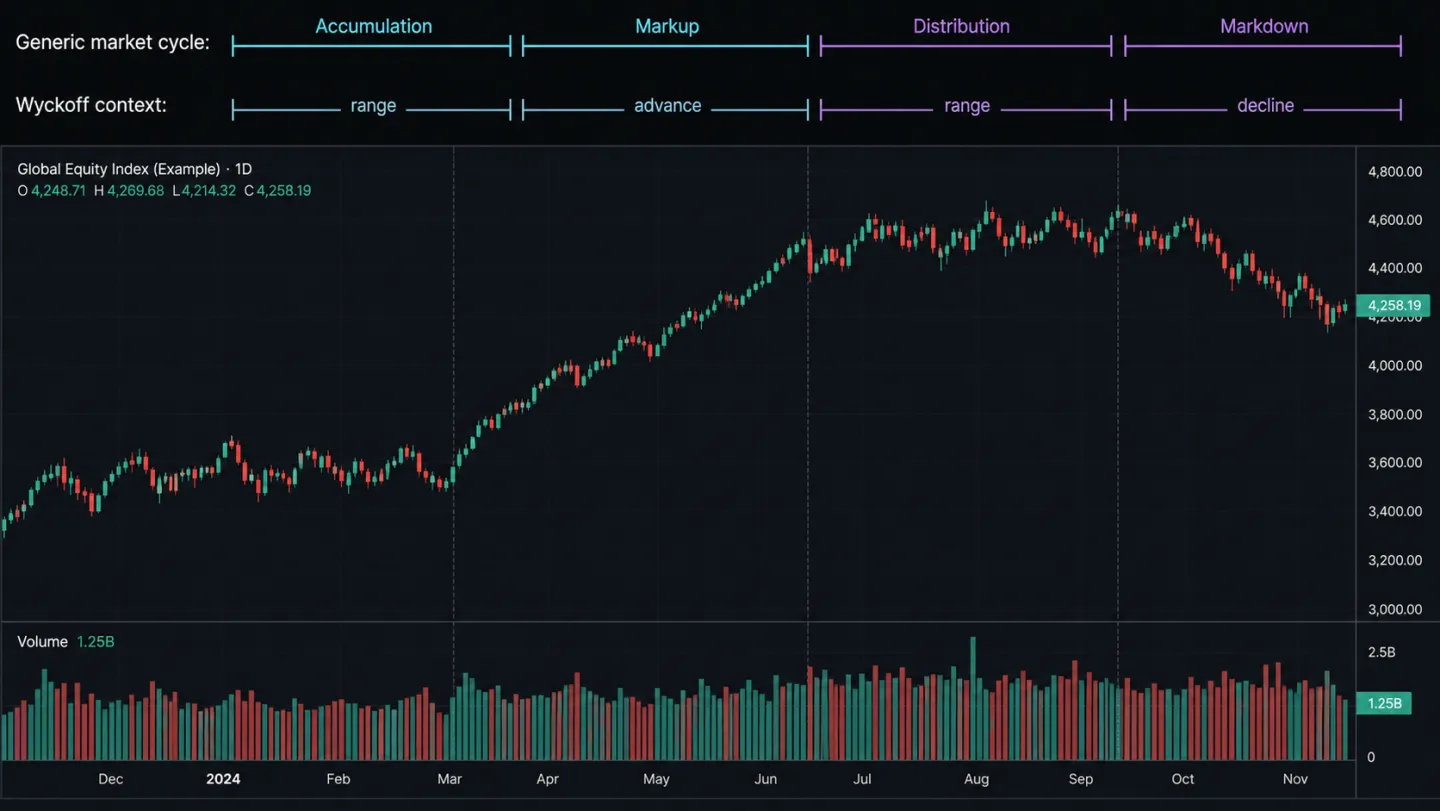
Market cycles commonly use accumulation, markup, distribution and markdown. They summarise behaviour through time. Wyckoff uses phases, events and effort-versus-result concepts to read a range in more detail. Because their jobs differ, the frameworks do not need to align candle by candle.
After a decline, price may form a range. Market-cycle language can call that balance after a decline. Only when the range supplies additional evidence under a written rule — repeated tests, credible volume behaviour, a spring/test or accepted breakout — should an accumulation hypothesis gain weight. Acceptance below the range weakens it.
This separation keeps the Wyckoff method, Wyckoff accumulation and market structure from competing for the same job.
Why similar ranges can mean different things
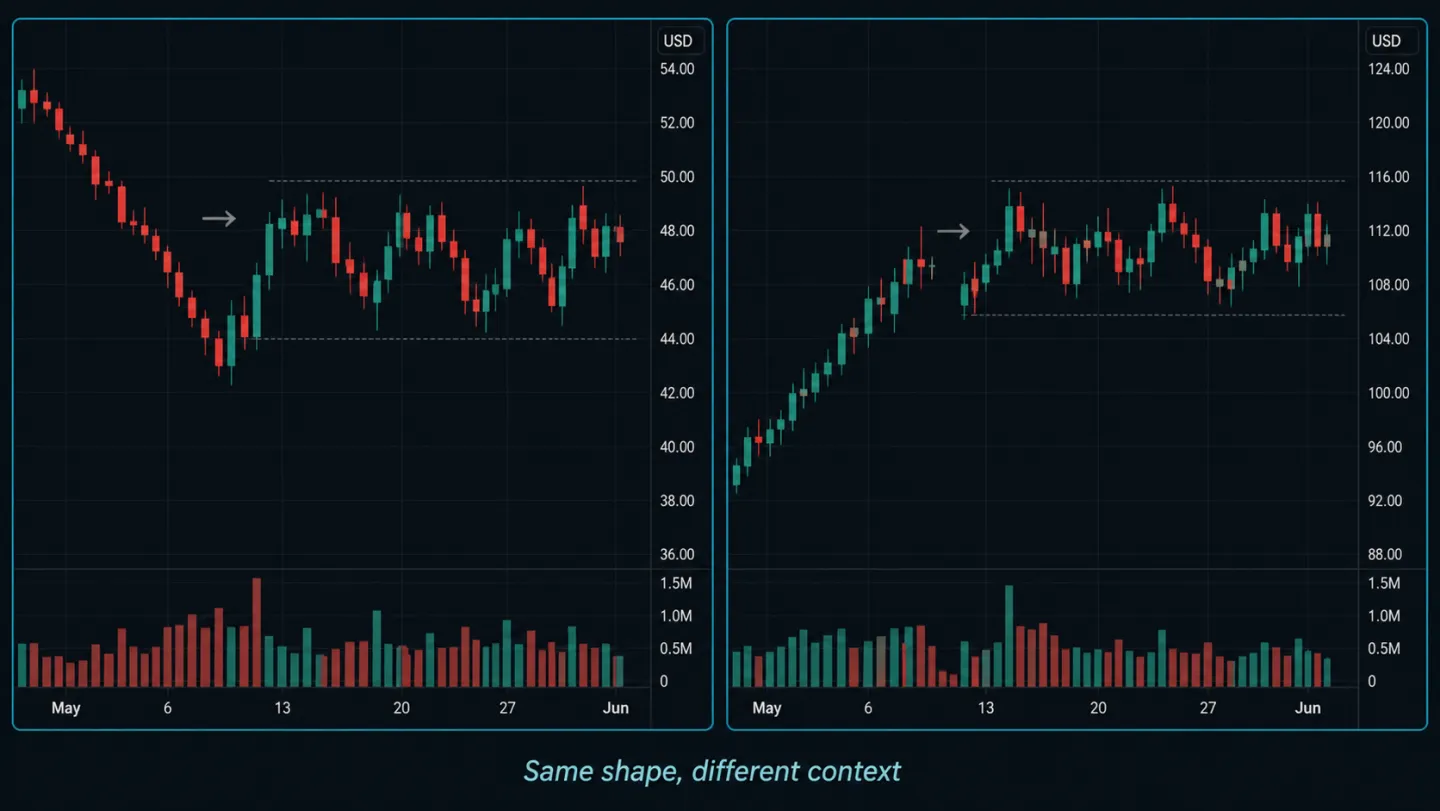
A range after a decline and a range after an advance can look identical but begin with different information. What came before the range? How does price react at its edges? Does price accept outside it or return? These questions are more useful than searching immediately for an event name.
Volume only adds value when its source and context are known. For centralized futures or equities, effort-versus-result can be compared within the same instrument and timeframe. Spot-Forex tick volume comes from a feed rather than the whole market. State the source; do not infer institutional intent from a single spike.
If a D1 range after a decline briefly breaks its lower edge and then closes back inside, it is a reason to observe more — not automatic proof of a spring. Scenario A may be reclaim and hold; scenario B may be acceptance below the boundary. Both require clear conditions.
A process that prevents forced labels
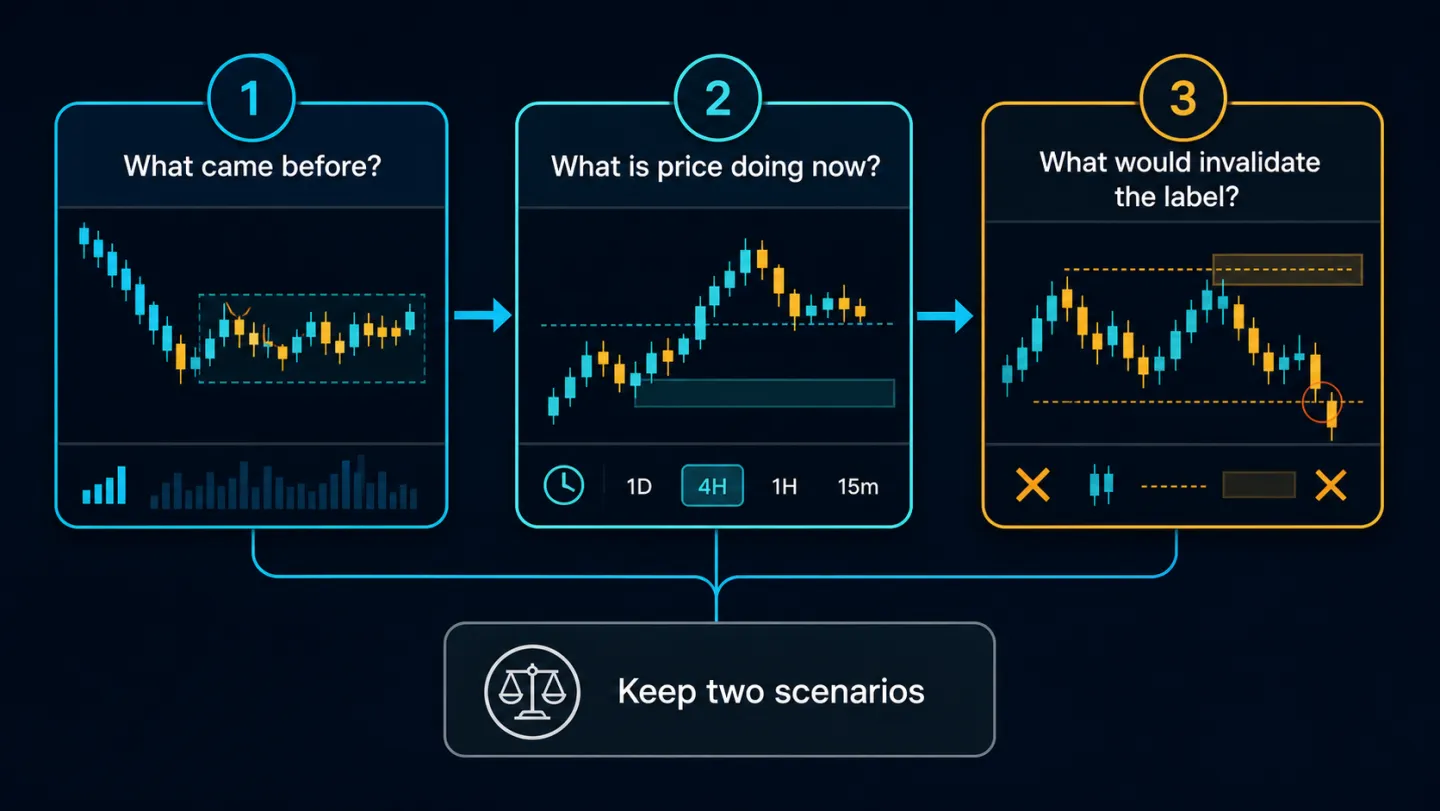
- What came before? Record the prior trend or range on the context timeframe.
- What is price doing now? Record closes, swings, range boundaries, follow-through and the limits of any volume data.
- What invalidates the label? State the close, retest or acceptance that makes the hypothesis less useful.
- Keep two scenarios. A label is not a trade. Position size and stop distance should be decided independently from the narrative.
The Wyckoff Spring and Test guide is a supporting page once the range context is established. It is not a standalone signal or a promise of a win rate.
When a market-cycle framework is enough
Market-cycle analysis is often enough for top-down context: is the market balancing or trending, which boundary matters and what changes the scenario? Add Wyckoff only when the criteria are defined in advance and the data allow a meaningful check. More terminology does not automatically make a decision better.
Risk disclosure: This educational content is not investment advice or a trade signal. Charts are illustrative; markets involve a risk of loss.
Sources and limits
- CMT Association — general technical-analysis education.
- Investor.gov — public financial-literacy and investment-risk education.
- The charts in this article are educational illustrations, not backtest data or evidence that a setup will work.