


Crypto open interest (OI) is the notional amount or number of futures and perpetual contracts that remain open on a specified venue or data feed. OI changes when contracts are opened or closed; it is not the same as traded volume and it does not reveal direction by itself. Context, coverage and timestamp matter.
What Is Crypto Open Interest?
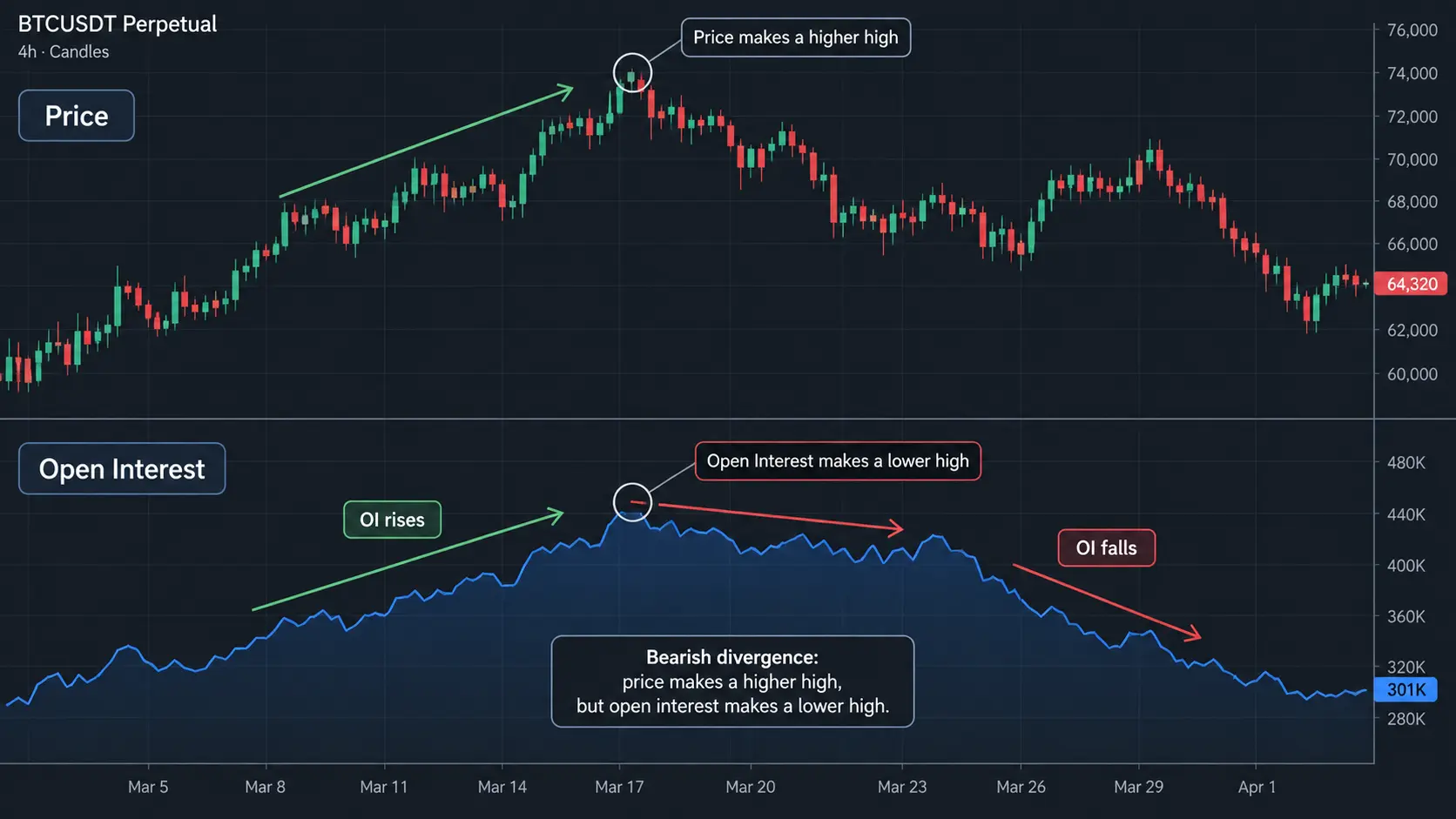
When a new buyer and seller create a futures contract, open interest generally increases. When an existing long and short close against each other, OI generally decreases. An exchange may report contracts, coins or notional dollars, and an aggregator may combine venues with different conventions. Record the unit, contract type, exchange coverage and timestamp before comparing series.
What OI can and cannot tell you
| Observation | Possible interpretation | Not established |
|---|---|---|
| OI rises while price rises | New contracts accompany an upward move | That longs will profit |
| OI rises while price falls | New contracts accompany a downward move | That all new positions are shorts |
| OI falls during a move | Positions may be closing or being liquidated | The move must reverse |
| OI is flat | Open contracts are stable on that feed | No positioning changed elsewhere |
For structure context, compare OI with market structure and document whether the feed covers one exchange or several.
Open Interest Versus Volume
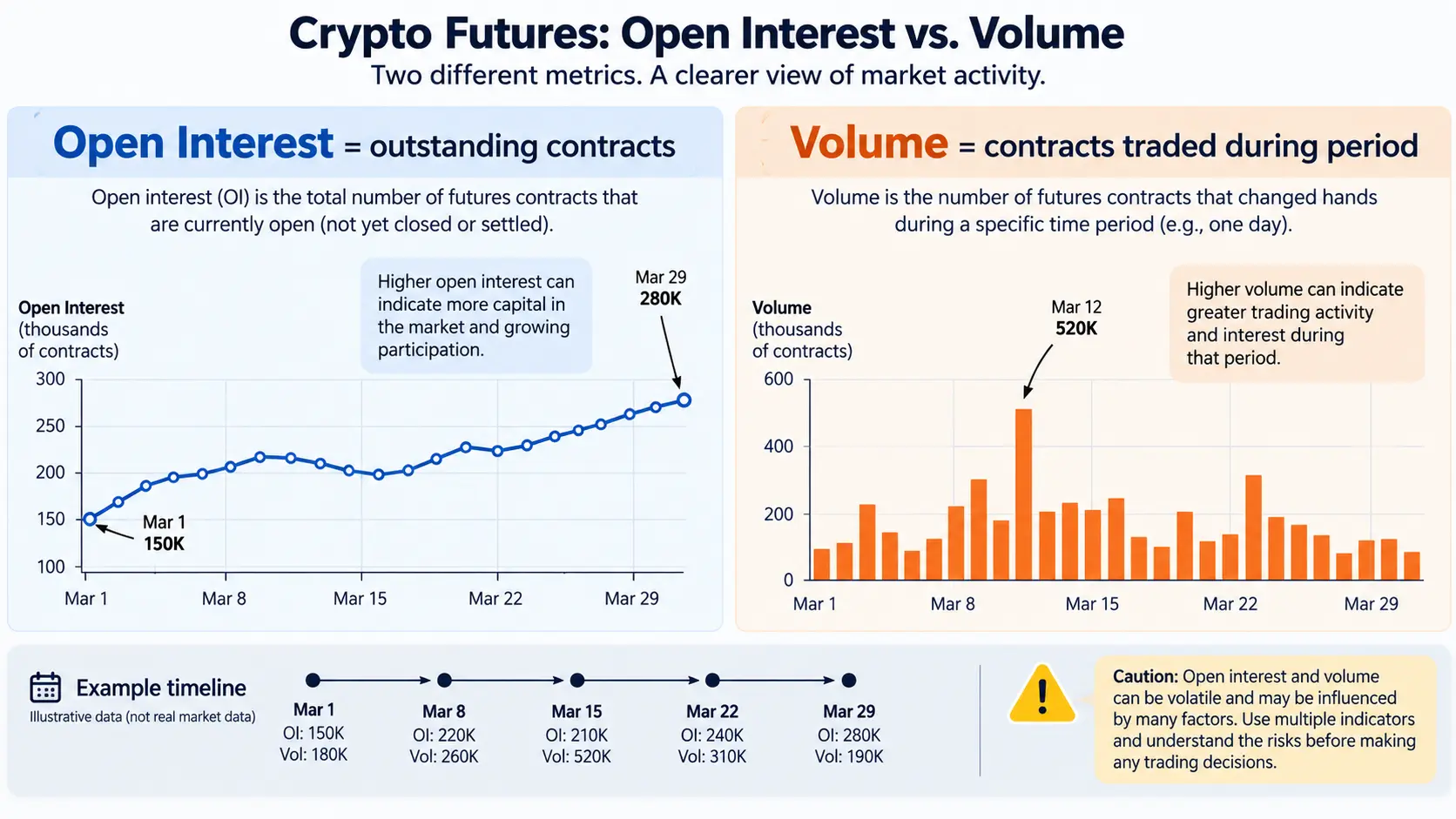
Volume counts contracts traded during a period; OI is a point-in-time measure of contracts still open. A high-volume session can leave OI unchanged if positions are opened and closed within the same period. Conversely, OI can rise with modest volume when new contracts are carried forward. Do not add the two metrics or treat one as a substitute for the other.
Measurement checklist
- use the same contract, quote currency and unit when comparing dates;
- check whether OI is exchange-specific, aggregated or estimated;
- align OI timestamps with the price and volume bar;
- note funding, liquidations, rollovers and contract changes;
- avoid inferring long/short direction from OI alone.
Four Price–OI Contexts: An Illustrative Example
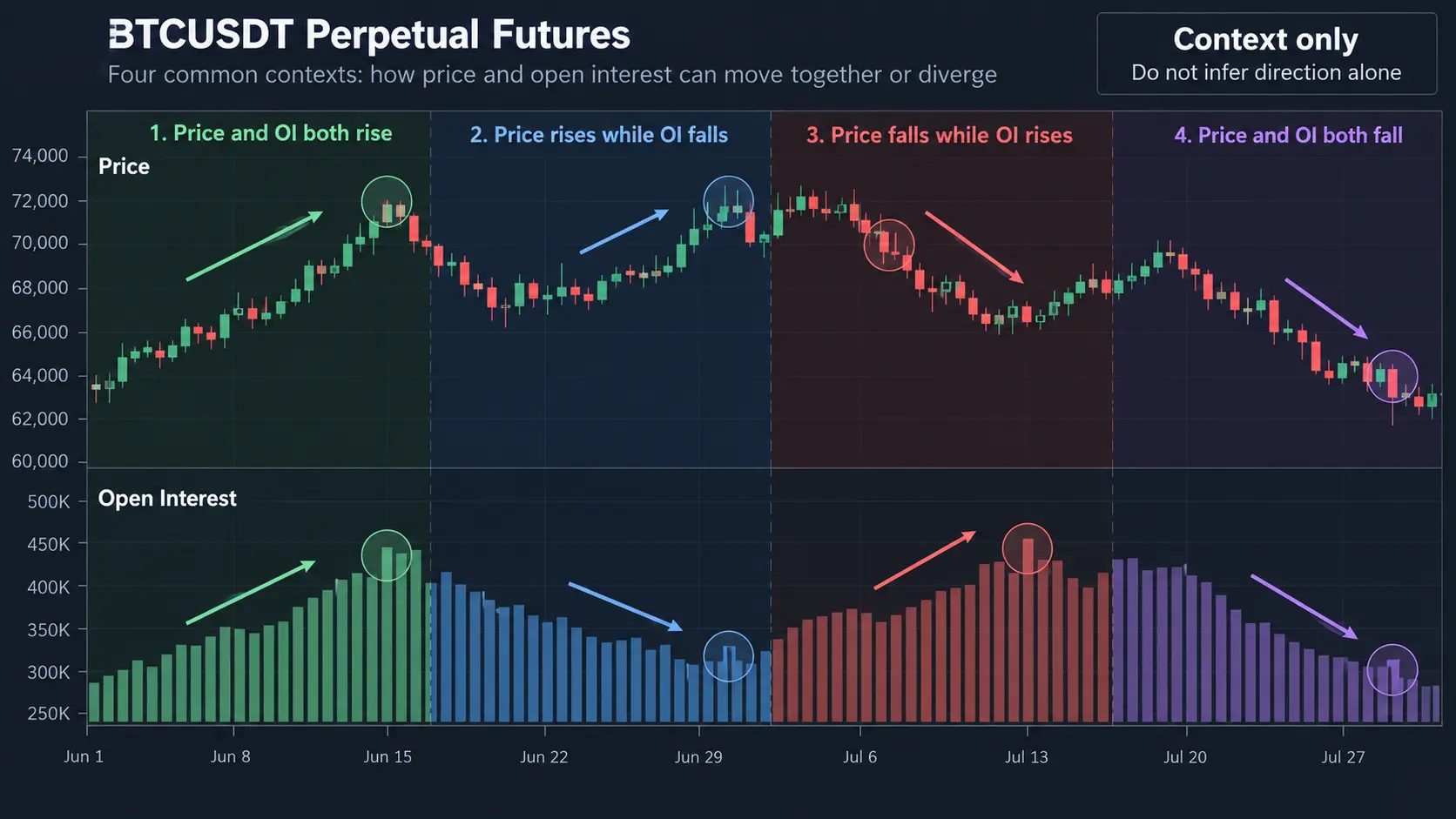
A fictional BTCUSDT perpetual sample can show price and OI both rising, price rising while OI falls, price falling while OI rises, and both falling. Each combination narrows a description of what the measured feed did; none identifies every participant or guarantees continuation. A liquidation event can reduce OI while price moves sharply, while basis and funding can change the cost of holding the remaining contracts.
Use risk–reward planning to write the invalidation and cost assumptions for any test. Do not turn a price–OI quadrant into an automatic trade rule.
A Reproducible OI Workflow and Data Limits
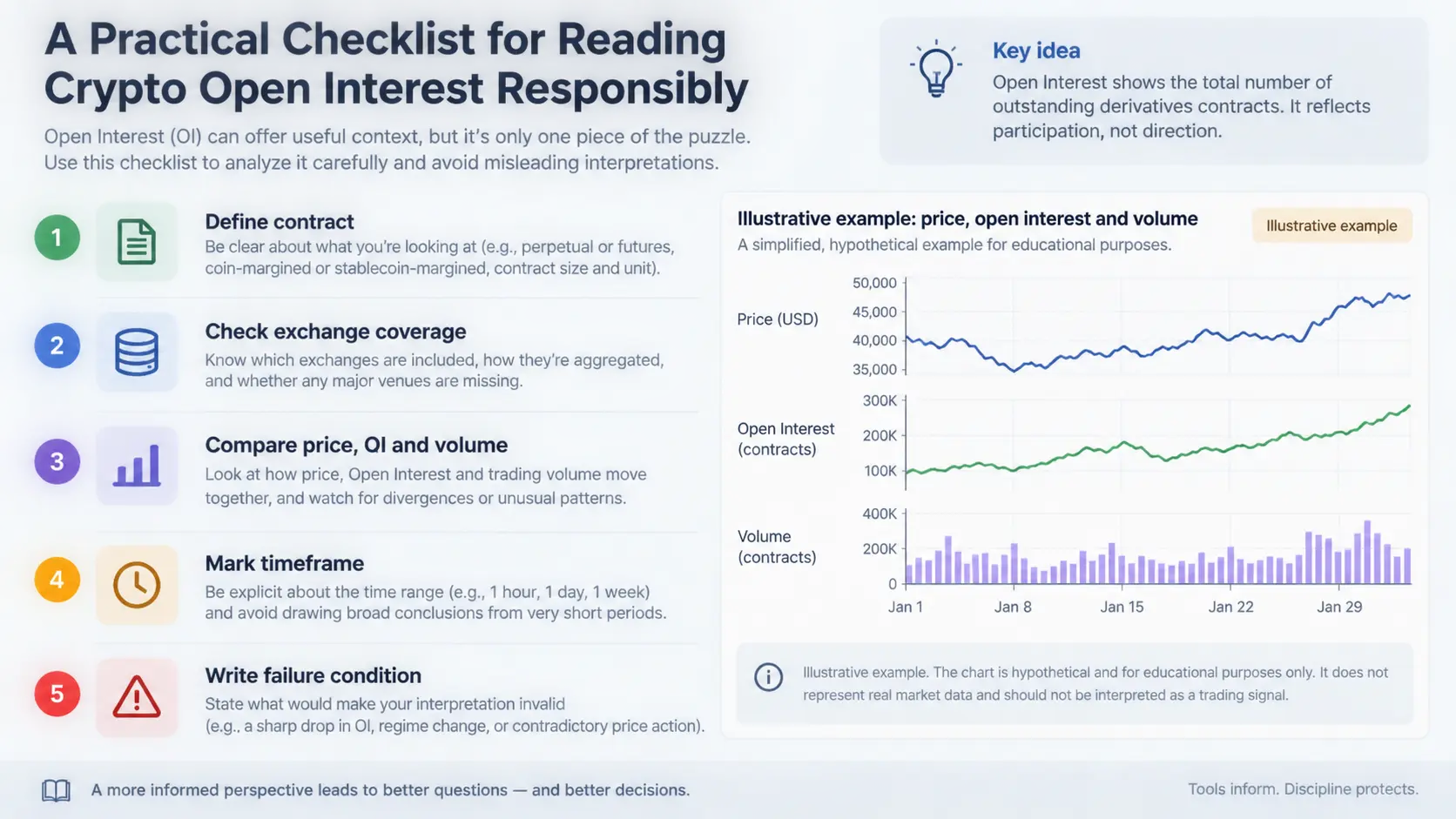
Workflow
- define instrument, contract type, venue coverage, unit and timezone;
- download a timestamped series for price, OI and volume;
- mark context changes and separate observation from explanation;
- check funding, basis, liquidation and roll events that may distort a snapshot;
- set a falsifiable hypothesis, sample window and invalidation before evaluating results.
Limits
- aggregators may omit venues or mix contract specifications;
- crypto OI is not a complete map of leverage or wallet exposure;
- data revisions, API gaps and timestamp differences can create false moves;
- spot markets do not have one global OI measure comparable to a centralized futures feed;
- one chart cannot establish a win rate, target or causal relationship.
Pair OI observations with candlestick context only as a descriptive aid, then log costs and risk rather than promising a result.
Key takeaways
- OI measures contracts still open on a defined feed;
- OI and volume answer different questions;
- price–OI combinations are context, not direction labels;
- coverage, unit and timestamp must be recorded;
- risk and invalidation come before any interpretation.
References
Risk note: This is educational content, not investment advice. Crypto derivatives and leverage can cause substantial losses; verify data coverage and manage risk.
Pingback: ICT Killzones: Session Context, Confirmation And Limits