


Spot and perpetual futures give exposure to crypto in different ways. Spot normally represents the underlying asset or its balance, while a perpetual is a margined derivative with no fixed expiry, a mark price, funding and liquidation rules. A useful comparison puts ownership, leverage, fees, liquidity and venue terms side by side; neither product is universally best.
How Do Spot and Perpetual Futures Differ?
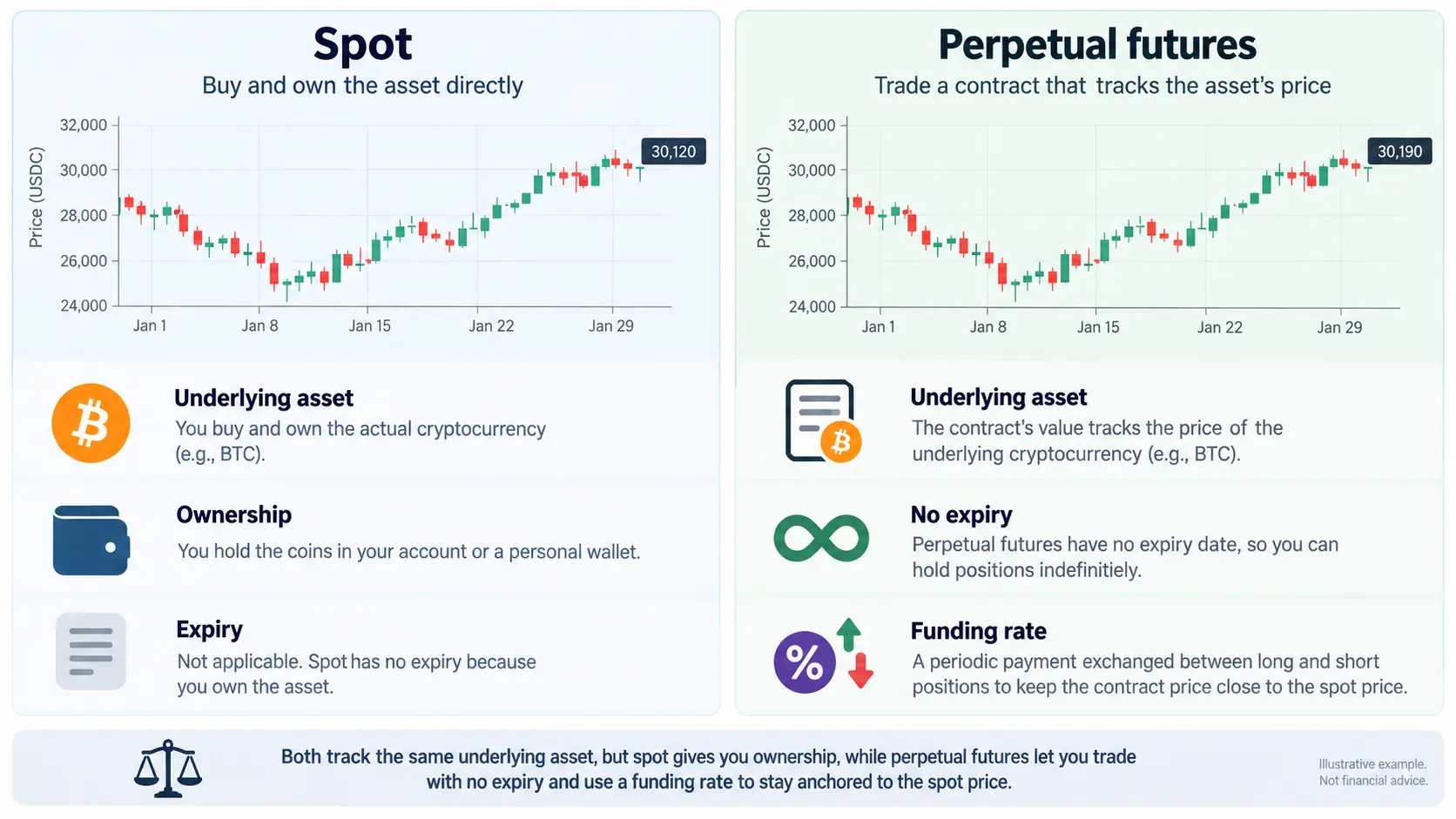
| Dimension | Spot | Perpetual futures |
|---|---|---|
| Exposure | Underlying asset or a corresponding balance | Contract tracking a reference price |
| Expiry | No contract expiry in the same sense | No fixed expiry date |
| Leverage | Not required for a basic purchase | Margin and leverage are core mechanics |
| Distinct costs | Spread, trading fee and custody/transfer where applicable | Funding, fees, spread, margin and liquidation |
| Main risks | Price decline and venue/custody risk | Price, funding, mark price and liquidation |
For execution context, see market structure and document the liquidity and fee assumptions rather than treating a product label as an edge.
Perpetual Mechanics: Margin, Mark Price and Funding
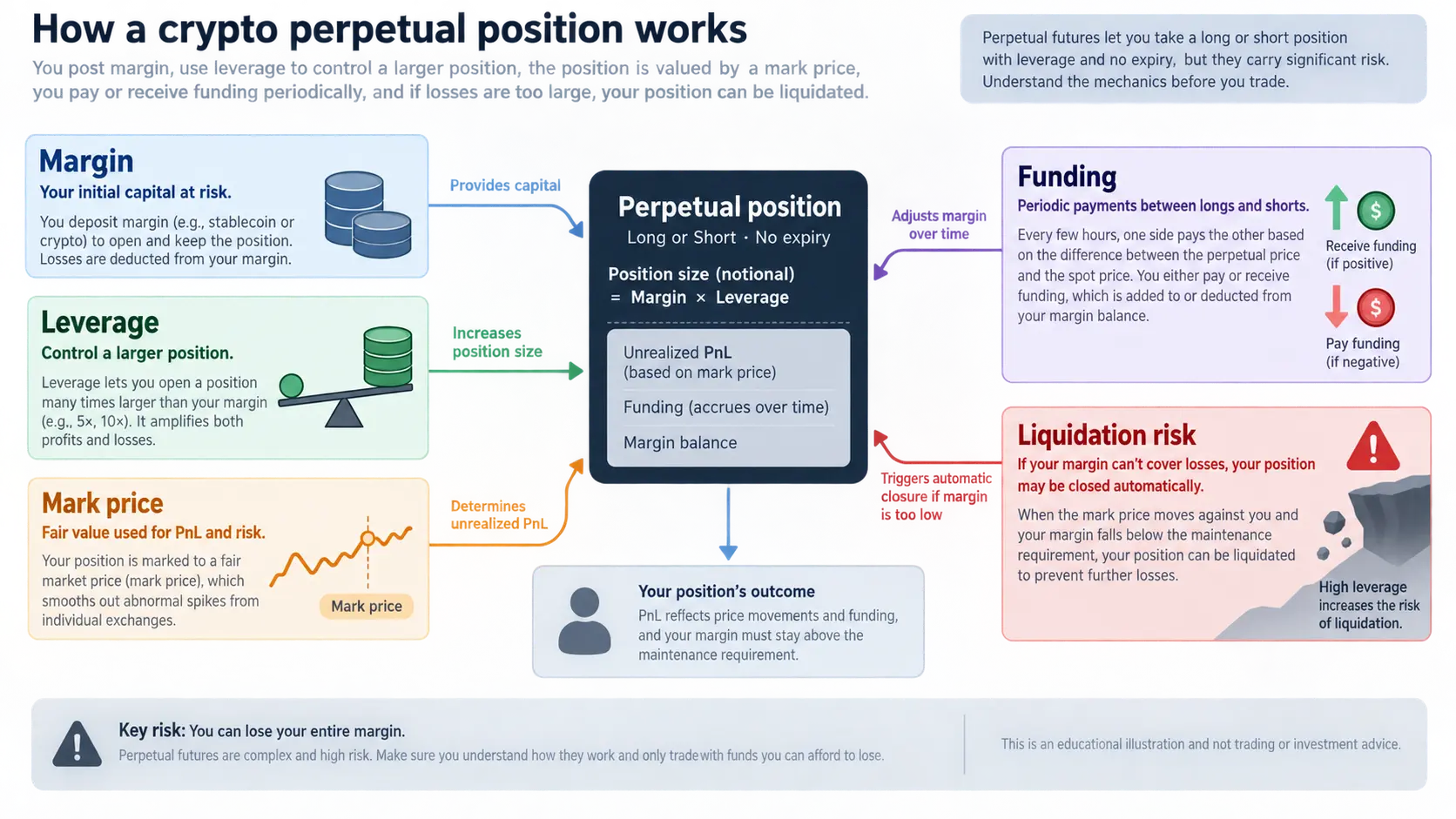
A perpetual uses margin to support a position with a larger notional value. Its mark price may be used for unrealized PnL or liquidation calculations and can differ from the last traded price. Funding transfers between longs and shorts at scheduled intervals. A position can therefore accumulate several costs even if the displayed price has moved very little.
Terms to verify
- whether margin is isolated or cross and which collateral is accepted;
- leverage limits, maintenance margin and the liquidation formula;
- funding interval, index/mark-price construction and maker/taker fees;
- deposit, withdrawal, transfer and incident procedures for the venue;
- price unit, contract size and timezone in the data.
Illustrative Example: Spot and Perpetual Basis Diverge
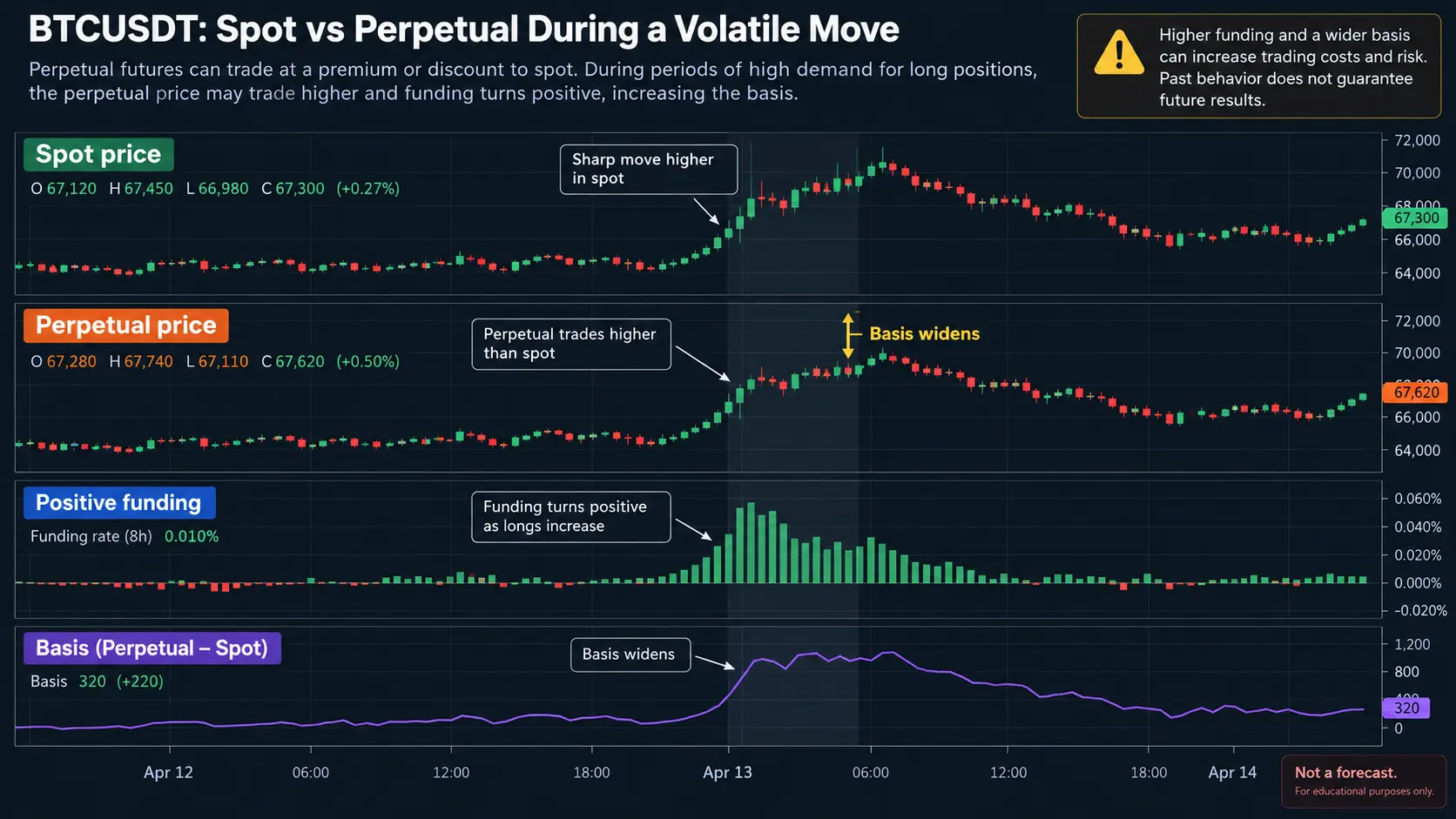
Suppose an illustrative chart from 10–14 May 2025 shows BTC spot near 66,000 while the perpetual trades higher and positive funding rises. The observation is that basis and holding cost changed; it does not establish which price will converge or whether spot will profit. With real data, record the venue, timestamp, position size and all fees before comparing instruments.
Use risk–reward planning to write invalidation and cost assumptions. Product comparison is not a buy or sell instruction.
A Neutral Selection Checklist and Limits
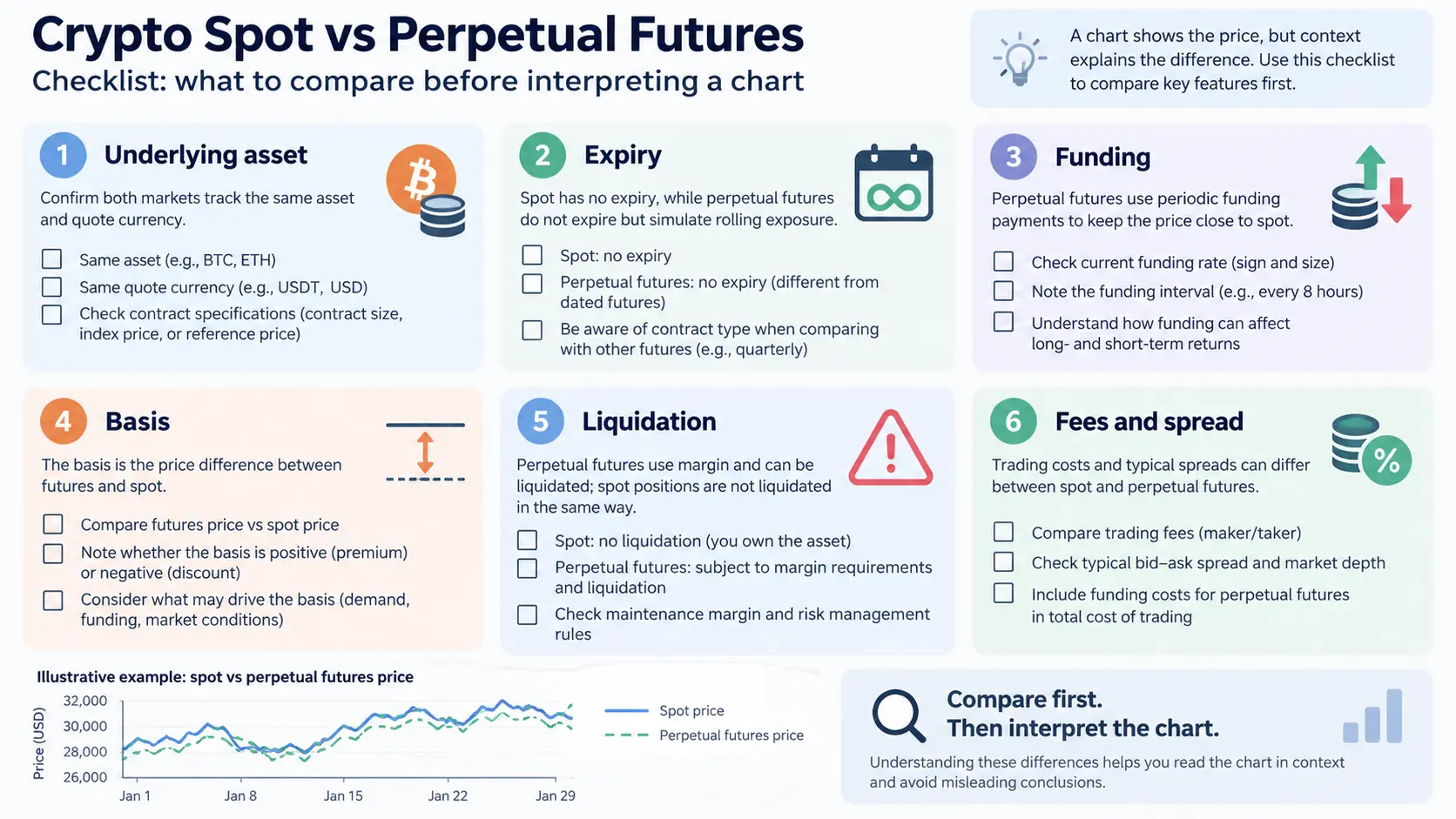
Workflow
- state the purpose: ownership, hedge, execution study or price observation;
- list spread, commission, funding, conversion, transfer and custody costs;
- start the comparison at zero leverage to isolate product mechanics;
- document mark price, liquidation and stop conditions from venue terms;
- test on timestamped data with explicit assumptions; never present an illustration as performance.
Failure cases
- comparing spot last price with perpetual mark price as if they were identical;
- ignoring funding or basis while holding a contract across intervals;
- using leverage to make nominal returns look attractive;
- assuming collateral remains liquid in every market condition;
- treating one venue as a proxy for the entire crypto market.
Verify contract terms, applicable rules and fees in your jurisdiction before using any product. This article explains mechanics and is not investment advice.
Key takeaways
- Spot represents the underlying asset; a perpetual is an unexpired contract;
- perpetuals add margin, mark price, funding and liquidation mechanics;
- basis and funding vary with venue and market conditions;
- fees and failure conditions should be written before comparison;
- neither product fits every objective or risk tolerance.
References
Risk note: This is educational content, not investment advice. Crypto derivatives and leverage can cause rapid losses; verify terms and manage risk.
Pingback: RSI Divergence: Regular Vs Hidden Signals Explained