


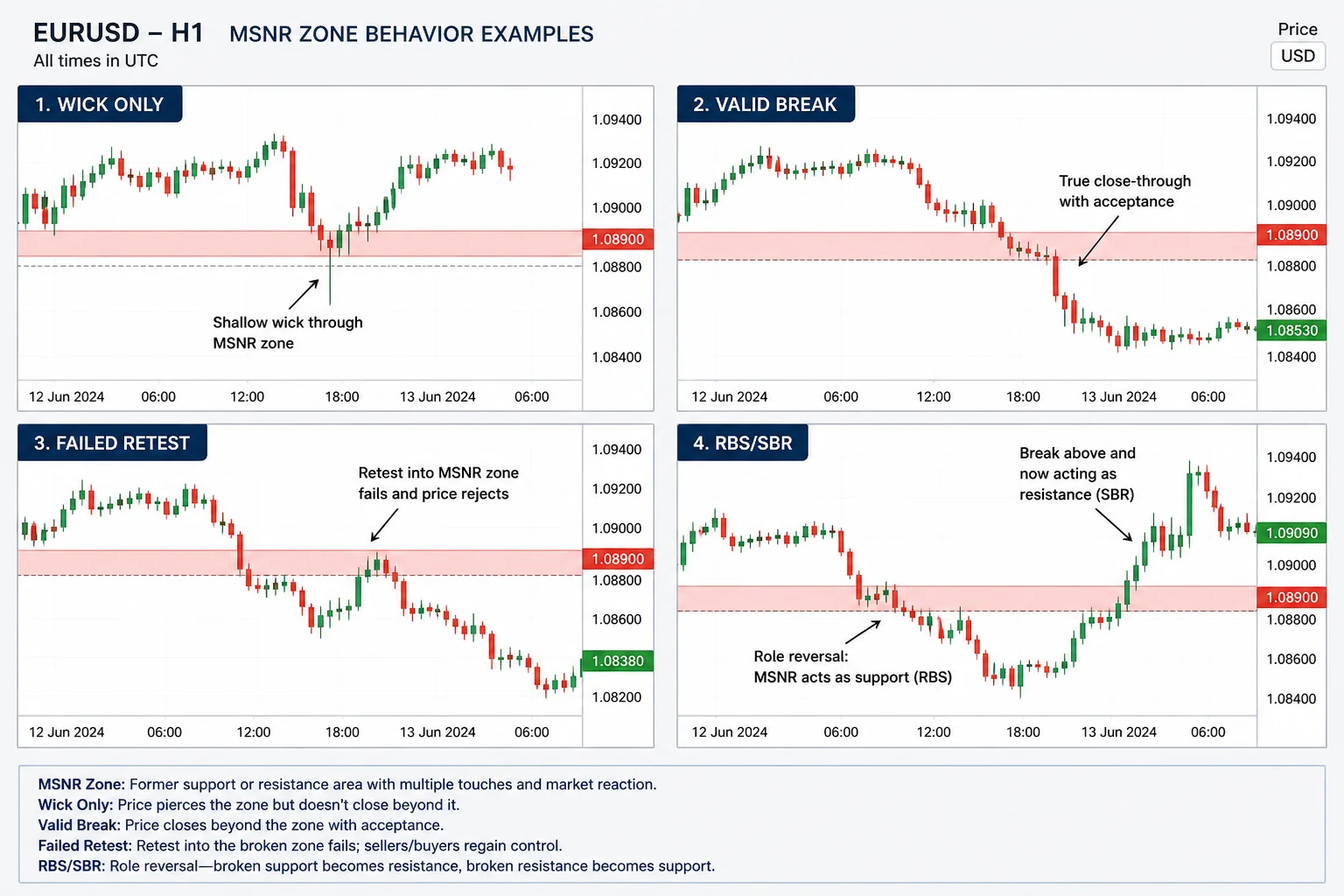
A broken MSNR zone means support or resistance is no longer holding its former role. A wick through a zone is not enough; look for a close-through, acceptance and usually a retest failure or role reversal. This distinction helps avoid shorting a zone that was only swept and reclaimed.
What is a broken MSNR zone?
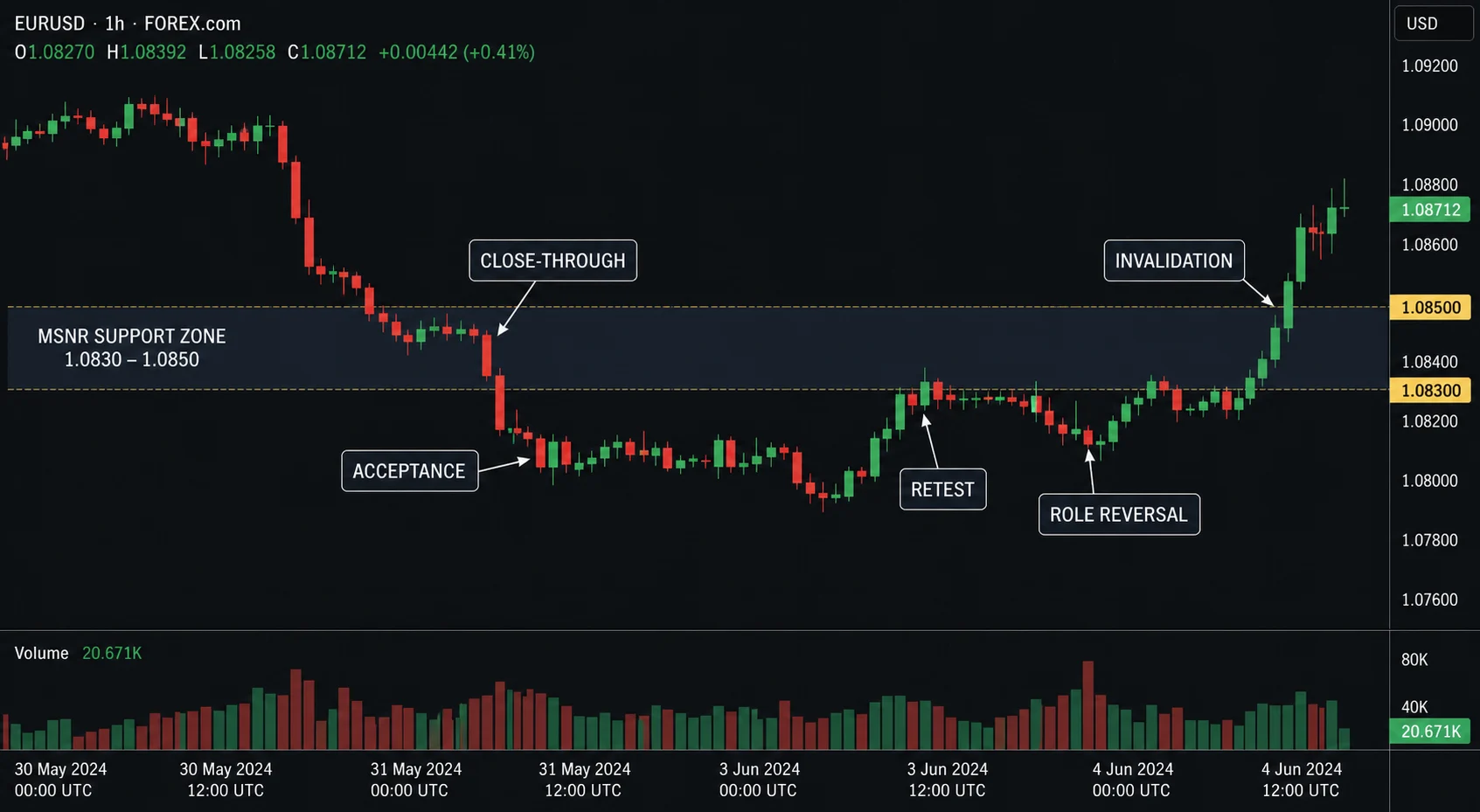
A zone is broken when new data shows that the former controlling side no longer protects the boundary. For support, the core evidence is an H1 close below the zone followed by candles accepting below it. Resistance uses the inverse logic. If price wicks through and reclaims, treat it as a sweep or rejection until your rule finds more evidence.
Close-through and acceptance
Measure the mapped boundaries. Assume support at 1.0830–1.0850. A candle with a low of 1.0818 but a close at 1.0842 remains inside the zone. An H1 candle closing at 1.0826 with an 18-pip range, followed by two closes at 1.0815–1.0820, provides stronger acceptance below. Volume is context, not proof; a high tick-volume reading on one broker is not centralized volume.
- Close-through: the close finishes beyond the boundary, not just the wick.
- Acceptance: following candles hold the new side or do not reclaim immediately.
- Invalidation: define the close that would put price back inside the zone.
Retest, RBS/SBR and role reversal
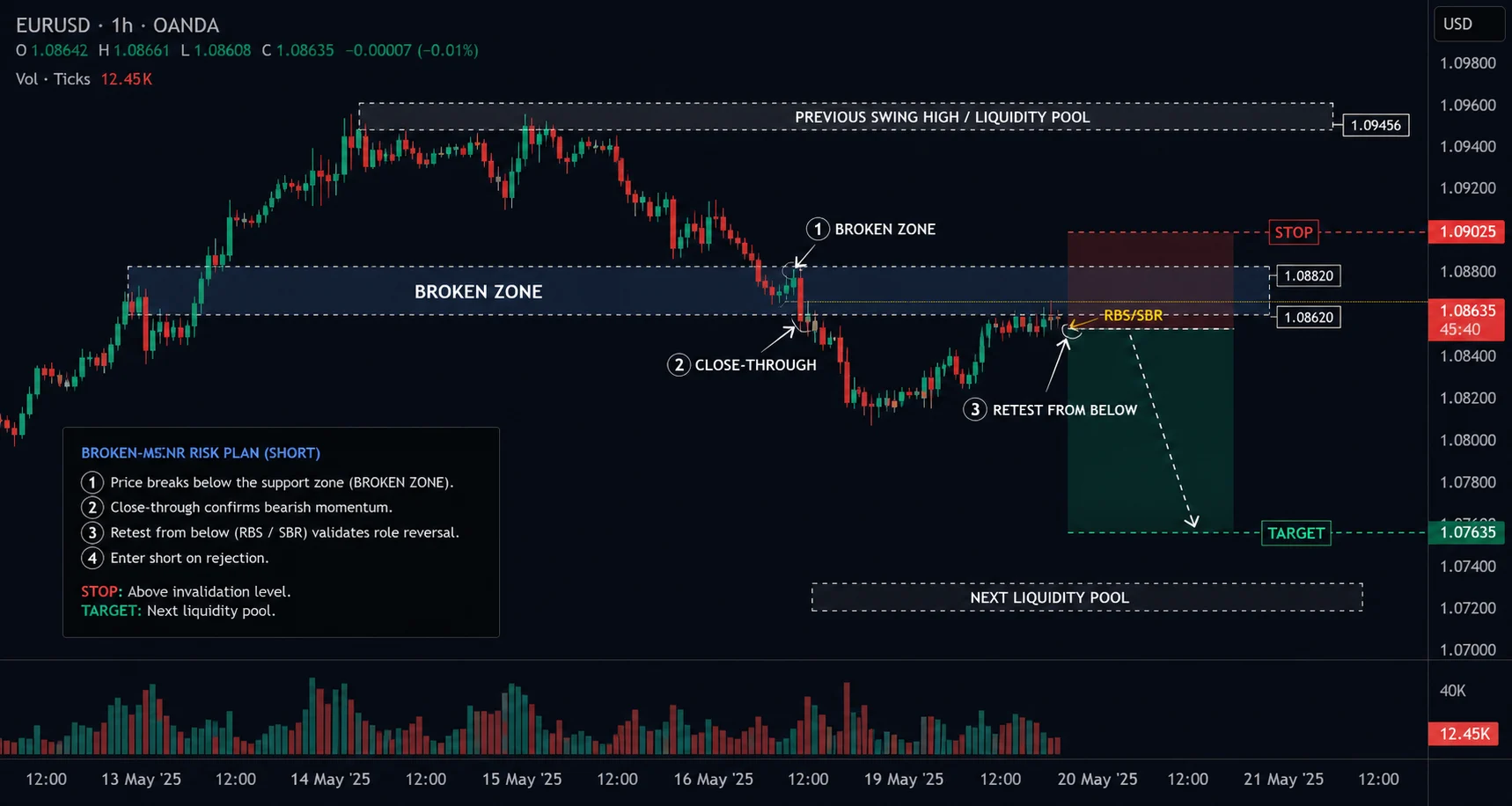
After support breaks, price may return from below. If 1.0850 rejects price and the next candle continues lower, former support is acting as resistance: SBR. When resistance breaks and a retest holds above, the role reversal is RBS. See RBS vs SBR in MSNR and First Pullback to a Fresh RBS or SBR Zone for supporting workflows.
Do not label a role reversal from one touch alone. Record the retest close, penetration depth, reaction at the boundary and the next liquidity target. If price closes back above 1.0850 under your rule, the short thesis is invalid; do not keep the “broken” label because the trade is already open.
Price-time-volume example
Assume EURUSD H1 support at 1.0830–1.0850. At 10:00 UTC, a candle closes at 1.0826 with an 18-pip range; tick volume is 20.7K versus a 20-candle median of 11.0K. The 11:00 and 12:00 candles close at 1.0819 and 1.0821, showing acceptance below. At 15:00, price retests 1.0843 but closes 1.0836; at 16:00, a bearish candle closes 1.0828. This is a rejected retest consistent with SBR. If 15:00 closes at 1.0854 and 16:00 holds above the zone, the short is invalid.
The example shows how to log observations; it does not prove a probability. Place the stop beyond the tested invalidation rule and choose a target from the next liquidity pool rather than a fixed pip promise.
FAQ
Is a wick through a zone a broken zone?
No. Require a close-through and acceptance or a retest confirmation under your rule.
Does every broken zone create a role reversal?
No. Price can continue, range or reclaim. RBS/SBR is a hypothesis to test.
Does high volume confirm a zone break?
Not alone. Compare the same feed and session; prioritize close, acceptance and invalidation.
Editorial: Học Làm Trader Editorial Team · Professional review: price and volume figures are hypothetical and require independent testing. Risk note: educational content only, not investment advice.
References
- StockCharts ChartSchool: The Wyckoff Method — A Tutorial.
- CMT Association: Wyckoff Method interactive session.
Price and volume examples are illustrative; they are not a backtest or investment advice.