


An MSNR limit entry is a pending order placed before price reaches the zone. It can improve entry price but may miss the move or fill while the context has changed. This execution tutorial covers conditions, buffer, spread, stop loss and invalidation without promising a win rate.
What is an MSNR limit entry?
A buy limit waits below the current price; a sell limit waits above it. In MSNR, a pending order is reasonable only after the zone, bias and invalidation are mapped. A limit is not a shortcut around confirmation; it is an execution choice trading entry price against fill certainty.
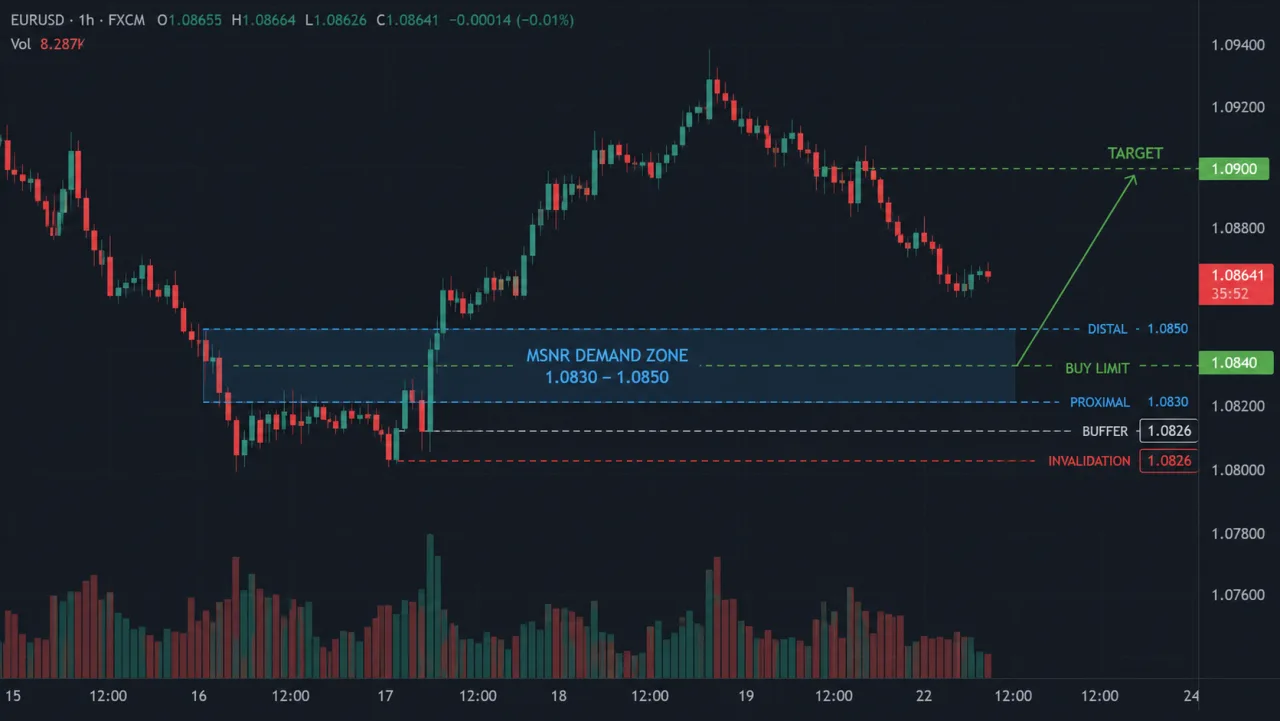
Review the MSNR framework and zone-width rules before placing a pending order.
Entry location and buffer
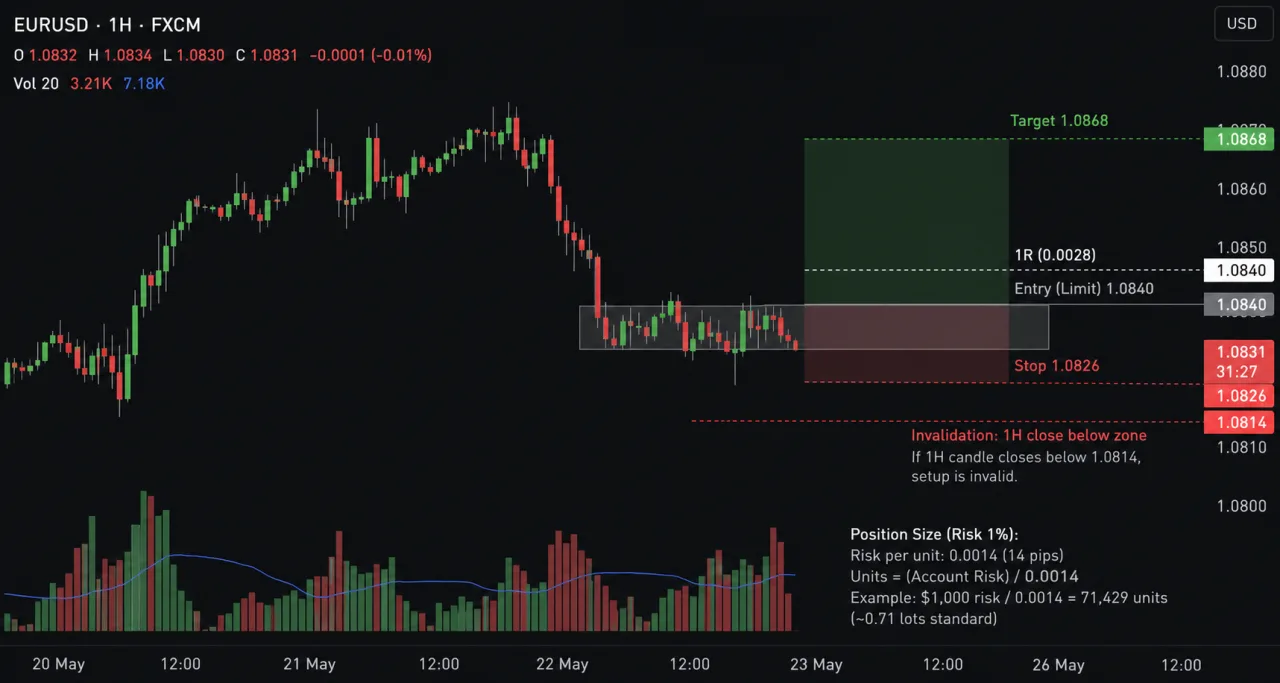
Zone width is not stop distance. Assume a 1.0830–1.0850 demand zone, 20 pips wide: a buy limit might sit at 1.0840, near 1.0848 or deeper at 1.0834. The buffer must be meaningful relative to spread and lower-timeframe noise; placing it beside the boundary can produce a fill from one tick followed by reversal.
- Record entry, zone boundaries, average spread and invalidation.
- Do not move the order into the middle only to improve an R multiple.
- After repeated touches, reduce limit priority or require a trigger.
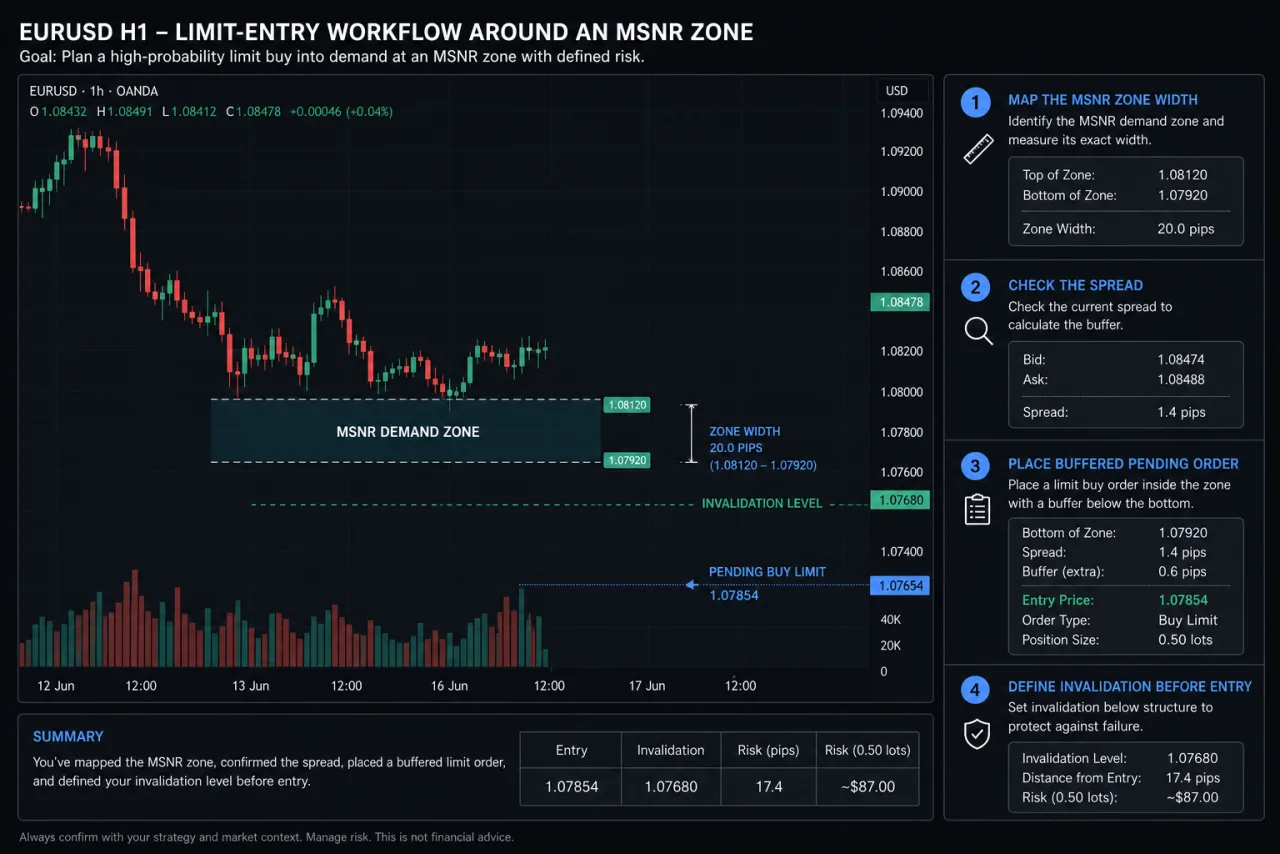
Spread and zone width
Assume EURUSD spread is 1.2 pips in a normal session and the zone is 20 pips wide. A 0.5-pip buffer is not automatically wrong, but test news and rollover conditions; if spread widens to 3–5 pips, fill and stop behavior can change. Backtest on the same broker/feed you plan to trade.
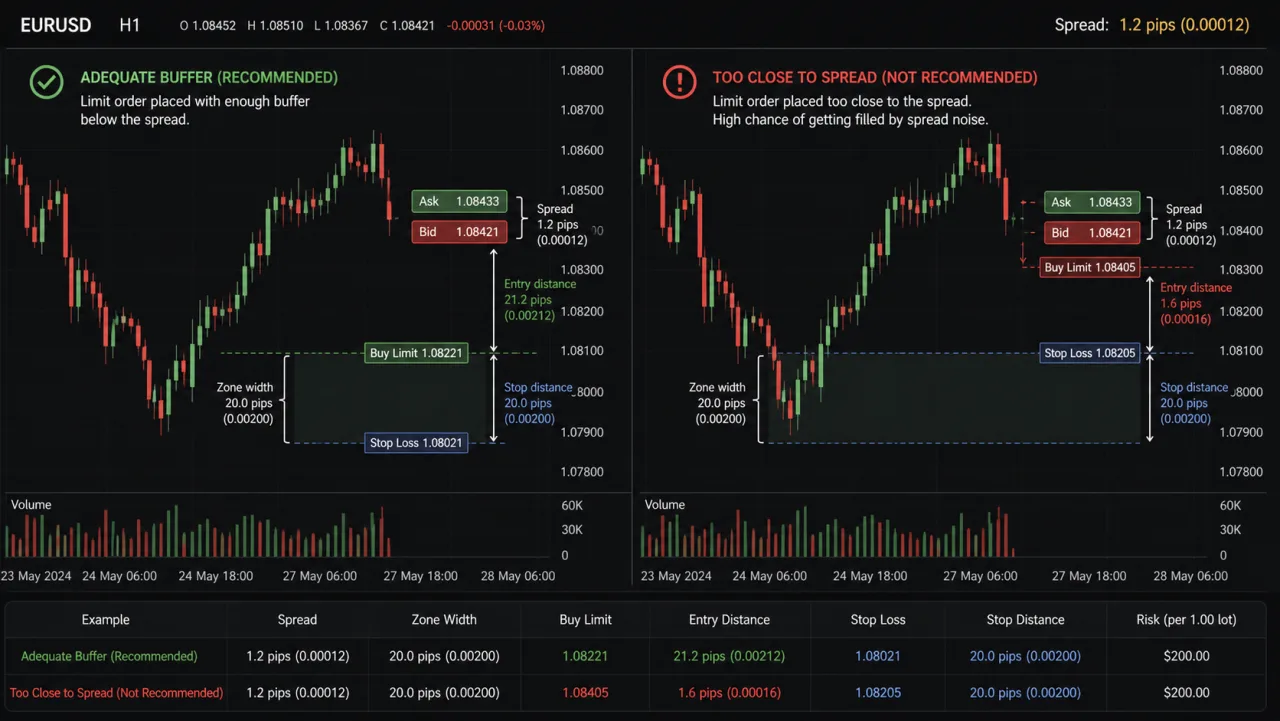
Pending-order example
Assume H1 zone 1.0830–1.0850, current price 1.0862, bullish bias and no red-calendar event. Place a buy limit at 1.0840, stop at 1.0826 and first objective at 1.0868. At 14:00 UTC price trades 1.0840; tick volume is 9.4K versus a 6.8K median and the order fills. In another path price turns at 1.0844 and runs to 1.0868: a missed limit is normal, not a reason to chase.
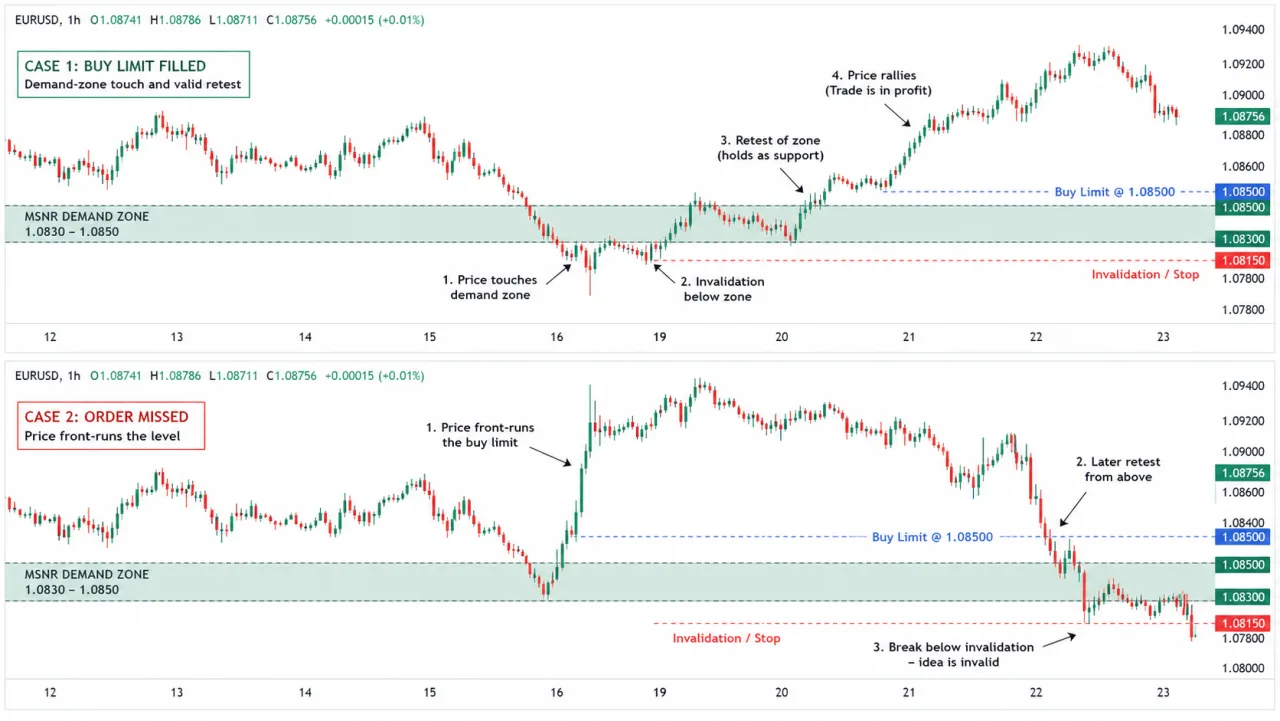
This example cannot be converted into a win-rate claim. Log filled, missed and invalidated orders separately.
Stop loss and invalidation
A stop loss is an exit price; invalidation says the zone thesis no longer holds. In this example an H1 close below 1.0826 is invalidation; a wick to 1.0825 that closes back above the zone can be handled by your tested rule. Monetary risk equals stop distance × pip value × size. Keep money risk fixed instead of increasing size to compensate for a missed order.
The CFTC Forex advisory explains why leverage magnifies losses as well as gains.
FAQ
Is a limit entry better than a market entry?
There is no universal answer. A limit prioritizes price but accepts missed fills; a market entry prioritizes confirmation but may incur slippage.
How large should the buffer be?
Measure it against spread, volatility and timeframe, then test it; do not use one number for every broker.
Should I move the limit as price approaches?
Only if that rule was written beforehand. Moving it from fear of missing out changes the original risk.
Editorial: Học Làm Trader Editorial Team · Professional review: examples are hypothetical and must be tested on your broker/feed. Risk note: educational content only, not investment advice.