


A liquidity sweep around an MSNR zone is a test of liquidity such as EQH or EQL followed by a reaction back toward the zone. The edge is not the wick itself; it is the location, the closing price, the follow-through and a predefined invalidation.
What is a liquidity sweep around MSNR?
Here, “sweep” is a trade hypothesis: price reaches liquidity outside an MSNR zone, often at equal highs or equal lows, and then reacts back. MSNR remains the anchor; EQH/EQL only identifies where stops or resting orders may cluster. A long wick alone is not confirmation.
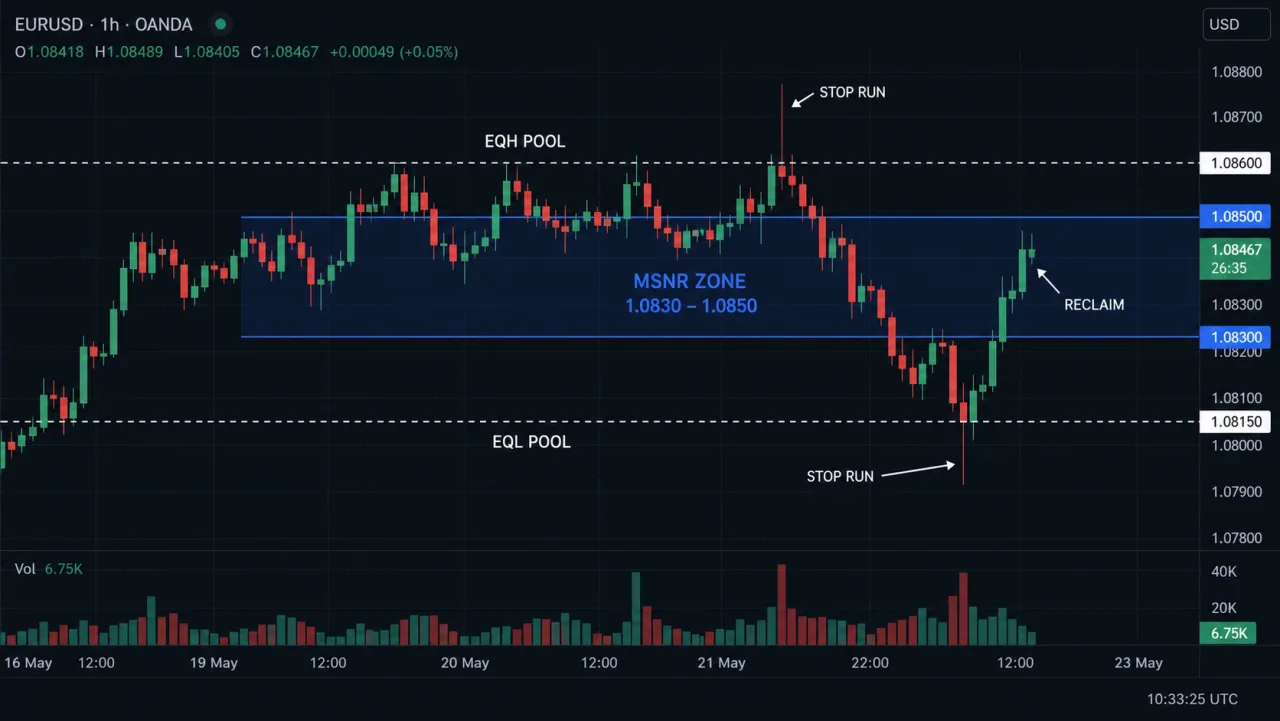
For zone construction, see the MSNR strategy framework and how to draw MSNR zones without overfitting. Those guides answer where the zone is; this article tests the reaction around it.
A four-step confirmation process
1. Map the zone and pool
On the zone-forming timeframe, mark the MSNR boundaries with your body-first rule. Then connect at least two near-equal highs into EQH or two near-equal lows into EQL. The pool should sit outside the zone, not in its middle.
2. Wait for a located stop run
A sweep has more context when it occurs on the side allowed by the narrative: EQH above a supply zone or EQL below demand. A wick in the middle of a strong trend is not automatically a reversal.
3. Require a close or reclaim
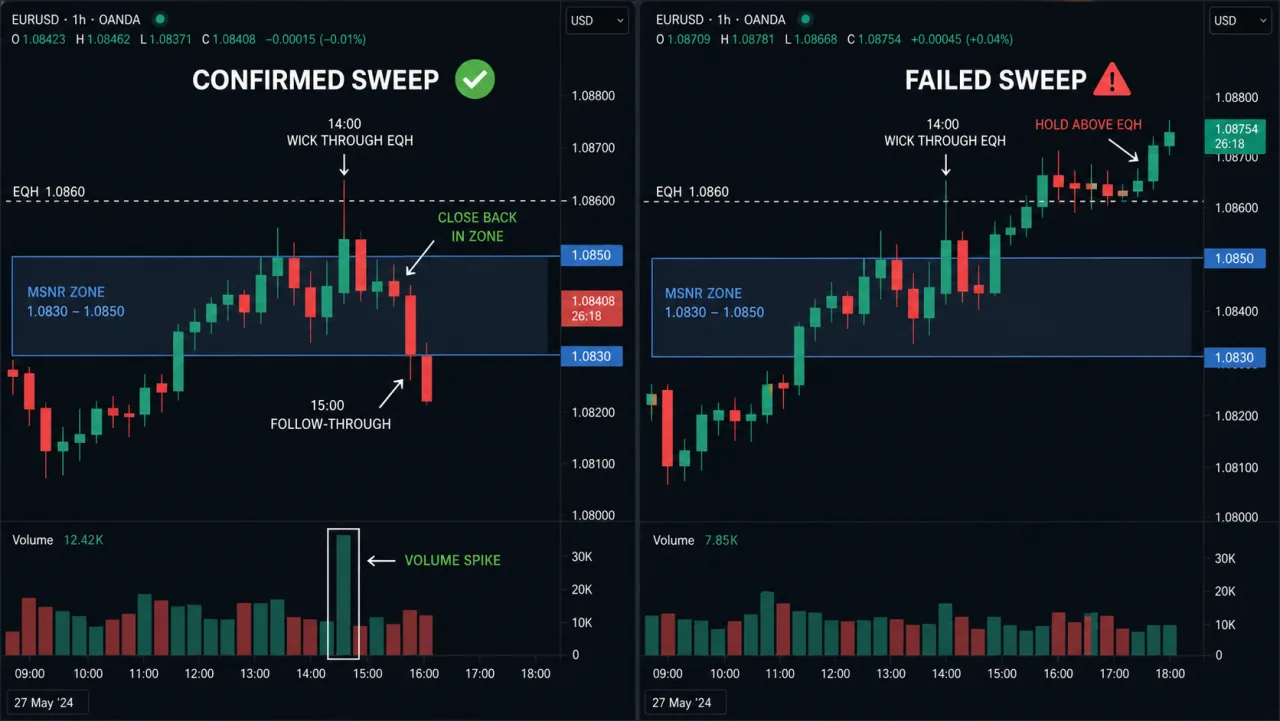
After an EQH sweep, look for a candle close back below EQH and preferably inside MSNR. After an EQL sweep, look for a close back above EQL and a reclaim. Do not enter merely because price crossed a line.
4. Check follow-through
The next candle should hold the zone or produce a retest with a reaction. Consecutive closes outside the pool weaken the sweep thesis and call for a breakout scenario or no trade.
EURUSD example with price, time and volume
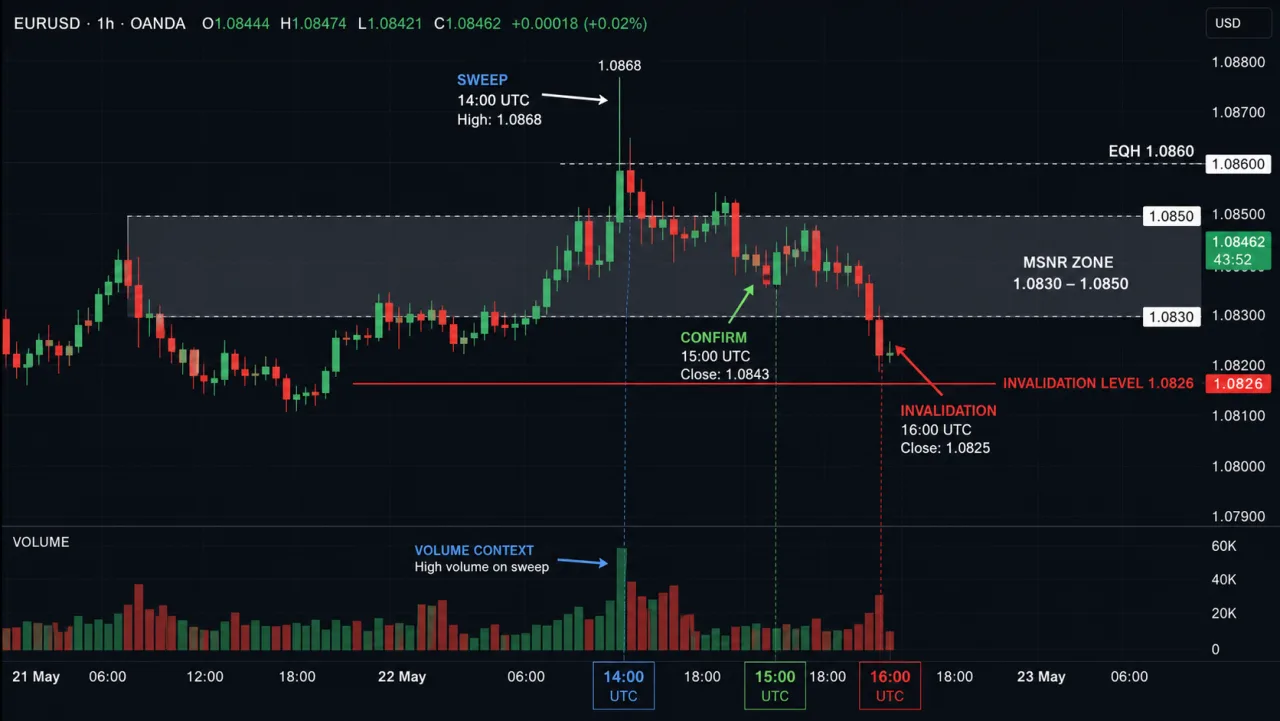
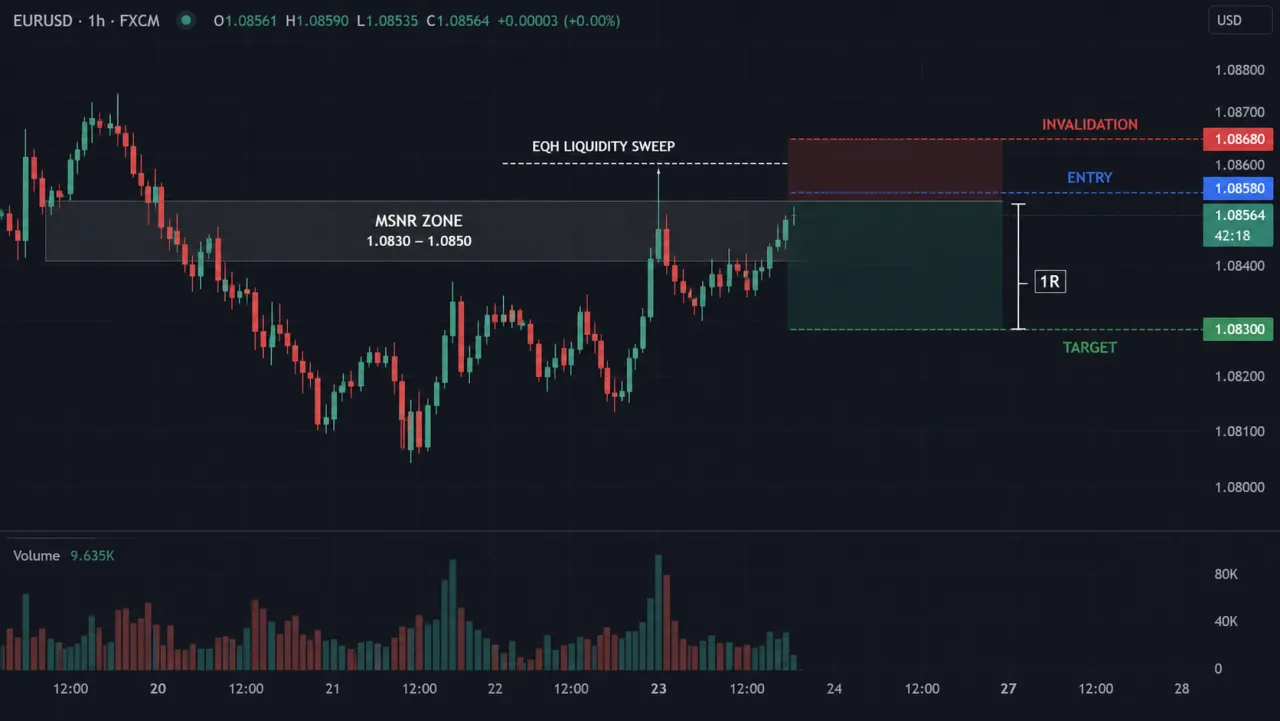
Assume EURUSD H1 has an MSNR zone at 1.0830–1.0850 and EQH at 1.0860. At 14:00 UTC, price wicks to 1.0868 but closes at 1.0847, back below EQH and inside the zone. Tick volume is 12.4K versus a 20-bar median of 6.9K, about 1.8 times higher. At 15:00, the next candle closes at 1.0858 and holds the upper boundary; that is supporting context, not proof.
Forex volume is broker-dependent tick data, not centralized market volume. Compare results on the same feed and test a meaningful sample. Fidelity’s OHLC chart guide is useful for reading candles, but volume should never be used alone.
Sweep versus a true breakout
| Test | Confirmed sweep | Breakout or failed sweep |
|---|---|---|
| Candle close | Returns to the pool or MSNR | Closes and holds outside the pool |
| Retest | Zone boundary holds | Old level becomes new support/resistance |
| Volume | Spike accompanies a reaction, as context | Activity persists during acceptance outside |
| Action | Wait for a trigger with defined risk | Do not force a fade; update the bias |
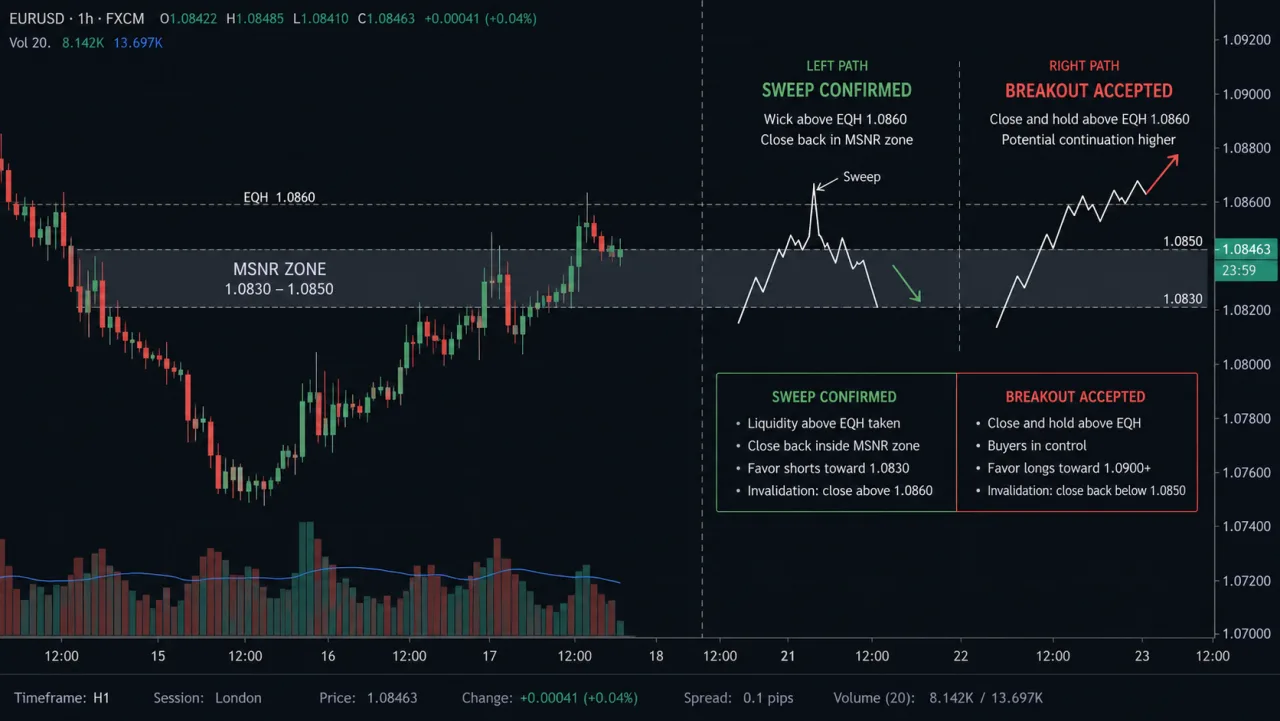
No checklist removes false positives. Higher-timeframe structure, sessions and news can keep price moving. Use the multi-timeframe analysis guide for top-down context.
Invalidation and risk management
For the EQH example, an invalidation can be an H1 close above 1.0868, or the fixed rule in your tested system. Do not move the stop because of a new wick. If entry follows the 15:00 close, a first objective near 1.0830 can be planned in R terms; never assume a sweep must become a large reversal. For an EQL sweep, a sustained close below the sweep low invalidates the idea.
Risk only a small, predefined fraction of capital and log the same broker/feed. The CFTC Forex advisory explains why leverage can magnify losses as well as gains.
FAQ
Is a volume spike required?
No. It is feed-dependent context. Prioritize the pool location, closing price and follow-through, then test volume separately.
How many candles confirm a sweep?
There is no universal number. One close back in the zone plus continuation is a minimum example; your rules may require a retest.
Should every EQH/EQL be traded?
No. Select pools beside a clearly mapped MSNR zone, aligned with your bias and paired with invalidation before entry.
Editorial: Học Làm Trader Editorial Team · Professional review: the process is cross-checked against technical-analysis references and must be backtested. Risk note: educational content only, not investment advice.