


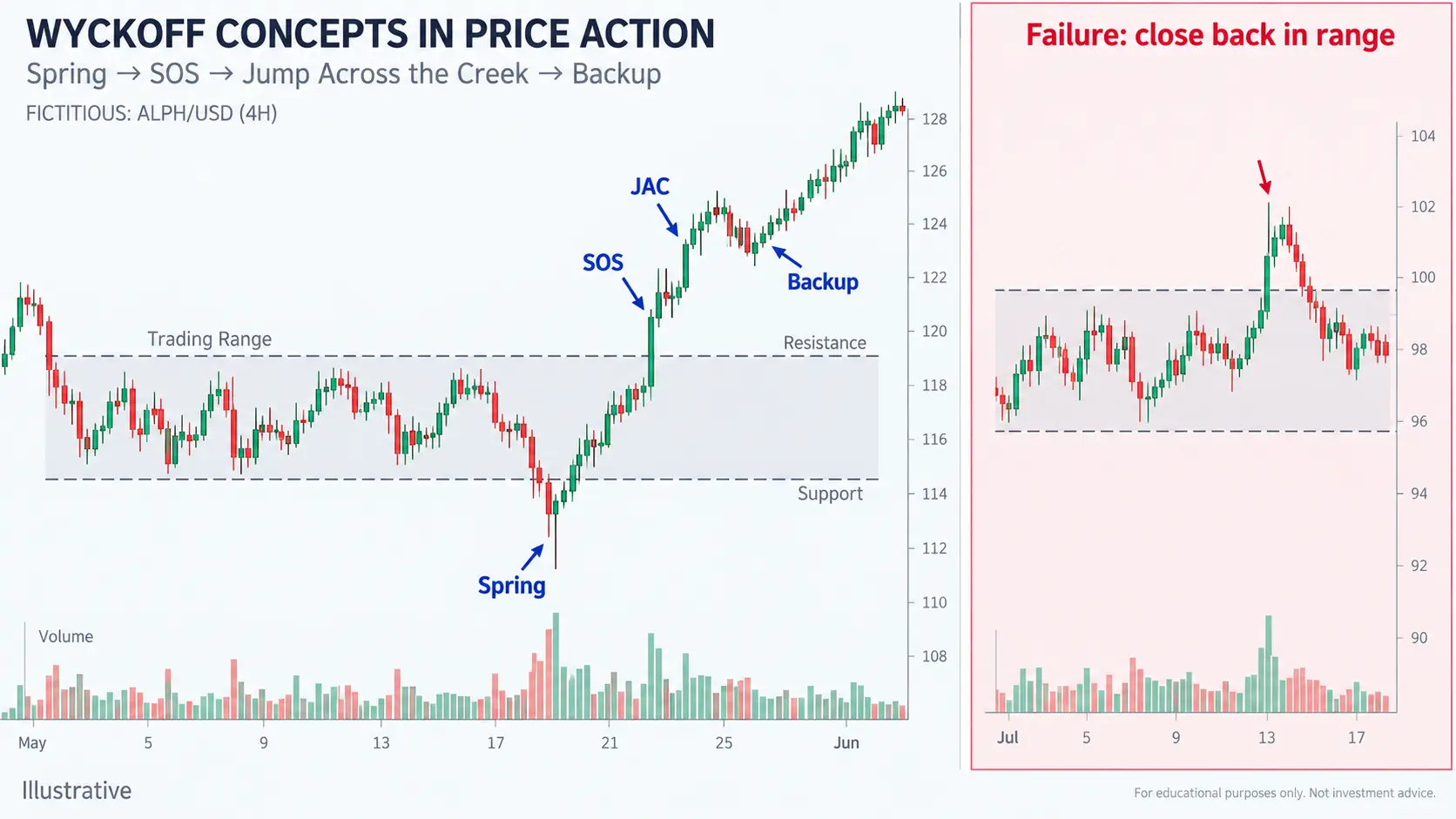
Wyckoff Creek is a conceptual resistance boundary across a trading range. A Jump Across the Creek (JAC) describes a decisive move above that boundary, while a Backup is a later test from above. The labels are contextual hypotheses—not a mechanical buy signal—and a breakout can fail back into the range.
What is the Wyckoff Creek?
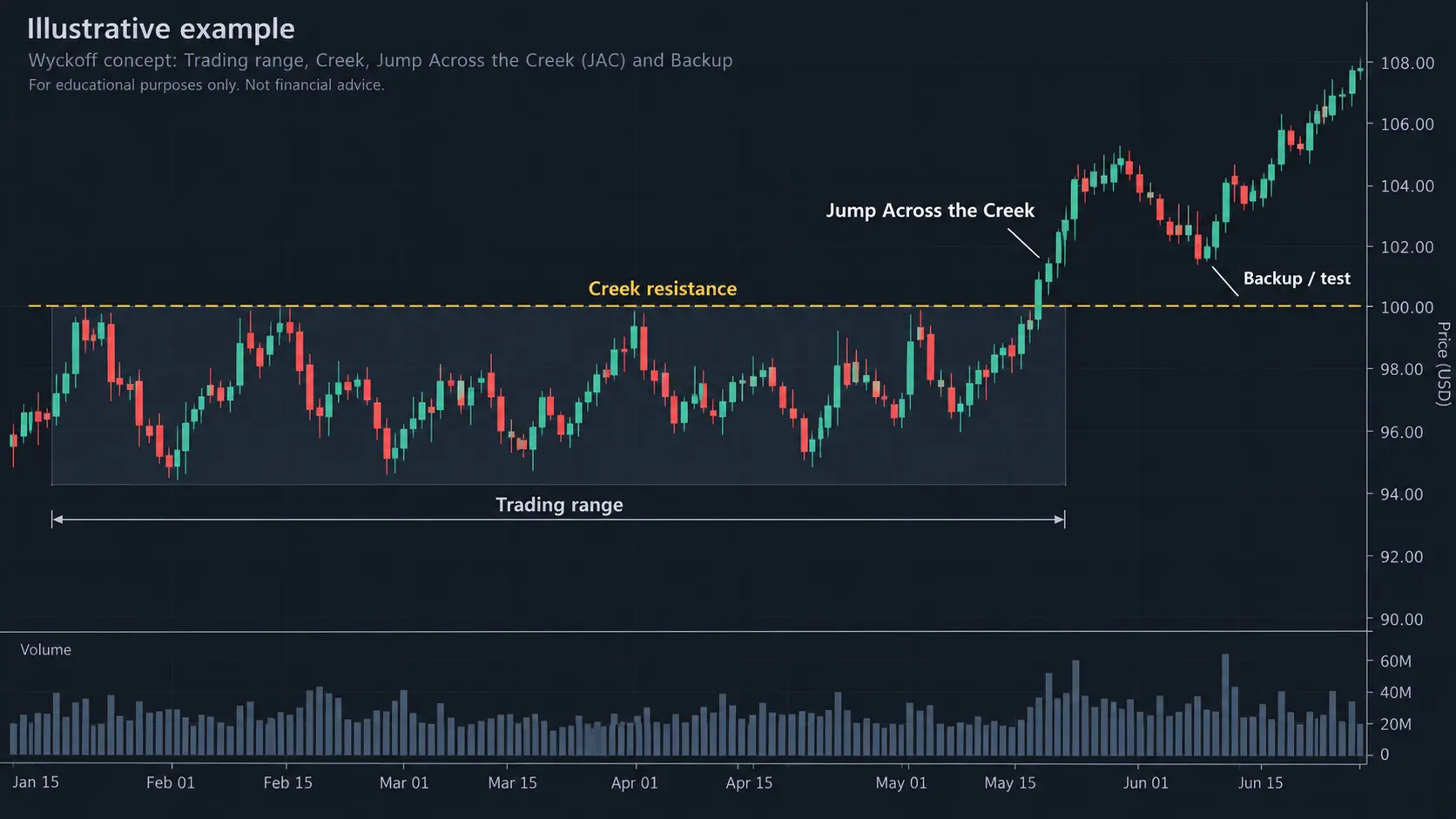
The “creek” metaphor describes supply that repeatedly caps rallies inside a range. The line is not necessarily a single exact price; it may be a band formed by swing highs, closing levels and failed attempts to leave the range. First define the range, then test whether the resistance boundary is meaningful on the chosen timeframe.
JAC, Backup and the context around a breakout
What to document
- the range boundaries, duration, timeframe and instrument;
- prior tests of the upper boundary and whether spread/volume changed with each test;
- the breakout close, follow-through and any return toward the boundary;
- a Backup/Test that holds above the creek versus a close back inside the range;
- the invalidation condition written before interpreting the pattern.
The broader Wyckoff Method guide separates events from the larger phase hypothesis. A JAC without a defined range is just a strong candle; a Backup without a prior acceptance above the boundary is not automatically confirmation.
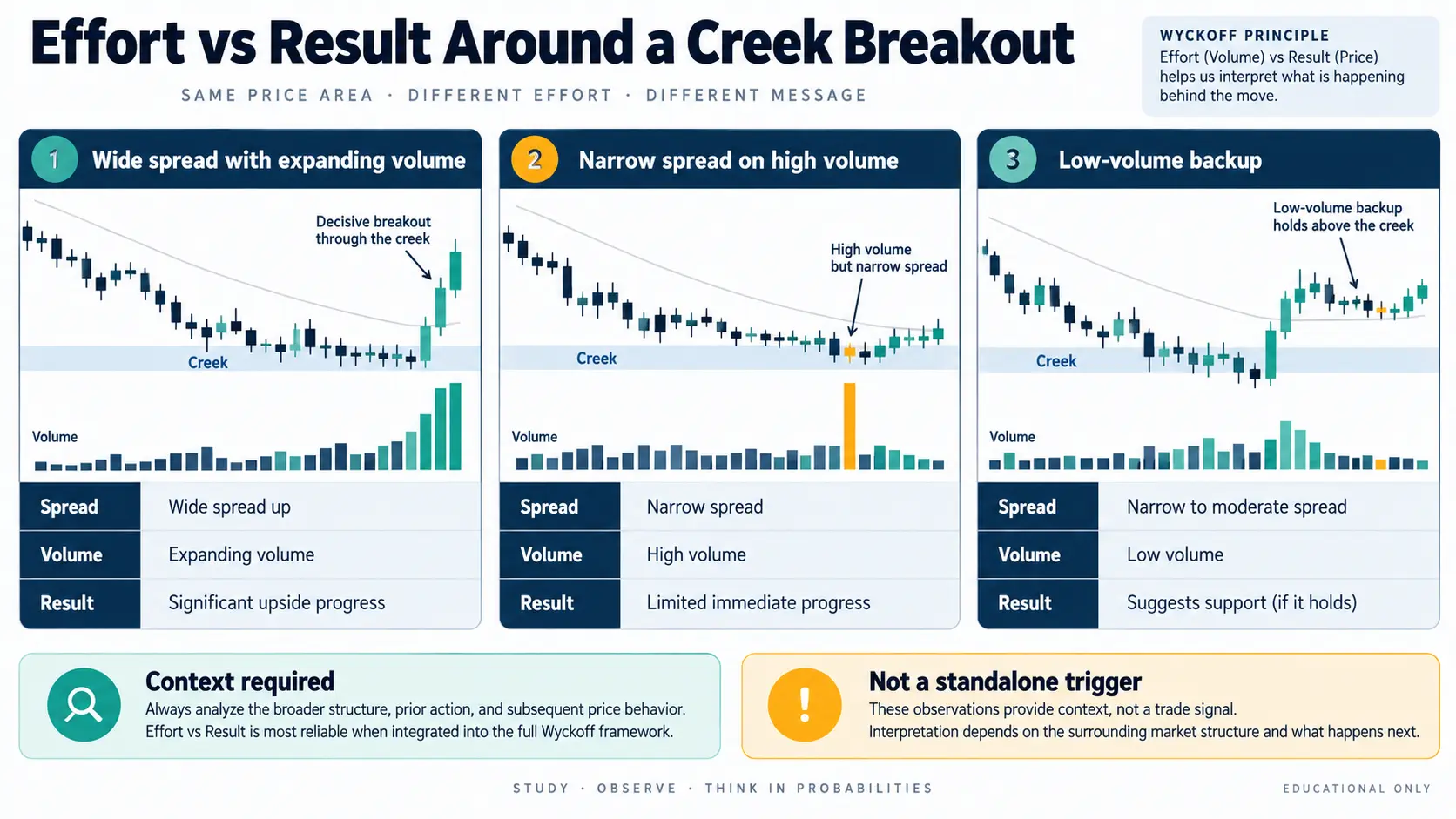
Effort versus result: a supporting observation
| Observation | Possible interpretation | What remains unknown |
|---|---|---|
| Wide spread with expanding volume through the boundary | Demand may be overcoming visible supply | Whether follow-through and acceptance will persist |
| High volume but little upward progress | Supply may still be absorbing demand | Whether the range will resolve up or fail |
| Quiet Backup with a narrower spread | Selling pressure may be lower in that moment | Whether the next test will hold |
| Close back inside the range | The breakout hypothesis is weakened or invalidated | Whether a later attempt will succeed |
Volume and spread are context, not independent triggers. Exchange volume can be more comparable on centralized markets; spot-Forex tick volume is a broker-specific activity proxy. Record the data source and period instead of presenting an unsupported statistic.
A reproducible Creek checklist
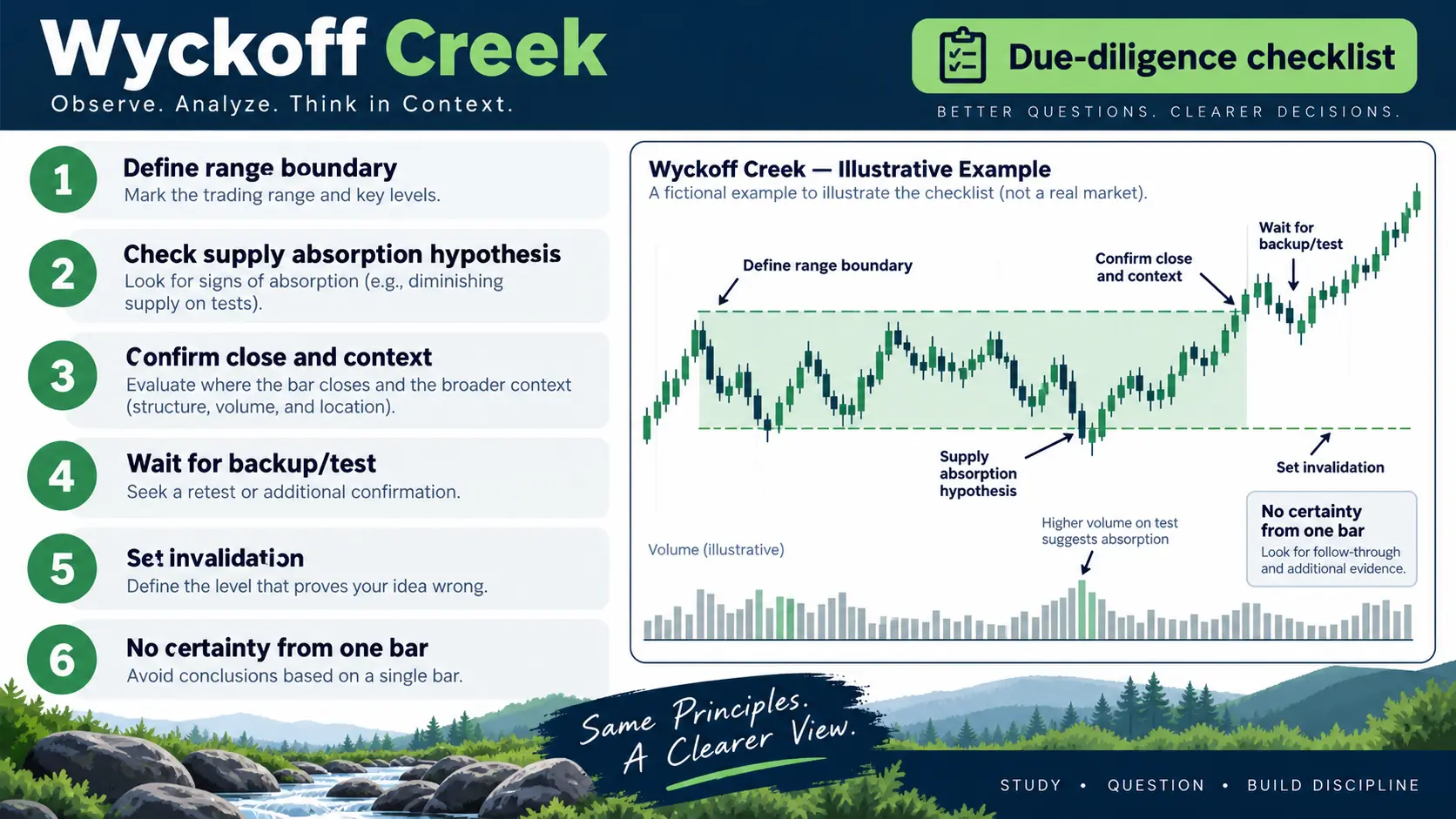
- mark the upper range boundary as a zone and note the timeframe;
- describe the supply-absorption hypothesis in words that could be falsified;
- require a close and follow-through observation rather than one intrabar spike;
- watch the Backup/Test for acceptance above the boundary or a return into the range;
- define invalidation and maximum risk before considering any execution plan.
Failure cases and limits
- a sloping or poorly defined range can make the “creek” subjective;
- news-driven gaps or thin sessions can look like a JAC without durable acceptance;
- a Backup may not occur, may be deep, or may fail immediately;
- phase and event labels are interpretive and can change as new bars arrive;
- one market or timeframe cannot establish a universal Wyckoff rule.
For related context, compare the Spring and Test and Upthrust/UTAD guides. Pair any hypothesis with risk–reward planning and documented invalidation; neither page promises a result.
Key takeaways
- Creek is a resistance boundary inside a defined range, not a universal line;
- JAC and Backup are event labels that need price, volume and context;
- a close back inside the range weakens the breakout hypothesis;
- spot-Forex volume and a single DOM/feed have important coverage limits;
- risk planning comes before interpreting a pattern as actionable.
Risk note: This is educational content, not investment advice. Wyckoff labels are hypotheses, and trading can cause losses. Validate data, costs and risk limits for your own circumstances.