


higher highs and higher lows Higher highs and higher lows describe an uptrend when successive external swing highs and swing lows progress upward. The definition depends on swing degree; a lower low on an execution chart may be an internal pullback inside a higher-timeframe uptrend. The method should be treated as a testable chart-reading framework rather than a forecast. Before using it, define the market condition, confirmation event, invalidation price, transaction costs and maximum risk. This guide explains the rules, a repeatable workflow, common failure modes and the most relevant supporting concepts.
Definition: What Are Higher Highs and Higher Lows?

A higher high forms when price rallies above a previous swing high. A higher low forms when price pulls back but stops above the previous swing low. Together, they create the basic rhythm of an uptrend: push, pullback, push, pullback, continuation. The highs show that buyers can push price into new territory. The lows show that pullbacks are being defended at higher prices than before.
A swing high is a visible point where price rises, pauses, and turns down. A swing low is a visible point where price falls, pauses, and turns up. The word “visible” matters. Traders should not treat every tiny candle wiggle as a meaningful swing. A useful swing should be clear enough that it helps explain the market, even after you zoom out slightly.
In a clean bullish sequence, price makes a higher high, then returns into a pullback. If the pullback holds above the prior swing low and price later turns upward, that pullback becomes a higher low. If price then breaks the latest high, the sequence continues. This is the classic higher highs and higher lows pattern.
The pattern is not only a label. It tells a story. Buyers are willing to buy at higher prices, sellers are failing to push price below the previous low, and each expansion confirms that the market is still accepting higher levels. The trader does not need to predict every candle. The structure itself gives a framework for deciding whether bullish continuation still makes sense.
How to Identify Higher Highs and Higher Lows

Start by zooming out until the main movement becomes easy to see. Many beginners make structure confusing because they work too close to the candles. If every candle looks important, step back. Higher highs and higher lows should describe the main swing rhythm, not every small fluctuation inside a pullback.
Next, mark the clearest swing highs and swing lows. A swing high should show a real pause or reversal from buying pressure. A swing low should show a real pause or reversal from selling pressure. If you have to argue with yourself about whether a point matters, it is probably not the first swing you should mark.
After the swings are marked, compare them in sequence. Ask three questions. Did the latest high break above the previous high? Did the latest pullback low stay above the previous low? Did price continue upward after holding that pullback? If the answer is yes, the market is likely forming higher highs and higher lows.
It also helps to separate major structure from minor structure. The daily chart may show a healthy uptrend, while the fifteen-minute chart shows a short-term pullback. That does not automatically break the larger bullish structure. Decide which timeframe controls your trade idea before labeling the chart.
Finally, watch how price behaves at the higher low area. A higher low is stronger when price rejects from a logical area, such as prior resistance turned support, a demand zone, a moving average area, or a higher-timeframe level. A random bounce in the middle of nowhere may still become a higher low, but it usually needs more confirmation.
Why Higher Highs and Higher Lows Work

The pattern works because it organizes buying and selling pressure into a readable sequence. A higher high shows expansion. Price has moved beyond the prior decision point, which means buyers had enough strength to overcome sellers at that area. A higher low shows defense. Sellers pushed price down, but they could not take it below the previous swing low.
This repeated defense can create confidence for trend-following traders. If every pullback is being bought sooner than the last one, the market is showing demand. Traders who missed the first move may wait for the next pullback. Short sellers may exit when price breaks above a previous high. Breakout traders may enter when price confirms another expansion. These reactions can help continuation develop.
Higher lows are often more important than higher highs. A new high can happen through a brief breakout or a temporary spike. A higher low shows whether the market can hold structure after excitement fades. If price breaks a high but then collapses below the prior low, the bullish story weakens. If price pulls back calmly and holds above the prior low, the trend remains healthier.
The pattern also helps with risk because it gives the trader a visible invalidation point. If a long idea depends on a higher low holding, then a clean break below that higher low may invalidate the idea. This does not make the trade safe, but it makes the risk more logical than entering without a structure point.
Step-by-Step Usage in a Trading Plan

- Define the market state. Is price already making higher highs and higher lows, or are you trying to guess the first turn before structure confirms it?
- Mark the active swing high and swing low. The high is the continuation level. The low is the structure point that should hold if the bullish idea remains valid.
- Wait for the pullback. Do not chase every higher high. A cleaner setup often appears when price returns to a logical area and begins forming a higher low.
- Look for confirmation. This can be a rejection candle, a lower-timeframe break upward, a successful retest, or a close back above a minor structure point.
- Plan invalidation first. If the setup depends on a higher low, a clean break below that higher low changes the idea.
- Define the target. Common targets include the prior high, a projected new high, or the next higher-timeframe resistance area.
Confirmation Rules for Higher Highs and Higher Lows

- Use meaningful swings. A tiny break above a tiny high may not change the market state. Focus on levels that matter on your trading timeframe.
- Prefer acceptance over a wick. A close above the prior high, a hold above the level, or a successful retest is stronger than a brief spike.
- Protect the higher low. If price breaks below the prior swing low after making a higher high, the bullish structure is no longer clean.
- Check location. A higher low forming from support is usually cleaner than one forming directly under major higher-timeframe resistance.
- Wait for behavior. A possible higher low becomes more useful only after price reacts and shows that buyers are defending it.
Examples of Higher Highs and Higher Lows
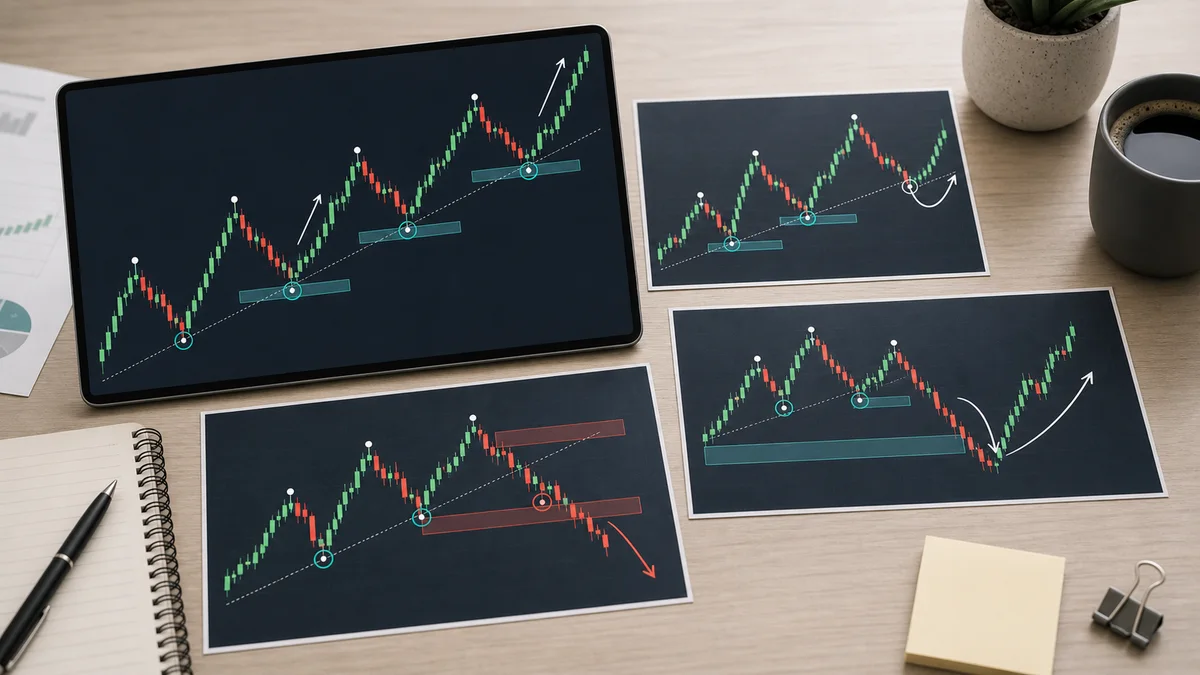
Example one is a clean trend continuation. Price breaks above a prior high, pulls back into the old breakout area, forms a higher low, and then rallies again. This is the easiest version to study because the sequence is obvious. The trader can see where the bullish idea begins, where it is confirmed, and where it would be wrong.
Example two is a deep pullback that still holds structure. Price makes a strong higher high, then retraces more deeply than expected. Many traders panic during the pullback, but price still holds above the prior swing low. If buyers step in and price breaks a minor lower-timeframe high, the market may still be forming a valid higher low.
Example three is a failed continuation. Price breaks above a prior high but cannot hold. It quickly falls back below the breakout area and later breaks below the previous swing low. In that case, the old bullish sequence is no longer clean. A disciplined trader stops treating the chart as a simple higher high and higher low trend.
Example four is a range pretending to be a trend. Price makes small marginal highs and small marginal lows, but each move lacks follow-through. The chart looks choppy, and every breakout fails quickly. In this case, forcing a trend label can lead to poor entries. The trader may need to wait until price leaves the range with stronger acceptance.
Common Mistakes When Trading Higher Highs and Higher Lows
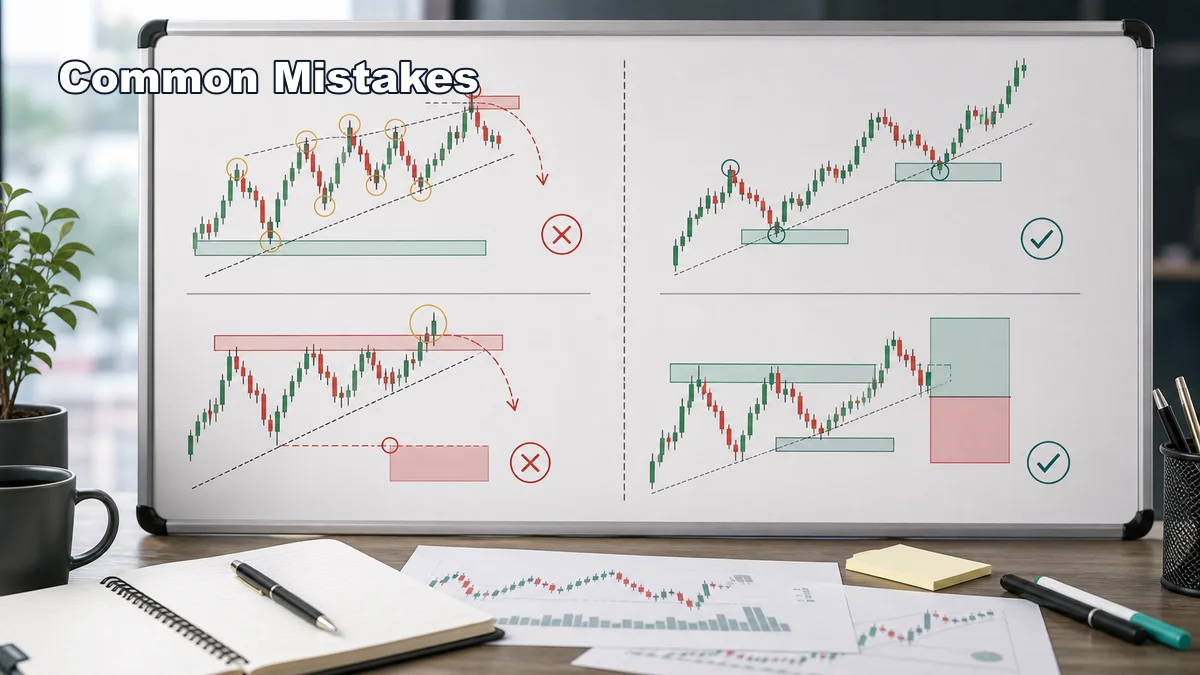
- Forcing tiny swings: marking every candle makes the chart unreadable. Start with the most obvious structure.
- Chasing the higher high: late breakout entries often leave poor risk-to-reward. Wait for the next pullback when possible.
- Ignoring the higher timeframe: a lower-timeframe uptrend can still be running into daily resistance.
- Moving invalidation: if the trade depends on a higher low, a strong break below that low changes the setup.
- Assuming continuation forever: trends age, momentum weakens, and the sequence can transition into a range or reversal.
Used correctly, higher highs and higher lows are a powerful beginner concept because they make market direction visible. They help traders read structure, wait for pullbacks, define invalidation, and avoid reacting to random candles. Study the pattern inside the broader Price Action hub and keep connecting it back to the Structure category so it becomes part of a complete chart-reading process.
Key takeaways
- Higher highs and higher lows describe an uptrend when successive external swing highs and swing lows progress upward.
- The definition depends on swing degree; a lower low on an execution chart may be an internal pullback inside a higher-timeframe uptrend.
- Choose the structural timeframe first and distinguish internal movement from the swing that defines the trend.
- A valid plan separates location, trigger, invalidation, position size and exit logic.
A validation workflow you can reproduce
- Define the sample: choose the market, timeframe, session and date range before reviewing outcomes.
- Write the rule: Choose the structural timeframe first and distinguish internal movement from the swing that defines the trend.
- Record invalidation: identify the observable price event that disproves the setup.
- Include execution costs: account for spread, commission and slippage where relevant.
- Validate separately: test the finished rule on data that was not used to create it.
When this concept is unreliable
The sequence is unreliable when tiny pivots are mixed with major swings or a wick is alternately accepted and ignored to keep the bias. Keep failed and skipped examples in the journal so the review is not limited to attractive winners.
Use this concept within a complete analysis
This method should remain connected to its parent framework and adjacent decision steps. Use Market Structure: Complete Guide for Traders, Break of Structure vs Change of Character, ICT Market Structure Explained, Price Action Trading: Structure, Setups and Risk, Multi-Timeframe Analysis: Complete Guide and Trading Theories: Complete Guide to Technical Analysis Frameworks to compare definitions, establish context and avoid treating one signal as a complete trading system.
References and methodology
Practise before considering real capital
Use historical charts or a demo account to test the written rules before considering live execution. Review the XM account and demo information. Availability, protections and trading conditions depend on jurisdiction, so review the applicable legal documents yourself.
Affiliate disclosure: Học Làm Trader may receive a commission if you open an account through this link, at no additional cost to you. This relationship does not determine the educational conclusions.
Risk warning: This article is for education and general information only. It is not investment advice, a trade signal or an invitation to trade. Trading can result in loss of capital, and past examples do not guarantee future results. Assess your own circumstances and risk tolerance.
Compare the bullish sequence with lower highs and lower lows so that trend labels remain timeframe-specific.
Related reading: Equal Highs and Equal Lows Trading Guide