


MSNR support becomes resistance Support-becomes-resistance describes a role-reversal hypothesis after price breaks and accepts below a former MSNR support zone. A wick below support is not enough; the break, acceptance and retest conditions must be defined before the flip is traded. The method should be treated as a testable chart-reading framework rather than a forecast. Before using it, define the market condition, confirmation event, invalidation price, transaction costs and maximum risk. This guide explains the rules, a repeatable workflow, common failure modes and the most relevant supporting concepts.
What Support Becomes Resistance MSNR Means in MSNR
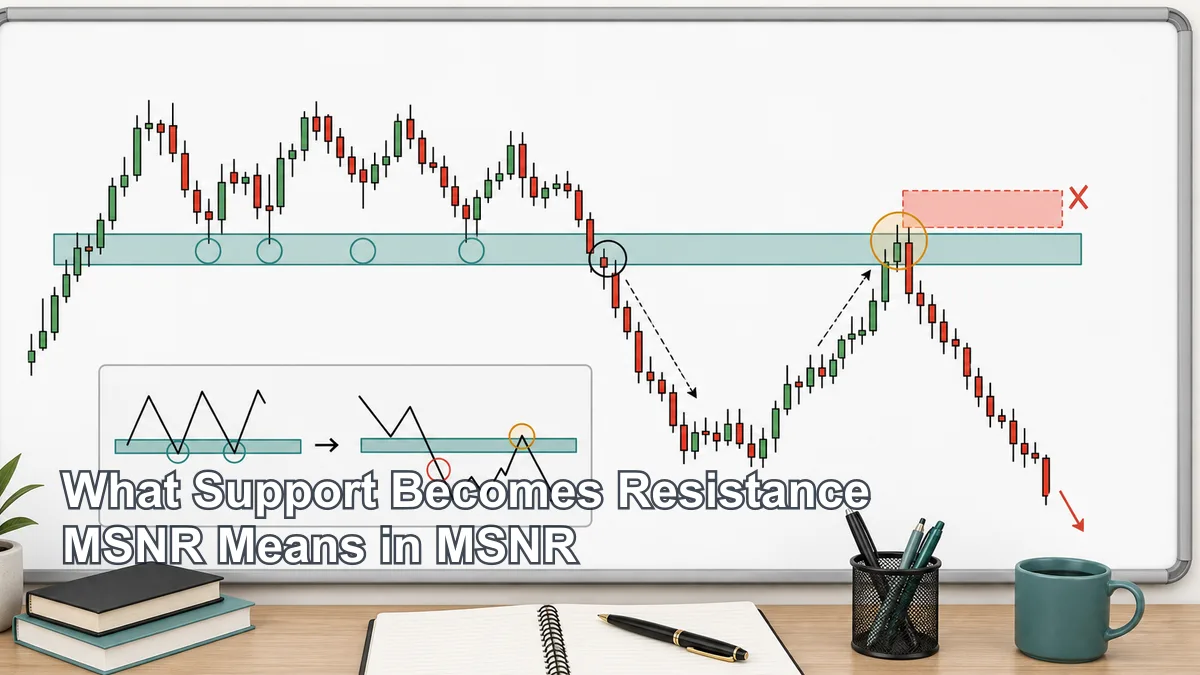
Support becomes resistance means that an area where price previously found demand later becomes an area where supply appears. Before the break, traders may see the level as support because price reacted upward from it. After the break, the same area can change meaning. If price returns to the broken support and fails to reclaim it, the level may act as resistance.
In MSNR, this is not just a horizontal line flip. It is a zone behavior shift. The original support should have a reason to exist: a clean reaction, a close-open body area, a range edge, a fresh support zone, or a level visible in the broader structure. If the original support was random, the role reversal may also be random. A weak level does not become strong just because price crossed it.
The break also matters. A small wick below support is not always a valid breakdown. It may be a liquidity sweep, news spike, spread event or temporary overshoot. For support to become resistance, many traders want to see some form of acceptance below the old support zone. That could be candle closes below the area, a lower-timeframe structure shift, or price failing to reclaim the zone after the break. The exact rule should be tested, but the principle is clear: do not treat every poke below support as a confirmed flip.
The retest is where the idea becomes interesting. Price returns to the old support zone. If the zone now rejects price, the trader may interpret it as resistance. If price reclaims the zone and holds above it, the bearish role reversal idea may be invalid. If price chops through the zone repeatedly, the level may be too messy for a clean setup.
The same idea exists in reverse as resistance becomes support. A broken resistance zone may become support on a later pullback. Together, these flips are often called SNR flip, role reversal trading, or support resistance flip. MSNR focuses on making the flip specific enough to review: original level quality, break quality, retest behavior, trigger, invalidation and risk.
Why It Matters Before Taking a Trade
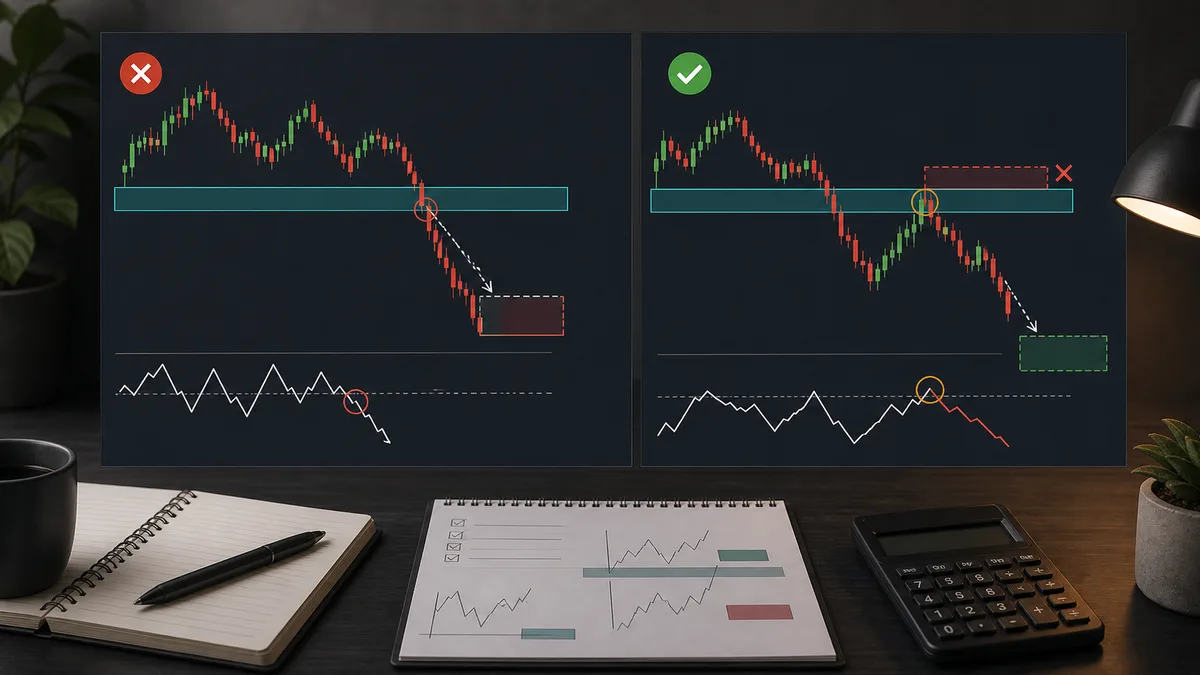
Support becomes resistance matters before a trade because it can help traders avoid chasing a breakdown. Many beginners see support break and immediately enter short. Sometimes price continues lower. Other times price snaps back above the level and traps late sellers. The retest gives the trader a chance to see whether the broken support is truly acting as resistance or whether the breakdown was only temporary.
A retest can improve trade location. Instead of selling after a large bearish candle far below support, the trader waits for price to return to the broken area. If the area rejects, the short entry may have a clearer invalidation point. If price reclaims the level, the trader can stand aside. This does not guarantee success, but it can make the plan easier to define.
The concept also matters because it connects structure to psychology. When support breaks, traders who bought the old support may be under pressure. If price retests the zone, some may exit near breakeven. Sellers may also defend the area because the market has shown weakness below it. This can create supply around the old support. However, this explanation should not become a story that replaces evidence. The chart still needs to show rejection, acceptance, or failure.
MSNR role reversal is most useful when it prevents emotional entries. A trader who waits for break, retest and reaction has more information than a trader who enters the first break. The trader can compare candle closes, wick behavior, body zones and market structure. They can define where the idea is wrong. If price closes back above the old support and holds, the bearish flip may no longer be valid.
The risk-first benefit is important. A support-becomes-resistance setup should give a logical place for invalidation. For a short idea, that may be above the retested zone, above the rejection high, or above a candle structure that should not be broken if sellers are in control. Without invalidation, the trader is only guessing that the flip will work.
Role reversal trading is not a profit claim. It is a chart-reading framework. Broken support can become resistance, but it can also become a failed breakdown, reclaim, range expansion, or choppy transition. The trader’s job is not to believe the flip automatically. The job is to test whether the flip is visible, tradable and controllable from a risk perspective.
Step-by-Step Chart-Reading Workflow
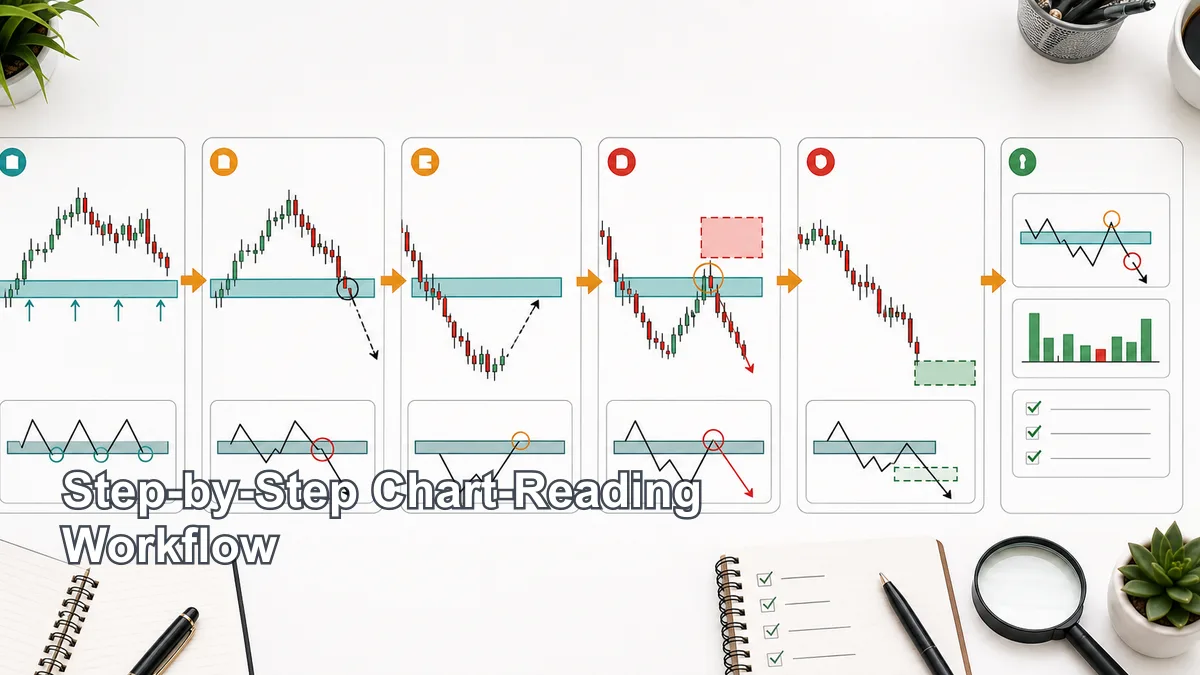
Use this workflow to study support becomes resistance MSNR setups. The goal is not to force trades. The goal is to identify whether the old support zone has actually changed role.
Step 1: Identify the original support zone. Start before the breakdown. Was the support level meaningful? Look for a visible reaction area, close-open body zone, range edge or fresh MSNR support. If the original support is weak or invisible, the later flip may not deserve attention.
Step 2: Check the broader context. A support break inside a higher-timeframe downtrend may have different meaning from a small support break inside a larger bullish structure. Ask whether the market is trending, ranging, compressing or transitioning. Role reversal works best when it aligns with the broader story, but the story still needs confirmation.
Step 3: Study the breakdown. Did price close below the zone, or only wick below it? Was the break strong, slow, news-driven or immediately rejected? A decisive break may suggest acceptance below support. A wick below and fast recovery may suggest a sweep rather than a true support-to-resistance flip.
Step 4: Wait for the retest. The retest is not always perfect. Price may return exactly to the old support zone, stop slightly below it, or overshoot into the upper part of the zone. Since MSNR works with zones, do not expect a one-pixel reaction. Watch how candles behave around the area.
Step 5: Look for rejection or acceptance. Rejection can appear as bearish candles, long upper wicks, failed closes above the zone, lower-timeframe structure shifts or a stall followed by downside continuation. Acceptance can appear as closes back above the zone, holding above it, or building support where resistance was expected. The setup depends on which behavior appears.
Step 6: Define the trigger. A trigger may be a rejection candle, a break of a small retest structure, a failed reclaim, or another tested rule. Do not enter only because price is near the old support. The trigger creates accountability for review.
Step 7: Define invalidation before entry. For a short role reversal setup, invalidation may sit above the retest high, above the MSNR zone, or above the structure that should hold if sellers are defending the level. If invalidation is unclear, skip the setup.
Step 8: Record the full sequence. Your journal should include the original support, breakdown candle, retest behavior, trigger, invalidation, stop-loss placement and outcome. Over time, this helps you learn whether role reversal trading is improving your decisions or simply adding another pattern name.
Entry, Invalidation and Stop-Loss Logic
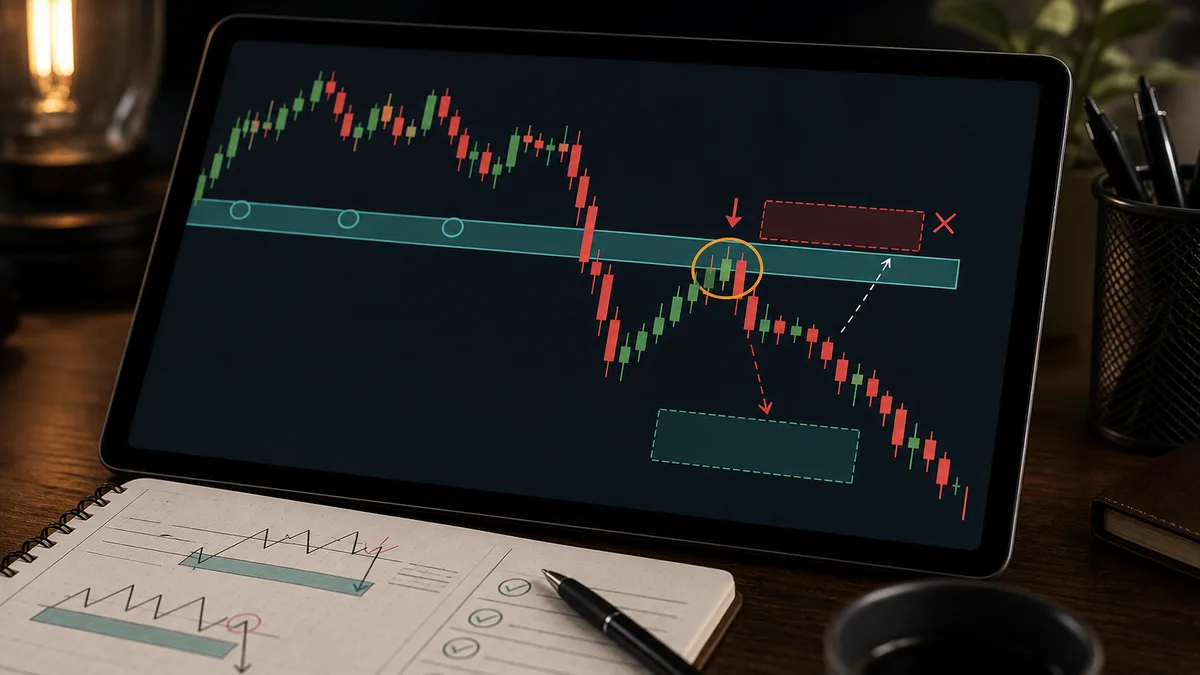
Entry in a support-becomes-resistance setup should come after the level has broken, retested and shown behavior that supports the bearish idea. The old support zone is only the area of interest. It does not automatically create a short trade. A trader still needs price behavior, a trigger and a risk plan.
One possible entry model is the rejection retest. Price breaks below support, returns to the broken MSNR zone, fails to close back above it, and then prints a bearish trigger. Another model is the failed reclaim. Price moves slightly back above the old support but cannot hold, then closes back below the zone. Another model is the lower-timeframe structure shift after the retest. These are examples for study, not recommendations.
Invalidation should be planned before the entry. If the short idea depends on old support acting as resistance, then acceptance above the zone may invalidate the idea. A stop loss may sit above the retest high, above the body zone, or above the structural point that should not break if the flip is valid. The exact placement depends on the tested method, timeframe, volatility and spread.
A common mistake is placing the stop too tightly inside the retest zone. Because MSNR uses zones, price may probe into the area before rejecting. If the stop is inside normal retest noise, the setup can be stopped out before the idea is truly invalid. The opposite problem is placing the stop so wide that the potential loss is too large or the reward-to-risk is poor. The stop should reflect the trade hypothesis and the trader’s risk limit.
Targets should also come from structure. If the short entry occurs after support becomes resistance, the next downside support or liquidity area may become an obstacle. A trader should ask whether there is enough room before the next opposing level. If the nearest support is too close, the setup may not offer enough practical space.
Position sizing connects the chart to account risk. A wider stop does not need to mean a larger dollar loss if the position size is reduced. A tighter stop does not automatically make a trade safer if it sits in a poor location. The risk should be decided before entry and accepted before the order is placed.
Before taking any role reversal setup, ask:
- Was the original support zone meaningful?
- Did price break with acceptance or only sweep the level?
- Did the retest show rejection instead of acceptance?
- What exact trigger activates the trade idea?
- Where is the short idea invalid?
- Can the stop loss sit beyond normal retest noise?
- Is the potential loss acceptable after position sizing?
- Is there enough room before the next downside support?
Common Mistakes and Checklist
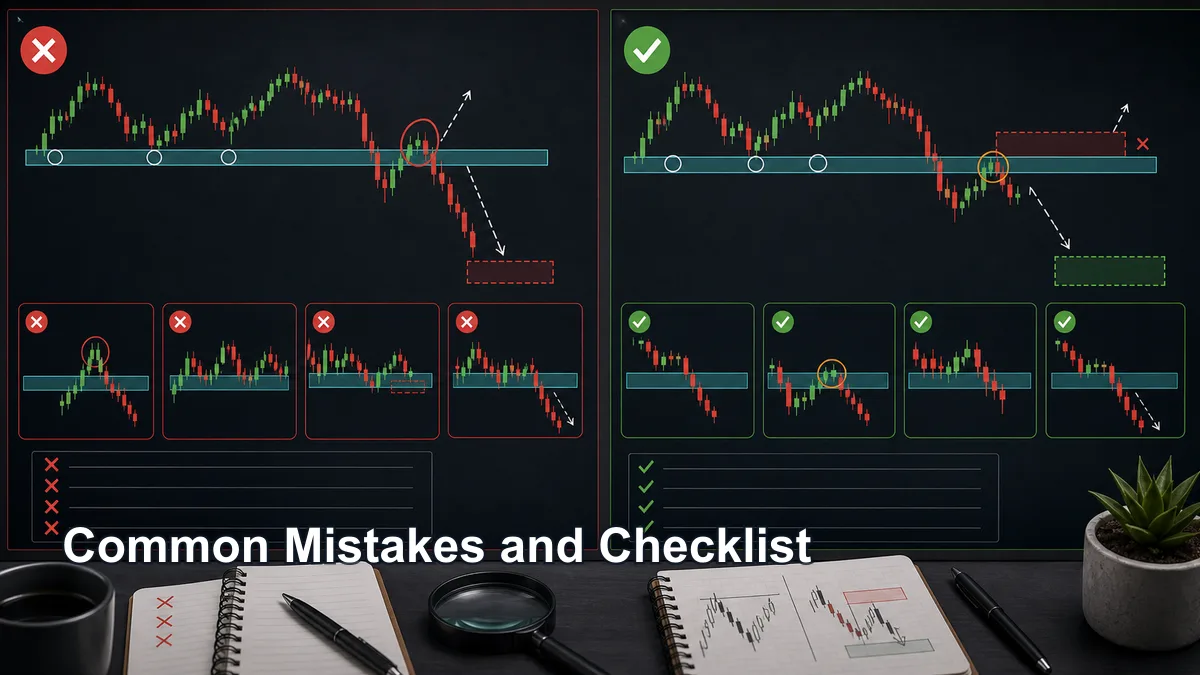
The first mistake is shorting the first break without waiting for evidence. A support break can continue lower, but it can also snap back and trap sellers. Waiting for a retest and reaction can make the idea easier to validate or reject.
The second mistake is treating every wick below support as a confirmed breakdown. Wicks can show liquidity sweeps, temporary volatility or failed breaks. In MSNR, the trader should study closes, body structure and acceptance below the zone before assuming support has become resistance.
The third mistake is using a weak original level. If the support zone was random, the retest may also be random. Role reversal works best when the old support zone had clear meaning before it broke.
The fourth mistake is ignoring acceptance back above the zone. If price reclaims the old support and holds above it, the bearish flip may be invalid. A trader who keeps insisting the level is resistance may be fighting the chart instead of reading it.
The fifth mistake is placing the stop inside the zone. Retests often probe into old levels. A stop inside normal noise may be hit before the setup has a fair chance to prove itself. At the same time, the stop cannot be so wide that the trade becomes irresponsible. Balance chart logic with position sizing.
The sixth mistake is judging the pattern from one clean example. Role reversal screenshots often look obvious after the move. Real charts include failed retests, reclaim candles, news spikes, choppy ranges and imperfect reactions. Build a sample of both working and failing examples before trusting the pattern.
Use this checklist before calling a setup support becomes resistance MSNR:
- The original support zone was visible and meaningful.
- The breakdown showed more than a random wick.
- Price retested the broken support area.
- The retest showed rejection, not clean acceptance.
- The entry trigger was defined before the trade.
- Invalidation was planned before position sizing.
- The stop loss respected zone noise and account risk.
- The next downside support left enough room.
- The chart was saved for review whether the trade won or lost.
CTA: To place role reversal inside the full framework, read the Full MSNR Guide. For the opposite flip, study resistance becomes support, then compare both with your own screenshots before using them in live conditions.
FAQs About Support Becomes Resistance MSNR
What does support becomes resistance mean?
It means an old support zone breaks and later acts as resistance when price retests it. In MSNR, the trader studies the original level, the break, the retest, the trigger and invalidation.
Is every support break a role reversal setup?
No. Some breaks are liquidity sweeps, temporary volatility or failed breakdowns. A role reversal setup needs evidence that price accepted below support and then rejected the retest.
What is the opposite of support becomes resistance?
The opposite is resistance becomes support. That happens when price breaks above resistance and later holds the same zone as support on a pullback.
Where should invalidation be in a support-to-resistance flip?
Invalidation often sits above the retest high, above the MSNR zone, or above the structure that should hold if sellers are defending the old support. The exact rule must be tested.
Does role reversal trading guarantee profit?
No. Role reversal is an educational chart-reading concept. Every setup can fail, so stop-loss logic, position sizing and review are essential.
Author note: Prepared by the Hoc Lam Trader editorial team for educational use. This guide was updated on May 12, 2026. Use screenshots, test data and demo practice before live trading, and treat each role reversal example as a hypothesis rather than a promise.
Key takeaways
- Support-becomes-resistance describes a role-reversal hypothesis after price breaks and accepts below a former MSNR support zone.
- A wick below support is not enough; the break, acceptance and retest conditions must be defined before the flip is traded.
- Distinguish a confirmed break from a failed breakdown and require rejection on the retest.
- A valid plan separates location, trigger, invalidation, position size and exit logic.
A validation workflow you can reproduce
- Define the sample: choose the market, timeframe, session and date range before reviewing outcomes.
- Write the rule: Distinguish a confirmed break from a failed breakdown and require rejection on the retest.
- Record invalidation: identify the observable price event that disproves the setup.
- Include execution costs: account for spread, commission and slippage where relevant.
- Validate separately: test the finished rule on data that was not used to create it.
When this concept is unreliable
Role reversal is unreliable when every brief breach is treated as a flip or the zone is moved to fit the retest. Keep failed and skipped examples in the journal so the review is not limited to attractive winners.
Use this concept within a complete analysis
This method should remain connected to its parent framework and adjacent decision steps. Use Line Chart vs Candlestick Chart for MSNR Levels, MSNR Engulfing Candle Strategy: Rules, Examples and Filters, What Is MSNR Trading? Meaning, Logic and Beginner Rules, How MSNR Uses Close and Open Prices Instead of Random Wick Lines, MSNR Terminology: SNR, Fresh Level, Storyline, Rejection and Confluence and MSNR Chart Setup: What Tools, Timeframes and Templates You Need to compare definitions, establish context and avoid treating one signal as a complete trading system.
References and methodology
Terminology note: SMC, ICT and MSNR terms are practitioner conventions, not standardized exchange or regulatory definitions. This article defines the convention it uses and avoids inferring participant identity from candles alone.
- CME Group — Technical Analysis
- CFTC — Eight Things to Know Before Trading Forex
- CME Group — Chart Types: Candlestick, Line and Bar
Practise before considering real capital
Use historical charts or a demo account to test the written rules before considering live execution. Review the XM account and demo information. Availability, protections and trading conditions depend on jurisdiction, so review the applicable legal documents yourself.
Affiliate disclosure: Học Làm Trader may receive a commission if you open an account through this link, at no additional cost to you. This relationship does not determine the educational conclusions.
Risk warning: This article is for education and general information only. It is not investment advice, a trade signal or an invitation to trade. Trading can result in loss of capital, and past examples do not guarantee future results. Assess your own circumstances and risk tolerance.