


MSNR terminology MSNR terminology gives consistent names to zones, their retest history, surrounding market narrative and evidence at a reaction point. This page serves glossary intent; drawing rules and full strategy steps remain in their dedicated guides to prevent keyword overlap. The method should be treated as a testable chart-reading framework rather than a forecast. Before using it, define the market condition, confirmation event, invalidation price, transaction costs and maximum risk. This guide explains the rules, a repeatable workflow, common failure modes and the most relevant supporting concepts.
What MSNR Terminology Means in MSNR

MSNR terminology is the shared language traders use to describe support and resistance decisions. Instead of saying “this chart looks good,” a trader can say the chart has a fresh SNR level, a clear storyline, a rejection at the zone, and enough confluence to consider a plan. Each word should reduce confusion. If the word does not change the decision, it is probably being used as decoration.
SNR means support and resistance. Support is an area where buyers previously reacted strongly enough to slow, hold, or reverse a decline. Resistance is an area where sellers previously reacted strongly enough to slow, hold, or reverse a rally. In MSNR, SNR is usually treated as a zone rather than a perfect line because price often probes, wicks, retests, and rejects around an area.
Fresh level means a support or resistance area that has not been tested too many times since its creation. Traders often value fresh levels because price has not repeatedly consumed the orders or interest around the zone. A fresh level is not guaranteed to hold, but it may deserve attention if it also fits the broader market context.
Storyline means the market narrative before the setup. Is price trending, ranging, breaking structure, sweeping liquidity, returning to an old level, or compressing before expansion? A level without storyline can become a random line. Storyline helps explain why the level matters now.
Rejection means price attempted to move through or into an area and then failed to continue. It may appear as a wick rejection, a strong close away from the level, a failed breakout, or a small structure shift. Rejection should be read with context, not as a single candle name.
Confluence means multiple independent reasons support the same trade idea. A support zone, higher-timeframe trend, wick rejection, nearby liquidity sweep, and clear invalidation may create confluence. But confluence should not become clutter. Five weak reasons do not equal one strong plan.
These terms work together. SNR gives the location. Fresh level describes whether the zone is newly tested or overused. Storyline explains the market context. Rejection gives possible reaction evidence. Confluence helps decide whether the trade idea is strong enough to plan. Risk management decides whether the trade is worth taking at all.
Why It Matters Before Taking a Trade
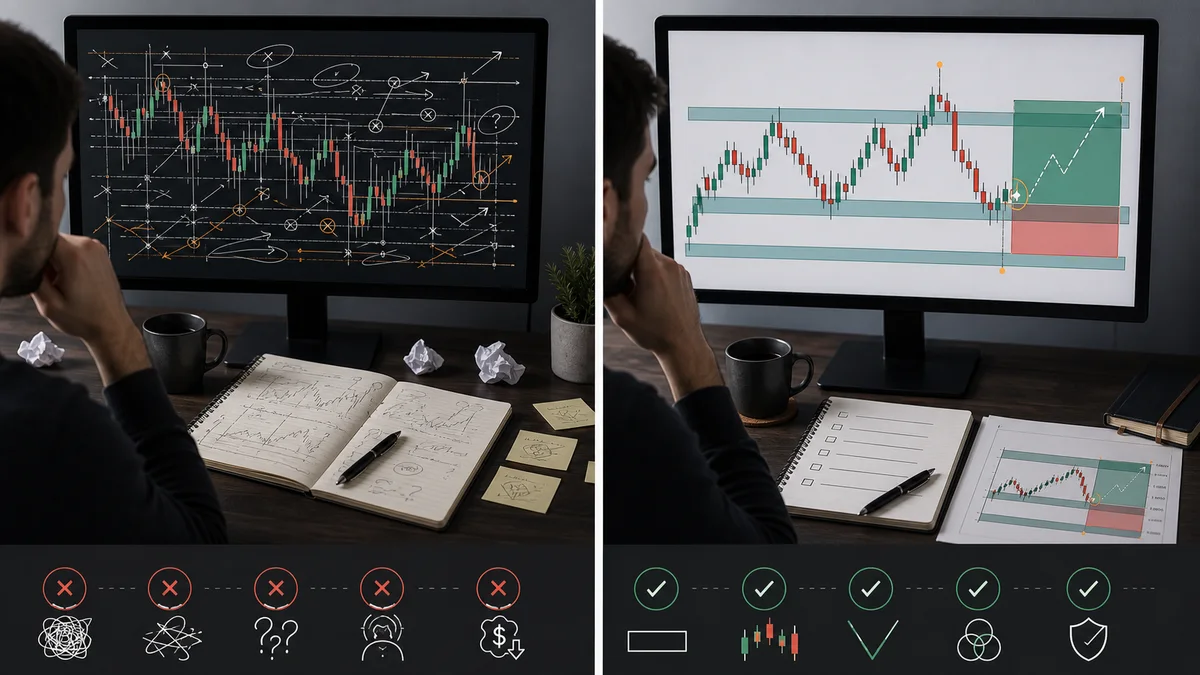
MSNR terminology matters because vague words create vague trades. A beginner may say “this is a good level,” but that sentence does not explain enough. Is it support or resistance? Is it fresh or already tested many times? What is the storyline? Has price rejected the zone or only touched it? Where is invalidation? Is there enough confluence after accounting for risk?
When traders define their terms clearly, they can build more consistent plans. A trader who understands SNR will avoid drawing every minor candle as a level. A trader who understands fresh levels will notice when a zone has been tapped repeatedly and may be weaker or more uncertain. A trader who understands storyline will avoid taking a lower-timeframe setup against a major higher-timeframe obstacle.
Terminology also helps with patience. If your rules require a fresh level plus rejection, then a level without rejection is not ready. If your rules require confluence, then a single wick at a random price is not enough. Good language slows down impulsive entries because it gives the trader specific conditions to wait for.
It also improves journaling. After a trade, you can record whether the SNR zone was obvious, whether the level was fresh, what the storyline was, what rejection appeared, and which confluence factors were present. Over time, this gives better feedback than simply recording win or loss. You may discover that some “fresh levels” were too minor, or that your best trades came when storyline and rejection were aligned.
The biggest benefit is risk clarity. Terms like rejection and confluence mean little if the trader cannot define invalidation. For example, if a long idea depends on support rejecting, the plan must identify what would prove that rejection failed. If the trade has no invalidation point, the terminology is not protecting the trader. It is only making the setup sound smarter.
For that reason, every glossary term should connect to a decision. SNR answers where. Fresh level answers how used the area is. Storyline answers why now. Rejection answers what price did there. Confluence answers whether the evidence is broad enough. Risk management answers whether the trade belongs in the account.
Step-by-Step Chart-Reading Workflow
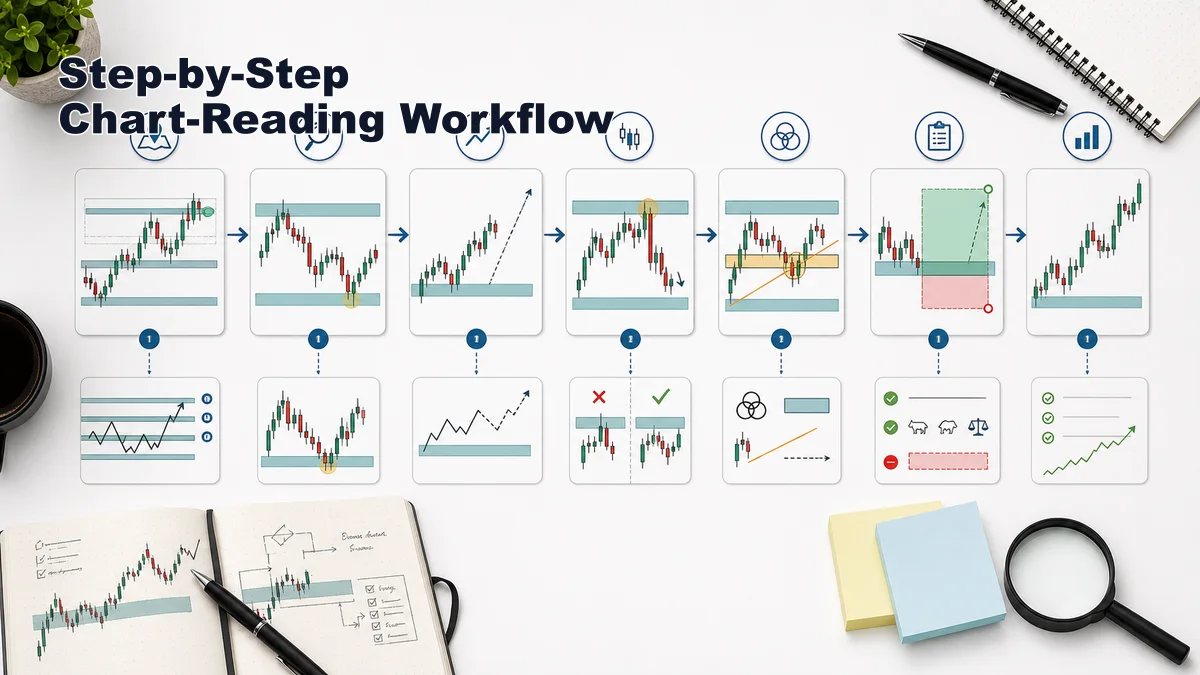
A repeatable workflow keeps MSNR terminology from becoming random vocabulary. The steps below show how to use the core terms in a practical order.
Step 1: Identify the SNR Map
Start by marking the most obvious support and resistance zones. Use major swing highs, swing lows, range boundaries, strong breakout areas, and repeated body closes. Avoid clutter. If the chart has too many levels, the SNR map stops helping. A beginner should usually mark fewer zones and focus on quality.
Step 2: Judge Whether the Level Is Fresh
After marking SNR, ask whether each level is fresh. Has price returned to the zone many times? Did it already react strongly from the level? Has the area been chopped through repeatedly? A level can still matter after several tests, but it may not deserve the same confidence as a cleaner first or second return. Freshness is a clue, not a guarantee.
Step 3: Read the Storyline
Next, describe what price has been doing. Is the market making higher highs and higher lows? Lower highs and lower lows? Is it ranging? Did it just break a major structure point? Did it sweep liquidity before returning to the zone? Storyline prevents you from treating all SNR levels equally. A fresh support level inside a strong downtrend may require different confirmation than support inside a healthy uptrend.
Step 4: Wait for Rejection or Acceptance
When price reaches the level, watch the reaction. Rejection may appear as a failed break, wick rejection, strong close away from the zone, or a small shift in structure. Acceptance may appear as candle bodies closing beyond the zone and holding there. Both are useful. Rejection may support a reversal or continuation-from-level idea. Acceptance may support a breakout-and-retest idea.
Step 5: Check Confluence Without Cluttering
Look for supporting evidence, but keep it disciplined. Useful confluence may include higher-timeframe alignment, a clean fresh level, a liquidity sweep, a strong rejection candle, market structure alignment, or a nearby logical target. Weak confluence includes adding random indicators after you already want to enter. The point is to clarify the decision, not decorate it.
Step 6: Define the Trade Plan
Before entry, write a simple plan using the terms. For example: “Price is in an uptrend storyline, returning to fresh support SNR, rejecting the zone, and showing confluence from higher-timeframe structure. The idea is invalid if price closes below the support zone.” If that sentence feels forced, the setup may not be clear enough.
Step 7: Review the Language Afterward
After the trade, review whether your words matched the chart. Was the level truly fresh? Was the rejection strong or did you exaggerate it? Was the confluence real or added after the fact? This review helps turn terminology into skill.
Entry, Invalidation and Stop-Loss Logic

MSNR terminology is incomplete without trade logic. A trader can identify SNR, fresh level, storyline, rejection, and confluence, but still take a poor trade if the entry and stop loss are random. The terms should guide the plan from observation to execution.
For a rejection entry, the trader first needs an SNR zone that fits the storyline. If price reaches fresh support in an uptrend and rejects, a long idea may become possible. But the entry still needs a trigger, such as a close back above the zone, a small market-structure shift, or a retest that holds. Entering only because price touched support is not enough.
For a breakout-and-retest entry, the language changes. The trader may see price close through resistance with acceptance, then return to the old resistance as possible support. In that case, the term “rejection” may apply to the retest, while “acceptance” describes the breakout close. The invalidation point may be price falling back below the retest zone or failing to hold the old resistance.
Invalidation is where the trade idea is wrong. If the setup depends on fresh support holding, invalidation may be a decisive close below support or below the rejection low. If the setup depends on resistance rejecting, invalidation may be a close above resistance with acceptance. If the setup depends on confluence from higher-timeframe trend, invalidation may also involve a structure break that removes that trend logic.
Stop loss should be placed around invalidation with room for normal market noise. A stop that is too tight may be hit by ordinary probing. A stop that is too wide may damage risk-to-reward. Position sizing solves part of this problem: the trader adjusts trade size so the planned stop matches the account risk limit. The answer is not to move the stop randomly after entry.
Targets should also come from the SNR map. A long trade may target the next resistance zone, range high, prior swing, or area where price may logically react. A short trade may target the next support zone, range low, or prior swing. If the next obstacle is too close, a setup with good terminology may still be a bad trade.
Use this simple chain: terminology creates the reason, rejection or acceptance creates the trigger, invalidation defines where the reason fails, stop loss controls the damage, and position sizing decides whether the trade is allowed.
Common Mistakes and Checklist
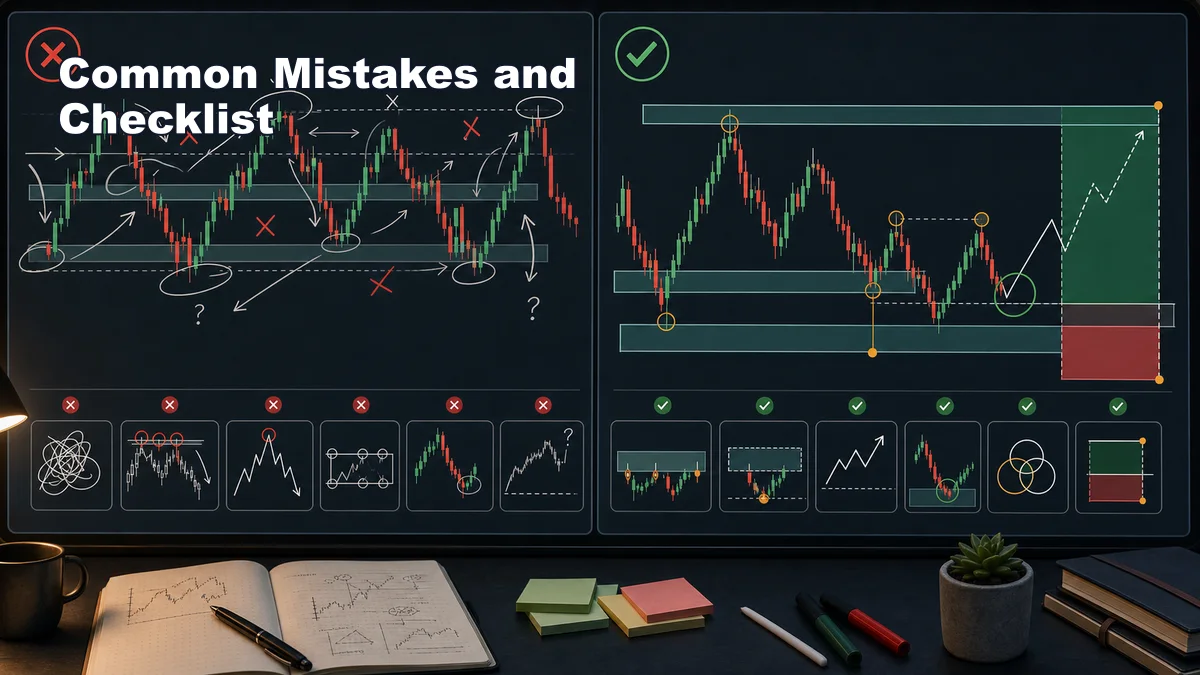
The first mistake is using terms without definitions. If two traders use “fresh level” differently, their trade plans will be different. Define what fresh means in your own rules. For example, you may decide that a level is fresh if price has not retested it since the strong move away, or if it has only one clean return. The definition should be testable.
The second mistake is forcing confluence. Beginners often add more tools to feel safer: trendline, moving average, Fibonacci, session level, candlestick name, and indicator signal. More evidence is useful only when each piece is relevant and independent. If every tool is added after the trader already wants the trade, confluence becomes confirmation bias.
The third mistake is calling every wick a rejection. A wick can show rejection, but it can also be noise inside a range or a normal liquidity probe before continuation. Rejection needs context and follow-through. A wick at a major SNR zone with a strong close away from the level is different from a tiny wick in the middle of a messy chart.
The fourth mistake is ignoring storyline. A fresh support level in a strong bullish context is not the same as fresh support during a sharp bearish breakdown. Storyline decides whether the level supports continuation, reversal, breakout, retest, or no trade. Without storyline, SNR becomes line drawing.
The fifth mistake is forgetting risk. Many traders can explain the terms but cannot say where the trade idea is wrong. If there is no invalidation, there is no complete setup. A glossary word should never replace a stop-loss plan.
Use this MSNR terminology checklist before building a trade:
- Is the SNR zone obvious on the chart?
- Is the level fresh, already tested, or heavily consumed?
- Can I describe the current storyline in one sentence?
- Has price shown rejection, acceptance, or no clear reaction?
- Is the confluence real, relevant, and not forced?
- Do I know the exact invalidation point?
- Does the stop loss sit beyond invalidation, not inside random noise?
- Is there a logical target before the next major obstacle?
- Have I calculated position size before entry?
- Will I journal whether my terminology matched the actual chart?
Read the Full MSNR Guide: Continue with the full MSNR trading strategy guide and pair this glossary with MSNR risk management. Clear terms should make you more selective, not more eager to trade.
Frequently Asked Questions
What does SNR mean in MSNR terminology?
SNR means support and resistance. In MSNR, SNR is usually treated as a zone where price has reacted or may react again, not a guaranteed buy or sell signal.
What is a fresh level in MSNR?
A fresh level is a support or resistance area that has not been retested too many times after its creation. Traders often watch fresh levels because the area may still contain meaningful untested interest, but it is never guaranteed to hold.
What is confluence in MSNR trading?
Confluence means several relevant pieces of evidence support the same trade idea, such as SNR, trend context, rejection, higher-timeframe alignment, and clear invalidation. It should clarify the plan, not clutter it.
Key takeaways
- MSNR terminology gives consistent names to zones, their retest history, surrounding market narrative and evidence at a reaction point.
- This page serves glossary intent; drawing rules and full strategy steps remain in their dedicated guides to prevent keyword overlap.
- Write each term in observable language so another reader can classify the same chart without knowing the outcome.
- A valid plan separates location, trigger, invalidation, position size and exit logic.
A validation workflow you can reproduce
- Define the sample: choose the market, timeframe, session and date range before reviewing outcomes.
- Write the rule: Write each term in observable language so another reader can classify the same chart without knowing the outcome.
- Record invalidation: identify the observable price event that disproves the setup.
- Include execution costs: account for spread, commission and slippage where relevant.
- Validate separately: test the finished rule on data that was not used to create it.
When this concept is unreliable
Terminology is unreliable when vague labels such as strong, clean or fresh have no measurable threshold. Keep failed and skipped examples in the journal so the review is not limited to attractive winners.
Use this concept within a complete analysis
This method should remain connected to its parent framework and adjacent decision steps. Use How MSNR Uses Close and Open Prices Instead of Random Wick Lines, MSNR Chart Setup: What Tools, Timeframes and Templates You Need, What Is MSNR Trading? Meaning, Logic and Beginner Rules, How to Practice MSNR Without Risking Real Money, MSNR vs Random Support and Resistance: The Key Differences and Malaysian Support and Resistance: The Core MSNR Zone Framework to compare definitions, establish context and avoid treating one signal as a complete trading system.
References and methodology
Terminology note: SMC, ICT and MSNR terms are practitioner conventions, not standardized exchange or regulatory definitions. This article defines the convention it uses and avoids inferring participant identity from candles alone.
- CME Group — Technical Analysis
- CFTC — Eight Things to Know Before Trading Forex
- CME Group — Chart Types: Candlestick, Line and Bar
Practise before considering real capital
Use historical charts or a demo account to test the written rules before considering live execution. Review the Exness account and demo information. Availability, protections and trading conditions depend on jurisdiction, so review the applicable legal documents yourself.
Affiliate disclosure: Học Làm Trader may receive a commission if you open an account through this link, at no additional cost to you. This relationship does not determine the educational conclusions.
Risk warning: This article is for education and general information only. It is not investment advice, a trade signal or an invitation to trade. Trading can result in loss of capital, and past examples do not guarantee future results. Assess your own circumstances and risk tolerance.
Related reading: SNR Zones and Volume: Should Volume Confirm MSNR?