


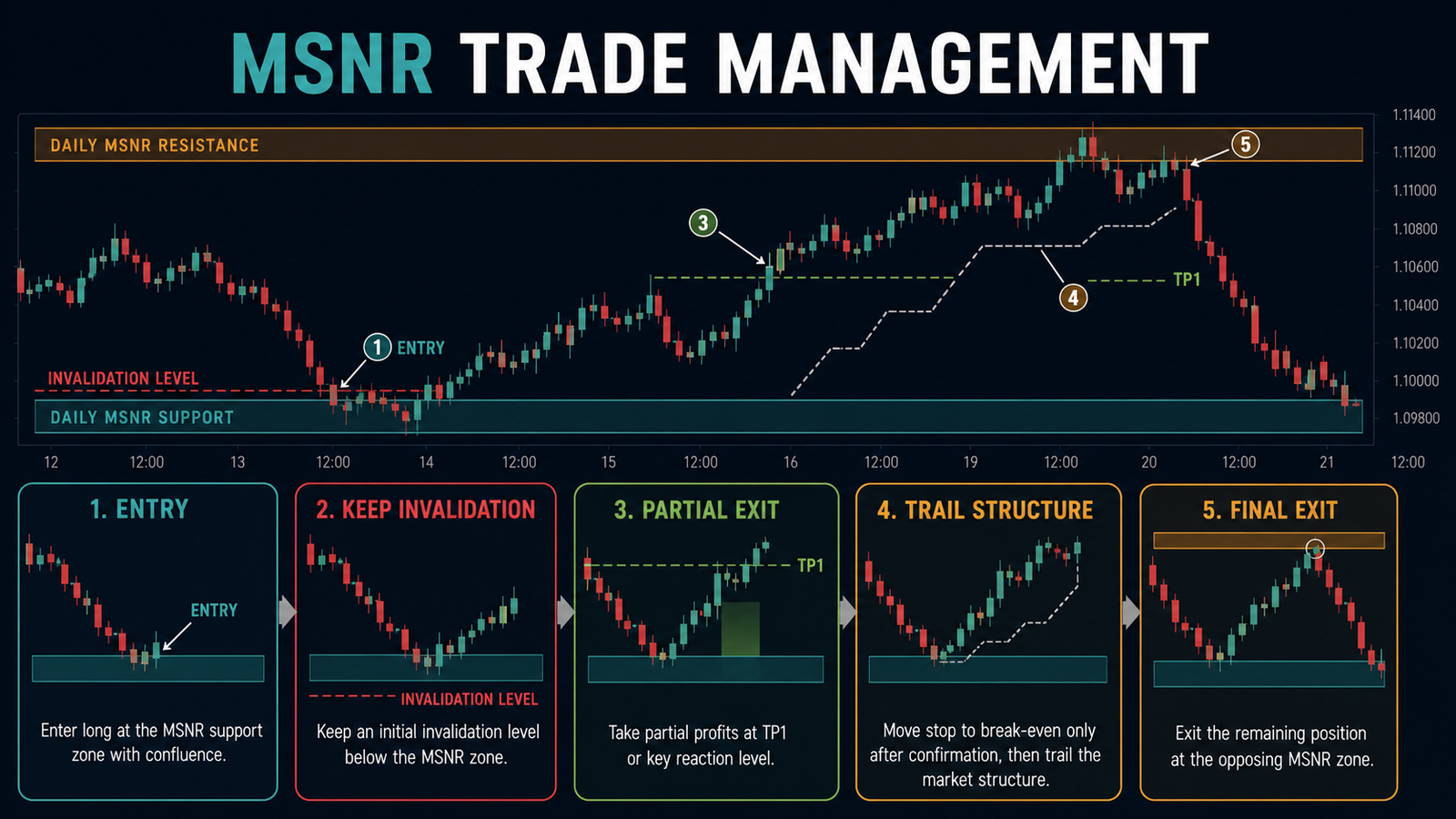
MSNR trade management starts by preserving structural invalidation until the market provides new evidence, then applying predefined rules for partial exits, break-even or structure trailing. Do not move a stop because a trade shows a small open profit, and never widen it merely to avoid a loss. Every action should be written before entry and evaluated through expectancy after costs.
Key takeaways
- The initial stop protects the thesis invalidation.
- Break-even is not free; it can remove future winning trades.
- Partials reduce outcome variance but also reduce maximum reward.
- Structure trailing requires an objective confirmed-swing rule.
- Early exit needs predefined deterioration evidence.
Five management stages
| Stage | Action | Avoid |
|---|---|---|
| After entry | Keep initial invalidation | Moving on every tick |
| At TP1 | Reduce predefined portion | Changing size from fear |
| Structure confirms | Consider BE or trailing | Moving before evidence |
| Near opposing area | Manage remainder | Extending target arbitrarily |
| Thesis fails | Exit under rules | Widening the stop |
Preserve initial invalidation
Immediately after entry, normal noise can produce wicks and pullbacks. If the stop is correctly located where structure invalidates the thesis, moving it closer from discomfort changes the system. If the stop is too wide for account risk, reduce position size or skip the trade rather than using a technically incorrect stop.
When to move to break-even
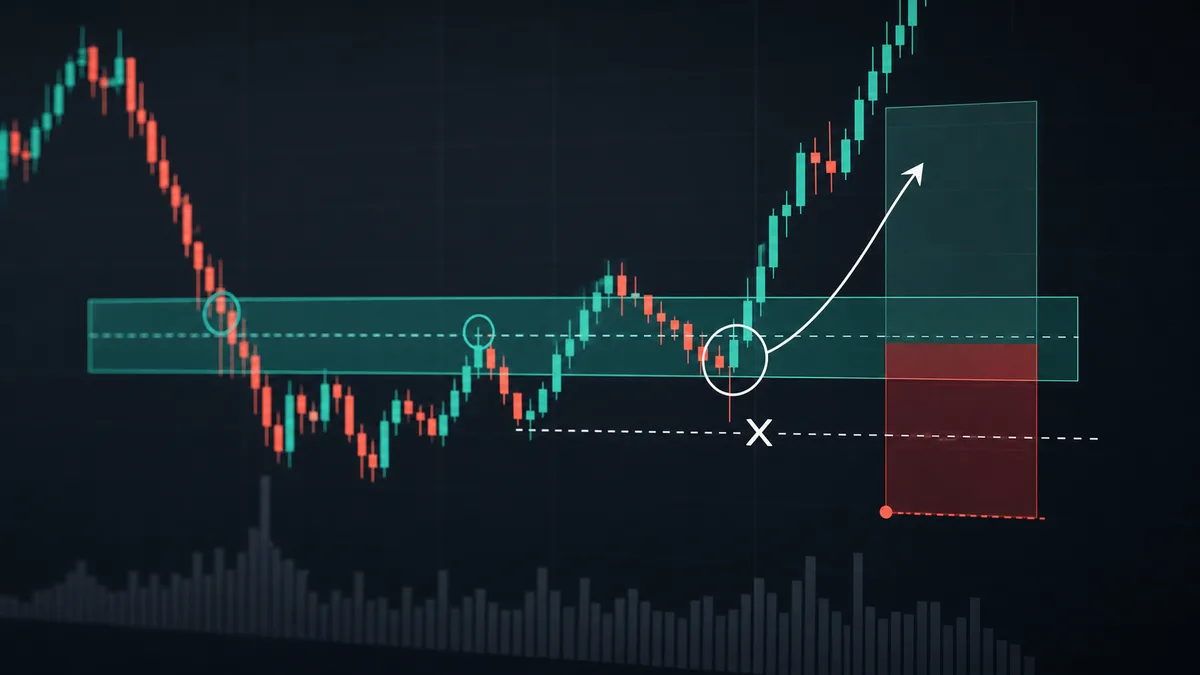
Break-even should follow an event such as a swing break, confirmed higher low or acceptance through an internal level. Moving at an arbitrary 0.5R may protect capital but also remove setups that require a retest. Test both versions separately.
Partial exits
A partial at TP1 can reduce psychological pressure, but the remainder still follows the plan. Closing 50% at 1R and stopping the rest at break-even produces 0.5R before costs, not a one-R winning trade. Journal weighted outcomes accurately.
Structure-based trailing
- Select the management timeframe before entry.
- Confirm swings with a fixed rule.
- For a long trade, move below a confirmed higher low.
- Never widen the stop again.
- End trailing at the primary exit area.
A tight trail is sensitive to noise; a wide trail returns more open profit. Optimize with out-of-sample data rather than a selected chart.
Early exit when the thesis weakens
One opposing candle is insufficient. Evidence can include opposite acceptance, failure of the trigger area or execution conditions outside the tested range. Without an early-exit rule, the initial stop is usually more consistent than an emotional close.
Hypothetical example
A long entry forms at H4 support after an M15 reclaim, with the stop below the area. At the internal swing, the plan reduces 30%. After a confirmed higher low, the stop trails below the new structure. The remainder exits before opposing H4 resistance. If the higher low fails first, the trailing stop ends the trade. This is not a current signal.
Three approaches compared
| Method | Benefit | Limit |
|---|---|---|
| Fixed TP | Simple testing | Ignores structural change |
| Partial + BE | Lower variance | Reduced reward and BE exits |
| Structure trail | Can follow extended trends | Complex and subjective |
Common mistakes
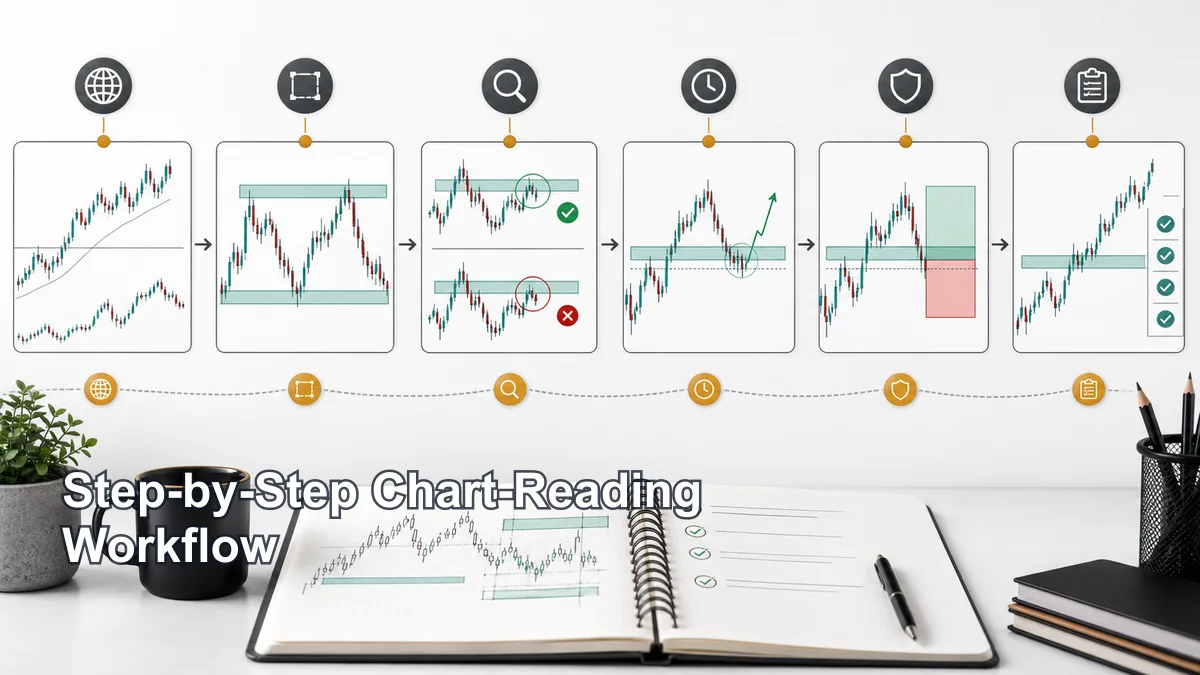
- Moving to break-even too early.
- Widening the stop near invalidation.
- Taking random partial percentages.
- Changing management timeframe mid-trade.
- Ignoring fees and slippage.
- Judging by money P/L rather than R.
Checklist
- Initial invalidation defined?
- TP1 percentage written?
- Break-even condition objective?
- Trailing swing rule fixed?
- Final opposing area active?
- Event and spread risk reviewed?
Management around scheduled events
Before a major release, spread and slippage can exceed normal assumptions. The plan should state whether to hold, reduce exposure or avoid new entries inside a defined window. Do not close merely from fear when the system has no event rule, but do not assume a stop will fill exactly during rapid movement.
Automating stops and partials
Tools can place several targets or trail a stop, but symbol handling, contract size, digits and disconnection behavior need testing. Do not use an unknown EA or enable unexplained DLL access. Automation should execute a stable rule, not replace the work of defining one.
Management metrics
| Metric | Purpose |
|---|---|
| Average R | Reward after costs |
| Break-even rate | Frequency removed at BE |
| MFE capture | Share of favorable excursion retained |
| MAE | Adverse movement before outcome |
| Rule adherence | Execution consistency |
Strategy outcome versus execution error
A stop taken under the written rule is a system outcome, not an execution mistake. Widening the stop, closing from fear or missing a planned partial is an execution error. Separate them in the journal so strategy rules are not changed to hide inconsistent behavior.
Review by management version
Label each rule set, such as fixed TP, partial plus break-even, or structure trail. Do not pool their outcomes into one sample because their reward distributions differ. When changing one parameter, start a new version and keep the prior sample intact for comparison.
FAQ
Move to break-even as soon as a trade profits?
No universal rule exists. Use a tested event rather than open P/L.
What percentage should be partialed?
The percentage must be included in expectancy; no value is universally best.
Trail on M15 or H1?
Use the timeframe defined before entry and consistent with the setup.
Should a stop be widened?
Usually not, because it changes invalidation and increases unplanned risk.
Sources and verification
- TradingView: sessions and IANA time zones
- CME Group: trade and risk management
- CFTC: retail Forex risk advisory
Continue the cluster: MSNR hub, MSNR definition, chart setup, timeframes for drawing MSNR levels, fresh versus tested MSNR levels, daily bias, MSNR breakout versus fakeout and TradingView alerts.
Demo practice: You may review Exness platforms and demo-account options before considering a live account.
Affiliate disclosure: Học Làm Trader may receive compensation if you register through this link. This is not a recommendation to open an account.
Risk notice: This content is educational, not investment advice or a trading signal. Trading can cause capital loss. Examples are hypothetical, and past performance does not guarantee future results.