


ICT Power of Three ICT Power of Three is a practitioner narrative that divides a selected period into accumulation, a false move or liquidity run, and directional expansion. The three phases are not guaranteed to appear each day, and the word manipulation should not be treated as proof of illegal market conduct. The method should be treated as a testable chart-reading framework rather than a forecast. Before using it, define the market condition, confirmation event, invalidation price, transaction costs and maximum risk. This guide explains the rules, a repeatable workflow, common failure modes and the most relevant supporting concepts.
Definition: What Is the ICT Power of Three?
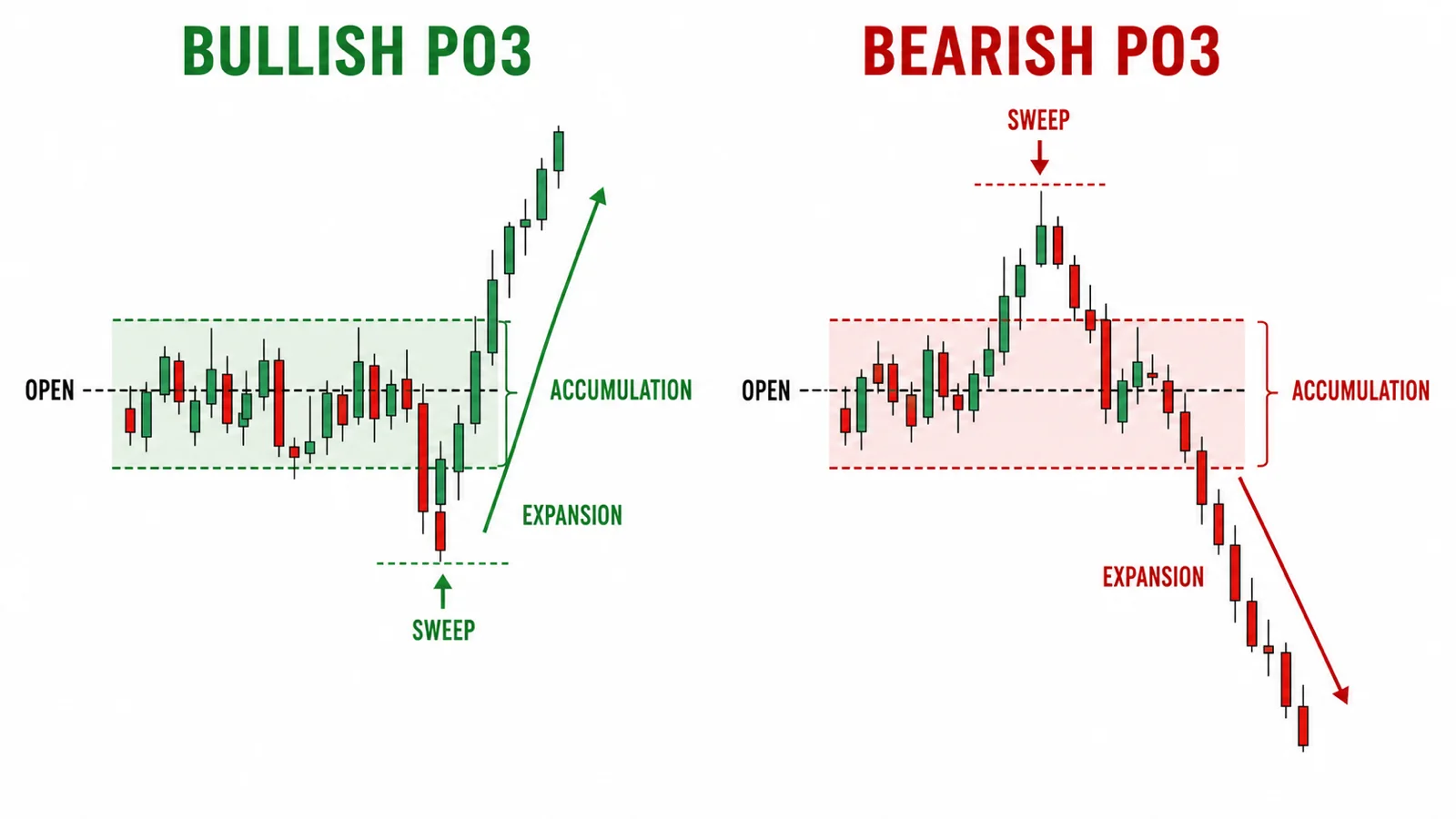
The ICT Power of Three, often shortened to PO3, is a model that divides a market move into accumulation, manipulation, and distribution. Traders usually apply it to a session, a daily candle, or a specific dealing range. The goal is to understand how price may prepare, mislead, and then expand.
Accumulation is the range-building phase. Price moves sideways or compresses while liquidity gathers above and below the range. This phase can look boring, but it matters because obvious highs and lows begin to form. Traders place stops around them, breakout traders watch them, and the market creates a clear reference area.
Manipulation is the false move outside the range. Price may break above the range high and quickly reject, or break below the range low and reclaim. This phase is often described as a stop run or liquidity sweep. The important part is not the wick itself. The important part is whether price fails to hold beyond the liquidity area.
Distribution is the directional expansion after manipulation. If price sweeps the high and then sells off with displacement, the distribution may be bearish. If price sweeps the low and then rallies with displacement, the distribution may be bullish. Distribution is where traders look for the actual delivery leg, but it still needs risk control and a clear invalidation point.
A clean definition is this: ICT Power of Three is a market narrative that uses range formation, liquidity manipulation, and directional expansion to organize a possible trade idea. It does not predict the future. It helps a trader decide what evidence is worth waiting for.
How to Identify Accumulation, Manipulation, and Distribution

You identify the ICT Power of Three by reading the sequence, not by forcing labels onto isolated candles. A range without a later sweep is not a complete PO3 setup. A sweep without rejection is not enough. A distribution move without prior context may simply be a normal breakout.
Start with accumulation. Look for a tight or relatively balanced range where price creates clear highs and lows. The range should be visible without zooming in too much or drawing tiny boxes around every candle. Equal highs, equal lows, session highs, session lows, and previous day levels can all become useful references.
Next, watch the manipulation phase. A bearish PO3 often pushes above a range high, attracts breakout buyers, collects buy-side liquidity, then rejects back into the range. A bullish PO3 often pushes below a range low, attracts breakdown sellers, collects sell-side liquidity, then reclaims the level. The reclaim or rejection is the first clue that the move may have been a trap.
Then look for distribution. The distribution phase should show stronger intent than the accumulation phase. It may appear as displacement candles, a break of short-term structure, a fair value gap, or a decisive move toward opposing liquidity. Weak drift after a sweep is less convincing than a clean expansion that changes behavior.
The cleanest PO3 examples usually have a simple visual shape: balanced range, one obvious false move, then a directional move away. If the chart needs too many explanations, the setup may not be clear enough to trade.
Why the ICT Power of Three Works as a Market Narrative
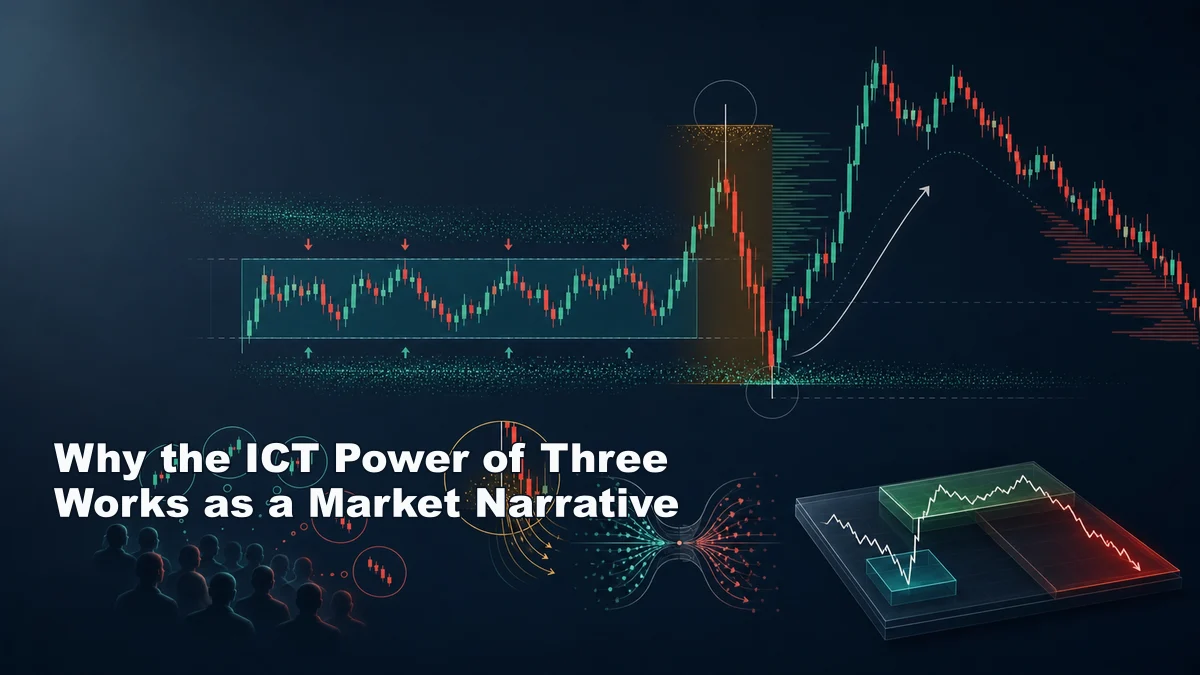
The ICT Power of Three works as a narrative because it connects trader behavior with visible price structure. It asks where liquidity builds, how price may trigger that liquidity, and whether the reaction creates a cleaner directional idea.
During accumulation, many traders become anchored to the range. Some plan breakout trades above the high. Others place stops beyond the high or low. As the range becomes more obvious, liquidity becomes easier to identify. The market does not need to know every trader’s order to show this behavior on a chart.
Manipulation matters because it tests whether the breakout is real. If price breaks above the range and keeps accepting higher, the breakout may be valid. If price breaks above, stalls, and then returns below the range high with force, trapped buyers may fuel the opposite move. The same logic applies below a range low.
Distribution is the phase where the narrative either proves useful or falls apart. A strong move away from the manipulation point can show that the market has shifted from balance to imbalance. That does not mean a trade is guaranteed. It means the trader now has something more specific to evaluate: where is the entry area, where is the invalidation, and where is the opposing liquidity target?
This is why PO3 belongs naturally with Smart Money Concepts. It combines liquidity, market structure, displacement, and timing into one readable sequence. Used well, it can reduce random entries. Used poorly, it becomes another excuse to predict every candle.
Step-by-Step Usage: From Bias to Entry Plan
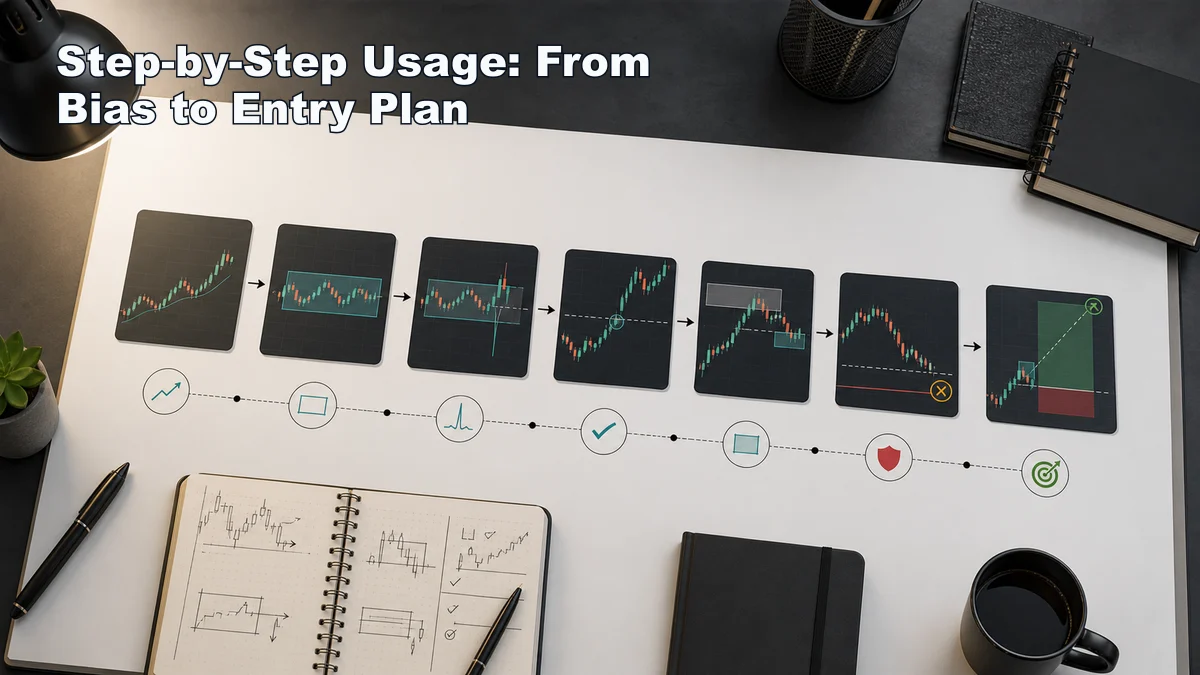
A practical PO3 workflow starts with context and ends with review. The model should not begin at entry. If you start by hunting the entry, you will usually see PO3 everywhere.
Step 1: Define the Higher-Timeframe Bias
Before marking a smaller range, decide what the higher timeframe is doing. Is price bullish, bearish, ranging, or sitting near a major decision area? A bullish PO3 has more value when it forms near a higher-timeframe discount area or after price reaches sell-side liquidity. A bearish PO3 has more value when it forms near premium or after price reaches buy-side liquidity.
Step 2: Mark the Active Accumulation Range
Choose the range that price is actually building around. Do not mark ten ranges and keep the one that works later. A useful accumulation range has clear boundaries and enough time spent inside it to attract attention. For intraday traders, this may be an Asian range, London range, New York morning range, or a smaller consolidation around a key level.
Step 3: Wait for Manipulation
Let price take one side of the range. The manipulation should interact with liquidity in a visible way. A tiny wick that barely touches a level is usually weaker than a clean sweep followed by rejection. The best clue is failure to accept beyond the range.
Step 4: Require Displacement or Structure Shift
After manipulation, wait for evidence that the market has changed direction. This may be a break of a short-term swing, a strong displacement candle, or an imbalance that forms away from the sweep. Without this step, a trader may enter while price is still deciding.
Step 5: Plan Entry, Invalidation, and Target
The entry area may be a fair value gap, order block, retracement zone, or retest of structure. Invalidation usually sits beyond the manipulation high or low, or beyond the structure that supports the setup. Targets often come from opposing liquidity, such as the other side of the range, a previous high, a previous low, or a higher-timeframe level.
Confirmation Rules Before You Treat PO3 as a Setup
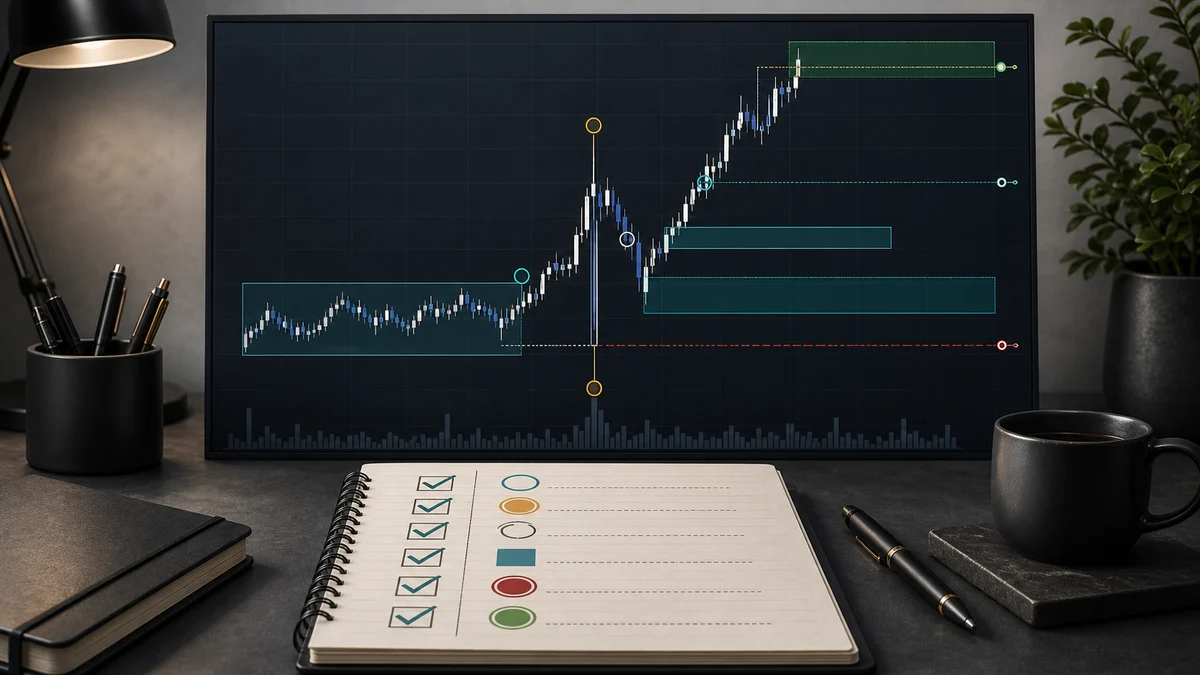
Confirmation rules decide whether a PO3 idea is tradable or only interesting. A chart can show accumulation and manipulation, but still fail to produce a clean setup.
The first rule is clear liquidity. If the accumulation range does not have obvious highs or lows, the manipulation phase becomes subjective. PO3 works best when the market takes a level many traders could have seen.
The second rule is failed acceptance. A manipulation move should fail to hold beyond the range. A candle that closes strongly outside the range and continues may be a breakout, not a trap. Rejection, reclaim, or fast return back inside the range gives the PO3 idea more weight.
The third rule is displacement. After the manipulation, price should move away with enough force to show a change in behavior. A slow drift can still work, but it gives weaker evidence. Many traders wait for a market structure shift or a fair value gap before planning entry.
The fourth rule is clean invalidation. If you cannot define where the idea is wrong, the setup is not ready. Invalidation should be logical, not chosen only because it makes the reward-to-risk ratio look attractive.
The fifth rule is realistic target space. If opposing liquidity is too close, the setup may not be worth the risk. A good-looking PO3 into a nearby higher-timeframe wall can still be a poor trade idea.
Examples of Bullish and Bearish ICT Power of Three
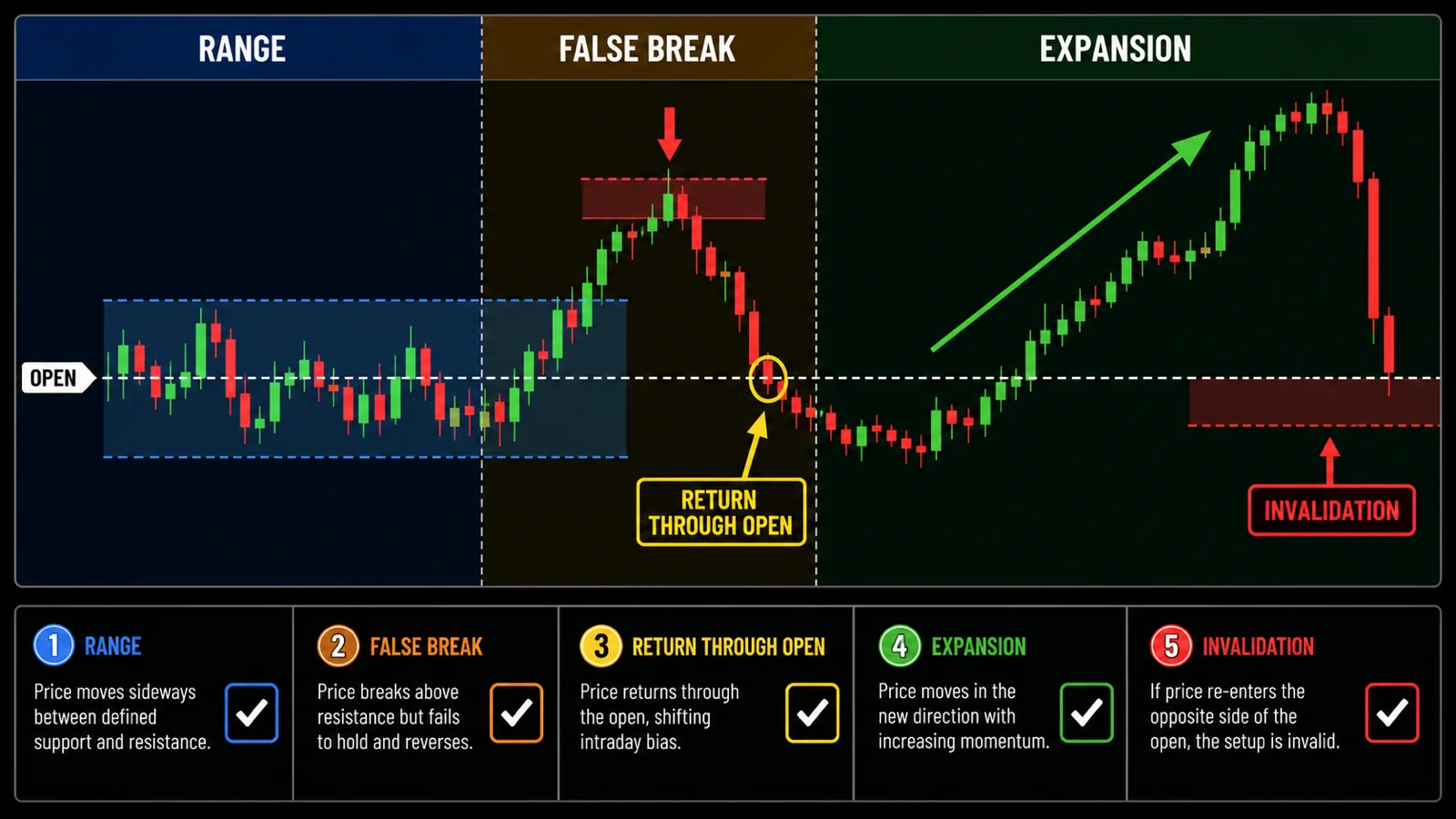
A bullish ICT Power of Three begins with price accumulating inside a range. Sell-side liquidity forms below the range low. Price breaks below that low, triggers sellers and stops, then quickly reclaims the range. If price then breaks short-term structure upward with displacement, a trader may watch for a retracement into a fair value gap or order block. Invalidation often sits below the manipulation low, and the target may be buy-side liquidity above the range.
A bearish ICT Power of Three is the mirror image. Price accumulates, buy-side liquidity forms above the range high, and price pushes above the high. If the move fails and price returns below the range high, trapped breakout buyers may be vulnerable. A structure shift lower and bearish displacement can create a short idea. Invalidation may sit above the manipulation high, while the target may be sell-side liquidity below the range.
There is also a non-trade example. Price accumulates, breaks above the range, and keeps closing above it with strength. That may not be manipulation. It may be acceptance and continuation. A trader who blindly shorts every range high sweep will get caught in real breakouts. This is why confirmation matters more than the label.
The goal is not to memorize a perfect drawing. The goal is to recognize when the market has moved from balance, through liquidity, into a confirmed directional move with defined risk.
Common Mistakes When Trading the ICT Power of Three
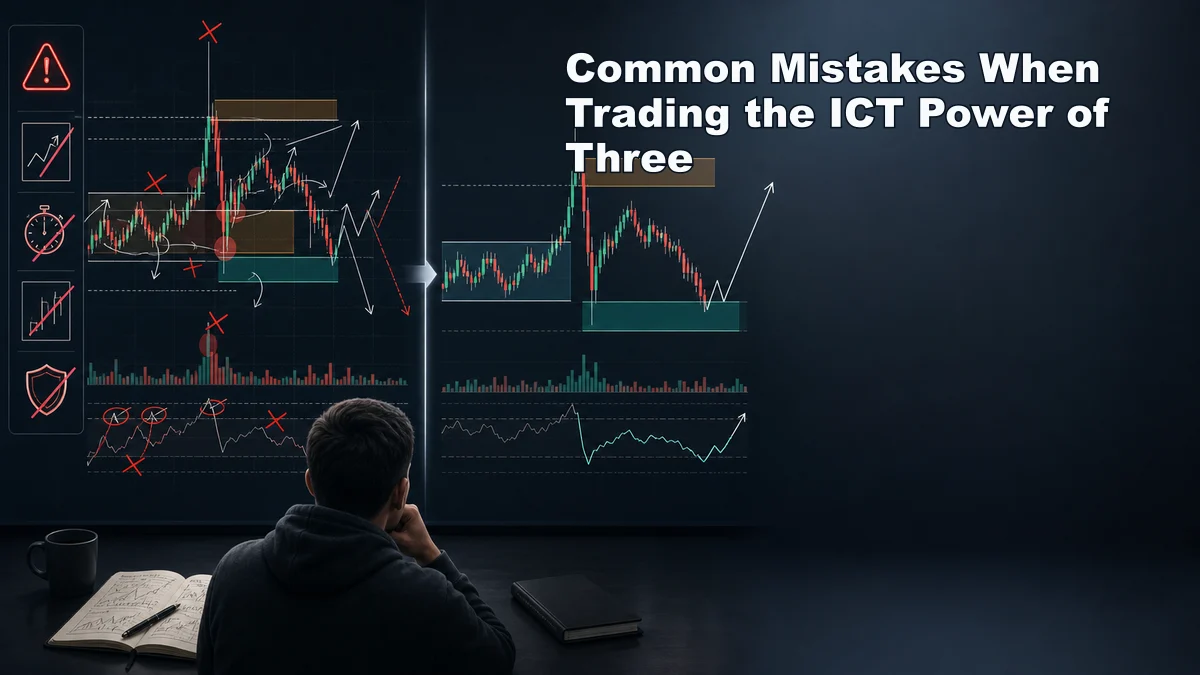
The biggest PO3 mistake is forcing the model onto every chart. Not every consolidation is accumulation. Not every wick is manipulation. Not every move after a wick is distribution. If the phases are not obvious, the setup may be too weak to trust.
Another common mistake is entering during manipulation. The false move can extend farther than expected. A trader who enters only because price swept a high or low may be early, and early entries often turn into emotional decisions. Waiting for rejection and displacement usually creates a cleaner plan.
Beginners also ignore higher-timeframe context. A bullish PO3 on a small timeframe may run directly into daily resistance. A bearish PO3 may form right above a higher-timeframe demand area. Context does not guarantee the outcome, but it helps filter low-quality locations.
A fourth mistake is using invalidation that does not match the idea. If the trade depends on the manipulation low holding, then a clean break below that low may invalidate the bullish idea. Moving the stop farther away after the fact changes the trade from a plan into hope.
Finally, many traders review only the winning examples. PO3 becomes useful when you journal the failures too. Save screenshots of clean failures, messy ranges, real breakouts, and early entries. Over time, your chart library will show which PO3 conditions you actually understand.
The ICT Power of Three is a helpful model when it simplifies price action into a testable sequence: accumulation, manipulation, distribution, confirmation, risk. It becomes harmful when it makes you overconfident about a move that has not confirmed yet. Use it as an educational framework, not financial advice or a signal for any specific trade.
Key takeaways
- ICT Power of Three is a practitioner narrative that divides a selected period into accumulation, a false move or liquidity run, and directional expansion.
- The three phases are not guaranteed to appear each day, and the word manipulation should not be treated as proof of illegal market conduct.
- Mark the range first, require a defined reclaim or structure shift and retain a continuation scenario when the range breaks cleanly.
- A valid plan separates location, trigger, invalidation, position size and exit logic.
A validation workflow you can reproduce
- Define the sample: choose the market, timeframe, session and date range before reviewing outcomes.
- Write the rule: Mark the range first, require a defined reclaim or structure shift and retain a continuation scenario when the range breaks cleanly.
- Record invalidation: identify the observable price event that disproves the setup.
- Include execution costs: account for spread, commission and slippage where relevant.
- Validate separately: test the finished rule on data that was not used to create it.
When this concept is unreliable
The model is unreliable when phases are labelled only after the session ends or every initial breakout is automatically called manipulation. Keep failed and skipped examples in the journal so the review is not limited to attractive winners.
Use this concept within a complete analysis
This method should remain connected to its parent framework and adjacent decision steps. Use Smart Money Concepts: Complete Trading Guide, Buy-Side Liquidity and Sell-Side Liquidity Explained, New York Session Liquidity Sweep Strategy, ICT Trading: Complete Beginner Guide, Liquidity in Trading: Complete Guide and Point of Interest in Trading: Complete Guide to compare definitions, establish context and avoid treating one signal as a complete trading system.
References and methodology
Terminology note: SMC, ICT and MSNR terms are practitioner conventions, not standardized exchange or regulatory definitions. This article defines the convention it uses and avoids inferring participant identity from candles alone.
Practise before considering real capital
Use historical charts or a demo account to test the written rules before considering live execution. Review the XM account and demo information. Availability, protections and trading conditions depend on jurisdiction, so review the applicable legal documents yourself.
Affiliate disclosure: Học Làm Trader may receive a commission if you open an account through this link, at no additional cost to you. This relationship does not determine the educational conclusions.