


practise MSNR trading Practising MSNR means testing written zone, trigger and invalidation rules on historical and demo data without treating simulated results as live performance. This article serves practice intent; it does not redefine MSNR zones or promise that demo results will transfer to real execution. The method should be treated as a testable chart-reading framework rather than a forecast. Before using it, define the market condition, confirmation event, invalidation price, transaction costs and maximum risk. This guide explains the rules, a repeatable workflow, common failure modes and the most relevant supporting concepts.
What Practice MSNR Trading Means in MSNR
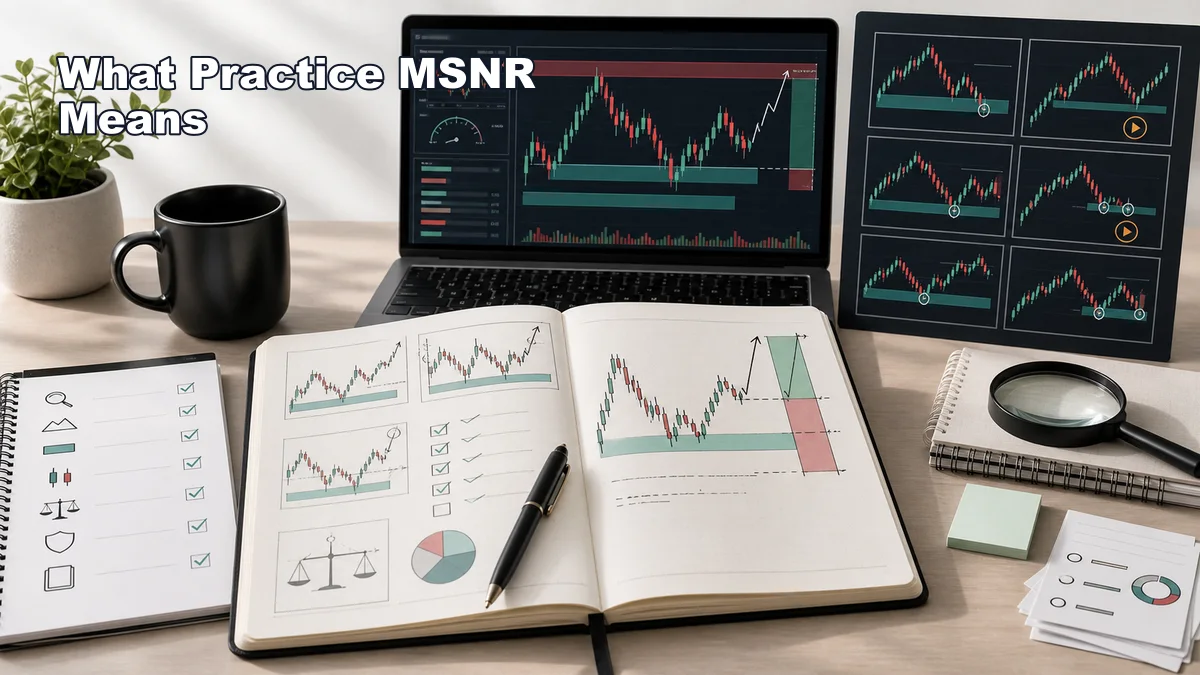
Practice MSNR trading means rehearsing the strategy in a controlled environment before live execution. It includes historical chart review, forward testing, demo trades, paper trading notes, screenshots, and post-trade review. A good practice routine trains both chart skill and decision discipline.
Many traders confuse practice with scrolling through old charts until they find examples that look good. That is not enough. In real practice, you mark the support and resistance zones before you know the outcome. You define the market context before the entry appears. You write the invalidation point before the trade is placed. You record the result whether the trade wins, loses, or is skipped.
Demo account MSNR is useful because it lets you rehearse order entry, stop placement, target planning, and emotional timing without risking capital. Paper trading MSNR is useful because it slows the process down and forces you to explain the setup in words. The strongest routine often uses both: paper trading for analysis and demo trading for execution practice.
The purpose is not to avoid risk forever. The purpose is to earn the right to consider live risk later. If you cannot follow your rules in practice, live money usually makes the problem worse.
Why It Matters Before Taking a Trade
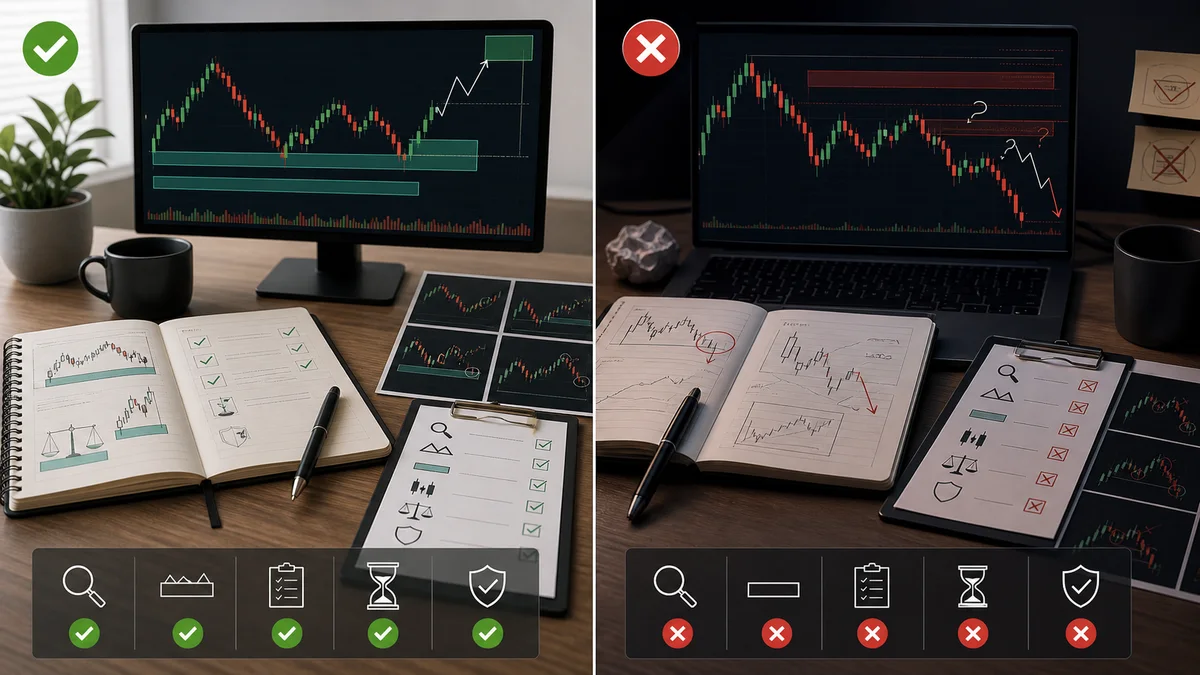
Practicing MSNR matters because the method depends on judgment. Support and resistance zones are not automatic signals. Price can reject, break, retest, sweep, or drift through a level. A trader needs enough screen time to recognize which situations are clear and which are too messy.
Practice also reveals whether your rules are specific enough. A beginner may say, “I will enter when price rejects support.” But what counts as rejection? A wick? A close? A structure shift? A retest? If the answer changes every day, the trader is not practicing a strategy. They are practicing improvisation.
A disciplined routine helps you collect evidence. After 50 or 100 practice examples, you may discover that some timeframes are too noisy, some markets spread too much around entries, or some setups look good only in hindsight. This feedback is much cheaper to learn in demo or paper trading than in a live account.
It also trains patience. If your practice routine requires price to reach a pre-marked zone and show a defined reaction, you will pass on many charts. That is healthy. The goal is not to trade more. The goal is to make better decisions when the setup is actually present.
Use the full MSNR trading strategy guide as the framework, then connect every practice example with MSNR risk management. No practice record is useful if it ignores invalidation, stop placement, and position sizing.
Step-by-Step Chart-Reading Workflow
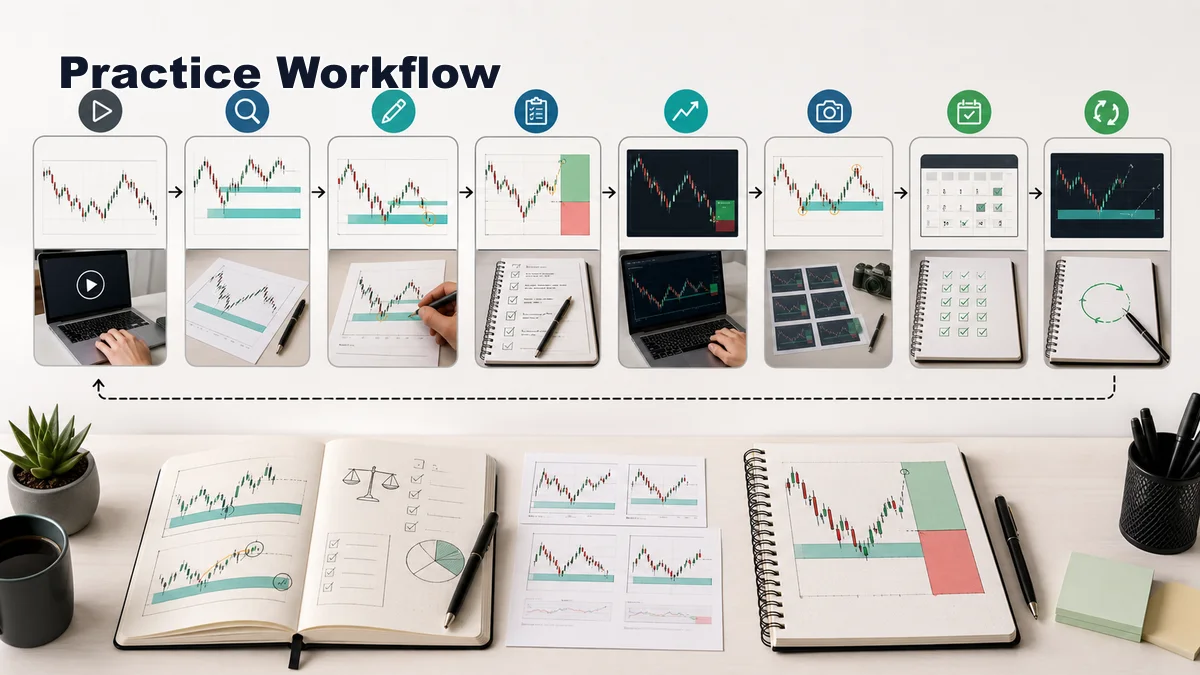
The routine below is designed to build skill without risking real money. Use it for at least several weeks before judging whether the method fits your personality and schedule.
Step 1: Choose One Market and Two Timeframes
Start narrow. Pick one market and one timeframe pairing, such as 4-hour context with 1-hour execution, or 1-hour context with 15-minute execution. Practicing too many markets at once makes review harder. You want enough repetition to see patterns and enough consistency to measure progress.
Step 2: Mark Zones Before Looking Ahead
Use chart replay or historical screenshots. Pause the chart before the reaction is known. Mark the support and resistance zones, describe the structure, and write what you would need to see before entry. This prevents hindsight bias and teaches you to make decisions with incomplete information.
Step 3: Write the Trade Plan
For every potential setup, write four lines: context, zone, reaction trigger, and invalidation. For example: “Context: bullish pullback. Zone: higher-timeframe support. Trigger: close back above support after rejection. Invalidation: clean break below the zone.” If you cannot write those lines, skip the setup.
Step 4: Paper Trade Before Demo Trading
Paper trading trains analysis. Record the planned entry, stop, target, and reason without placing an order. This is useful when you are still learning what a valid MSNR setup looks like. It also helps you slow down and remove the excitement of execution from the learning process.
Step 5: Move to Demo Execution
After you can consistently write clear paper plans, move to a demo account. Use the same risk percentage you would use later in a small live account, even though no real money is involved. This builds the habit of sizing positions, placing stops, and respecting invalidation.
Step 6: Screenshot Every Decision
Take a screenshot before entry, after entry, and after exit. Also screenshot skipped trades when the chart looked tempting but failed your rules. Skipped-trade screenshots are powerful because they teach patience and help you see whether your checklist is protecting you from low-quality conditions.
Step 7: Review Once a Week
Do not judge the routine after one trade. Review weekly. Group examples by setup type: rejection from support, rejection from resistance, breakout retest, range edge, and no-trade conditions. Look for repeated mistakes. The review should produce one small improvement for the next week, not a complete system rewrite after every loss.
A Simple Four-Week Practice Schedule
In week one, use only historical chart replay. Your job is to mark zones before the outcome is visible and write whether the chart is clear enough to study. Do not worry about win rate yet. In week two, add paper trading. Record planned entry, invalidation, stop, and target, but still avoid demo execution if the written plan is vague. In week three, move only the cleanest setups into a demo account and place orders with realistic position sizing. In week four, review the full sample and decide which setup type deserves more practice.
This schedule prevents a common beginner problem: moving to demo execution before the chart-reading routine is stable. If week one reveals that your zones are inconsistent, stay with chart replay. If week two reveals that you cannot define invalidation, stay with paper trading. Progress should be based on rule-following quality, not excitement. A slower routine is usually better than practicing bad habits quickly.
Entry, Invalidation and Stop-Loss Logic
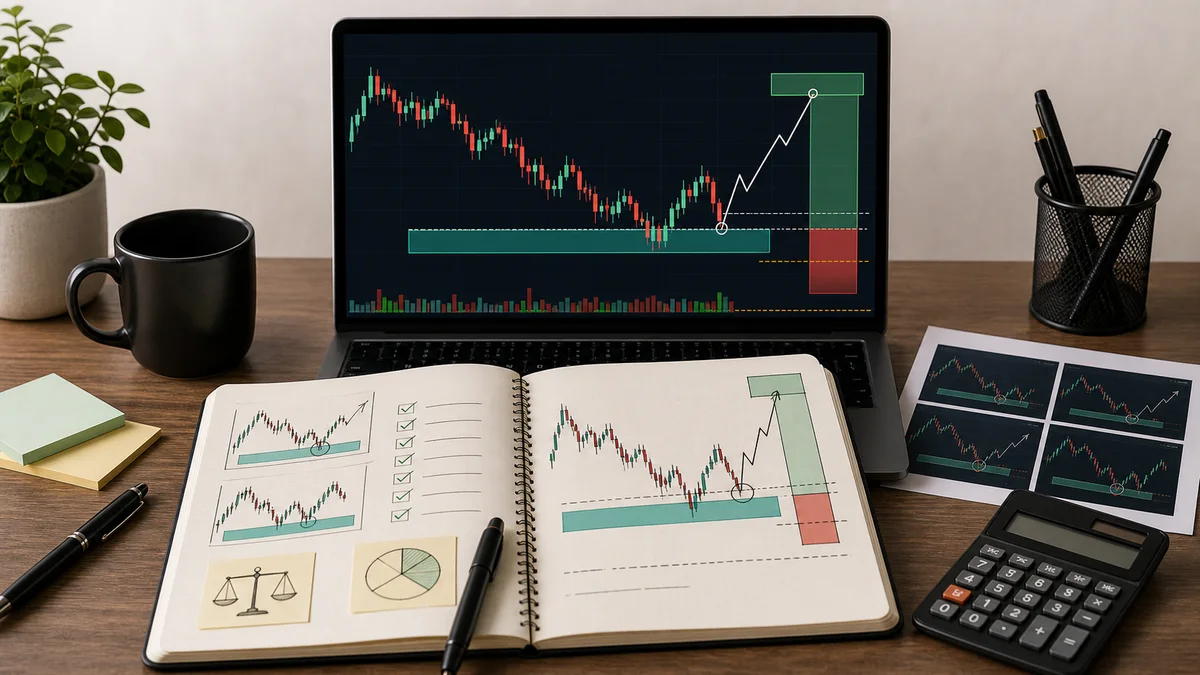
Entry practice should be rule-based. Do not record a trade only because price touched a level. Record the exact trigger. Was it a rejection candle, a close back inside the zone, a structure shift, a breakout-and-retest, or a range-edge failure? The trigger should be clear enough that future-you can review it honestly.
Invalidation practice is even more important. A practice trade without invalidation teaches the wrong habit. Before entry, write where the idea is wrong. If the long idea depends on support holding, define what failure looks like. If the short idea depends on resistance rejecting, define what acceptance above resistance would mean.
Stop-loss practice should follow invalidation, not a random number. Place the stop where the trade idea no longer makes sense, then calculate position size from that distance. In demo, use realistic position sizing. A demo account with oversized trades can make bad habits feel exciting and make normal losing streaks look meaningless.
Targets should also be realistic. Use the next support or resistance zone, prior swing, range boundary, or logical liquidity area. Do not place targets far away just to make the risk-to-reward look good. If the setup cannot offer reasonable room before the next obstacle, record it as a skip.
A simple practice rule works well: if the setup does not have a written trigger, invalidation point, stop area, and target before entry, it does not count as a valid practice trade.
Common Mistakes and Checklist
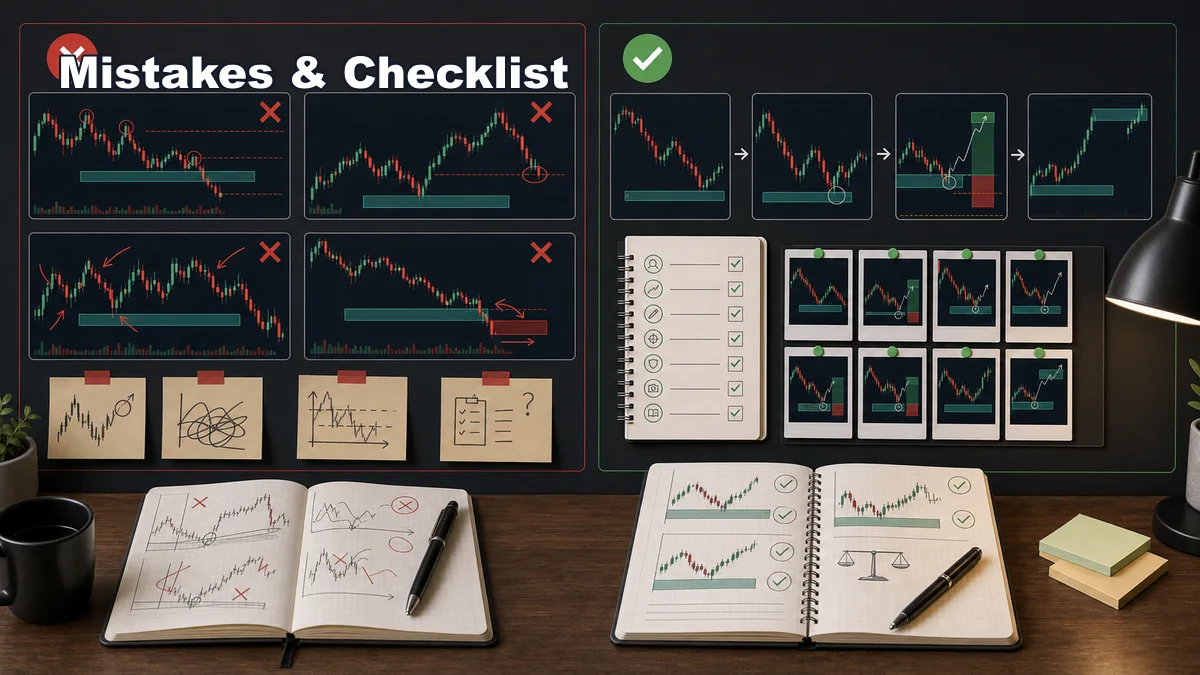
The first mistake is using hindsight examples as proof. Old charts are helpful only when you hide the future and make decisions step by step. If you already know the outcome, your brain will find the best-looking level after the fact.
The second mistake is treating demo money like a game. If you oversize, revenge trade, move stops, or ignore the plan in demo, you are practicing those behaviors. Demo trading should be realistic enough to train execution discipline.
The third mistake is changing rules too quickly. One losing practice trade does not mean the setup is broken. One winning practice trade does not mean it is ready for live money. Review groups of trades and screenshots, then make small changes.
The fourth mistake is measuring only win rate. A trader can have a high win rate with poor risk-to-reward, or a lower win rate with controlled losses and better planning. Track whether you followed the process, whether the setup matched your rules, and whether the stop and target were logical.
The fifth mistake is skipping emotional notes. Even in demo, you can feel impatience, fear of missing out, boredom, or frustration. Record those emotions. They often become stronger when real money is involved.
Use this MSNR practice checklist:
- Have I chosen one market and one timeframe pairing?
- Did I mark zones before knowing the outcome?
- Can I describe the market context in one sentence?
- Is the support or resistance zone obvious?
- Did price show a defined reaction trigger?
- Did I write invalidation before entry?
- Is the stop loss connected to invalidation?
- Is the target based on the next logical area?
- Did I screenshot the setup and result?
- Will I review the trade with a group of examples, not alone?
Read the Full MSNR Guide: Continue with the full MSNR trading strategy guide and pair this routine with MSNR risk management. Practice should make your rules clearer before your money is involved.
Frequently Asked Questions
How long should I practice MSNR before live trading?
There is no fixed number, but you should have a meaningful sample of paper and demo trades, clear screenshots, and evidence that you can follow rules consistently. Many beginners benefit from several weeks or months of structured practice before risking real money.
Is demo account MSNR enough?
Demo trading is useful, but it is not identical to live trading. It helps with process, execution, and review, but live trading adds emotion, slippage, spread pressure, and real account consequences. Treat demo success as preparation, not proof.
What should I track in an MSNR practice journal?
Track market, timeframe, context, zone, reaction trigger, entry, invalidation, stop loss, target, result, screenshot, rule-following score, and emotional notes. The review should focus on process quality as much as trade outcome.
Key takeaways
- Practising MSNR means testing written zone, trigger and invalidation rules on historical and demo data without treating simulated results as live performance.
- This article serves practice intent; it does not redefine MSNR zones or promise that demo results will transfer to real execution.
- Separate chart review, replay and forward demo testing, then record spreads, slippage and rule violations.
- A valid plan separates location, trigger, invalidation, position size and exit logic.
A validation workflow you can reproduce
- Define the sample: choose the market, timeframe, session and date range before reviewing outcomes.
- Write the rule: Separate chart review, replay and forward demo testing, then record spreads, slippage and rule violations.
- Record invalidation: identify the observable price event that disproves the setup.
- Include execution costs: account for spread, commission and slippage where relevant.
- Validate separately: test the finished rule on data that was not used to create it.
When this concept is unreliable
Practice becomes unreliable when examples are selected after the outcome, losing setups are omitted or demo fills are assumed to match live trading. Keep failed and skipped examples in the journal so the review is not limited to attractive winners.
Use this concept within a complete analysis
This method should remain connected to its parent framework and adjacent decision steps. Use MSNR Chart Setup: What Tools, Timeframes and Templates You Need, MSNR vs Random Support and Resistance: The Key Differences, What Is MSNR Trading? Meaning, Logic and Beginner Rules, How MSNR Uses Close and Open Prices Instead of Random Wick Lines, MSNR Terminology: SNR, Fresh Level, Storyline, Rejection and Confluence and Malaysian Support and Resistance: The Core MSNR Zone Framework to compare definitions, establish context and avoid treating one signal as a complete trading system.
References and methodology
Terminology note: SMC, ICT and MSNR terms are practitioner conventions, not standardized exchange or regulatory definitions. This article defines the convention it uses and avoids inferring participant identity from candles alone.
- CME Group — Technical Analysis
- CFTC — Eight Things to Know Before Trading Forex
- CME Group — Chart Types: Candlestick, Line and Bar
Practise before considering real capital
Use historical charts or a demo account to test the written rules before considering live execution. Review the Exness account and demo information. Availability, protections and trading conditions depend on jurisdiction, so review the applicable legal documents yourself.
Affiliate disclosure: Học Làm Trader may receive a commission if you open an account through this link, at no additional cost to you. This relationship does not determine the educational conclusions.
Risk warning: This article is for education and general information only. It is not investment advice, a trade signal or an invitation to trade. Trading can result in loss of capital, and past examples do not guarantee future results. Assess your own circumstances and risk tolerance.