


VWAP, or Volume-Weighted Average Price, is the cumulative average of price weighted by volume from a defined starting point. Session VWAP normally resets at each trading session; Anchored VWAP begins at a user-selected event or pivot. Price above a rising VWAP can support an intraday bullish context, while price below a falling VWAP can support a bearish context, but a cross alone is not a complete setup. VWAP is based on historical data, can lag, and depends on the volume feed, session definition, anchor, source price, and chart timeframe.
Key takeaways
- VWAP combines price and volume from a defined start point.
- Session VWAP and Anchored VWAP answer different questions.
- A cross needs context, close behavior, and invalidation.
- Bands measure distance from VWAP; they are not automatic reversal levels.
- Spot-forex VWAP depends on broker-specific tick volume.
What VWAP calculates
A common calculation uses typical price: (high + low + close) / 3. Each bar’s typical price is multiplied by its volume, the results are accumulated, and the total is divided by cumulative volume. Because every new bar is added to the running totals, the line changes through the period and usually becomes less responsive later in a long session.
VWAP is related to moving averages but is not identical. A moving average uses a rolling window; session VWAP accumulates from the reset. Review the moving-average guide and the broader indicator framework before combining tools with overlapping information.
The calculation is only as representative as its volume input. On centralized futures or equities data, volume refers to that venue. On OTC spot forex, a platform may use broker tick volume. Do not present one broker’s VWAP as the universal average transaction price for the global currency market.
Session VWAP versus Anchored VWAP
Session VWAP resets at a defined open and summarizes that session. It is suited to intraday questions such as whether price is trading above or below the session’s weighted average. Session templates matter: a futures chart using a nearly 24-hour session can differ from a regular-hours equity chart.
Anchored VWAP starts from a selected point such as a major swing, breakout, earnings event, or session low. The anchor must be chosen for a rule-based reason before seeing the later outcome. Moving the anchor until the line fits price is curve fitting, not analysis.
TradingView’s documentation notes that the anchor period should contain several bars. A session VWAP on a daily chart that resets every bar is not meaningful. Assign chart roles with multi-timeframe analysis rather than forcing one VWAP onto every timeframe.
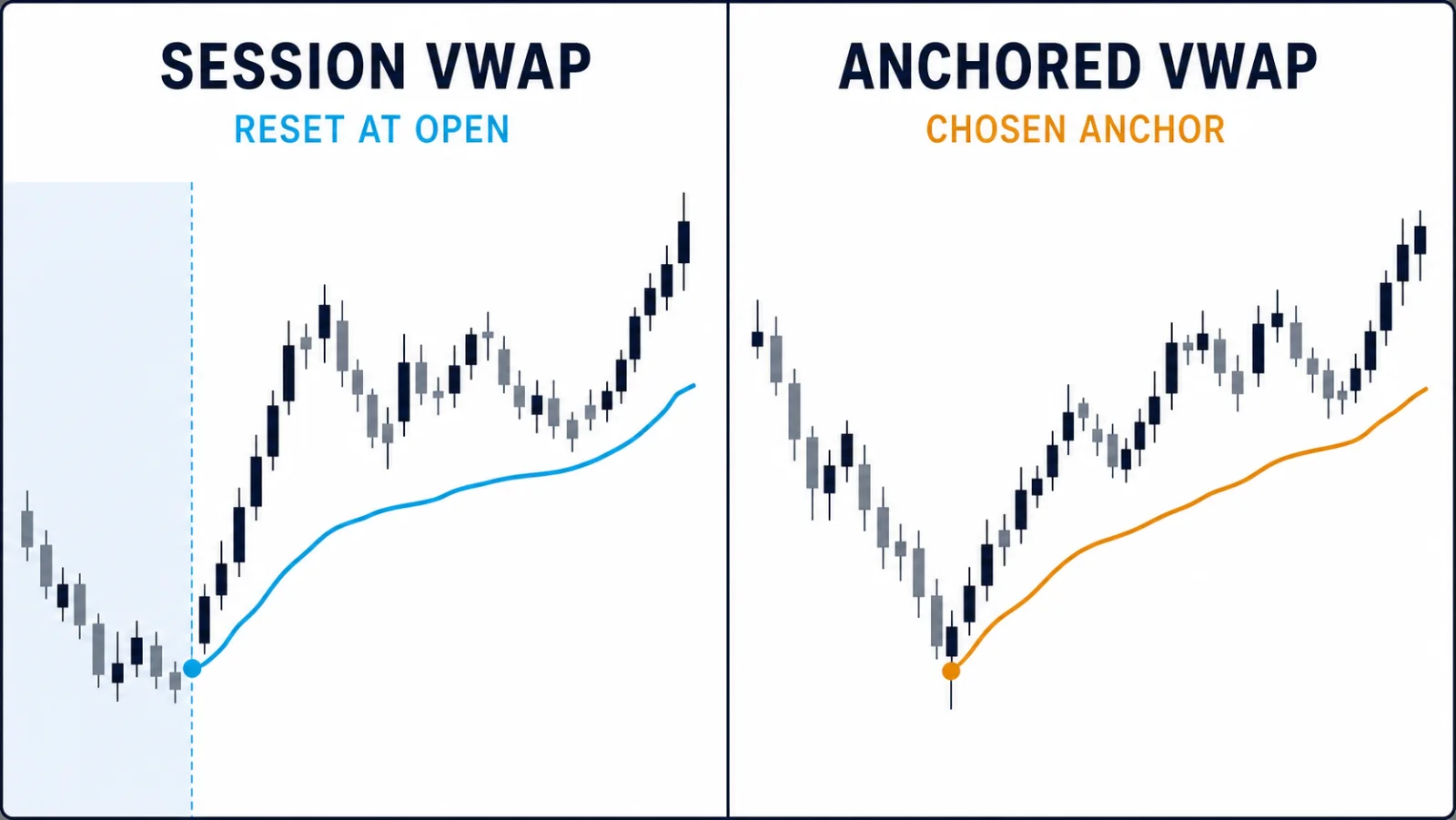
Three practical VWAP scenarios
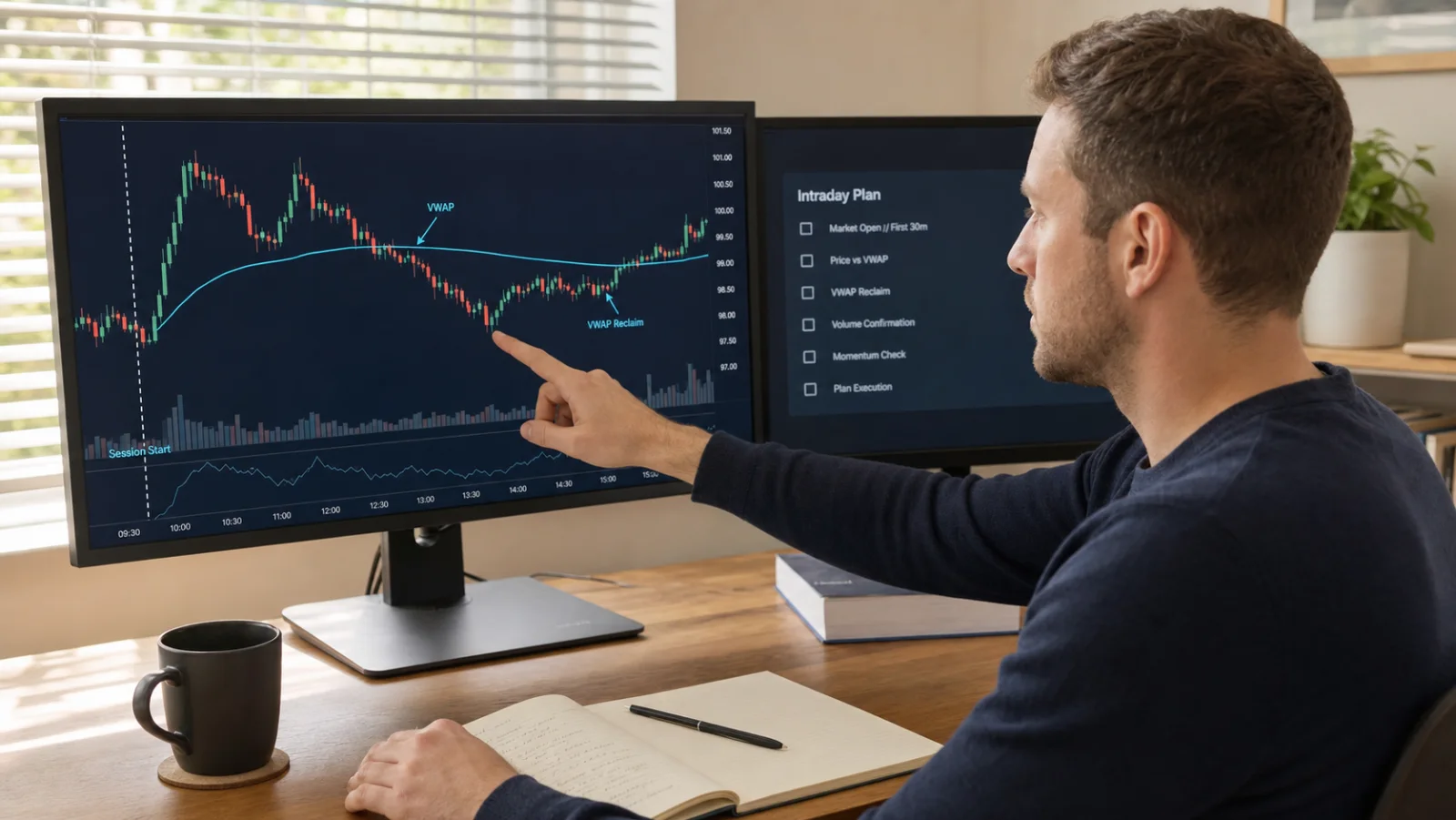
A trend-hold scenario looks for price remaining on one side of a sloping VWAP, with pullbacks failing to establish closes through it. A reclaim scenario starts after price trades below VWAP, closes back above, and then holds or retests. A rejection scenario requires price to test VWAP and move away with a close and structure break.
These are descriptions, not entries. A reclaim during a strong downtrend can fail immediately; a band touch during a trend can show strength rather than exhaustion. Use market structure and trading-session context to decide what evidence matters.
Standard-deviation or percentage bands measure distance from VWAP. Wider distance can identify an unusual extension relative to the current calculation, but it does not prove that price must revert. The same outer-band touch can precede continuation in a trend and rotation in a balanced session.
A step-by-step reading workflow
- Select session or anchored VWAP before opening the test.
- Record the session template, timezone, source price, and volume feed.
- Read the higher-timeframe structure and current session state.
- Classify VWAP slope and whether price is above, below, or rotating around it.
- Choose one scenario: hold, reclaim, rejection, or no trade.
- Wait for the required candle close and structure event.
- Define invalidation and the next obstacle.
- Record realistic spreads, slippage, and missed entries.
Session VWAP, Anchored VWAP and bands
| Tool | Starts from | Best question | Main risk |
|---|---|---|---|
| Session VWAP | Session open | Where is price versus session average? | Wrong session template |
| Anchored VWAP | Chosen event or pivot | How has price behaved since the anchor? | Hindsight anchor |
| VWAP bands | Distance from VWAP | Is price unusually extended? | Automatic mean-reversion assumption |
| Multiple VWAPs | Different periods | Do references cluster? | Clutter and duplicated data |
Record the exact reset and anchor rules; otherwise the test cannot be reproduced.
Worked chart example
Assume an intraday market opens above the prior close, sells below session VWAP, then closes back above it while M15 breaks the nearest lower high. The trader labels a potential reclaim only after the close and structure event are complete.
A pullback that holds above VWAP may provide a testable trigger. Invalidation is a close back below the reclaim structure, not the visual VWAP line alone. The next resistance or prior session high limits the available space.
If price repeatedly crosses a flat VWAP with overlapping candles, the session is balanced. The same reclaim rule may create whipsaws, so the plan stands aside rather than treating every cross as a new trade.
VWAP, Volume Profile and duplicated information
VWAP compresses cumulative price and volume into a line. Volume Profile distributes activity across price rows. They can be used together, but agreement does not create certainty; both may reflect the same underlying price-volume history.
Avoid stacking VWAP, VWMA, several moving averages, and volume-weighted profiles without a decision role for each. A clean plan might use structure for direction, VWAP for session location, and a candle close for activation. Every additional indicator should change a defined decision.
For a new learner, one VWAP and raw price are enough. Test the basic read before adding bands, multiple anchors, or custom sources.
Common mistakes
- Using the wrong session template or timezone.
- Anchoring after seeing the outcome.
- Treating every VWAP cross as a signal.
- Assuming every outer-band touch will mean-revert.
- Ignoring that spot-forex volume is feed-specific.
- Combining several volume-weighted tools without distinct roles.
VWAP is most useful as a location and context reference. The trigger must come from a rule that can be tested.
Risk management and invalidation
VWAP can act as part of invalidation only when the thesis depends on a reclaim, hold, or rejection. A small intrabar cross is not necessarily failure. Define whether invalidation requires a close, a structure break, or both, and keep that rule consistent across the sample.
An indicator condition does not determine position size. Define the chart condition that invalidates the setup, measure the actual distance to that point, and only then calculate exposure. The position-sizing formula and the limits of the risk–reward ratio should be applied after the technical thesis is clear. If the coherent invalidation point creates more risk than the plan allows, reduce size or skip the trade.
Spread, slippage, gaps, data-feed differences, and fast conditions can change execution. The CFTC warns that leverage amplifies both gains and losses and that OTC forex customers trade through a dealer-controlled platform rather than a live exchange. A correct chart observation can still lead to a loss, poor fill, or missed trade.
Pre-trade checklist
- Reset or anchor is rule-based.
- Session and timezone are correct.
- VWAP slope and price location are clear.
- The market is trending or balanced by a written definition.
- The trigger is closed, not anticipated.
- Invalidation and nearby obstacles are marked.
How to backtest without hindsight
Test one VWAP scenario at a time and keep session data consistent. A New York-session reclaim should not be pooled with an arbitrary anchored-VWAP bounce.
- Freeze VWAP settings.
- Capture the chart before the trigger.
- Advance one bar at a time.
- Count crosses, holds, failures, and no-trade sessions.
- Include the open and high-volatility periods.
- Validate on another instrument or unseen period.
Save a screenshot before the signal and another after the scenario is complete. Record the instrument, timeframe, settings, market state, trigger, invalidation, maximum adverse excursion, maximum favorable excursion, spread, slippage, and whether the order could realistically have been filled. Keep failed and ambiguous cases. Removing them creates survivorship bias.
Score process separately from outcome. A profitable trade taken outside the rules is poor process, while a losing trade that followed a tested plan can still be a valid sample. Use the same definitions for at least 30–50 examples before changing a rule. When parameters change, date the revision and start a separate data group.
When not to use this tool
Stand aside when VWAP is flat and price repeatedly crosses it, the chart timeframe has too few bars inside the anchor period, or the selected volume feed is unsuitable for the claim being made. A line through the middle of congestion is not a directional edge.
Do not chase price far from VWAP because the earlier reclaim was missed. The setup location and risk have changed. A missed trade should be recorded as a normal outcome.
Frequently asked questions
Is VWAP only for day trading?
Session VWAP is primarily intraday, while weekly, monthly, or anchored versions can be studied over longer periods.
Does price above VWAP mean buy?
No. It describes location relative to a historical weighted average and needs context and a trigger.
Is Anchored VWAP objective?
Only if the anchor rule is defined before the outcome. A manually fitted anchor introduces hindsight.
Why does VWAP differ between brokers?
Volume feed, session, timezone, source price, and platform calculation can differ.
Conclusion
VWAP becomes useful when its reset, anchor, and volume limitations are explicit. Read it as a context line, then require closed-price evidence, structure, and a prewritten invalidation rule.
Sources and limitations
- TradingView — Volume-Weighted Average Price, accessed August 2, 2026.
- TradingView — Anchored VWAP drawing tool, accessed August 2, 2026.
- CME Group — Technical Analysis, accessed August 2, 2026.
- CFTC — Eight Things You Should Know Before Trading Forex, accessed August 2, 2026.
VWAP implementations and feeds differ. Platform documentation explains calculation and settings, not a guaranteed trading strategy.
Affiliate disclosure: If you need a practice environment, you may review an Exness demo account. This is a sponsored affiliate link, and Học Làm Trader may receive a commission if you register. The link is not a recommendation to open an account. Check costs, product terms, legal availability in your jurisdiction, and suitability before using any service.
Risk warning: This article is for education and general information only. It is not investment advice, a trade signal, or an invitation to trade. Indicators summarize historical price or volume data and can produce late, conflicting, or false signals. Leveraged trading can cause rapid losses, and past performance does not guarantee future results. Test every rule independently, include realistic costs, assess your ability to bear loss, and take responsibility for your decisions.