


point of interest trading A point of interest (POI) is a predefined chart area where a trader plans to observe price for evidence, not an automatic entry zone. The label may refer to support, resistance, an order block or an imbalance, so its construction rule must be documented. The method should be treated as a testable chart-reading framework rather than a forecast. Before using it, define the market condition, confirmation event, invalidation price, transaction costs and maximum risk. This guide explains the rules, a repeatable workflow, common failure modes and the most relevant supporting concepts.
Definition: What Is a Point of Interest in Trading?
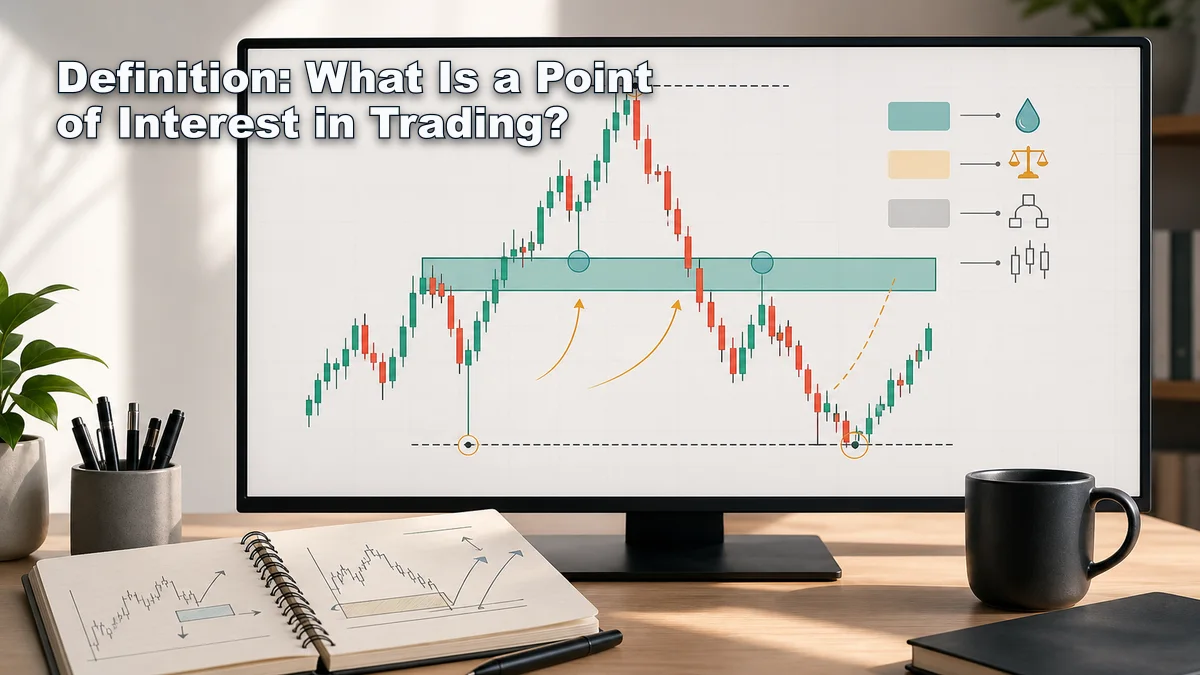
A Point of Interest, often shortened to POI, is a zone on the chart that deserves attention because price may react there. Traders use POIs to avoid watching the entire chart equally. Instead of asking whether price can move up or down from anywhere, they define the areas where a reaction would be logical.
For example, if price breaks market structure with strong displacement and leaves a clear imbalance, a trader may mark the imbalance or the last opposing candle before the move as a POI. If price later returns to that area, the trader watches for confirmation. The POI is not the entry by itself. It is the place where the trader becomes alert.
POIs can come from several frameworks. In price action, a POI may be a support or resistance zone. In supply and demand trading, it may be an untested supply or demand area. In Smart Money Concepts, it may be an order block, fair value gap, breaker block, mitigation block, or premium-discount area after liquidity has been taken. In all cases, the same rule applies: the zone must have a reason to matter.
A POI is different from a random box. A random box is drawn because price stopped there once. A stronger POI is drawn because the level connects with context: a higher-timeframe level, a liquidity event, a structure shift, strong displacement, a clean reaction, or a clear invalidation point. The more meaningful the context, the more useful the POI becomes.
It also helps to remember that trading has real execution costs. Investor.gov explains that bid and ask prices create a spread, which is the gap between what buyers are willing to pay and what sellers are willing to accept. A POI that looks precise on a chart can still be difficult to trade if the spread is wide, the market is thin, or the trader enters during poor liquidity conditions.
Core Principles Behind a Useful POI
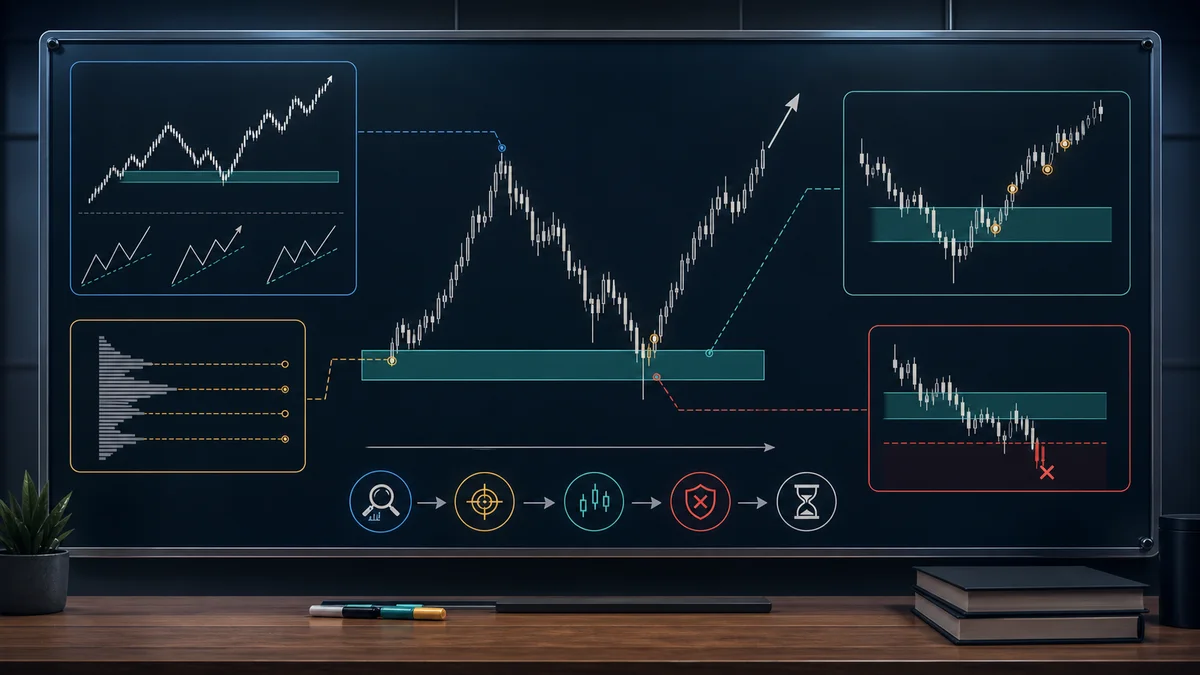
The first principle is context. A POI becomes stronger when it fits the market environment. A bullish demand zone inside a higher-timeframe uptrend has a different quality from the same-looking zone directly below major resistance. A bearish supply zone after a liquidity sweep has a different meaning from a random candle in the middle of a choppy range.
The second principle is confluence. Confluence means that several independent clues point to the same area. A POI may line up with a previous swing, a higher-timeframe level, a liquidity pool, a fair value gap, a volume reaction, or a premium-discount zone. Confluence does not guarantee a win, but it gives the zone a stronger reason to exist.
The third principle is reaction evidence. A POI should not be traded just because price touches it. Traders should watch how price behaves when it arrives. Does price slow down? Does it reject? Does it create displacement away from the zone? Does it shift lower-timeframe structure? Does it fail and accept through the area? The reaction gives the trader information that the box alone cannot provide.
The fourth principle is invalidation. Every POI should answer the question: where is this idea wrong? If a bullish POI is based on a demand zone, accepting below the demand zone may weaken the idea. If a bearish POI depends on a sweep above a high, strong acceptance above that sweep may invalidate the short scenario. If you cannot define invalidation, the POI is not ready for risk.
The fifth principle is selectivity. The more POIs you mark, the less useful they become. A chart with ten boxes gives the trader ten excuses. A chart with one or two high-context zones creates patience. Beginners should practice marking only the obvious POIs first. If the level is not clear without zooming in too much, it may not deserve attention.
The sixth principle is simplicity. A POI should make the chart easier to trade, not harder. If a trader needs several minutes to explain why a zone matters, the idea may be too forced. A strong POI can usually be described in one sentence: price swept sell-side liquidity and displaced higher, so the fair value gap left by that move is the area to watch. Simple explanations are easier to test, journal, and improve.
Key POI Patterns and Models
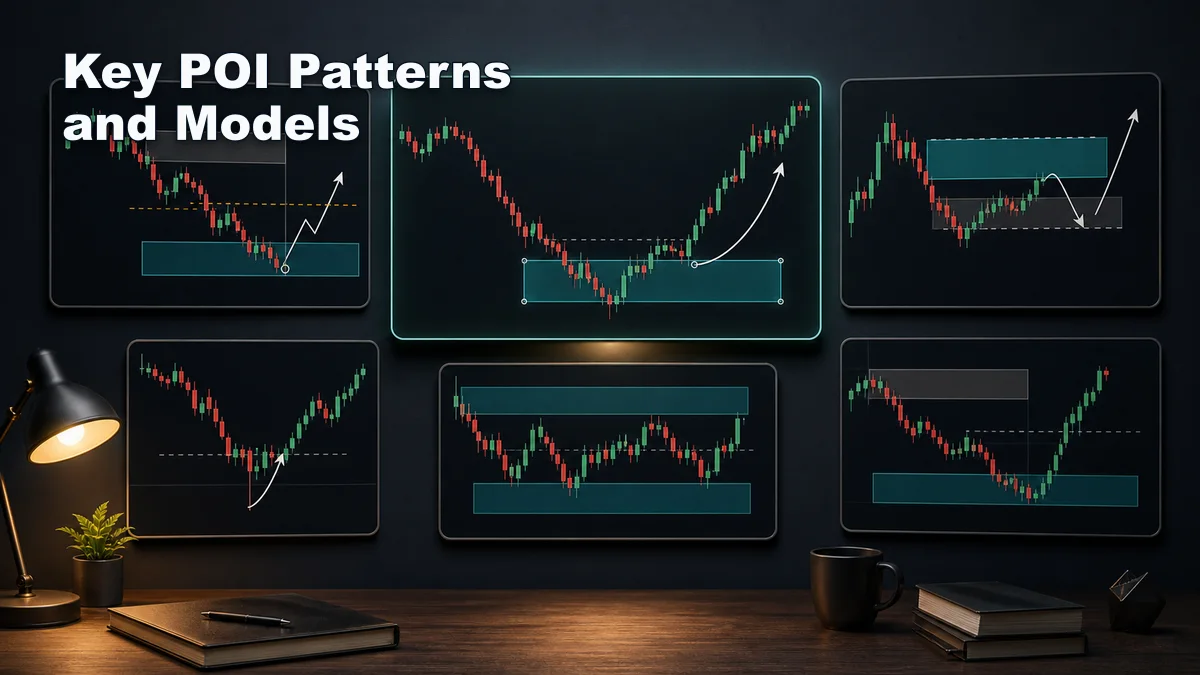
The first common POI model is the support and resistance zone. Price has reacted from the area before, so traders watch whether it rejects, breaks, or flips when price returns. This model is simple, but it works best when the zone is clean and connected to current structure.
The second model is the supply or demand zone. A demand zone is an area where buying previously overwhelmed selling. A supply zone is an area where selling previously overwhelmed buying. Traders often watch untested zones because the first return may create a meaningful reaction. The zone is stronger when it created displacement or broke structure.
The third model is the order block. In Smart Money Concepts, an order block is commonly treated as the last opposing candle or small consolidation before a strong move away. A bullish order block may appear before a powerful rally. A bearish order block may appear before a sharp selloff. Not every candle before a move is a quality order block. The best ones have location, displacement, and clear invalidation.
The fourth model is the fair value gap. A fair value gap is an imbalance left by a fast move. Traders may mark the gap as a POI because price can return to rebalance part of the move before continuing. This model should be filtered carefully. Fair value gaps appear often, and many are low quality unless they form after a strong liquidity event or structure break.
The fifth model is the liquidity sweep into POI. In this model, price takes liquidity above a high or below a low, then returns into a nearby POI and reacts. This is popular among Smart Money traders because it combines three ideas: liquidity, location, and confirmation. The sweep shows where orders may have been triggered. The POI gives a reaction zone. The structure shift gives evidence.
The sixth model is the support-resistance flip. Old resistance may become support after price breaks and accepts above it. Old support may become resistance after price breaks and accepts below it. This is one of the easiest POI models for beginners to understand because the invalidation is often clear: if price fails to hold the flipped zone, the idea weakens.
How to Identify a POI on a Chart

Start with the higher timeframe. If you plan to trade on the 15-minute chart, first study the daily, four-hour, or one-hour chart. Mark the main trend, range, major swing highs, swing lows, and important support or resistance areas. Higher-timeframe POIs usually matter more than small zones on an entry chart.
Next, identify liquidity. Liquidity often sits above previous highs, below previous lows, around equal highs and equal lows, and near range boundaries. A POI close to obvious liquidity can be important because price may move toward that pool before reacting. This is why POI analysis often connects naturally with the Liquidity in Trading complete guide.
Then look for displacement. A strong move away from an area tells you that price did not merely pause there. It moved with force. If that move broke structure, created imbalance, or started after a sweep, the origin of the move may become a POI. Weak movement usually produces weaker zones.
After that, narrow the zone. A POI should be broad enough to account for wick noise, spread, and normal retests, but not so wide that the risk becomes meaningless. Many traders use the body-to-wick area of a candle, the open and close of a displacement candle, the edges of an imbalance, or the boundaries of a consolidation base.
Finally, wait for reaction. A POI is not confirmed just because price reaches it. Watch whether price respects the area, rejects it, forms a lower-timeframe structure shift, or breaks through with acceptance. A failed POI can be just as useful as a successful one because it tells you the market may be moving toward the next liquidity pool.
To improve accuracy, combine POIs with market structure and multi-timeframe analysis. A small POI becomes more meaningful when it aligns with a larger trend or a major decision area.
A Practical POI Trading Workflow
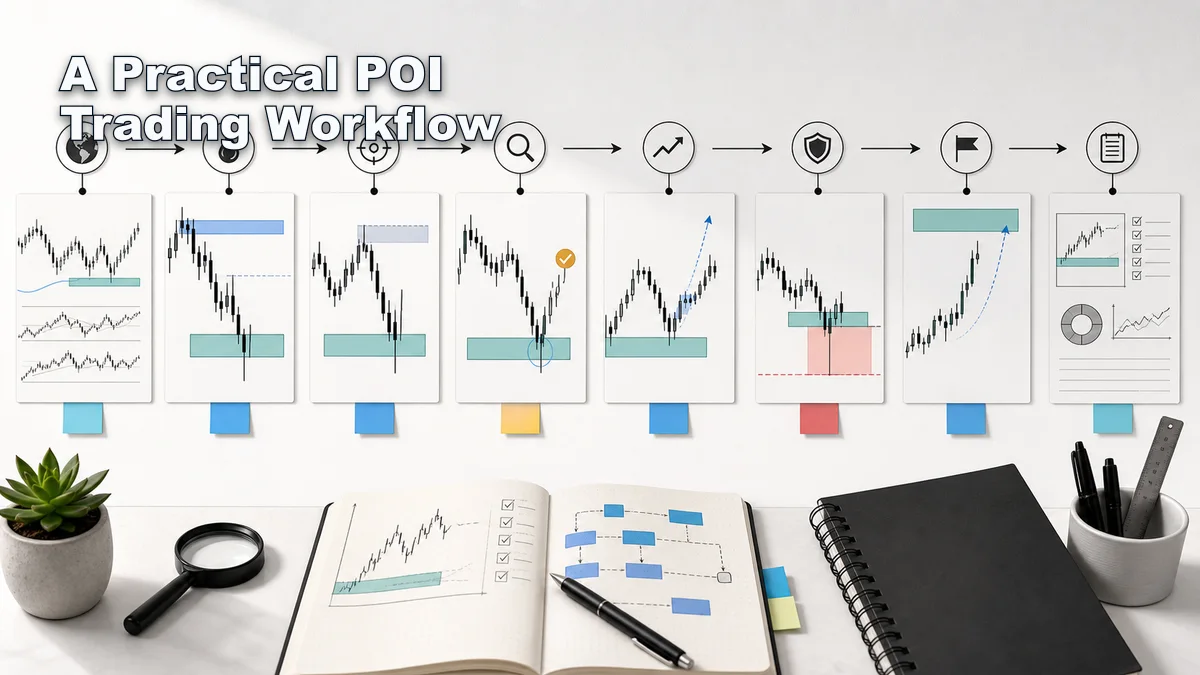
A workflow prevents POI trading from becoming box drawing. The goal is to turn the concept into a repeatable decision process.
Step one: define the environment. Decide whether the market is trending, ranging, reversing, or moving into a major level. A POI in a trend may be used for continuation. A POI inside a range may be used for mean reversion. A POI after a liquidity sweep may be used for reversal, but only if price confirms.
Step two: map the active liquidity. Mark the high or low that price is most likely reacting around now. This may be a previous day high, previous day low, equal highs, equal lows, session extreme, or range boundary. The active liquidity pool helps explain why price may move into or away from your POI.
Step three: choose the POI. Select one or two zones that have the best context. Do not mark every possible order block or gap. A good POI should have a clear story: why it formed, what it caused, and why price returning there would matter.
Step four: wait for confirmation. Confirmation can be a rejection candle, lower-timeframe structure shift, displacement away from the zone, failed breakout, or clean retest. The exact trigger depends on your model. The key is that price must give evidence before risk is taken.
Step five: define entry, invalidation, and target. Entry should come after the POI and confirmation align. Invalidation should sit where the POI idea is wrong, not where the trader emotionally hopes the stop will survive. Target can often be the next opposing liquidity pool or higher-timeframe level.
Step six: manage execution conditions. Check spread, news risk, session timing, and volatility. A beautiful POI during a thin session can create poor fills. Investor.gov describes liquidity as the ease of selling an investment in the secondary market, and that idea matters for short-term traders too: poor liquidity can turn a clean chart idea into a bad execution.
News risk deserves special attention. A POI that looks clean before a major data release may be ignored completely when volatility expands. Price can spike through several zones, spreads can widen, and stop orders can fill worse than expected. Many traders either stand aside during scheduled high-impact news or reduce risk until the market returns to normal behavior. The POI is only one part of the plan; the trading environment decides whether the plan is reasonable to execute.
Step seven: journal the result. Save screenshots before and after the trade. Record the higher-timeframe context, liquidity pool, POI type, confirmation trigger, entry, invalidation, target, and outcome. Over time, your journal will show which POI models you actually execute well.
Examples of Point of Interest in Trading
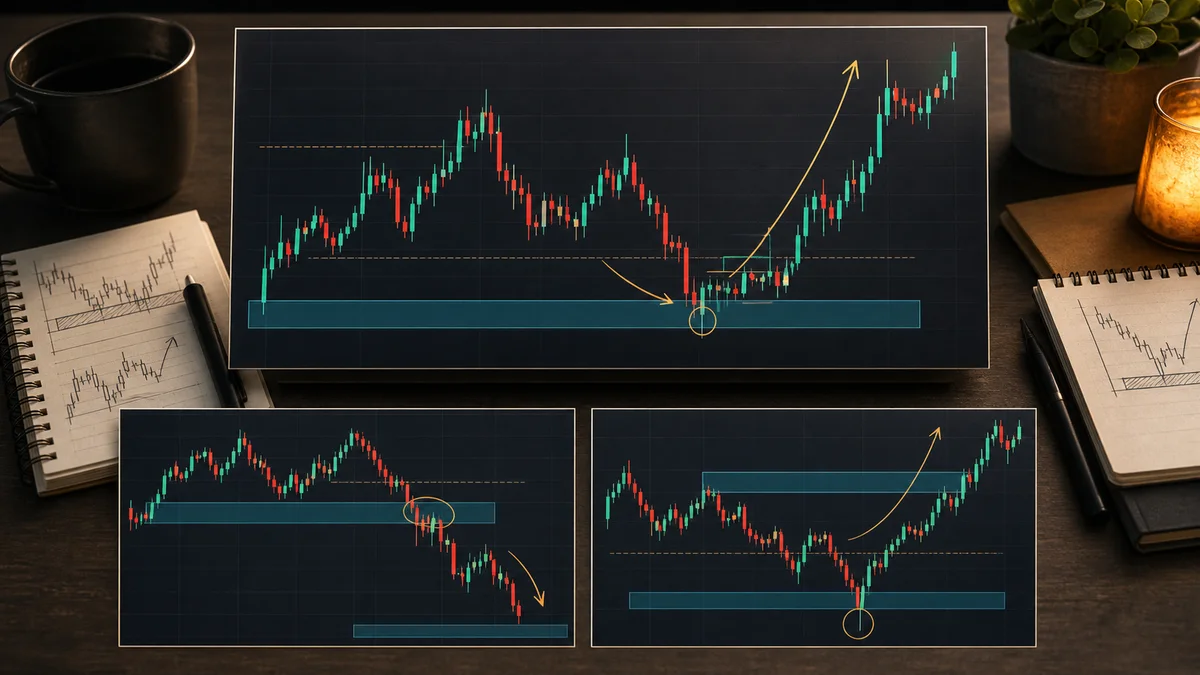
Example one: price is in an uptrend on the four-hour chart. It breaks above a previous swing high with strong candles and leaves a clean demand zone near the origin of the move. When price returns to that demand zone, the trader watches the lower timeframe for rejection and a break of minor structure. The demand zone is the POI, but the lower-timeframe reaction is what creates the trade idea.
Example two: price forms equal lows inside a range. It pushes below those lows, sweeps sell-side liquidity, then reclaims the range with a strong bullish candle. The trader marks the fair value gap created by the reclaim move as a POI. If price retraces into that gap and holds, the next target may be buy-side liquidity above the range.
Example three: price breaks through a resistance level, holds above it, and later retests it from the other side. The old resistance becomes a support POI. If the retest holds and the market continues to make higher lows, the trader may look for continuation. If price falls back below the level and accepts inside the old range, the POI has failed.
Example four: price returns to a bearish order block after a strong selloff. Many beginners short immediately because the zone looks clean. However, price does not reject. It consolidates inside the POI and then closes strongly above it. In this case, the POI failure gives useful information. It may mean sellers are not defending the area and price can move toward the next buy-side liquidity pool.
Example five: a trader marks three POIs on a five-minute chart without checking the higher timeframe. Price reacts briefly from the first zone, breaks the second, and reverses at the third. The trader feels confused because every zone seemed valid. The real problem is not the chart. The problem is that the trader marked too many small areas without context. A higher-timeframe plan would have filtered the noise.
Related Guides and Next Learning Path
Point of Interest belongs naturally inside the Smart Money hub. Smart Money traders use POIs to organize liquidity, structure, displacement, order blocks, fair value gaps, premium-discount context, and risk. If you are building a topical cluster, this POI pillar should become the parent guide that future articles link back to.
The next guide to study is the Smart Money Concepts complete trading guide. It explains the broader framework that gives POIs context. After that, review Liquidity in Trading, because many POIs become stronger after a sweep, stop run, or clear move into resting orders.
You should also study Market Structure. A POI only matters if it fits the current structure. A bullish POI in an uptrend, a bullish POI inside a range, and a bullish POI directly under higher-timeframe resistance are not the same trade.
The ICT Trading complete beginner guide can help traders who want a more model-based approach. ICT concepts often combine liquidity sweeps, market structure shifts, fair value gaps, order blocks, session timing, and opposing liquidity targets. POI selection is one part of that larger sequence.
Future POI cluster guides can go deeper into order block POIs, fair value gap POIs, supply and demand POIs, liquidity sweep into POI, and how to validate a point of interest. Each cluster should link back to this pillar so the POI category develops a clear internal structure.
For beginners, the best practice is simple: start with higher-timeframe context, mark only the clearest liquidity and structure, choose one or two POIs, wait for reaction, define invalidation, and journal the result. A point of interest is useful because it gives your attention a location. It becomes powerful only when it is combined with evidence, risk control, and patience.
A fair value gap can be evaluated as one type of reaction area; the fair value gap validation guide explains how to distinguish the three-candle definition from an entry signal.
Key takeaways
- A point of interest (POI) is a predefined chart area where a trader plans to observe price for evidence, not an automatic entry zone.
- The label may refer to support, resistance, an order block or an imbalance, so its construction rule must be documented.
- Select the location on the context chart, wait for a separate trigger and place invalidation beyond the structure that disproves the idea.
- A valid plan separates location, trigger, invalidation, position size and exit logic.
A validation workflow you can reproduce
- Define the sample: choose the market, timeframe, session and date range before reviewing outcomes.
- Write the rule: Select the location on the context chart, wait for a separate trigger and place invalidation beyond the structure that disproves the idea.
- Record invalidation: identify the observable price event that disproves the setup.
- Include execution costs: account for spread, commission and slippage where relevant.
- Validate separately: test the finished rule on data that was not used to create it.
When this concept is unreliable
A POI is unreliable when it is widened, moved or renamed after price fails to react as expected. Keep failed and skipped examples in the journal so the review is not limited to attractive winners.
Use this concept within a complete analysis
This method should remain connected to its parent framework and adjacent decision steps. Use Order Block Trading: How to Find High-Probability POIs and Buy-Side Liquidity and Sell-Side Liquidity Explained to compare definitions, establish context and avoid treating one signal as a complete trading system.
References and methodology
Terminology note: SMC, ICT and MSNR terms are practitioner conventions, not standardized exchange or regulatory definitions. This article defines the convention it uses and avoids inferring participant identity from candles alone.
Practise before considering real capital
Use historical charts or a demo account to test the written rules before considering live execution. Review the Exness account and demo information. Availability, protections and trading conditions depend on jurisdiction, so review the applicable legal documents yourself.
Affiliate disclosure: Học Làm Trader may receive a commission if you open an account through this link, at no additional cost to you. This relationship does not determine the educational conclusions.
Risk warning: This article is for education and general information only. It is not investment advice, a trade signal or an invitation to trade. Trading can result in loss of capital, and past examples do not guarantee future results. Assess your own circumstances and risk tolerance.
Related guides in this topic
- Breaker Block Trading Guide
- Order Block Trading: How to Find well-defined POIs