


chart patterns Chart patterns organize repeated price structures such as triangles, flags, ranges, double tops and head-and-shoulders formations. Their boundaries and targets involve judgement, so a pattern should be defined before the breakout rather than named after the result. The method should be treated as a testable chart-reading framework rather than a forecast. Before using it, define the market condition, confirmation event, invalidation price, transaction costs and maximum risk. This guide explains the rules, a repeatable workflow, common failure modes and the most relevant supporting concepts.
Definition: What Are Chart Patterns?

Chart patterns are recognizable formations created by price movement over time. They usually form when buyers and sellers repeatedly defend or attack certain areas. A pattern can be simple, such as a double top, or more complex, such as a harmonic Gartley pattern. In every case, the pattern is a visual summary of supply, demand, momentum, and market psychology.
For example, a triangle pattern forms when price contracts between converging trendlines. This can show uncertainty, balance, or compression before expansion. A head and shoulders pattern forms when price creates a peak, a higher peak, and then a weaker peak around a neckline area. This can suggest that bullish pressure is fading, but the pattern is not confirmed until price reacts through the neckline with context.
Chart patterns are often divided into continuation, reversal, bilateral, and harmonic patterns. Continuation patterns suggest that an existing trend may resume after a pause. Reversal patterns suggest that the previous direction may weaken or change. Bilateral patterns can break either way. Harmonic patterns use measured swings and ratios to define possible reaction zones.
A chart pattern is different from a single candlestick pattern. A candlestick pattern may form in one to three candles. A chart pattern usually requires a broader structure with several swings. That broader structure can reveal more information about market rhythm, failed attempts, compression, and liquidity placement.
The biggest beginner mistake is treating pattern names as signals. A triangle is not automatically bullish. A double top is not automatically bearish. A bullish flag is not valid just because price pauses after a rally. The pattern only matters when it fits the trend, location, volatility, timeframe, and risk plan.
A useful chart pattern should answer three questions. What behavior created the structure? Where would the pattern be confirmed? Where would the pattern be invalidated? If you cannot answer those questions, you may be looking at a shape rather than a tradeable pattern.
Pattern quality also depends on clarity. A strong pattern does not need a trader to over-explain it. The swings are visible, the levels are reasonable, the risk point is logical, and the market has enough room to move after confirmation. If a pattern only works after changing timeframes many times, ignoring obvious wicks, or drawing several conflicting lines, it may be better to wait for a cleaner structure.
Core Principles of Chart Patterns
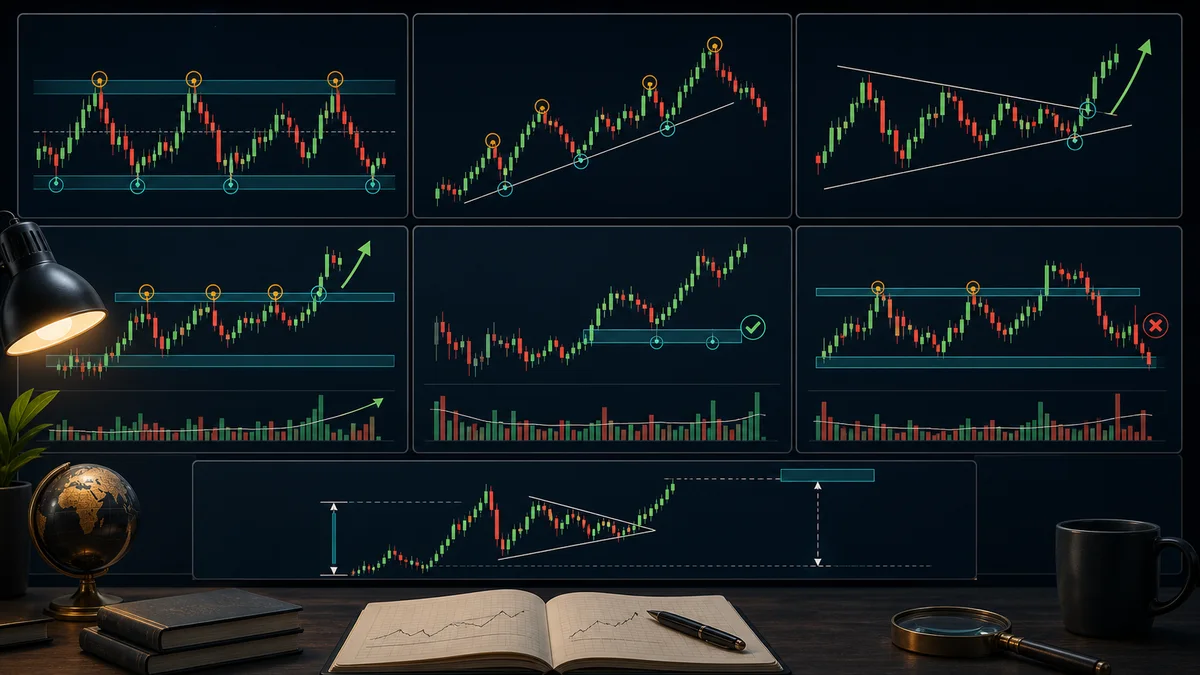
The first principle is context. A pattern that forms with the trend is not the same as a pattern that forms against the trend. A bullish flag after strong displacement has a different meaning from a bullish-looking consolidation directly below major resistance. Always begin with higher-timeframe structure before judging the pattern on the entry chart.
The second principle is location. Patterns near meaningful levels are usually more useful than patterns in the middle of nowhere. A double bottom near higher-timeframe support can matter. A double bottom inside a noisy range may be weak. A wedge into a liquidity pool can create a different trade idea from a wedge in the middle of a trend.
The third principle is clean swing structure. A pattern needs visible swing highs and swing lows. If you must force the trendlines, resize the chart excessively, or ignore several messy candles to make the shape fit, the pattern may not be clear enough. Good patterns are usually easy to explain visually.
The fourth principle is confirmation. Many patterns are not confirmed until price breaks a key level, rejects a retest, shifts structure, or shows displacement. Entering too early can turn a good pattern idea into a poor trade. Confirmation helps separate a developing pattern from a completed pattern.
The fifth principle is invalidation. Every pattern should have a point where the trade idea is wrong. For a breakout pattern, invalidation may be a failed retest and close back inside the range. For a reversal pattern, invalidation may be acceptance beyond the pattern extreme. For a harmonic pattern, invalidation may be price moving beyond the projected reaction zone.
The sixth principle is target logic. Many traders use measured moves, previous structure, opposing liquidity, or nearby support and resistance to estimate targets. A measured move can be helpful, but it should not be treated as a promise. If the target sits beyond a major opposing level, the trader should adjust expectations.
The seventh principle is volume and volatility. In markets where volume data is meaningful, expansion on a breakout can support the idea that participation increased. In forex, tick volume and volatility can still provide clues. A breakout with no follow-through may be weaker than a breakout with strong candles and clean acceptance.
The eighth principle is patience. Many chart patterns spend most of their life incomplete. Traders often lose money by entering while the structure is still forming, then watching price redraw the pattern in another direction. It is usually better to miss the first candle and trade a confirmed plan than to enter early just because the shape looks promising.
Key Chart Pattern Models
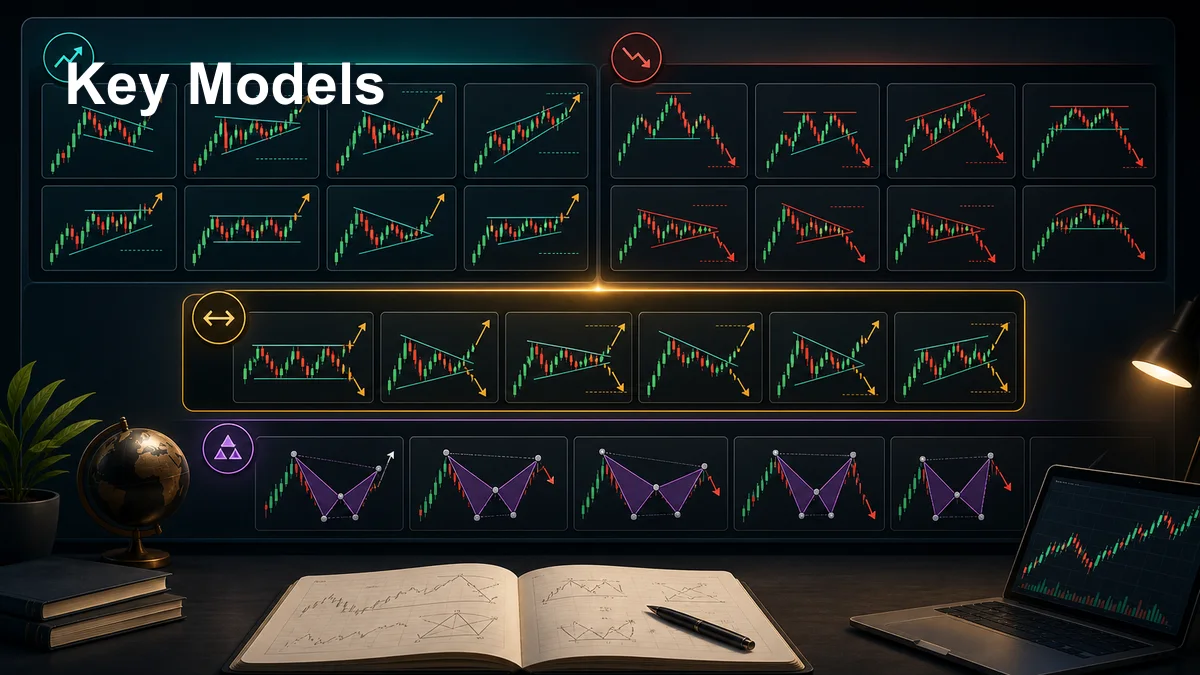
The first family is continuation patterns. These include flags, pennants, rectangles, and some triangle structures. They often appear after a strong move, then price pauses or compresses before attempting to continue. A good continuation pattern should show momentum before the pause and a logical reason for the trend to resume.
The second family is reversal patterns. These include double tops, double bottoms, head and shoulders, inverse head and shoulders, rounding tops, and rounding bottoms. Reversal patterns are popular because they can catch turning points, but they require caution. A reversal pattern against a powerful trend can fail quickly if the broader market still supports continuation.
The third family is bilateral patterns. Symmetrical triangles and some broadening formations can break either direction. These patterns are better treated as compression zones rather than directional predictions. Traders can mark the range, wait for expansion, and then evaluate whether the breakout has acceptance or is only a liquidity sweep.
The fourth family is breakout-retest patterns. A rectangle breakout, triangle breakout, or neckline break often becomes more tradeable after price retests the broken area. The retest can offer cleaner invalidation than chasing the first breakout candle. However, not every breakout returns for a retest, and not every retest holds.
The fifth family is harmonic patterns. Harmonic patterns such as Gartley, Bat, Butterfly, Crab, and Cypher models use measured legs and ratio relationships. They are more rule-based than many classic patterns. The goal is not just to see a shape, but to define a potential reversal zone where the measured structure becomes interesting.
The sixth family is failed patterns. A failed head and shoulders, failed triangle breakout, or failed double top can create strong movement in the opposite direction because trapped traders must exit. Failure is not just a problem to avoid. It can also become information. If a bearish pattern fails strongly, the market may be revealing bullish strength.
The seventh family is hybrid patterns. Real charts often combine ideas. A wedge may form inside a larger flag. A harmonic completion may happen near a double bottom. A triangle may break after sweeping liquidity below a range. The best traders do not memorize isolated shapes only; they connect pattern structure with context.
How to Identify Chart Patterns on a Chart
Start with the timeframe. A pattern on the daily chart usually carries more weight than a pattern on the one-minute chart. Lower-timeframe patterns can still be useful, especially for intraday traders, but they are more vulnerable to noise. Choose the timeframe that matches your strategy and then check the higher timeframe for context.
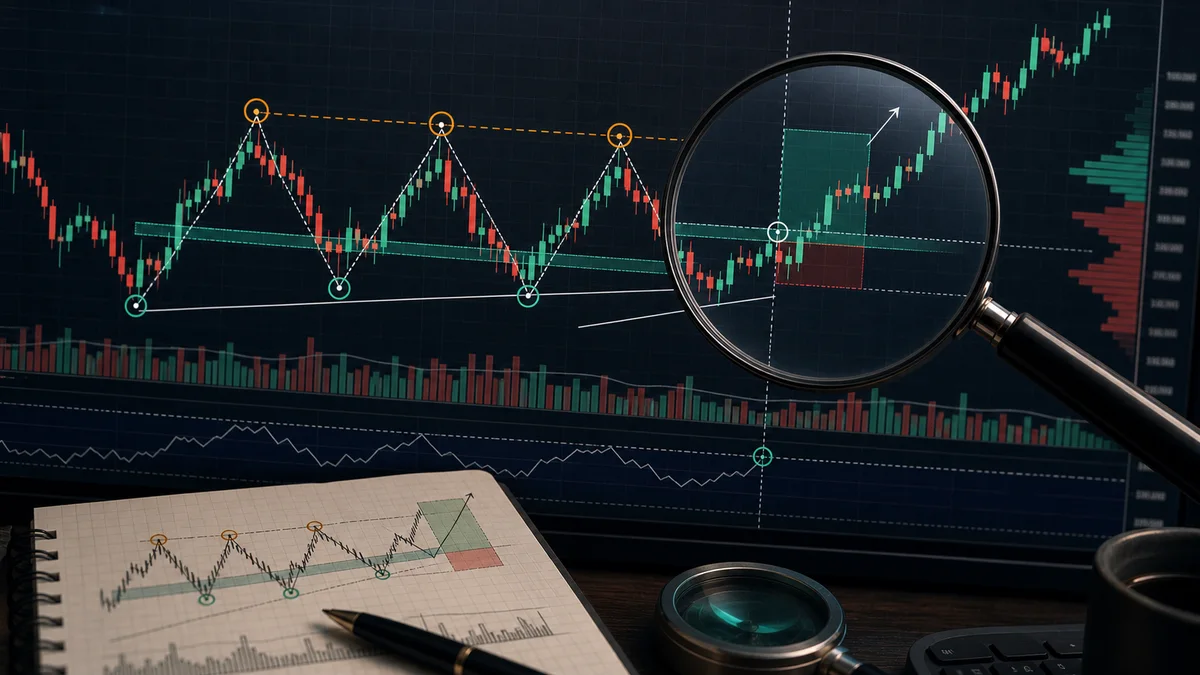
Next, mark the major swing highs and swing lows. Do not draw pattern lines first. Identify the actual turning points that price respected. These swings reveal whether price is trending, ranging, compressing, expanding, or failing to continue. Once the swing structure is clear, the pattern shape becomes easier to see.
Then mark important horizontal levels. Many patterns depend on support, resistance, necklines, range highs, range lows, or prior reaction zones. Trendlines are useful, but horizontal levels often define the real decision point. A head and shoulders pattern, for example, is not useful without a neckline area that price can confirm or reject.
After that, draw trendlines conservatively. A valid trendline should connect meaningful swings without cutting through too much price action. If a line only works when you ignore obvious candles, the pattern is probably forced. Trendlines are guides, not magic barriers.
Next, look for compression or failure. Triangles and wedges often show compression as each swing becomes smaller. Reversal patterns often show failure, such as a higher high that cannot continue or a lower low that quickly reclaims. The behavior behind the pattern is more important than the name.
Finally, wait for confirmation and plan invalidation. A pattern becomes actionable only when price gives evidence. That evidence might be a breakout, retest, displacement candle, volume expansion, lower-timeframe structure shift, or rejection from a harmonic zone. If the confirmation is unclear, the best decision may be no trade.
A Practical Chart Pattern Trading Workflow

A workflow prevents chart pattern trading from becoming shape hunting. Step one is to define the market environment. Is the market trending, ranging, reversing, or consolidating before news? A continuation pattern works best when the trend has room to continue. A reversal pattern needs a meaningful reason for the previous move to weaken.
Step two is to choose the pattern candidate. Mark only the clearest structures. Beginners often draw ten patterns on one chart and then wonder why the plan feels confusing. A clean chart may have one primary pattern and one backup scenario. If everything is a pattern, nothing is useful.
Step three is to define the confirmation trigger. For a triangle, it may be a breakout and retest. For a double top, it may be a break below the neckline. For a flag, it may be continuation above the flag boundary. For a harmonic pattern, it may be rejection from the potential reversal zone plus a lower-timeframe shift.
Step four is to define invalidation before entry. This is where many traders fail. They identify a pattern, enter, and then decide later where they are wrong. That is backwards. The invalidation point should be clear before the trade. If invalidation is too far away, the setup may not offer acceptable risk.
Step five is to choose a realistic target. Use measured moves, previous highs and lows, support and resistance, liquidity pools, or higher-timeframe levels. Avoid targets that require price to pass through several strong opposing zones without reaction. A target should fit market structure, not just pattern theory.
Step six is to manage execution quality. Check spread, session timing, news, and volatility. A clean breakout during a liquid session may behave differently from the same breakout during a thin period. A pattern before major news may be invalidated by volatility that has nothing to do with the structure itself.
Step seven is to journal the result. Save screenshots before entry, after confirmation, and after exit. Record whether the pattern was clear, whether the confirmation followed your plan, whether invalidation was respected, and whether the target was realistic. Over time, your journal will show which patterns you trade well and which ones you only like in hindsight.
Chart Pattern Examples

Example one: price is in an uptrend and then forms a tight flag after a strong impulse. The flag slopes slightly against the trend, volume or volatility cools, and price holds above a higher-timeframe support area. A breakout above the flag with strong follow-through may create a continuation idea. The trader can use the flag low or failed retest area as invalidation, depending on the entry model.
Example two: price forms a double top near resistance. Many beginners short the second touch immediately. A more disciplined trader waits to see whether price breaks the neckline. If price rejects resistance but never breaks the neckline, the pattern remains unconfirmed. If price breaks the neckline and retests it from below, the setup becomes cleaner.
Example three: a head and shoulders appears after a long rally, but the neckline break fails. Price quickly reclaims the neckline and pushes above the right shoulder. This failed bearish pattern can become bullish information. Traders who entered short are trapped, and their exits can add fuel to the opposite move.
Example four: a symmetrical triangle forms inside a higher-timeframe range. Price breaks upward, but the breakout runs directly into a major resistance level. The measured move looks attractive, but location is poor. A trader who respects context may take partial profit early, skip the trade, or wait for acceptance above resistance.
Example five: a harmonic pattern completes near a prior demand zone. Price enters the projected reversal area, sweeps the previous low, and then reclaims the zone with displacement. The harmonic model provides the area, but the reaction provides evidence. Without reaction, the ratio completion is only a warning zone, not an entry.
Example six: a trader sees a triangle on a five-minute chart but ignores a major economic release scheduled in ten minutes. The pattern breaks perfectly, then reverses violently when news hits. The lesson is simple: chart patterns do not cancel news risk. A technical setup still needs execution awareness.
Related Guides and Next Learning Path

Chart Patterns belongs inside the THEORIES hub because patterns are part of the broader technical analysis framework traders use to organize price behavior. This article should become the parent guide for future clusters in Chart & Harmonic Patterns.
The first related guide to study is Trading Theories: Complete Guide to Technical Analysis Frameworks. It explains how chart patterns fit beside Dow Theory, Elliott Wave, Wyckoff, Gann, price action, and other frameworks. That broader context prevents traders from treating pattern names as isolated signals.
Next, study Candlestick Patterns. Candlesticks help you read the reaction inside a larger chart pattern. A breakout candle, rejection wick, engulfing candle, or indecision candle can add useful information when price reaches a neckline, trendline, or harmonic reaction zone.
You should also review Market Structure and Price Action Trading. Pattern analysis becomes much stronger when you understand trend direction, swing points, ranges, support, resistance, and failed continuation.
Future Chart & Harmonic Patterns cluster articles can go deeper into triangle patterns, head and shoulders patterns, double top and double bottom patterns, flag and pennant patterns, wedge patterns, harmonic patterns, and failed chart patterns. Each cluster should link back to this pillar so the category builds a clear internal map.
For beginners, the practical path is simple: learn the main pattern families, practice drawing clean swings and levels, study confirmation and failure, define invalidation before entry, and journal every setup. Chart patterns are useful because they organize price structure. They become dangerous only when traders treat them as guaranteed signals instead of conditional trade ideas.
Key takeaways
- Chart patterns organize repeated price structures such as triangles, flags, ranges, double tops and head-and-shoulders formations.
- Their boundaries and targets involve judgement, so a pattern should be defined before the breakout rather than named after the result.
- Record the boundary, confirmation rule, invalidation and target method before entering or backtesting the setup.
- A valid plan separates location, trigger, invalidation, position size and exit logic.
A validation workflow you can reproduce
- Define the sample: choose the market, timeframe, session and date range before reviewing outcomes.
- Write the rule: Record the boundary, confirmation rule, invalidation and target method before entering or backtesting the setup.
- Record invalidation: identify the observable price event that disproves the setup.
- Include execution costs: account for spread, commission and slippage where relevant.
- Validate separately: test the finished rule on data that was not used to create it.
When this concept is unreliable
Pattern analysis becomes unreliable when diagonal lines are repeatedly adjusted or incomplete structures are forced into familiar shapes. Keep failed and skipped examples in the journal so the review is not limited to attractive winners.
Use this concept within a complete analysis
This method should remain connected to its parent framework and adjacent decision steps. Use Bullish Candlestick Patterns Every Trader Should Know, How to Read Candlesticks in Forex and Crypto and Multi-Timeframe Analysis: Complete Guide to compare definitions, establish context and avoid treating one signal as a complete trading system.
References and methodology
- CME Group — Technical Analysis
- CFTC — Eight Things to Know Before Trading Forex
- CME Group — Chart Types: Candlestick, Line and Bar
- CME Group — Technical Patterns: Reversals
Practise before considering real capital
Use historical charts or a demo account to test the written rules before considering live execution. Review the Exness account and demo information. Availability, protections and trading conditions depend on jurisdiction, so review the applicable legal documents yourself.
Affiliate disclosure: Học Làm Trader may receive a commission if you open an account through this link, at no additional cost to you. This relationship does not determine the educational conclusions.
Risk warning: This article is for education and general information only. It is not investment advice, a trade signal or an invitation to trade. Trading can result in loss of capital, and past examples do not guarantee future results. Assess your own circumstances and risk tolerance.