


chart patterns cheat sheet A chart-pattern cheat sheet is a reference for identifying recurring structures, not a substitute for context or a tested trading plan. Continuation and reversal labels describe the usual hypothesis, while any individual pattern can fail or resolve in the opposite direction. The method should be treated as a testable chart-reading framework rather than a forecast. Before using it, define the market condition, confirmation event, invalidation price, transaction costs and maximum risk. This guide explains the rules, a repeatable workflow, common failure modes and the most relevant supporting concepts.
Definition

Classic chart patterns are recognizable shapes created by swing highs, swing lows, trendlines, support, resistance, and consolidation. They are not magic formations. They are a visual way to describe how buyers and sellers interact over time.
Continuation patterns include flags, pennants, rectangles, and some triangles. They suggest price may continue in the direction of the prior move if the breakout confirms. Reversal patterns include double tops, double bottoms, head and shoulders, inverse head and shoulders, and some wedges. They suggest the prior direction may be weakening.
The cheat sheet idea is useful because it groups patterns by behavior: compression, breakout, retest, failure, and target planning. A trader who understands behavior will usually do better than a trader who only memorizes shapes.
A simple way to group the cheat sheet is this: flags and pennants often describe continuation after momentum; rectangles and triangles often describe consolidation and breakout pressure; double tops and double bottoms often describe failed continuation; head and shoulders patterns often describe a transition from trend to reversal. These are tendencies, not guarantees.
How to Identify

Start with the market context. Is price trending, ranging, or transitioning? A bull flag has more meaning after a strong bullish move. A double top matters more near resistance after buyers have failed twice. A triangle in the middle of random chop may be less useful than a triangle forming after a clear trend.
Next, mark the boundaries. For a triangle, draw the converging trendlines. For a rectangle, mark the range high and low. For head and shoulders, mark the neckline. For a flag, identify the impulse move and the corrective channel. If the boundaries are unclear, the pattern may not be worth trading.
Finally, check whether the pattern has enough space. A breakout directly into a major higher-timeframe level may have poor room. A pattern with no clear invalidation point is also weak because risk cannot be defined cleanly.
Do not name the pattern too early. Many traders see one shoulder, one triangle line, or one retest and immediately decide what the chart “must” be. Let the structure finish building first. A good pattern should become easier to see over time, not require imagination.
Why It Works

Chart patterns work because they show repeated pressure around visible areas. A triangle shows price compressing between buyers and sellers. A rectangle shows repeated rejection from similar highs and lows. A double top shows buyers failing twice near the same area. A flag shows a pause after an impulse move.
These structures can attract orders. Breakout traders may enter when price leaves the pattern. Traders on the wrong side may exit when the boundary breaks. Retest traders may wait for old resistance to become support, or old support to become resistance. This order flow can create continuation or reversal, but only when the breakout is accepted.
The key word is “accepted.” A wick through a pattern boundary is not enough. Many false breakouts happen because traders enter too early. A close beyond the boundary, a retest, or a strong displacement move gives better evidence that the pattern has changed behavior.
This is why classic patterns work better with market structure. A bullish breakout from an ascending triangle is more meaningful when the higher timeframe is also bullish or when price is leaving a clear accumulation range. A bearish head and shoulders is stronger when it forms after an extended trend and breaks a meaningful neckline.
Step-by-Step Usage

- Define context. Decide whether the market is trending, ranging, or near a major level.
- Mark the structure. Draw only the clean boundaries that price has respected.
- Name the pattern last. Do not force a label before the swings are clear.
- Wait for confirmation. Look for a close beyond the boundary, displacement, or a retest.
- Set invalidation. A trade needs a clear point where the pattern idea is wrong.
- Plan the target. Use nearby liquidity, support/resistance, or measured-move logic only when there is enough room.
- Review the outcome. Save screenshots of clean wins, failed patterns, and skipped setups.
This workflow prevents the most common pattern mistake: seeing a shape first and building a trade around it afterward. Context and boundaries should come before the label.
For journaling, keep screenshots of both clean and failed versions. Over time, you may find that one pattern fits your market better than others. Some traders read rectangles well but force wedges. Others understand flags but enter reversal patterns too early. The journal turns the cheat sheet into personal feedback.
Confirmation Rules

- Clean boundary: the pattern should have levels or trendlines that price clearly respected.
- Breakout acceptance: a close beyond the boundary is stronger than a wick.
- Retest quality: a retest that holds can improve risk placement.
- Invalidation: the stop should sit where the pattern thesis fails, not at a random distance.
- Room to target: avoid patterns that break directly into nearby support or resistance.
- Market condition: patterns are cleaner when volatility and spread conditions are reasonable.
Confirmation does not make a setup safe. It only filters out weaker pattern reads. A valid-looking pattern can still fail, so risk management remains central.
If confirmation appears too late, skip the trade. Many beginners feel forced to enter because they identified the pattern correctly. But a correct read with poor entry location can still be a bad trade. The chart must offer both confirmation and acceptable risk.
Examples
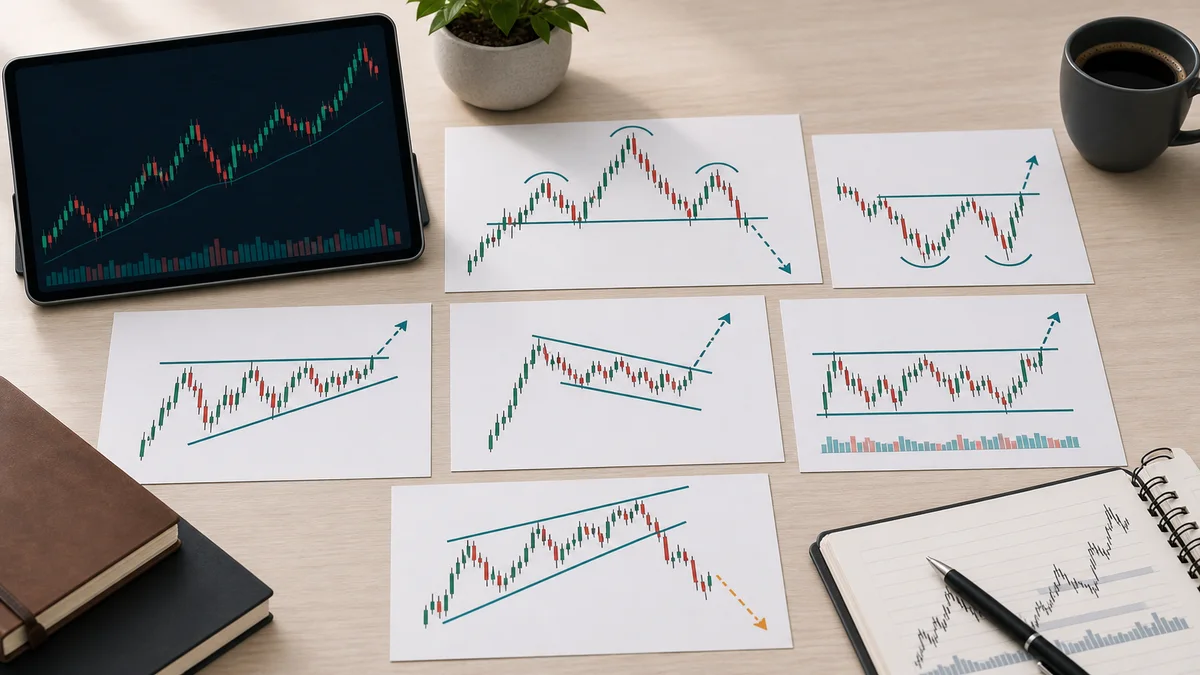
A bullish flag forms after a strong upward impulse. Price then pulls back in a controlled channel. A breakout above the flag boundary may support continuation if the higher timeframe gives room.
A double bottom forms when price tests a support area twice and fails to break lower. The pattern becomes more useful if price then breaks above the middle reaction high and holds on a retest.
A head and shoulders pattern shows a left shoulder, higher head, right shoulder, and neckline. It is not complete just because the shape appears. Traders usually wait for the neckline to break and hold below before treating it as a stronger bearish signal.
An ascending triangle shows rising lows pressing into a similar resistance area. It can signal bullish pressure, but a failed breakout can trap late buyers. The reaction after the boundary break matters more than the name of the pattern.
A rectangle breakout is another common example. Price moves between similar highs and lows, building a clear range. If price breaks above the range and holds on a retest, continuation may be reasonable. If price breaks out and quickly returns inside, the pattern may become a failed breakout instead.
Common Mistakes
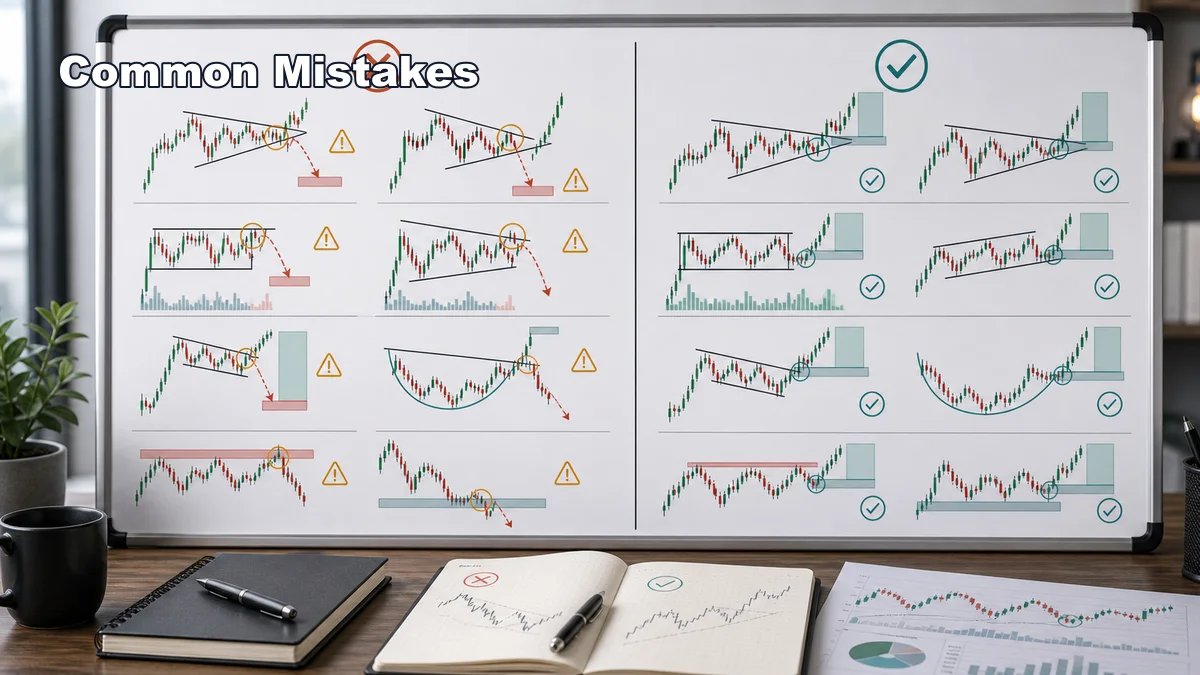
- Forcing patterns: if the boundaries are not obvious, the pattern is probably not clean.
- Entering before confirmation: many patterns fail before breaking the boundary.
- Ignoring context: a bullish pattern under major resistance may have limited room.
- Using measured moves blindly: targets should respect nearby levels and liquidity.
- Placing stops too tight: stops inside noisy structure can get hit before the real move.
- Memorizing names only: pattern behavior matters more than perfect textbook shape.
Classic chart patterns are useful when they simplify the chart. They become harmful when traders use them to justify every trade. Use this cheat sheet as a starting point, then connect it back to the THEORIES hub and the Chart & Harmonic Patterns category as the topic cluster grows.
The best use of a classic chart patterns cheat sheet is review, not prediction. Before a trade, it helps you identify boundaries and plan confirmation. After a trade, it helps you decide whether the pattern was actually clean or whether you forced the chart to match a textbook drawing.
Key takeaways
- A chart-pattern cheat sheet is a reference for identifying recurring structures, not a substitute for context or a tested trading plan.
- Continuation and reversal labels describe the usual hypothesis, while any individual pattern can fail or resolve in the opposite direction.
- Use the sheet to check boundaries and confirmation, then document invalidation before considering a trade.
- A valid plan separates location, trigger, invalidation, position size and exit logic.
A validation workflow you can reproduce
- Define the sample: choose the market, timeframe, session and date range before reviewing outcomes.
- Write the rule: Use the sheet to check boundaries and confirmation, then document invalidation before considering a trade.
- Record invalidation: identify the observable price event that disproves the setup.
- Include execution costs: account for spread, commission and slippage where relevant.
- Validate separately: test the finished rule on data that was not used to create it.
When this concept is unreliable
The reference becomes unreliable when simplified drawings are treated as exact templates and ambiguous real charts are forced to match them. Keep failed and skipped examples in the journal so the review is not limited to attractive winners.
Use this concept within a complete analysis
This method should remain connected to its parent framework and adjacent decision steps. Use Candlestick Patterns: Complete Guide for Traders, Chart Patterns: Complete Guide for Traders, Price Action Trading: Structure, Setups and Risk, How to Read Candlesticks in Forex and Crypto, Bullish Candlestick Patterns Every Trader Should Know and Market Structure: Complete Guide for Traders to compare definitions, establish context and avoid treating one signal as a complete trading system.
References and methodology
- CME Group — Technical Analysis
- CFTC — Eight Things to Know Before Trading Forex
- CME Group — Chart Types: Candlestick, Line and Bar
- CME Group — Technical Patterns: Reversals
Practise before considering real capital
Use historical charts or a demo account to test the written rules before considering live execution. Review the XM account and demo information. Availability, protections and trading conditions depend on jurisdiction, so review the applicable legal documents yourself.
Affiliate disclosure: Học Làm Trader may receive a commission if you open an account through this link, at no additional cost to you. This relationship does not determine the educational conclusions.
Risk warning: This article is for education and general information only. It is not investment advice, a trade signal or an invitation to trade. Trading can result in loss of capital, and past examples do not guarantee future results. Assess your own circumstances and risk tolerance.