


Learning how to count Elliott waves correctly is less about predicting every tick and more about organizing market structure. Elliott Wave analysis tries to separate directional movement from corrective movement. In simple terms, traders look for five-wave motive sequences in the direction of the larger trend and three-wave corrective structures against that trend.
The difficulty is that live markets are messy. A wave count can look obvious after the move is finished, but uncertain while price is forming. That is why the goal is not a perfect count. The goal is a disciplined count with clear rules, alternate scenarios, and invalidation. A useful wave count should tell you what price is likely doing, what evidence would support the count, and what price action would make the count wrong.
This guide supports the THEORIES hub and the Elliott Wave category. For the wider technical-analysis framework, read Trading Theories: Complete Guide to Technical Analysis Frameworks. For the previous related guide, study Elliott Wave Theory Simplified.
Nothing in this article is financial advice or a trading signal. Elliott Wave counts can fail, and different analysts can label the same chart differently. The count should support a risk plan, not replace it.
Definition: What Does It Mean to Count Elliott Waves Correctly?
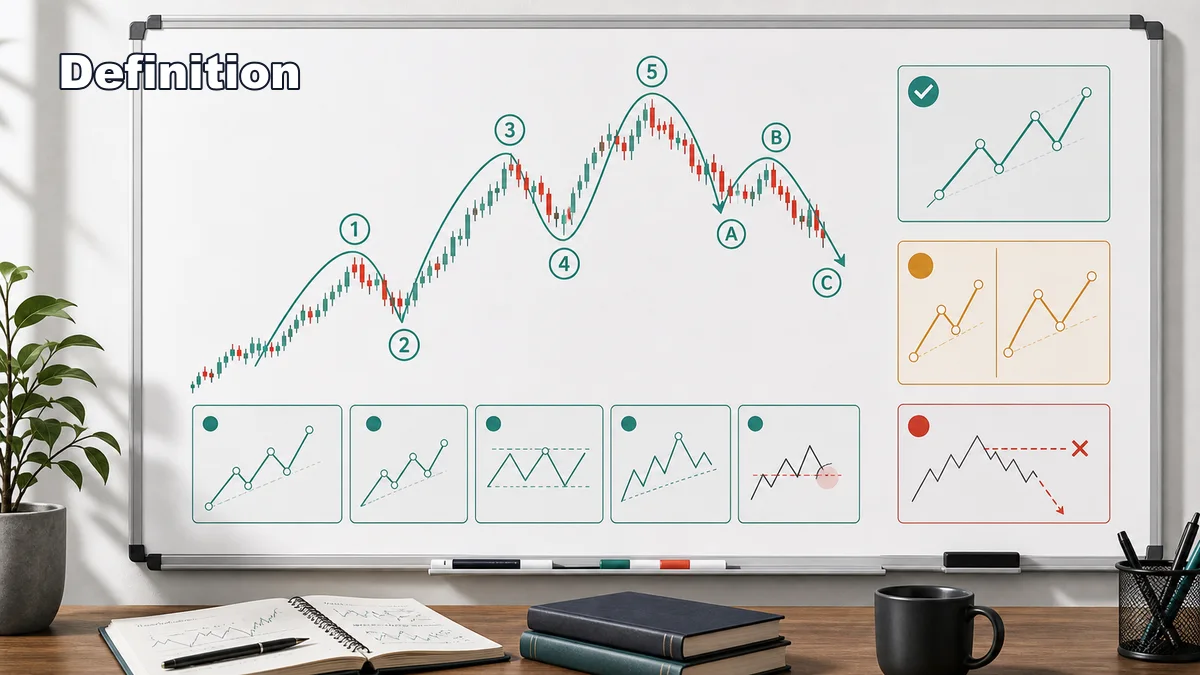
To count Elliott waves correctly means to label price movement in a way that respects the core Elliott Wave structure and the rules of the pattern. A basic bullish cycle has five waves up and three waves down. Waves 1, 3, and 5 move with the trend. Waves 2 and 4 correct part of that trend. After the five-wave sequence, an A-B-C correction often develops against it.
A correct count is not the count that looks pretty on a screenshot. A correct count is one that survives the rules. In a standard impulse, Wave 2 should not retrace beyond the start of Wave 1. Wave 3 should not be the shortest of Waves 1, 3, and 5. Wave 4 should not overlap the price territory of Wave 1 in a normal impulse. If your count breaks a core rule, the count must be revised.
Correct counting also means understanding degree. A small five-wave move can exist inside a larger Wave 1, Wave 3, or Wave 5. A correction on a lower timeframe may be only a tiny part of a larger trend. This fractal nature is useful, but it can also cause confusion if the trader mixes timeframes without a plan.
How to Identify the Current Elliott Wave Count
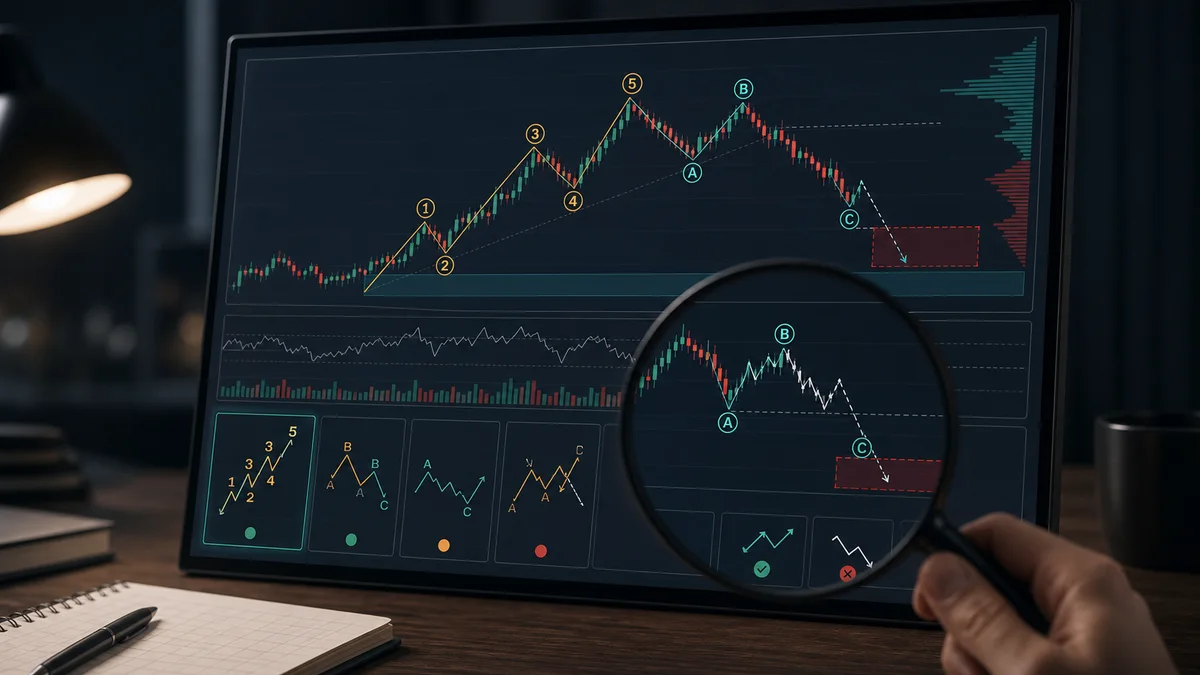
Begin with the higher timeframe. If you are trading a one-hour chart, review the daily and four-hour structure first. Elliott Wave counting becomes much harder when you start from a tiny timeframe and ignore the larger trend. The larger chart tells you whether the market is likely building an impulse, a correction, a range, or a possible reversal.
Next, mark the most obvious swing highs and swing lows. Do not label every small candle. Elliott Wave counting starts with structure, not decoration. Look for directional legs with momentum and corrective pauses with overlap or slower movement. In a bullish sequence, Waves 1, 3, and 5 should generally push upward, while Waves 2 and 4 should correct without destroying the impulse idea.
Then apply the three core impulse rules. If Wave 2 breaks the start of Wave 1, the impulse count is invalid. If Wave 3 is shorter than both Wave 1 and Wave 5, the count is invalid. If Wave 4 overlaps Wave 1 territory in a normal impulse, the count is suspect or invalid depending on the structure. These rules remove many weak counts quickly.
Why Correct Elliott Wave Counting Works
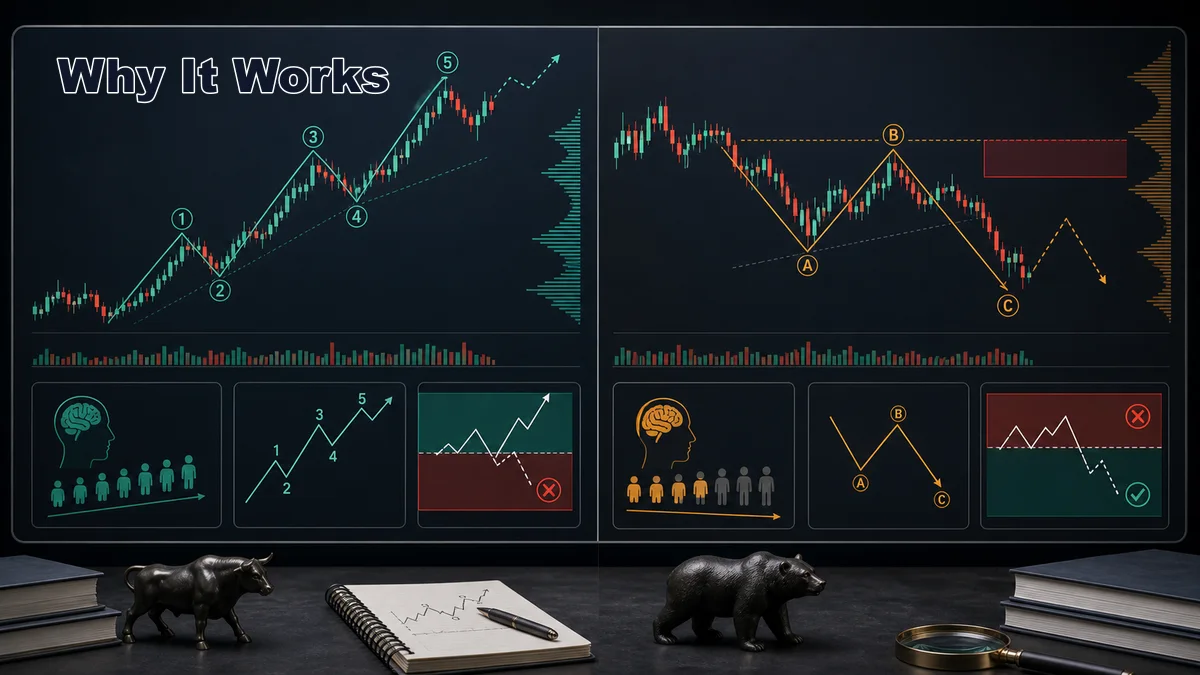
Correct Elliott Wave counting works as a trading framework because markets often alternate between expansion and correction. Strong directional moves attract participation. Pullbacks test whether the trend still has support. Later pushes may show continuation or exhaustion. Elliott Wave gives traders a language for these changes in market psychology.
Elliott Wave also works because it creates objective invalidation when used correctly. If a bullish Wave 2 moves below the start of Wave 1, the bullish impulse count is wrong. If a supposed Wave 4 overlaps too deeply with Wave 1, the trader must reconsider. These invalidation points make the theory more practical than a vague opinion.
Step-by-Step Usage for Counting Elliott Waves
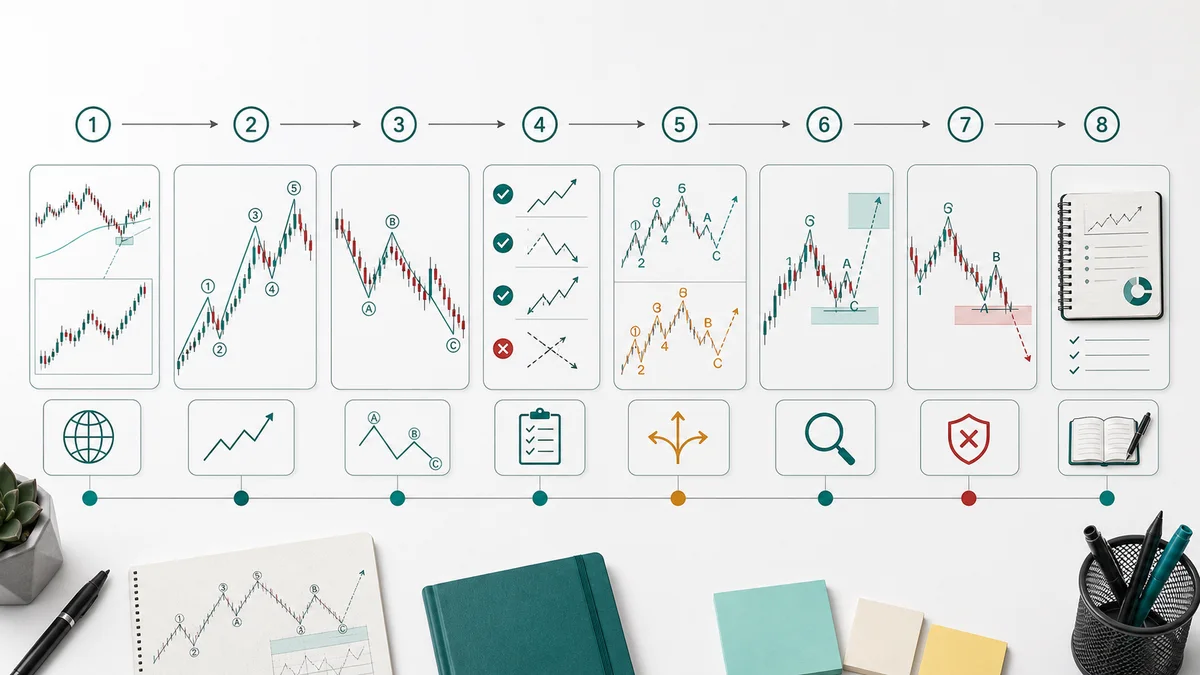
Step one is to define the dominant structure. Is the market trending, ranging, reversing, or correcting? If the higher timeframe is unclear, your lower-timeframe count will probably be fragile. Mark the largest obvious swings first and decide whether the current move looks impulsive or corrective.
Step two is to label a possible motive sequence. In an uptrend, look for Wave 1 up, Wave 2 pullback, Wave 3 expansion, Wave 4 pause, and Wave 5 final push. In a downtrend, invert the logic. Do not force five waves where the chart only shows three. If the movement is overlapping and choppy, it may be corrective rather than impulsive.
Step three is to check the rules. This step is non-negotiable. A count that breaks the impulse rules should be revised, not defended. Write the invalidation level on the chart. For example, if you believe price is in Wave 2, the start of Wave 1 is the major invalidation point for that bullish impulse idea.
Step four is to prepare an alternate count. Elliott Wave is probabilistic. You may have a primary count and one alternate count. If you need five alternate counts to explain the chart, the market may be too unclear. Keep the alternate simple: impulse versus correction, Wave 3 starting versus Wave C still unfolding, or Wave 5 complete versus one more push remaining.
Confirmation Rules for Elliott Wave Counts
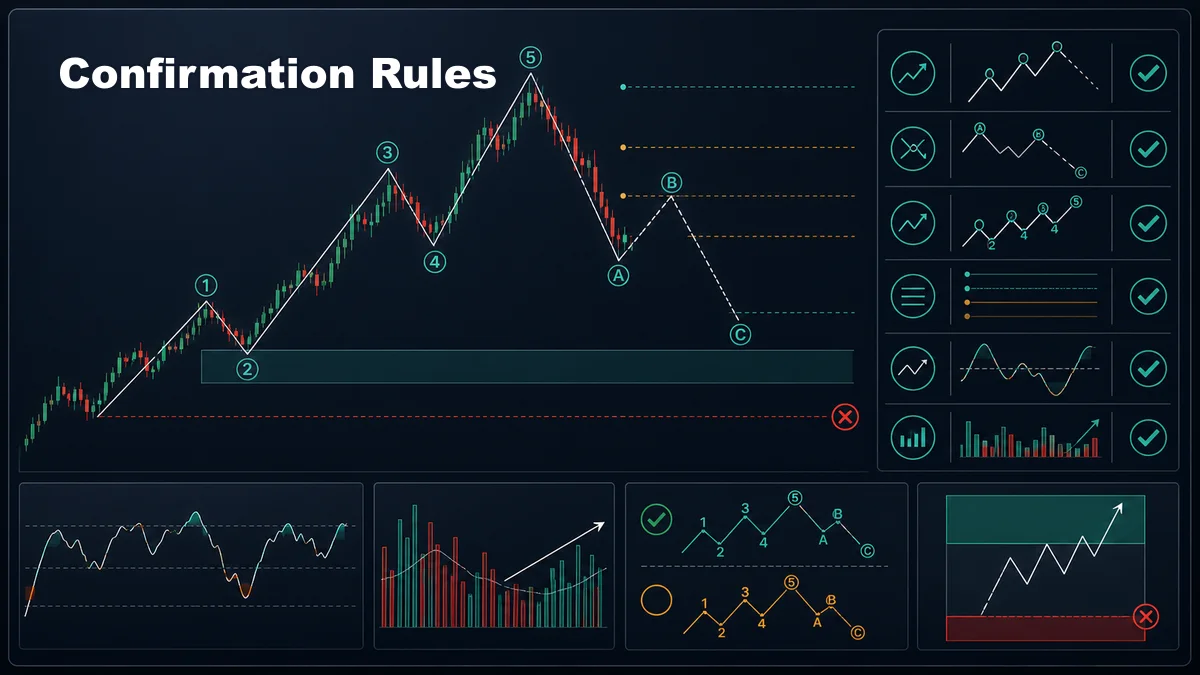
The first confirmation rule is rule compliance. Before looking for trade ideas, confirm that the count does not break the core Elliott Wave rules. This removes many emotional counts. If the rules are broken, change the count or stand aside.
The third rule is momentum. Wave 3 often has strong momentum and clear participation. If your Wave 3 is weak, short, and overlapping, it may not be Wave 3. Wave 5 can sometimes show momentum divergence, which may warn that the impulse is maturing, but divergence alone is not a reversal signal.
The fourth rule is location. Fibonacci retracements can help estimate where Wave 2 or Wave 4 may end, but they should not replace price action. A Wave 2 pullback near a 50% or 61.8% retracement is more useful if price also shows rejection, support, or a structure shift. A Wave 4 area is more useful if it respects the rules and avoids Wave 1 overlap.
Examples of Correct Elliott Wave Counting
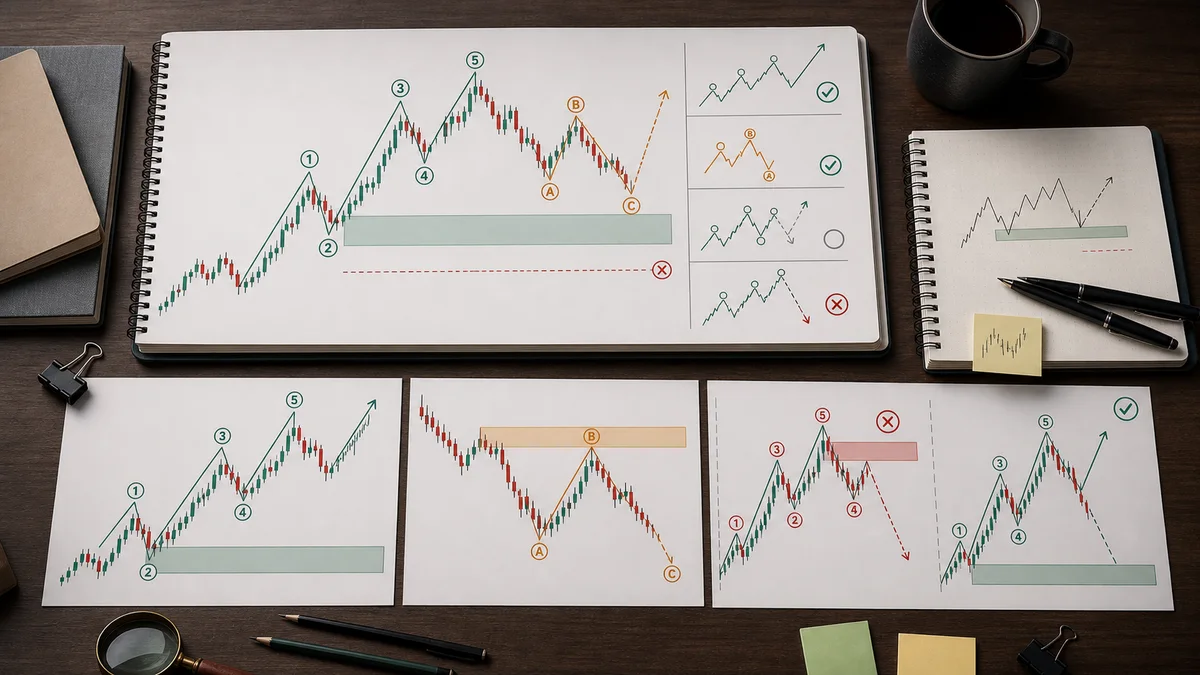
Example one: price breaks out from a base and forms a clear upward leg. It pulls back without breaking the start of the move, then expands strongly higher with the best momentum of the sequence. This can support a bullish Wave 1, Wave 2, and Wave 3 interpretation. The count becomes more credible if Wave 3 is not the shortest and price later forms a Wave 4 that does not overlap Wave 1 territory.
Example two: after five waves up, price begins a three-part decline. Wave A moves down, Wave B retraces part of that decline, and Wave C pushes lower. If the correction holds above a larger support area, the trader may prepare for the next possible impulse. The important point is not to buy only because the labels say A-B-C. The trader still waits for confirmation.
Example three: a trader labels a move as Wave 3, but it is shorter than both Wave 1 and Wave 5. This breaks a core rule. The count is wrong. The correct response is to relabel the structure, consider a different degree, or accept that the chart is not showing a clean impulse.
Common Mistakes When Counting Elliott Waves
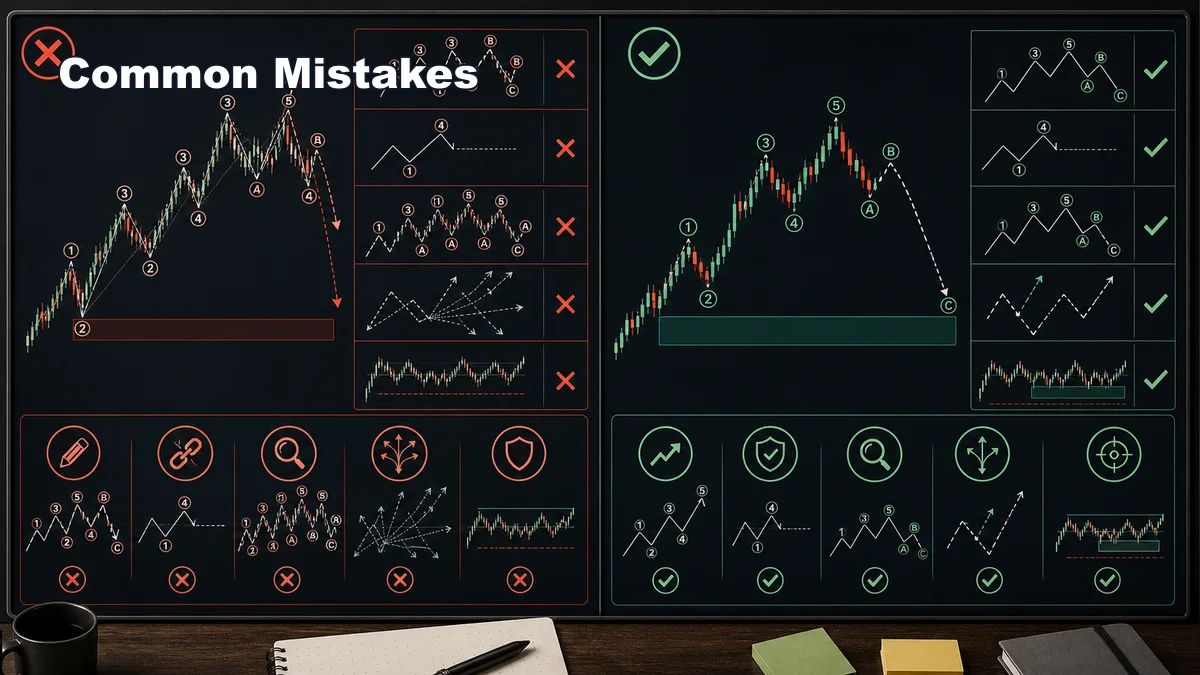
The first mistake is forcing a five-wave count on every move. Not every trend leg is a clean impulse. Many moves are corrective, overlapping, or part of a larger range. If the chart does not fit the rules, do not force it.
The second mistake is counting from the smallest timeframe first. This creates constant relabeling because every small move appears important. Start from the higher timeframe, then move down only when the larger structure is clear.
The third mistake is ignoring invalidation. A trader may keep adjusting labels to avoid admitting the count failed. This turns Elliott Wave from a framework into a bias machine. Write the invalidation level before the trade idea becomes emotional.
The fourth mistake is using too many alternate counts. One primary and one alternate count is usually enough. If you need several alternates, the market is probably unclear. Standing aside is a valid decision.
The fifth mistake is trading the count without confirmation. A label is not an entry. If you expect Wave 3, wait for evidence that momentum is returning. If you expect Wave C to finish, wait for rejection, structure shift, or another confirmation tool. Wave counting should improve context, not replace execution rules.
Read next: Continue with the THEORIES hub, the Elliott Wave category, and Elliott Wave Theory Simplified to place wave counting inside a complete technical-analysis framework.
Frequently Asked Questions
What is the easiest way to count Elliott waves?
Start from the higher timeframe, mark the obvious swings, label only the clearest motive and corrective legs, then apply the three core impulse rules before trusting the count.
Can two Elliott Wave counts both be valid?
Yes. Elliott Wave is probabilistic. A primary count and a simple alternate count can both be reasonable until price confirms one and invalidates the other.
Should beginners use Fibonacci for Elliott Wave counting?
Fibonacci can help estimate correction zones, but beginners should learn structure and rules first. A Fibonacci level is not enough without price action and invalidation.
When a count becomes ambiguous, classify the structure before adding smaller labels. The Elliott corrective-wave checklist separates 5-3-5, 3-3-5 and five-leg corrections, while the Diagonal guide covers five overlapping actionary waves.
Sources and limits
General market-risk and technical-analysis references:
Strategy labels and chart examples are interpretive; they are not standardized signals and do not guarantee outcomes.