


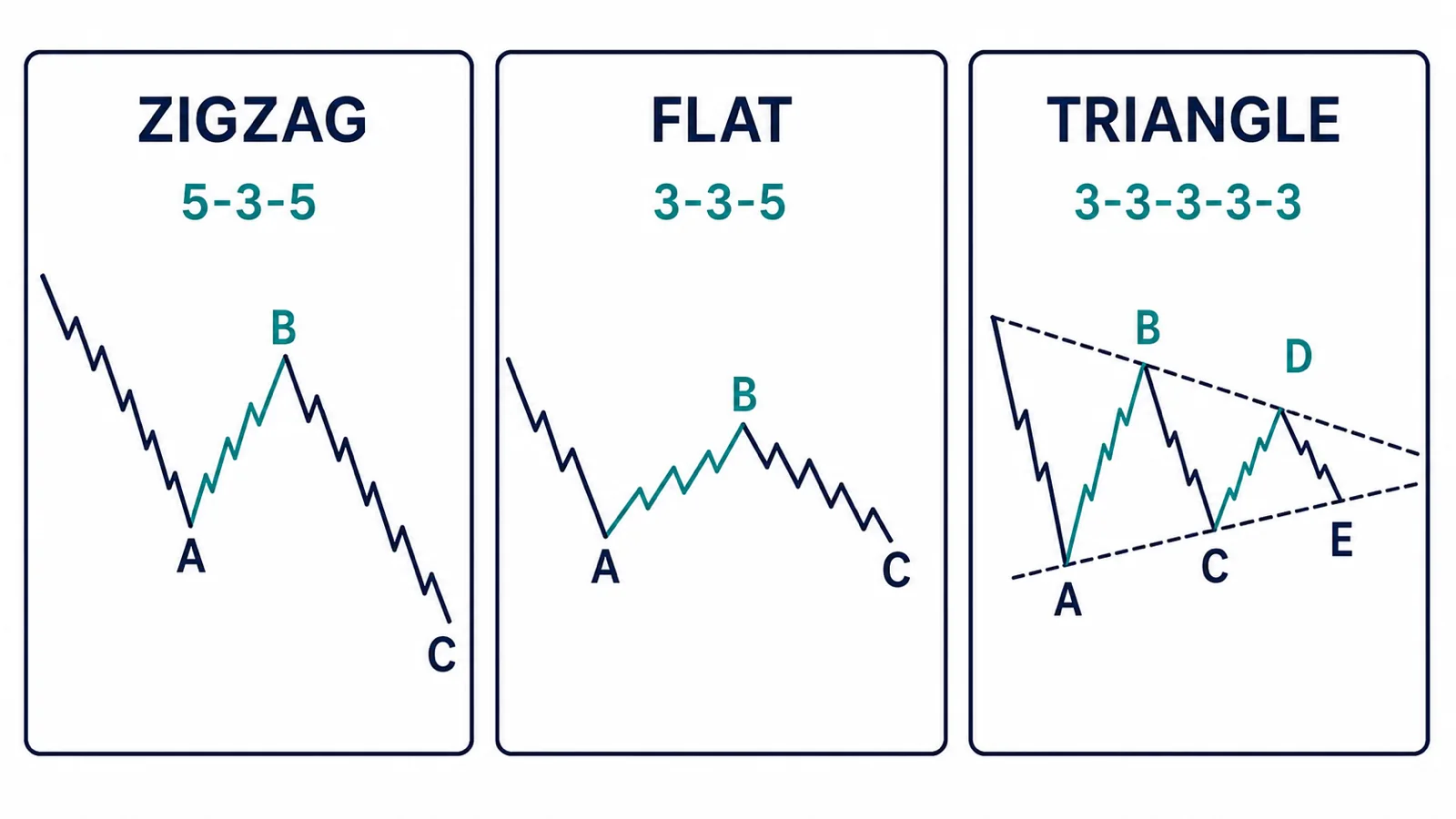
Elliott corrective waves are countertrend or consolidating structures that interrupt a larger directional move. The three core families are Zigzag, Flat and Triangle. A Zigzag normally has a sharper 5-3-5 appearance, a Flat develops as a 3-3-5 structure, and a Triangle contracts or expands through five three-wave legs. These labels describe internal organization, not a promise about the next move. The useful task is to compare competing counts, define what would invalidate each one, and wait for price to provide enough completed structure.
Key takeaways
- A correction can move sideways, retrace sharply, or consume time without retracing much price.
- The internal subdivision matters more than the visual resemblance to a letter on the chart.
- Zigzags are generally directional; Flats are generally sideways; Triangles compress through five legs.
- A pattern should not be considered complete until its required legs and boundary behavior are visible.
- Use Elliott analysis as a scenario framework, not as a reason to ignore price invalidation.
What is an Elliott corrective wave?
A corrective wave is a structure that moves against, or pauses, the trend at the next higher degree. It commonly appears as wave 2 or wave 4 of an impulse, or as wave B within a larger correction. Corrective price action often overlaps, changes speed, and produces several plausible counts. That uncertainty is normal. The analyst should reduce possibilities as new swings complete instead of pretending the first label is certain.
Begin with the larger context explained in the Elliott Wave Theory guide. Identify the degree you are analyzing, the direction of the larger trend, and the price level that would make your working count impossible. Without those three items, counting smaller swings can become arbitrary.
Before classifying a correction, compare it with a standard Elliott impulse and review the rules for counting Elliott waves consistently. These references help prevent actionary waves and corrective legs from being mixed at different degrees.
Zigzag: the directional correction
A Zigzag is labeled A-B-C and typically subdivides 5-3-5. Wave A develops as an impulse or leading diagonal, wave B is corrective, and wave C develops as an impulse or ending diagonal. Because waves A and C are directional, the full correction often retraces price more quickly than a Flat or Triangle.
How to recognize a Zigzag
- Wave A shows five-wave behavior rather than a three-wave drift.
- Wave B retraces part of wave A but does not erase the entire structure in a standard Zigzag.
- Wave C moves decisively in the direction of wave A and completes five waves.
- The A-C path usually has a visible slope rather than a broad horizontal range.
Do not identify a Zigzag only because price fell quickly. A news candle or liquidity sweep is not automatically wave A. The internal swings must remain consistent with the proposed degree. If wave A is clearly three waves, a standard Zigzag count becomes less likely and a Flat, Triangle component, or combination should be considered.
Flat: a sideways 3-3-5 correction
A Flat is also labeled A-B-C, but its internal structure is 3-3-5. Wave A is corrective, wave B retraces a large portion of wave A, and wave C completes a five-wave move. Because wave B returns near the origin of wave A, the pattern usually consumes more time and looks more horizontal than a Zigzag.
Regular, expanded and running Flats
In a regular Flat, wave B ends near the start of wave A and wave C ends near the termination of wave A. In an expanded Flat, wave B exceeds the start of wave A and wave C travels beyond the end of wave A. A running Flat has a strong wave B beyond the origin while wave C fails to pass the end of wave A. Running Flats should be labeled cautiously because an incomplete count can easily be mistaken for one.
A common error is to call every false breakout an expanded Flat. First establish that wave A and wave B are corrective three-wave structures. Then inspect whether wave C is developing as five waves. If those requirements are absent, the false breakout may be better explained by a liquidity sweep or ordinary range behavior.
Triangle: five overlapping legs
An Elliott Triangle is labeled A-B-C-D-E. Each leg normally subdivides into three waves, producing a 3-3-3-3-3 structure. Contracting Triangles are the most familiar form: their upper and lower boundaries converge as price compresses. Expanding and barrier variations exist, but they should not be used to rescue a count that has already violated its logic.
Triangles commonly appear before the final actionary move of a sequence, such as wave 4 in an impulse or wave B in an A-B-C correction. They are not usually complete after only three touches. Calling a small wedge a Triangle before waves D and E develop creates premature breakout expectations.
Zigzag vs Flat vs Triangle
| Feature | Zigzag | Flat | Triangle |
|---|---|---|---|
| Internal structure | 5-3-5 | 3-3-5 | 3-3-3-3-3 |
| Typical shape | Sharp and directional | Sideways and broad | Contracting or expanding |
| Main labels | A-B-C | A-B-C | A-B-C-D-E |
| Key clue | Five-wave A | Three-wave A and deep B | Five overlapping legs |
| Frequent mistake | Counting any fast move | Using only retracement depth | Calling three swings complete |
A step-by-step classification workflow
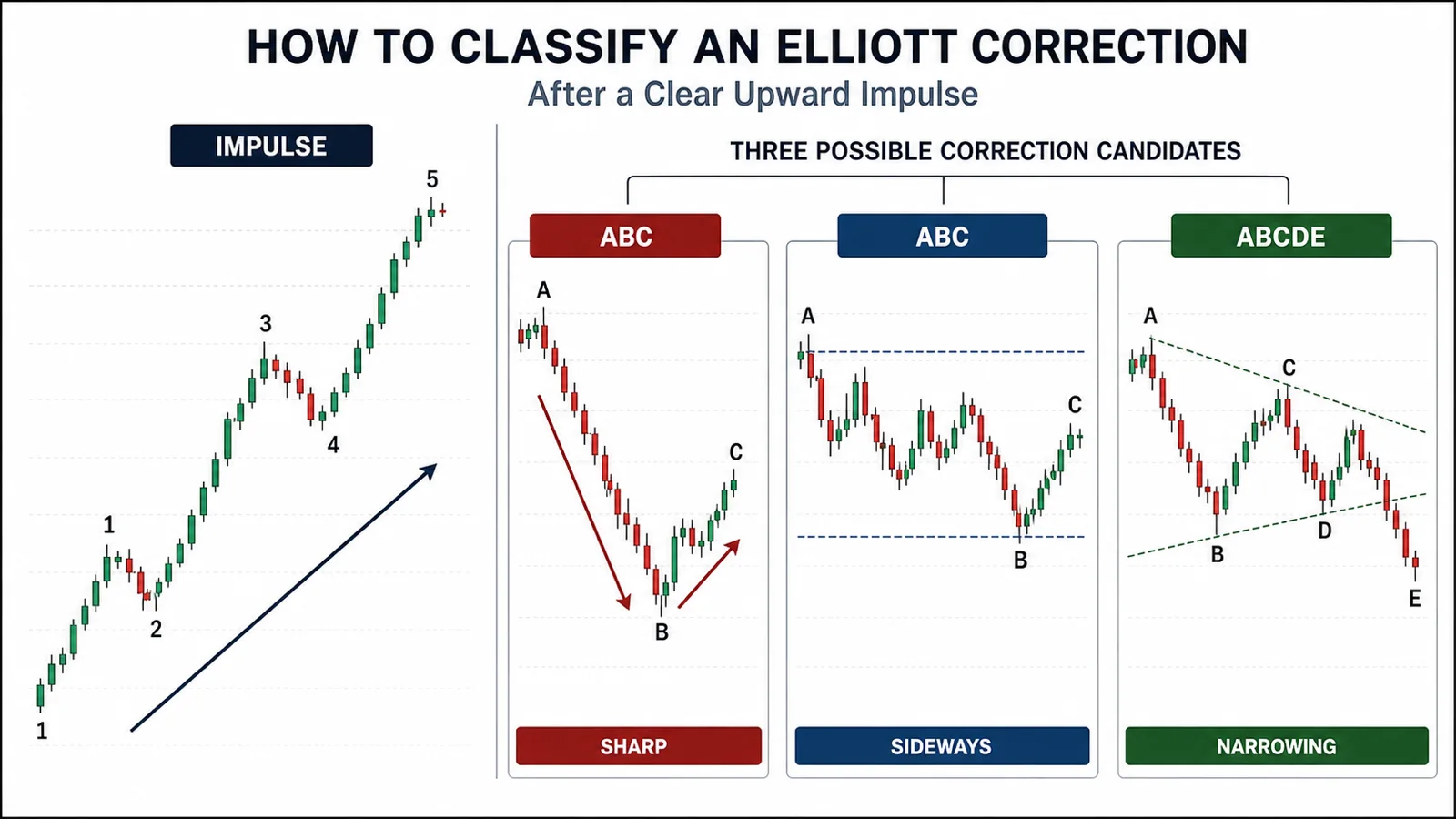
- Mark the larger trend and the degree of the suspected correction.
- Count the first countertrend leg as five waves or three waves without forcing subdivisions.
- Evaluate how deeply wave B retraces and whether it exceeds the origin of wave A.
- Check whether the structure has three legs or is developing five alternating legs.
- Draw boundaries only after enough swing points exist; do not make price fit the lines.
- Write the invalidation level and at least one alternative count.
- Wait for completion and a price trigger before planning execution.
A completed pattern is not an entry signal by itself. Traders still need a trigger, an invalidation point, position size, and a realistic target. The risk–reward ratio guide explains why a visually attractive setup may still be unsuitable when the stop and target are poorly located.
Hypothetical example
Assume an index completes a clear five-wave advance on the daily chart. It then falls in five smaller waves, rebounds in three, and begins another five-wave decline. A Zigzag is the leading hypothesis because the developing sequence is 5-3-5. If the first decline is later resolved as three waves and the rebound returns above the prior peak, an expanded Flat becomes more plausible. This is a historical-style illustration, not a current signal.
Alternative counts and multi-timeframe checks
A useful Elliott analysis keeps at least one alternative count. For example, what looks like wave C of a Zigzag on H1 may be only wave A of a larger Flat on H4. A supposed Triangle on M15 may be noise inside one daily candle. Start with the timeframe that defines the trade horizon, then move down only far enough to inspect subdivisions. If the lower-timeframe count contradicts the larger structure, reduce confidence instead of selectively hiding swings.
The multi-timeframe analysis guide provides a consistent top-down sequence for selecting context and execution charts.
Write alternatives in observable terms. The primary scenario might require five waves down and a break below wave A. The alternative might require a three-wave decline followed by a return above the origin. When one condition occurs, the other scenario is removed. This approach is more useful than assigning subjective probabilities without a record.
Time correction versus price correction
Corrections do not need to retrace deeply to be meaningful. A Triangle or Flat may correct mainly through time while price remains near the prior extreme. Traders who expect a fixed Fibonacci retracement can enter against a strong trend too early. Retracement ratios are reference measurements, not pattern definitions. Internal structure and invalidation should remain the primary evidence.
Common mistakes
- Choosing a label from shape alone without checking internal structure.
- Changing the wave degree whenever a count becomes inconvenient.
- Assuming every wave 4 must be a Triangle.
- Calling a Triangle complete before waves D and E are visible.
- Ignoring an invalidation level because the larger narrative still feels right.
- Entering before the correction is complete and then relabeling adverse movement.
Risk management
Elliott analysis is probabilistic. Build risk around the price level that disproves the setup, not around the distance you would prefer to lose. If the invalidation is too far away, reduce position size or skip the trade. Never widen a stop only because the count can be renamed. Record the original count, alternative count and reason for entry so that review remains honest.
Affiliate disclosure: Học Làm Trader may receive a commission if you open an account through the XM link below. This does not increase your cost and does not affect the educational analysis in this article.
Practice the workflow with an Exness demo account before considering real-money execution. A demo result does not predict future performance.
Frequently asked questions
Is every three-wave correction a Flat?
No. Zigzag wave B, Triangle legs and complex combinations can also subdivide into three waves. The position and the complete structure matter.
Can a Triangle appear in wave 2?
Under standard Elliott guidelines, a Triangle is not expected as the entire wave 2. Recheck the degree or consider whether the Triangle belongs to wave B of a larger correction.
Which correction is easiest to trade?
None is consistently easiest. Zigzags may look clearer, while Flats and Triangles can create repeated false starts. Trade selection should depend on confirmation and risk, not the label alone.
Sources and further reading
- Elliott Wave International — Waveopedia
- CME Group — Technical Analysis
- CFTC — Foreign Currency Trading Advisory
Risk warning: This material is for education and general information only. It is not investment advice, a trade signal, or an invitation to trade. Trading can result in loss of capital. Past performance does not guarantee future results. Test every idea, assess your risk tolerance, and remain responsible for your decisions.